
Opening this holiday season by taking on religious nutjubs


 But the art suggests that the story is meant to be read by at least older kids: While Thompson is clearly capable of rendering characters in a far more mawkish style, she applies restraint to the anthropomorphizing of the cast so that they still mostly look and behave like normal animals. Thus the violence is also less cartoony and has real consequences. Dorkin and Thompson make a concession to the narrative convention of using the animal's breed as a shortcut to underlining or contradicting the individual's personality: The Pug is pugnacious, the Jack Russell Terrier is excitable, and the Doberman looks mean but is actually a big coward. If this was a movie made today, the animals would be enhanced or rendered entirely in creepy looking CGI, while voiced by highly paid actors (Like here). So I count it as a good thing that the reader has only the comic art as a reference for now.
 Issue #1 is somewhat hindered by the need to reestablish the characters. While there is an attempt to minimize the info dump, the dialogue is sometimes hampered by the regular referencing of past events. The supernatural threat that eventually reveals itself is visually impressive, but seems to be mainly there to demonstrate the demon fighting credentials of the Scooby Gang.
 In Issue #2, the gang has been shouldering more responsibility in protecting Burden Hill. But the series then veers unexpectedly into far more ambiguous territory when the threat turns out to be internal in origin and too mundane for their supernatural training to handle. And the ending is the most shocking so far delivered by the comic.

 |
| Never ascend Mount Everest without the proper climbing equipment |
 |
| Magical Girl Pretty Sammy by AIC |
The passage of this landmark bill is very timely since we are going to commemorate the 20th year of the United Nations Convention on the Rights of the Child on Nov. 20...The bill seems to have widespread support, or at least no particularly strong opposition, from the local press so far:
Now that we already have a stringent law against child pornography, we can efficiently prosecute perpetrators who produce, use and distribute child pornography,
This is one law that while long overdue, is still welcome. If properly enforced then it would be integral in cleaning up our country's reputation for being a place where pedophiles, local and foreign alike, can roam free, victimize children, and get away with almost anything. However, like most well meaning laws in this country, there is always the distinct possibility that it will die a natural death due to lack of interest by law enforcement officials and agencies. The legislative department has done its part. It is now up to the law enforcement agencies and the local governments to do their part and protect our children from the worst kind of predators in this planet.Or this editorial by Fr Shay Cullen:
There is no total and absolute right over anything or anybody in the world. If the freedom of action of some is harming and allowing the abuse of others, especially children, then action must be taken to protect the vulnerable and the victimized. One right must not be used to violate another right. Besides we all have a moral responsibility to protect children and bring violators to justice. Industry has a social responsibility to make their services child safe just like any other product. They must put children before profits.
She explained that the said images of real and indistinguishable children in films, digital images or computer images, whether made or produced electronically or mechanically; drawings, cartoons, sculptures or paintings depicting children in an explicit sexual activity are just some of the visual depictions considered as child pornography materials.
The theatre of moralism seems a popular political pastime of late. Loli bans have been proposed in Japan, and passed in the US, UK and Australia. Perhaps such histrionics prove a useful distraction from poor economic stewardship...
(b) "Pornographic or pornography" refers to objects or subjects of film, television shows, photography, illustrations, music, games, paintings, drawings, illustrations, advertisements, writings, literature or narratives, contained in any format, whether audio or visual, still or moving pictures, in all forms of film, print, electronic, outdoor or broadcast mass media, or whatever future technologies to be developed, which are calculated to excite, stimulate or arouse impure thoughts and prurient interest, regardless of the motive of the author thereof.
(c) "Mass media" refers to film, print, broadcast, electronic and outdoor media including, but not limited to, internet, newspapers, tabloids, magazines, newsletters, books, comic books, billboards, calendars, posters, optical discs, magnetic media, future technologies, and the like.
(d) "Materials" refers to all movies, films, television shows, photographs, music, games, paintings, drawings, illustrations, advertisements, writings, literature or narratives, whether produced in the Philippines or abroad.
(e) "Sex" refers to the area of human behavior concerning sexual activity, sexual desires and instinct, and their expressions.
(f) "Sexual act" refers to having sex or the act of satisfying one's sexual instinct.
...any representation, whether visual, audio, or written combination thereof, by electronic, mechanical, digital, optical, magnetic or any other means, or a child engaged or involved in real or simulated explicit sexual activities
For the purpose of this Act, a child shall also refer to:
(1) a person regardless of age who is presented, depicted or believed to be a child as defined herein; and
(2) a computer-generated, digitally or manually crafted images or graphics of a person who is represented or who is made to appear to be a child as defined herein.
(b) “Child pornography” refers to any public or private representation, by whatever means, of a child engaged in real or simulated explicit sexual activities or any representation of the sexual parts of a child for primarily sexual purposes.
(c) “Child pornography materials” refers to the means and methods by which child pornography is carried out:
(1) As to form:
(i) Visual depiction – which includes not only images of real children but also digital image, computer image or computer-generated image that is indistinguishable from that of real children engaging in an explicit sexual activity. Visual depiction shall include:
(aa) undeveloped film and videotapes;
(bb) data and/or images stored on a computer disk or by electronic means capable of conversion into a visual image;
(cc) photograph, film, video, picture, digital image or picture, computer image or picture, whether made or produced by electronic, mechanical or other means;
(dd) drawings, cartoons, sculptures or paintings depicting children; or
(ee) other analogous visual depiction...
(emphasis mine)
SEC. 6. Duties of an Internet Content Host. – An Internet content host shall:
(a) Not host any child pornography on its Internet address;
(b) Within seven (7) days, report the presence of child pornography, as well as the particulars of the person maintaining, hosting, distributing or in any manner contributing to such Internet address, to the proper authorities; and
(c) Preserve such evidence for purposes of investigation and prosecution by relevant authorities.
An Internet content host shall, upon the request of proper authorities, furnish the particulars of users who gained or attempted to gain access to an Internet address that contains child pornography materials.
 |
| Shueisha's Shonen Jump characters |
Honestly, the situation in Japan where comics are released in weekly anthologies is a very abnormal one. Everyone has become accustomed to it and deals with it like it was nothing, but people overseas think that producing comics of this quality on a weekly basis is insane. ... Yeah, it really is insane.A bit more doom and gloom: More reports about the decline of the manga magazine industry. Simon Jones disagrees with the analysis that the industry's growing focus on its hardcore fans is the cause rather than a symptom of other causes.
- Naoki Urasawa

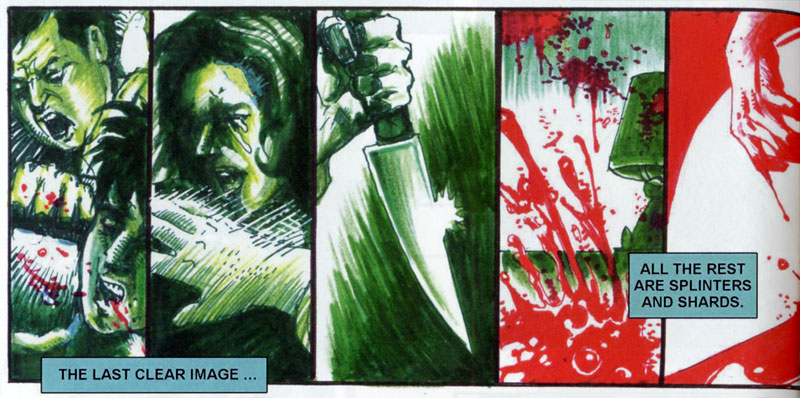
 Judas Kiss adopted from a story by David Hontiveros is plodding, literary, and didactic. It's the story of a man being haunted by the ghosts of his wife and brother, whom he murdered. It contains a twist ending that more experienced readers will see coming. The surreal imagery and day-glow secondary colors employed by artist Oliver Pulumbarit gives the impression that the protagonist is going through a really bad acid trip. This is the least successful story of the collection.
 Katumbas, also by Hontiveros, is closer to fantasy-inspired superhero adventure of the Buffy or Trese kind. The story about a supernaturally empowered warrior battling demons and spirits is intriguing but feels incomplete as an episode of an ongoing series. The art supplied by Ian Sta. Maria is the slickest, most detailed, and most likely to appeal to mainstream tastes. But I need a bit more out of the narrative before I'm willing to commit.
 Speaking of Trese, The Clinic, by Trese co-creators Budjette Tan and Kajo Baldisimo is itself a shout out to one of their earlier stories. As the subject matter is about a supernaturally run clinic that performs illegal abortions (abortion is illegal in the Philippines) and collects the infant souls, this is no doubt the most unsettling and unpleasant story in the book.


 |
| Wizard Magazine |
For all the comic book philosophy of the superhero as the next stage of human evolution (really just a mutant iteration of the old "Fans are Slans" riff) creatively they've hit a dead end, save for the occasional irruption. The superhero genre may not be the Titanic, no icebergs in sight, but everyone's still just rearranging deck chairs now. That's how the companies want it, because they're no longer marketing creations. They're peddling brands. Branding is everything now, and it's almost always more profitable to cash in on a long-established brand than to create, develop and market a new one. The superhero as brand name might be with us until the end of time, now, but the superhero as expression of genuine creativity is pretty much dead.
On the one hand, you might argue I guess that Steven's tendency not to see the super-heroes all around him is of a piece with the status quo among the big two; that is, if they could only start to think about super-hero stories in different ways, maybe they wouldn't be so perpetually shitty. Perhaps they could finally start telling stories somebody cared about, and maybe even come up with some new heroes that were different from the old heroes in ways which would allow them to appeal to a broader audience.
But really, I think that's too harsh on Steven and not sufficiently harsh on DC and Marvel. The truth is, DC and Marvel seem pretty thoroughly irredeemable. Steven was right; they're creatively D.O.A. They're going nowhere and changing nothing, and the chances of either of them ever coming up with an exciting, marketable new concepts is roughly the same as the chances of a monkey crawling out of my butt and handing me a power ring. So, yeah, I think it's important to recognize that super-heroes are still popular, but not because doing so will help DC and Marvel. On the contrary, I think it's important because, until you realize that super-heroes are doing just fine, you can't really understand how truly lame Marvel and DC are.
Who says the Japanese don't do superhero comics? It surprises me how many manga, like X and SILENT MOBIUS, are thinly disguised superhero comics, and so is BASILISK, which glories in the simple plot of two Shogunate-era ninja clans whose chief members are all blessed with bizarre and idiosyncratic "techniques" (read: "superpowers) fight each other to the death for not much more reason than they're told to. Toss in heavy doses of sex/nudity, violence and weepy soul-searching, and voila! The best X-MEN story ever. And that's not a complaint; with its uncomplicated storytelling and extreme character explorations, it's growing on me.


 A weakness of the first two volumes of Budjette Tan and Kajo Baldisimo's popular series Trese was the lack of any particularly clear direction in the comic. Sure the confluence of traditional Filipino legends with modern urban settings might sound clever at first. But despite the Filipino setting, Trese conceptually and visually still stuck a little too close to its Hollywood and mainstream roots to feel original. Its creators seemed to be randomly tossing ideas left and right from zombies to drag racing tikbalang to test what worked. And the character designs were a bit empty and cliched: Whether it was the wisecracking sidekicks the Kambal or the unflappable hero Alexandra Trese (This became something of a personal pet peeve: Who the f#@k wears a dark trench coat in Manila?) There was energy and potential, but for the most part the stories felt a little erratic.
 And the choreographing of action scenes has become a lot more dynamic and economical:
 All of this is a good start for a healthy run. Whether Trese becomes the Pinoy equivalent of Hellboy or just another also-ran will depend on how well its co-creators can build on the work found inside this volume.
 |
| Anime adaptation of the Lucky Star yonkoma |
The big problem in Japan is that the bubble in the industry has definitely burst for both anime and manga. I think it's probably worse than many of the official statistics reveal. I was in Tokyo in May - and I go to Tokyo every year to watch trends - and the thing that drove the point home to me is that on the train, almost no one is reading manga. That's a huge, huge change from ten years ago, huge. On top of that, you have a new era in Japan where there's a declining population of young people, which is still the main readership and market for manga and anime. So publishers and producers of shows are confronting this very stark reality that fewer people are buying their products, and there are fewer people to buy their products. It's not only that they are buying less, but that there are fewer people to buy them! So no one knows what's going to happen yet.Which is reinforced by Jason Thompson:
But for all their cultural clout, weekly manga, like newspaper strips and network television, is a fading medium. Except for Weekly Comic Bunch (which skews towards an aging readership anyway), all the existing weekly magazines in Japan are at least 20 years old; recent attempts like Comic Gumbo have been failures. Publishing a weekly manga magazine requires tremendous resources, and with the fragmentation of media, perhaps the generalist audience required to sustain these massive magazines is dwindling. Oddly, there are no weekly shojo manga magazines (although there are several biweekly ones), possibly a sign of shojo's smaller economic footprint; a few weekly shojo magazines were published in the 1960s but never caught on.But on the other hand, this benefits yonkoma in much the same way that many American webcomics are gag strips that take advantage of the internet:
Yonkoma manga is easy to make, easy to read, and—surprisingly considering its low profile in the U.S.—very successful. While other manga magazines' circulations dwindle, yonkoma manga is the fastest growing area of the manga industry. Four-panel series such as Lucky Star are increasingly being adapted into animation and merchandise. There are many magazines devoted solely to four-panel manga. Online and cellphone manga is overwhelmingly four-panel-oriented, as it's the easiest type of manga to read on mobile devices, and some yonkoma webcomics, such as Hidekaz Himaruya's Hetalia Axis Powers, have even become hits and made it into the big time.
 |
| Anime adaptation of the Minami-ke yonkoma |

Over the past few years I've noticed smarter critical commentary on the Net, but it's scattered all over the place, buried in the usual mountain of frivolous, tepid, dimwitted, unreadable fanboy drivel. There's no single website you can visit and anticipate a range of interesting sensibilities on an equal footing, so one of my goals is to distill the best criticism and journalism we can into a single site. - Gary Groth
It's no secret that newspapers and magazines are suffering because so much of what they've traditionally done can be done on the web, faster and cheaper. We decided therefore to redesign the editorial and physical format of the magazine to take advantage of what print's best at -- upscale production values, longer prose, more permanent content -- and bring the Journal's mandate for criticism and commentary to the web with a vengeance. - Gary Groth
If the magazine's arrogance, whether a clever marketing ploy or come by honestly, wasn't much appreciated by publishers or talent, and often not even by most fans, it was the right approach, making THE COMICS JOURNAL indispensible reading for several years, and a bracing antidote to the sycophancy that by then increasingly earmarked other publications. Virtually nobody claimed to like the Journal, but virtually everyone read it.- Steven Grant
Among its reviewers the Journal has a contingent of solid, trust-worthy writers: Kent Worcester, Rich Kreiner, Shaenon Garrity, and Kristian Williams, but they tend to get drowned out by crankier and less-informed critics, writers who mistake abrasiveness for insight. The magazine’s review section does seem too diffuse and scattershot. I’m never quite sure why some books get reviewed and others don’t. There’s a lot of good critics on the web now – Rob Clough comes to mind right way. The most promising prospect for the next incarnation of the Journal is to recruit these writers (I know Clough has already signed on). - Jeet Heer
For me, I've been happiest with the Journal when it pursued other visions — Tom Crippen working out why super-heroes matter and why they don't, for example, or Dirk's marvelous shojo issue. The larger, bi-annual approach seems like an opportunity to go further down that road...I'd love, for example, to see what Kristy Valenti or Bill Randall would do if given carte blanche with an issue. Gary will always be the Journal, in some sense, but one of the things he's done right over the years, in my view, is to have the courage and the generosity to let other folks pursue their own idiosyncratic ideas and interests with his ink and his press. - Noah Berlatsky
Everything will be free. We’ll maintain an archival copy of the current website for our online subscribers — more on that soon, I promise — but the new site will have no “subscriber area” or special features that need a password to access - Dirk Deppey


