Showing posts with label Budjette Tan. Show all posts

11/16/2009

Underpass

Underpass
One of the most high profile books to come out of Komikon was magazine conglomerate Summit Media entering stepping into the world of Filipino comic book publishing (Oh sorry, I meant graphic novel), the largest company to make the move so far. The material for this foray is from a commercial standpoint a safe choice: Underpass is a modest horror anthology of four stories written by some of the more recognizable genre creators in the Philippines. Summit must be hoping that horror's popularity will translate into healthy sales. They certainly put considerable care into the packaging: This is a handsome square bound softcover volume printed on thick, glossy, and fully colored paper stock.

Horror fiction of course has a long literary tradition, and comics has its own rich history with the genre. But for mass appeal, horror is most successful in film. The genre is one of the more successful in Filipino cinema. The medium's nature of combining visual and temporal elements has an unmatched way of building terror that can't be easily replicated by comics. Not that it ever stopped the komiks industry from producing numerous horror titles during its heyday. The stories in this volume settle on being dark, creepy and disturbing. And despite the underpass metaphor, there's not much that overtly connects them beyond the genre itself.

The opening story Sim by Gerry Alanguilan is a straightforward tale of someone receiving a phone call from beyond, with predictably deadly results. His contribution is the one that sticks closest to horror films. Alanguilan possesses the cleanest, most direct, and easiest to follow art in the book. The story itself is slight.

Sim panelsJudas Kiss adopted from a story by David Hontiveros is plodding, literary, and didactic. It's the story of a man being haunted by the ghosts of his wife and brother, whom he murdered. It contains a twist ending that more experienced readers will see coming. The surreal imagery and day-glow secondary colors employed by artist Oliver Pulumbarit gives the impression that the protagonist is going through a really bad acid trip. This is the least successful story of the collection.
Judas Kiss PanelsKatumbas, also by Hontiveros, is closer to fantasy-inspired superhero adventure of the Buffy or Trese kind. The story about a supernaturally empowered warrior battling demons and spirits is intriguing but feels incomplete as an episode of an ongoing series. The art supplied by Ian Sta. Maria is the slickest, most detailed, and most likely to appeal to mainstream tastes. But I need a bit more out of the narrative before I'm willing to commit.

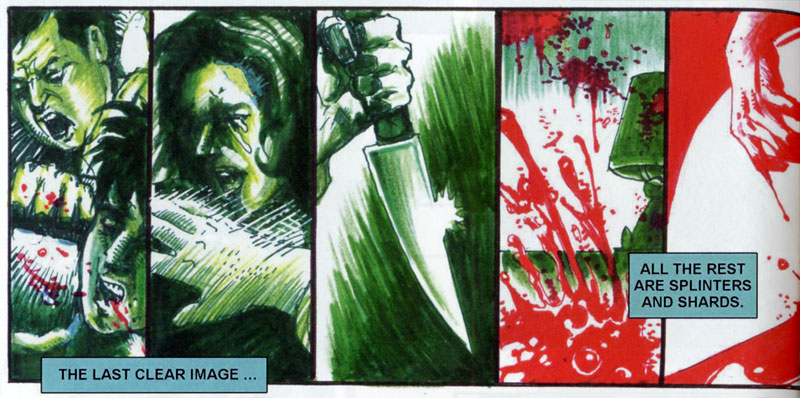
Katumbas panelsSpeaking of Trese, The Clinic, by Trese co-creators Budjette Tan and Kajo Baldisimo is itself a shout out to one of their earlier stories. As the subject matter is about a supernaturally run clinic that performs illegal abortions (abortion is illegal in the Philippines) and collects the infant souls, this is no doubt the most unsettling and unpleasant story in the book.

The Clinic Panel 1The Clinic Panel 2 The Clinic Panel 3 The Clinic Panel 4
Underpass is a solid effort. But I don't find the material within original or consequential enough to be a satisfactory reading experience. Mainly, it's because I'm pretty jaded to the old fashioned horror formula which relies on a "gotcha" ending for impact. And I find these kind of stories thuddingly moralistic. But this brand of entertainment should strongly appeal to local tastes, which might bring a few more readers back to the komiks medium.

11/05/2009

Trese: Mass Murders

Trese: Mass Murders A weakness of the first two volumes of Budjette Tan and Kajo Baldisimo's popular series Trese was the lack of any particularly clear direction in the comic. Sure the confluence of traditional Filipino legends with modern urban settings might sound clever at first. But despite the Filipino setting, Trese conceptually and visually still stuck a little too close to its Hollywood and mainstream roots to feel original. Its creators seemed to be randomly tossing ideas left and right from zombies to drag racing tikbalang to test what worked. And the character designs were a bit empty and cliched: Whether it was the wisecracking sidekicks the Kambal or the unflappable hero Alexandra Trese (This became something of a personal pet peeve: Who the f#@k wears a dark trench coat in Manila?) There was energy and potential, but for the most part the stories felt a little erratic.

Still, some very successful and long-lived serials began from similarly tentative beginnings. And if Trese turns out to be one of these, then the first eight stories will be looked back as early fan-pleasing efforts necessary to build the audience for the comic's survival. Much of this latest volume focuses on the laying the foundations for future world building. A great deal is revealed about the history of the Trese clan and Alexandra's own personal background. While not adding any depth to the character, this provides much needed context missing in the previous stories. The arc that introduces the nearly unstoppable ancient war god Talagbusao produces not only the series first truly compelling villain, but is also the first time that Trese effectively conveys a sense that there is a complex universe full of interconnected beings and interdependent relationships instead of just a haphazard menagerie of monsters for Alexandra to fight.

This is also the first volume where Kajo is fully comfortable with his black and white style. It can take awhile before an artist settles into a reliable shorthand for portraying his or her cast. His figures are less clumsily staged, and while backgrounds are not his forte, the former rough cross-hatching is replaced by fluid line work which is far better in evoking a setting and a particular mood:

Trese: Mass Murders strip club And the choreographing of action scenes has become a lot more dynamic and economical:

Trese: Mass Murders guardian All of this is a good start for a healthy run. Whether Trese becomes the Pinoy equivalent of Hellboy or just another also-ran will depend on how well its co-creators can build on the work found inside this volume.

9/04/2009

Trese Book 1-2

Trese: Murder on Balete DriveTrese: Unreported Murders
Trese: Murder on Balete Drive
Trese: Unreported Murders


Trese is the kind of conventional high concept series that could have come out of the nineties: A police procedural blended with a supernatural thriller. What it has going for it is the novelty of drawing from a completely different and, for Western readers, unknown collection of myths and superstitions. That's a lot of source material for writer Budjette Tan and artist KaJo Baldisimo to mine. With the possible exception of a homage to a certain local super-hero, these story references should not pose an insurmountable obstacle for unfamiliar readers. A lot of the fun comes from trying to figure out the rules of the game. These tales are packaged in a noir comic that would not look out of place in the contemporary Direct Market.

TRESE 1: At the Intersection of Balate and 13th Street

A limitation with the series is found in the protagonist Alexandra Trese. She's called in as a consultant by Manila's police force whenever the supernatural is suspected to be involved in a murder case. Little is revealed to the reader other than that she inherited this role from her father. Precious little information is added as the series progresses. And almost nothing about her inner life is divulged, including the slightest hint of what personally motivates her. She remains a cipher: A stoic and tough pose wrapped in a trench coat. All attitude, but devoid of personality. This works well enough in its original incarnation as an occasionally consumed episodic adventure. But it gets repetitious when read in trade paperback form. What gets particularly tiresome is how often she or some other character keeps name dropping her dad as a justification for her own magical expertise or as a substitute to explaining her numerous supernatural connections.

Baldisimo's art is pretty slick, but can't completely hide his stylistic weaknesses. For an urban fantasy that hops all over Manila, his backgrounds and cityscapes are often disappointingly nondescript, and strangely lacking in individual character in a comic drawn with chiaroscuro. Working with a limited palette is extremely difficult, and many times Baldisimo resorts to augmenting his inky shadows with line hatching in order to prevent the panels from becoming too muddy. But the results can look a bit disjointed. It feels sometimes like a mash-up between the styles of Frank Miller and Jim Lee.

TRESE 2: The Rules of the Race

Only towards the end of the last story in these two volumes does Tan begin to move the story forward, by implying that Trese's actions will have consequences down the line that may result in all-out conflict between the various supernatural factions. Cool, but that's a very long set-up for the first and possibly last story arc.