Showing posts with label Gerry Alanguilan. Show all posts

11/16/2009

Underpass

Underpass
One of the most high profile books to come out of Komikon was magazine conglomerate Summit Media entering stepping into the world of Filipino comic book publishing (Oh sorry, I meant graphic novel), the largest company to make the move so far. The material for this foray is from a commercial standpoint a safe choice: Underpass is a modest horror anthology of four stories written by some of the more recognizable genre creators in the Philippines. Summit must be hoping that horror's popularity will translate into healthy sales. They certainly put considerable care into the packaging: This is a handsome square bound softcover volume printed on thick, glossy, and fully colored paper stock.

Horror fiction of course has a long literary tradition, and comics has its own rich history with the genre. But for mass appeal, horror is most successful in film. The genre is one of the more successful in Filipino cinema. The medium's nature of combining visual and temporal elements has an unmatched way of building terror that can't be easily replicated by comics. Not that it ever stopped the komiks industry from producing numerous horror titles during its heyday. The stories in this volume settle on being dark, creepy and disturbing. And despite the underpass metaphor, there's not much that overtly connects them beyond the genre itself.

The opening story Sim by Gerry Alanguilan is a straightforward tale of someone receiving a phone call from beyond, with predictably deadly results. His contribution is the one that sticks closest to horror films. Alanguilan possesses the cleanest, most direct, and easiest to follow art in the book. The story itself is slight.

Sim panelsJudas Kiss adopted from a story by David Hontiveros is plodding, literary, and didactic. It's the story of a man being haunted by the ghosts of his wife and brother, whom he murdered. It contains a twist ending that more experienced readers will see coming. The surreal imagery and day-glow secondary colors employed by artist Oliver Pulumbarit gives the impression that the protagonist is going through a really bad acid trip. This is the least successful story of the collection.
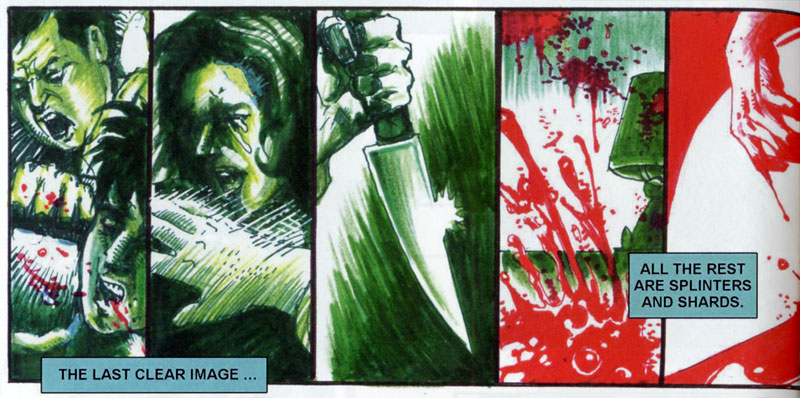
Judas Kiss PanelsKatumbas, also by Hontiveros, is closer to fantasy-inspired superhero adventure of the Buffy or Trese kind. The story about a supernaturally empowered warrior battling demons and spirits is intriguing but feels incomplete as an episode of an ongoing series. The art supplied by Ian Sta. Maria is the slickest, most detailed, and most likely to appeal to mainstream tastes. But I need a bit more out of the narrative before I'm willing to commit.

Katumbas panelsSpeaking of Trese, The Clinic, by Trese co-creators Budjette Tan and Kajo Baldisimo is itself a shout out to one of their earlier stories. As the subject matter is about a supernaturally run clinic that performs illegal abortions (abortion is illegal in the Philippines) and collects the infant souls, this is no doubt the most unsettling and unpleasant story in the book.

The Clinic Panel 1The Clinic Panel 2 The Clinic Panel 3 The Clinic Panel 4
Underpass is a solid effort. But I don't find the material within original or consequential enough to be a satisfactory reading experience. Mainly, it's because I'm pretty jaded to the old fashioned horror formula which relies on a "gotcha" ending for impact. And I find these kind of stories thuddingly moralistic. But this brand of entertainment should strongly appeal to local tastes, which might bring a few more readers back to the komiks medium.

10/29/2009

Where Bold Stars Go To Die

We're All Grown Up Now

Where Bold Stars Go To DieOn the surface the Philippines retains a prudish attitude towards sex and public depictions of nudity. What this inevitably does is drive sexually-charged content behind its conservative facade. Since the 60s sexually oriented entertainment was labeled as "bomba" , and bomba komiks were sold on the sly. The Martial Law years initially saw a strict clampdown of the bomba genre, but this only led to a later resurgence of sexually oriented material now renamed "bold". But the bold movie genre continually faces pressure from the government body responsible for rating film and television, the Movie and Television Review and Classification Board (MTRCB), which oscillates between periods of prudery and leniency, depending on who's in charge of the agency and the presidential administration. They also have to deal with attacks from religious organizations who condemn them as immoral, particularly the powerful Catholic Church, and feminist groups criticizing the exploitative nature of many of these films.

Gerry Alanguilan is either sensing a possible backlash or simply covering his bases, because the afterward for his latest book Where Bold Stars Go To Die reads like a carefully considered preemptive defense:
"I think it's high time that people realize that comics has grown up in the last 20 years. People are making comics for adults now. Oh yeah, that's right. Comics are no longer just for kids, and to us in the comics industry, this is old news. This comic book is not for immature reading. That goes for children and adults with immature sensibilities.

The emotional and intellectual well being of children are the responsibility of the parents. It is their job to teach their children what they believe is wrong and what is right. That is not my job. My job is to write and draw stories, and to let myself go where that creativity takes me. That is my job as an artist. That is my reason for being. Do not pass that responsibility of raising your children to me, and to us artists as a whole..."
I personally think it's a bit embarrassing that this even has to be said at all.

WBSGTD is part comic, part pin-up gallery drawn by various Filipino comics artists. There is a mood throughout the entire book of arguing for a legitimate Filipino erotic comic art tradition, even drafting komiks legend Francisco V. Coching to make its case. But the 32 page story is a rather somber and all too earnest effort: A young man becomes fascinated with an 80s bold star who has since vanished into obscurity. It develops into such a powerful obsession that he somehow enters into some kind of collective unconscious where faded bold stars retain their youth and cavort in sun dappled forests. He then has an ecstatic encounter with a perfect vision of his idol. It feels like it's meant to be a beautiful, cathartic, even spiritual experience. But to me it just comes across as cliched as it sounds. If one of the goals is to show that it's OK for Filipinos to illustrate erotic subject matter, then the story succeeded. But there has to be much better ways of demonstrating that comics have grown up than telling this banal kind of juvenile wish fulfillment that ultimately cops out rather than deal with the emotional consequences of having sex with an actual person.

Even on the level of one callow youth's overblown crush on a media starlet, the story fails to connect because of the inability to observe the admonition "Show, don't tell." In the beginning, the protagonist's voice-over narration compares his object of desire to that of an angel. But the art isn't evocative enough to create the same impression. And when he finally meets her, she's physically indistinguishable from all the other pneumatically built bold stars inhabiting that spiritual plane. Even worse, she lacks any clear personality that could be accepted as remotely intriguing. There's nothing that differentiates her from the rest of the competition except the protagonist's declaration of her beauty.

Where Bold Stars Go To Die panels
The story art supplied by neophyte comics artist Arlanzandro C. Esmeña is of professional, if workmanlike, caliber. A lot of it looks photo referenced, particularly the likenesses of the bold stars. While this isn't as problematic for illustration work, it sometimes produces comics figures that appear flat, posed, and lifelessly static. Indeed the attention to accurate detail tends to inhibit the flow from panel to panel. The line work can be too tight and inorganic in places, particularly in continuously portraying natural-looking facial expressions. In contrast, the cover art he supplies has the grace and understated eroticism missing in the interior art. The pin-up art is mostly supplied by artists who draw in an American superhero vein. Two notable exceptions are Brice Beckham of Mr. Belvedere fame, and Arnold Arre who supplies pin-ups with cartoony, vaguely manga-style, lolicon figures. Not surprisingly the overall results are pretty, and emotionally removed from the subject.

Where Bold Stars Go To Die panels 2

8/17/2009

ELMER

Elmer by Gerry Alanguilan.

Reading ELMER, the latest opus of Filipino cartoonist Gerry Alanguilan makes apparent how much he is rooted in old-school comics storytelling. His character renditions and particular attention to detail looks like something that compare with the best black and white independent comics. The dark fantasy elements, creeping sense of dread, and punctuated violence, are descended from American comic book's pulp traditions. Even Alanguilan's religious adherence to the nine panel grid structure and heavy use of first person textual narration makes ELMER appear very traditional when compared to contemporaneous efforts.

Jake Gallo brings up history from ELMER #1
If Alanguilan's sensibilities seem a bit retrograde, they are not there to draw attention to themselves but to serve the story that he's interested in communicating. In this regard he succeeds in telling a deeply felt and humane narrative. If one takes the premise of recently sentient chickens living amongst humans literally, then certain aspects of Alanguilan's world-building rests on shaky ground. For example, the chicken population's preference to integrate into human society rather than seeking to build their own autonomous culture is an unrealistic representation of real world international relations. But ELMER goes out of its way to avoid specific political allegory. Nor does it show any interest in addressing the science fiction underpinnings of its own premise. Human and chicken sentience are simply presumed to be similar despite their physiological differences. Instead, the human-chicken conflict functions more as a general metaphor for the way people fear what they don't understand and as a source of paranoia for protagonist Jake Gallo. Like most malcontents he's willing to blame outside circumstances, which in his case is a perceived human prejudice against him as a chicken. Jake and his siblings are summoned to take care of their dying father Elmer. His views undergo a change after learning more about his father's mysterious past and his friendship with a farmer called Ben.

While the comic is meant to be inclusive, Alanguilan taps into his own cultural background for raw material. Many rural people in Southeast Asia in general, and the Philippines in particular, live in close proximity to chickens and other farm animals. But the fighting rooster also plays an important part in Filipino iconography. During the early period of their sentience, some chickens use their cockfighting prowess to terrorize humans. The brutality of these attacks only exacerbates the war between the two species. One doomed character is described in admiring terms by his fellow chickens because of his exemplary sabong performance. ELMER doesn't use the chickens as a stand-in for any particular group. But on some level it plays with the fear of being overthrown by the things we subjugate. Alanguilan's chickens are drawn with far more grace than his stiff-looking humans. But even they pale into insignificance when compared to the richly detailed Filipino landscapes. This could be the influence of my own memories, but there's a sense of nostalgia that permeates ELMER's provincial setting which feels derived from Alanguilan's real life. But any preconceptions of pastoral innocence are violently subverted by the terror of many thousands of suddenly self-aware chickens being led to their deaths.

Farmer Ben walks back to his house in ELMER #2
There is are sentimental and cliched aspects to the domestic drama that threaten to derail the whole narrative as the personal revelations start to accumulate. But ELMER is counterbalanced by many nice little character touches. Chickens have their own standards of beauty as well as a sense of modesty. What seems like one normal looking chicken to the reader is quickly reprimanded for being naked in front of others. They also have varying ethical attitudes. When two chickens taste pork for the first time, one reacts with quiet gusto while another is horrified to having eaten another farm animal. I like how most panels are drawn from a chicken's point of view, so that a sudden human appearance, even a friendly one, can seem quite ominous.

Farmer Ben witnesses dying sapient chickens in ELMER #2
it's a shame that more people won't be exposed to ELMER because of the issues I've mentioned before. This is a work deserving of wider recognition from a creator who's learned to bend the conventions surrounding his craft to tell an intimate story that I think many would appreciate. But Gerry Alanguilan has chosen to work with a threatened species, the Filipino comic book pamphlet.
__

This is the first review based on copies purchased at the Metro Comic Con. I'll be slowly going through my small pile of komiks in future posts. In the meantime I've been posting pictures at the photo-blog from the con starting with this entry.

7/27/2009

The Direct Market Ghetto

Panel from Elmer #1 by Gerry Alanguilan
Filipino comics creator Gerry Alanguilan is considering not distributing his ELMER graphic novel through the franchise after learning that they charge a 40-50% reseller fee. National is by a significant margin the largest bookstore chain in the Philippines, so the decision severely limits his ability to attain broad national exposure. His comments encapsulates the available options for Filipino indie comics creators (which is almost everyone): "Within Metro Manila I already have several comic book stores that could carry it for me, and with more comics conventions in a year where I could sell these, I could make reasonable business with this, as I have done the previous individual issues of Elmer."