5/26/2008
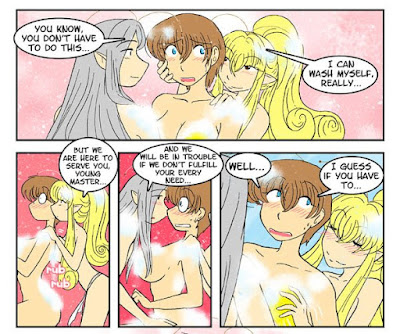
Communal Bathing is Fun
Today's guilty pleasure reading is the "onsen" scene from gender-bending magical girl comedy Sparkling Generation Valkyrie Yuuki (Gosh, what a mouthful!) by Kittyhawk. All that's left now to take place is a beach episode, and oh yeah, a school festival misadventure at Montrose Academy.
The Other: Stories from Closed-off Places
One factor contributing to the respectability of the comics medium is subject-matter. When Art Spiegelman's opus Maus: A Survivor's Tale won a Pulitzer Prize in 1992, it prompted the expected round of "comics grow up" articles from the mainstream press. This was a comic that had the audacity to depict the Nazi Holocaust by drawing its characters as anthropomorphized animals. Although the novelty of the graphic novel has since faded, it's no longer unusual for news publications to include comic book reviews, especially if the book's subject-matter is considered weighty enough to warrant serious attention. Today I'm going to examine two such works that attempt to lift the veil behind authoritarian states that have already received considerable media coverage both in the past, and during the present so-called war against terror.
The Complete Persepolis
I only managed to finish Persepolis last week - the critical darling of the mainstream press from a few years back. Set in post-revolutionary Iran, it is the bildungsroman of the author Marjane Satrapi. The book made Time magazine's Best Comix of 2003 list and was awarded a prize at Angoulême. Recently it has been adapted into an animated feature. It's easy to see how this story would get the attention it did. Iran has been labeled an enemy of the West and a source of international terrorism. Satrapi has the added advantage of being an insider. At its heart the real conflict is the inner battle typical of the western-educated elite of many non-western countries: The progressive, secular world view clashing with cherished religious beliefs. An only child of a liberal Muslim family residing in Tehran in the 1980s, Satrapi's rebellion against religious authority as an impetuous teenager causes her parents to send her to Austria. But like most exiles, she's ill at ease in her new environment. The culture shock and isolation eventually get to her. She returns to Iran where she experiences reverse culture shock. At first feeling lonely and depressed, Satrapi resolves to improve herself. When she leaves Iran for the second time, she has developed into a confident, more mature woman.
On paper the author's tale of growing up in modern Iran sounds fascinating. Anything that opens the country to a world that regards it with fear and suspicion, humanizes its citizens, and provides some historical context is a commendable act. So readers are now aware that not everyone in Iran is a card carrying Muslim fanatic. Also important to the work's premise is how the age-old conflict between Arabs and Persians colors the modern-day war between Iraq and Iran. The decision to tell this story as a comic seems particularly clever. As a prose work it would have disappeared amongst all the autobiographies, but as a graphic novel it stands out as something less academic and more accessible.
All of this doesn't change my feeling that subject-matter aside, this is a rather uninspired comic. Marjane Satrapi's use of narrative captions and small panels doesn't particularly make good use of the comic medium. Indeed she doesn't have much to say about it. There's not anything particularly sophisticated about her word-image balance that would make it better than most illustrated prose. While her simple black and white art is easy to follow, it doesn't flow easily from panel to panel. Much of the pace depends on the often digressive narrative text. This lack of grasp of panel transitions makes for a rather disjointed and jerky narrative. As for her characters, while Satrapi is a good enough artist to capture the likeness of a person with a few lines, but there's still something generic about the way they move and act and speak.
Sadly, this applies to the main character of "Marji" herself. She makes for a somewhat interesting kid living in what to western eyes is unusual circumstances. But as she moves from adolescence to adulthood, she doesn't transcend the usual cliches found in coming-of-age tales. She experiences teenage alienation, takes drugs, looses her virginity, falls in love with the wrong guy, breaks-up with him, falls for another guy, gets married. The events themselves aren't the issue, but the banal manner in which they are told. I wanted to like the protagonist, but I didn't find myself caring for her when I finally put the book down. Instead I was making unfavorable comparisons to David B's much more accomplished autobiography Epileptic. This leaves me in two minds about Persepolis. On one hand I can't begrudge the success of a book. But I wouldn't recommend it as a shining example of the comics medium.
Pyongyang: A Journey in North Korea
Pyongyang is a travelogue by Canadian Quebecois comics creator Guy Delisle. It chronicles his two month stay in that city working as a liaison between a French animation studio and the North Korean animators the company has outsourced its work to. All North Korean animators work at the state-controlled Scientific Educational Korea (SEK). During his time there, Delisle stayed in one of three hotels built to house foreign expatriate workers. He was never allowed to leave the hotel unattended. At all times he was required to be accompanied by a state-assigned guide or translator.
Right of the bat Delisle takes some self-conscious pride in being an outsider to the system. He brings a copy of George Orwell's anti-totalitarian novel 1984, noting that none of the locals seem to recognize its subversive nature. He even lends it to his translator at one point, which predictably produces an upset reaction later on. He also brings CDs of music designed to provoke the locals (reggae, jazz, and electronic music artist Aphex Twin) and even smuggles in a transistor radio - a contraband item.
Delisle is an entertaining storyteller. He's a cynical and funny observer: taking note of little details from the local fashions, to the immaculate condition of the city streets, to the ubiquitous and strangely similar portraits of Kim Il Sung and Kim Jong Il. Throughout the book he peppers his story with the kind of information accessible to him from outside of North Korea, but never shares with the locals. For example when discussing the reunification issue between North and South Korea with his translator (which he insists on calling "captain" Sin), he doesn't argue against the claim that the United States is the primary opponent to blocking reunification, but expresses his opinion to the reader that North Korea's own poverty and military build-up are a bigger obstacle to reunification. As a westerner, he is constantly aware of the of the censorship, paranoia, and repression which the North Koreans do not address. The only time he can talk freely is when he is around colleagues and other members of the expatriate community, which constitutes an island of cosmopolitanism carefully segregated from the rest of the population.
At the same time, the North Korean government never let's an opportunity to propagandize to anyone go to waste. Every weekend Delisle is invited by his guide to visit some national monument or site dedicated to the cult of Kim Il-Sung or Kim Jong-Il. he dutifully follows his guides around, but it soon gets to be too much for him. When asked by them what he thought of America after seeing a museum exhibit depicting alleged war crimes commited by American soldiers during the Korean War, Delisle makes light of those atrocities in an attempt to sound fair and balanced. They are not amused his response.
This is a significant limitation of Delisle's story. He knows how totalitarian the North Korean regime is, and wonders whether his guide and translator do: "Do they really believe the bullshit that's being forced down their throats?" But they in turn seem equally convinced that Kim Il Sung is the greatest leader on Earth, and North Korea is the world's greatest nation. His inability to cross the huge gap in perception between foreigners and locals is what prevents Delisle from coming up with anything more insightful a conclusion than that ordinary North Koreans have been cowed by fear of retribution from the state - something he had already learned from Orwell. Delisle is no Joe Sacco. He's never able to penetrate the exotic strangeness of the country, or get past the ideological mask and connect with the North Koreans as individuals. I imagine that his guide and translator probably saw him as an odd and condescending westerner. But that's to be expected given the restrictions placed on him. Between the hotel and his job at the SEK, Delisle didn't have the time or the initiative to do much else. Considering these circumstances and the immensity of the cultural divide, the most he could probably ever hope to do was bond with his hosts over a good meal and a bottle of Hennessy.
5/18/2008
Linux Humor
Now this is really geeky. Randall Munroe knocks the more prominent Linux distros. Thank God for the internet. But wow! Ubuntu received the most unkind cut.
5/10/2008
Animania Festival 2008: So Many Joshikousei
Yesterday I finally did what I've been avoiding since 2004 - I bought a new set of SLR camera lenses to replace the ones I've been using up to now. When I made the move to digital photography, I continued to use my old Nikon 35 mm lenses (Backward compatibility is a wonderful thing). But they've aged rather badly since then. The rubber started to come loose, and on one lens the Aperture adjustment became unresponsive. Retirement was inevitable. The last straw was the Brisbane Supanova convention. Too many photos came out flat, blurry, or suffering from a bad case of lens flare. I couldn't shoot with my equipment anymore if I wanted acceptable results. So after much deliberation I purchased a pair of Nikkor DX lenses with VR capabilities: One wide angle and one telephoto. They're not my top choices, but given my present financial situation, they were all I could afford. The ones I really want alas still remain wishlist items. In certain respects their handling and performance is inferior to my old lenses when they were in top condition. But they make up for that by returning to me the wider angle view I lost when I started to shoot with a DX body. In addition the VR feature has saved what would have been otherwise unusable photos.
Why am I relaying all this? Because what eventually got me to buy new photographic equipment is the topic of this post: Today's Animania Festival . The most appropriate word to describe the one day mini event would be "intimate." It occupied the fifth floor of the local Holiday Inn, filling the hall and the four conference rooms - One for vendors, two for anime screenings, and the largest for main events like the cosplay competition. Running from 10 AM - 4 PM, the organizers kept things moving by packing the schedule with activities like games shows, demonstrations, karaoke, contests, all carried out by a small but enthusiastic group of staffers from (I presume) the main convention in Sydney. It's a typical anime-themed convention. But the franchise's local success has lead to the announcement of a second Animania for Brisbane later this year in September. What anyone would have to look forward to in another Animania is beyond me.
The other big news (It's big news if you're a cosplayer) is that the Animania franchise is participating in the selection of representatives for the World Cosplay Summit. I'm not familiar with the event, but the Japanese government seems to support it as a means to promote the country's "soft power" abroad. Only two contestants showed-up to fill the two spots for the next stage of the preliminaries to be held in Sydney, so there was no real suspense about not qualifying. Unlike the usual cosplay contest, the participants, in addition to performing a cosplay skit, were asked a series of questions from a panel of judges, reminiscent of a beauty contest or job interview: They had to field the usual obvious queries like "Why do you think you should represent Australia at the WCS?" or "How would you improve your act?" Off course every contestant wanted to go to Japan. I myself would like to tag along with them just to watch Japanese otaku in their native element.
Comics-wise there's nothing to talk about. This is a pure fan convention - more celebratory than critical. Not a single manga or anime professional was seen or heard. The only panel being held was about cosplaying. Substance was never Animania's strong suit. But today I had new equipment I was dying to field test, and that's what I did. My first photo post is already up with more on the way.
5/04/2008
A Look at Free Comic Book Day
Free Comic Book Day has come and gone. I'm mostly skeptical about the event's ability to bring in new readers. Much of its success or failure depends on the particular retailer's ability to attract people who would usually not step into a comic book store. There are three of them within a block of each other at Brisbane's commercial center. One didn't bother to participate. The second allowed only one free comic per shopper. The last hung balloons on the walls to lure customers up to its 3rd story entrance. While business was brisk, it didn't seem like anyone besides the usual comic book crowd was shopping inside. I thought I'd evaluate three books for their ability to attract potential readers.
IGNATZ
I'm pleased to see this book being offered during FCBD. None of the material is self-contained, but excerpts of much longer stories. As a sampler it's pretty much what I would expect from a high-end art comics line published by Fantagraphics, which is to say it's good, mostly non-genre work. David B's autobiographical Epileptic was a masterpiece of surreal storytelling. His sequel Babel, which continues to record the mental deterioration of his older brother, seems no less accomplished. Another intriguing feauture is Kevin Huizenga's stories of everyman hero Glenn Ganges (Also published by Drawn and Quarterly). So is Richard Sala's gothic retelling of a classic fairy-tale in Delphine.
All of the stories are worth examining further, but your mileage may vary. A certain aesthetic can be found in most of the comics: The solid, organic, line-work, the monochromatic coloring, the six-panel grid, and the European-leaning definition for "international." It doesn't showcase flashy black and white manga-style, or cute anthropomorphic art. Unfortunately the cheap printing quality doesn't do it any favors. The IGNATZ acronym feels clumsy and pretentious. I doubt this comic book line will attract readers who aren't already familiar with Fantagraphics' output, but those who are beginning to explore the medium beyond the confines of formulaic entertainment will want to read it.
DC Universe 0
Technically not an FCBD offering, but the retailer was giving it away. I'm obviously not the first to say this, but DC's and Marvel's super-hero lines have difficulty pulling in new readers. What do you expect when the publisher chooses to advance a convoluted shared universe mired with decades worth of continuity? DC Universe 0 is structured like a movie trailer: A short teaser is followed by a portentous full-page ad tying the story to the upcoming crossover event Final Crisis. DC's biggest names are under threat: Superman, Batman, Wonder Woman, Green Lantern, and the Spectre (So what else is new?). A super-villain society is formed that worships a dark new god. And a long-dead hero returns in a flash of lightning.
if you don't get the references, then you're not hard-core enough. The person this is meant to appeal to, other than the longtime fanboy, is the older lapsed reader - someone who's at least been around since Crisis on Infinite Earths and has been out-of-touch. I'm sure there are plenty of them out there. Heck I'm one of them. And no I'm not really interested in returning from the look of things here. It's all too depressing just thinking about it.
Amelia Rules!
Hey, a comic book that's meant for kids. Appropriately cute artwork for the target audience. According to its creator Jimmy Gownley, he is abandoning the pamphlet format for paperback, which is a better fit for the bookstore market (news source here). The lead story is surprisingly weighty because it ties in with a larger work about a reservist father drafted to fight in Iraq. Unfortunately the subject-matter threatens to crush any forward momentum. As the characters try to make sense of a war they cannot understand, the number of talking-head panels increases, and the info-dump eventually grinds things to a halt. If the execution isn't quite successful, I imagine that children grappling with these very issues will find it relevant. Not the most whimsical material for its intended demographic.
Some Notes:
I'm dissapointed that none of the retailers I visited stocked copies of Gegika. That would have made an excellent stylistic contrast to IGNATZ, and a counterpoint to the more mainstream Shonen Jump. The latter book's excerpts should be familiar to its readers, but otherwise mostly confuse the uninitiated, except for Slam Dunk, which Viz seems to be banking on as its next hit. I didn't need to pick-up All Star Superman #1, already owning a copy. It's a logical choice - being largely free of the trappings of the DC Universe, and revisiting Silver-Age concepts familiar to the general public. It's well-written and drawn, but I doubt it will interest anyone who thinks Superman is old-fashioned, and the whiff of nostalgia inevitably creeps into the story. I also glanced at Tiny Titans #1, which was something of a disappointment. It's funny and cute, but unless the six year olds this is aimed at are fanboys themselves, many of the jokes are going to go over their heads.
4/22/2008
Emma Vol. 7
One of the pleasures of reading Emma is observing the evolution of the art of creator Kaoru Mori. As expected for a historical drama, everything is drawn with an eye towards detailed accuracy. But a comparison between the first and this latest volume reveals how far Mori has developed as a cartoonist. The drawings become more meticulous and the cross-hatching more intricate. At the same time the line-work becomes more confident and sensual, the panels for every page become more numerous, yet never overcrowded. The figures become more rounded and the faces more animated. The marriage of quiet understatement with the expressive qualities associated with manga makes Emma an interesting work. Beneath the surface restraint lies intense emotions which are incrementally revealed as the story unfolds.
For all its seriousness, Mori regularly injects a good deal of humor throughout the proceedings. The exotic Hakim Atawari may, or may not be, a faithful representation of an Indian prince, but his ostentatious behavior feels like something out of a Bollywood musical. The assertive and impulsive Countess Monica Mildrake has qualities reminiscent of tomboys and overprotective big sisters found in manga. There's also Emma's clumsy best friend and roommate Tasha and the witty barbs between the Jones siblings. These supporting characters go a long way to livening the narrative.

In volume 6 the forces arrayed against wealthy merchant's son William Jones and low-born maid Emma finally act to destroy their relationship. Volume 5 revealed the background of William's parents. The older couple had married despite societal disapproval, but the stress caused from trying to fulfill unreasonable social expectations did permanent damage to their marriage. Contrasting this with Emma's and William's response to their crisis in volume 7 helps put in perspective the difficulties that lie ahead for them, while suggesting some basis to hope for a happier outcome.

Throughout the course of the story, Kaoru Mori has taken the opportunity to develop Emma's charms. She's naturally intelligent, serious, industrious, and emotionally mature. Her quiet and dignified personality have earned her either admiration or befuddlement amongst her colleagues at Haworth. She's more than a match for the likes of William's fiancee Eleanor Campbell and the frivolous upper-crust girls she associates with. But like William, her main weakness is her fatalism. She confesses that she went along with her forced separation from William because she believed this was the only reasonable course of action to take. She should have resisted William's courting her. They didn't belong to the same class. He was already arranged to a more suitable mate. So as compensation she didn't resist when circumstances led her away from her beloved.

Meanwhile William's character has gone through considerable character development. In the first volume he was indecisive and passive, then acquires a newfound determination to carry-out his familial obligations. In this volume he develops enough resolve to speak against the prevailing class structure, symbolized by Viscount Campbell. And thanks to the assistance of Hakim, he manages to reunite with Emma, and they learn to find strength in one another.
The traditional upstairs-downstairs romance has become something of a cliche, but here it's somehow made fresh. Perhaps it's the the way one culture is being seen through the eyes of an outsider. Kaoru Mori's fascination with England, and her obsession with maids in particular, is so genuine it's infectious (Japan has recently become known for its maid cafes). No facet, however small, is too insignificant for her, whether it's the clothes the people wear, their mannerisms, the tiny gestures, the rules of etiquette observed, the tableware they use, the furniture and decor. It's this unadulterated love for her subject that allows Mori to conjure a world that feels authentic, yet also full of romanticism. The banter between the household servants and the pride they take in their work serves to heighten the self-indulgence of the upper-class. Chatty London society types condescend to their rural counterparts. The established aristocracy sneers at the rising bourgeois. And foreigners observe all this with utter bemusement. The class hierarchy is conveyed without coming across as a social studies lesson. That is a remarkable achievement for any young cartoonist.
For all its seriousness, Mori regularly injects a good deal of humor throughout the proceedings. The exotic Hakim Atawari may, or may not be, a faithful representation of an Indian prince, but his ostentatious behavior feels like something out of a Bollywood musical. The assertive and impulsive Countess Monica Mildrake has qualities reminiscent of tomboys and overprotective big sisters found in manga. There's also Emma's clumsy best friend and roommate Tasha and the witty barbs between the Jones siblings. These supporting characters go a long way to livening the narrative.

In volume 6 the forces arrayed against wealthy merchant's son William Jones and low-born maid Emma finally act to destroy their relationship. Volume 5 revealed the background of William's parents. The older couple had married despite societal disapproval, but the stress caused from trying to fulfill unreasonable social expectations did permanent damage to their marriage. Contrasting this with Emma's and William's response to their crisis in volume 7 helps put in perspective the difficulties that lie ahead for them, while suggesting some basis to hope for a happier outcome.

Throughout the course of the story, Kaoru Mori has taken the opportunity to develop Emma's charms. She's naturally intelligent, serious, industrious, and emotionally mature. Her quiet and dignified personality have earned her either admiration or befuddlement amongst her colleagues at Haworth. She's more than a match for the likes of William's fiancee Eleanor Campbell and the frivolous upper-crust girls she associates with. But like William, her main weakness is her fatalism. She confesses that she went along with her forced separation from William because she believed this was the only reasonable course of action to take. She should have resisted William's courting her. They didn't belong to the same class. He was already arranged to a more suitable mate. So as compensation she didn't resist when circumstances led her away from her beloved.

Meanwhile William's character has gone through considerable character development. In the first volume he was indecisive and passive, then acquires a newfound determination to carry-out his familial obligations. In this volume he develops enough resolve to speak against the prevailing class structure, symbolized by Viscount Campbell. And thanks to the assistance of Hakim, he manages to reunite with Emma, and they learn to find strength in one another.The traditional upstairs-downstairs romance has become something of a cliche, but here it's somehow made fresh. Perhaps it's the the way one culture is being seen through the eyes of an outsider. Kaoru Mori's fascination with England, and her obsession with maids in particular, is so genuine it's infectious (Japan has recently become known for its maid cafes). No facet, however small, is too insignificant for her, whether it's the clothes the people wear, their mannerisms, the tiny gestures, the rules of etiquette observed, the tableware they use, the furniture and decor. It's this unadulterated love for her subject that allows Mori to conjure a world that feels authentic, yet also full of romanticism. The banter between the household servants and the pride they take in their work serves to heighten the self-indulgence of the upper-class. Chatty London society types condescend to their rural counterparts. The established aristocracy sneers at the rising bourgeois. And foreigners observe all this with utter bemusement. The class hierarchy is conveyed without coming across as a social studies lesson. That is a remarkable achievement for any young cartoonist.
4/19/2008
Josephine!
Kate Beaton has some fun at Napoleon's expense. Unsurprisingly, he's epitomized as a chibi character. There's also a recent one about Pope John Paul.
4/14/2008
American Splendor Volume 2 #1

Harvey Pekar has been producing his American Splendor comic book for thirty-odd years, mainly as a self-publishing effort. He's collaborated with a number of artists, most notably Underground Comix cartoonists like Robert Crumb, Gary Dumm, and Frank Stack. But the voice expressed has been consistently that of a working-class individual finely attuned to everyday reality's potential to be a source of many small pleasures and equally acute frustrations. He was doing autobiography before it became a dirty word associated with alternative comics. None of today's indie creators can quite match his ability to mix personal angst and social/political commentary within the confines anecdotal story-telling. And of course none of them has managed to denounce David Letterman as a corporate shill while appearing as a guest on Late Night.

Despite the Letterman connection, Pekar continued to work in obscurity until the recent American Splendor biopic in which he sometimes plays himself. That project and his retirement from his job as a file clerk at the VA hospital he worked most of his adult life marked as important a milestone as his bout with cancer less than a decade ago. First Dark Horse, and now DC/Vertigo publish his work. Hopefully the exposure to a wider audience has brought new readers. A more immediate effect of his recent fame is that a new crop of artists have been brought in by his publishers to illustrate his work. Vertigo's first American Splendor series included a diverse collection of talent from Eddie Campbell to Richard Corben. The results were predictably mixed.
This second series continues to recruit artists from both mainstream and independent comics. But the sequel does seem to be a bit more consistent. Ed Piskor channels Crumb in making Pekar look like the cantankerous slob of those early stories. Chris Weston's meticulously detailed line-work is well suited to capture the pain experienced from tripping and falling down on the front steps of a house. Zachary Baldus shadings complement the 50s setting of a disreputable movie theater where a younger Pekar used to work.

These post-movie American Splendor books chronicle a Harvey Pekar mellowed by age and fame. In the first story I'm No Help he indulges a young fan who only knows him from watching the film. In Restraint he takes pride in not causing a scene when a pharmacist refuses to refill his prescription. And in The Kirkus Reviewer he notes that he hasn't put down criticism of his work in a long time, but feels compelled to defend the merits of his graphic novel Macedonia. As a reader of his earlier stories, it's a interesting development in his character. Even the story of his youth is filled with a certain longing that could only have come from many years of reflection and the affect of attempting to capture fading memories. Welcome to the late period of Harvey Pekar's career.
4/09/2008
Blame Evangelion
Jesus is a naif blonde. Satan is a lute-playing sorcerer. And caught in the middle is your standard shonen hero. It's a showdown between good and evil at a small seaside village in Croatia. Don't ask, just click.
4/08/2008
Kick-Ass #1-2

"Putting on a mask and helping people isn't impossible...you'd think all these guys talking about it online every day, at least one would give it a try..." says the adolescent protagonist of Mark Millar's latest comic book series Kick-Ass, apparently unaware of the activities of real-life vigilantes. His obsession with superheroes leads him to imitate their conduct: He works-out to improve his body, dons a costume and mask, and goes on nightly patrols looking to fight crime, yielding predictably disastrous results.
Set not in a fantastic superhero universe, but a facsimile of the mundane world, this is a fairly unpleasant story of a very unlikable character. Dave Lizewski is a lonely, depressed person seriously out of touch with reality. In his first foray into crime-fighting, he antagonizes a trio of black teenagers by calling them "homos" - Not the smartest thing a skinny, short, white kid should be saying to a group of African-Americans. In his second effort he fights a group of Puerto-Ricans adults. His excuse for repeating such self-destructive behavior? "The beast was friggin' in me, man." Expect plenty of swearing and random pop-culture references that usually passes for witty dialogue in a Millar comic. John Romita Jr.'s art is good, but perhaps a little too cartoony to evoke the gritty, urban, atmosphere the story seems to be demanding.
Mark Millar's fans might enjoy this series, but so far, aside from the art, I can't find anything here worth pursuing.
4/05/2008
Our Humble Convention
Small cities bequeath small fan conventions. So it is with the Supanova Pop Culture Expo being held this weekend in Brisbane, a show that breaks barely above 10,000 people in attendance. That's on the order of twelve times smaller than Comic Con International. But this is the biggest event of its kind in the city. There is nowhere better to go to without leaving the state of Queensland. The venue is so intimate I seem to run into the same cosplayers every year.
The biggest celebrity guests for this year were Jewel Staite of Firefly and Stargate Atlantis, and Teryl Rothery of Stagate SG-1. Given that Firefly and SG-1 are no longer airing new episodes, that feels like something of a step down from last year's Aaron Douglas of the continuing hit series Battlestar Galactica. The Supanova franchise is modeled after the typical geeky pop culture mishmash that is most American comic book conventions. Every year the organizers manage to wrangle some actors, writers, comic book artists, and other stateside professionals to visit Brisbane and mingle with the local talent and aspiring fans. This year's artists who made the trip to Australia included Ms Marvel cover artist Greg Horn (whose art adorns the Supanova promo) and Marvel Zombies cover artist Arthur Suydam. Unfortunately I don't find either of their respective works particularly interesting.
I'm tired so I'll let the pictures do the talking. Photos of today's convention will be posted at some point within the next week or two on my photoblog.
3/31/2008
Men of Tomorrow and The American Dream
If Siegel and Shuster had done business with honorable men, their lives — and the lives of their families — would have been far different. But they didn’t. Harry Donenfeld was a crook. Jack Liebowitz was a two-faced socialist who abandoned his principles in the name of corporate profits. If there’s a Hell below, I’ll surely meet both men there. No: Siegel and Shuster struggled financially for decades, and while each died earning stipends that DC Comics had been shamed into paying them, these sums were nothing compared to the hundreds of millions of dollars the company had reaped over the decades and continues to reap, a gluttonous middle finger thrust into the face of the American Dream.
- Dirk Deppey on the sordid history of Detective Comics conduct toward Superman creators Jerome Siegel and Joseph Shuster.

I'm pretty much in agreement with those sentiments. However Judge Larson's decision limited itself to the creation of Superman in Action Comics #1. He upheld a previous court ruling rejecting DC's dubious claims that the company had significant input into the creation of the story:
The thrust of defendants’ argument was made and rejected by the Second Circuit in the 1970s Superman copyright renewal litigation, and is thus precluded as a matter of collateral estoppel here. In that litigation, defendants’ predecessors-in-interest presented much of the same evidence now submitted in this case to argue that this additional material transformed the entirety of Siegel and Shuster’s pre-existing Superman material published in Action Comics, Vol. 1, into a work made for hire. The Second Circuit rejected this argument, elaborating: “In the case before us, Superman and his miraculous powers were completely developed long before the employment relationship was instituted. The record indicates that the revisions directed by the defendants were simply to accommodate Superman to a magazine format. We do not consider this sufficient to create the presumption that the [comic book] strip was a work for hire.” Siegel, 508 F.2d at 914. This conclusion forecloses any further litigation on the point of whether Shuster’s additional drawings when reformatting the underlying Superman material into a comic book format or other facts related to such a theory such as the colorization process for Action Comics, Vol. 1, or the party responsible for the illustration of the cover to the magazine, rendered all or portions of the resulting comic book a work made for hire.
Which sidestepped the issue of ownership for subsequent works created under work-for-hire conditions. As Deppey puts it:
...few if any original concepts and/or characters currently in use by major comic-book companies can so easily be demonstrated to have been created and produced outside the premises of the company before being licensed for publication. Two borderline examples — Dan DeCarlo’s co-authorship of Josie and Marv Wolfman’s creation of Blade — have already been struck down by the courts as having been created on a work-for-hire basis. From the perspective of the larger New York corporate-comics industry, then, this really isn’t going to change anything save, perhaps, the way that DC Comics’ accounting department deals with Superman. And even there, changes won’t become immediately apparent until the other issues in the Siegal case are resolved. Until that occurs, DC Comics is still entitled to create and publish new Superman comics, and Warner Brothers is still entitled to make Superman movies and license the characters out to third parties for lunchboxes and whatnot.
So there won't be an avalanche of creators from the thirties or forties successfully reversing copyright for comics created under work-for-hire conditions back to themselves. Nonetheless the story of DC's screwing of Siegel and Shuster is the story that defined the one-sided nature of the relationship between publisher and creator for the next several decades. And it's important that some justice be served for their years laboring for less than honorable people.
3/30/2008
Truth and Justice

After seventy years, Jerome Siegel’s heirs regain what he granted so long ago – the copyright in the Superman material that was published in Action Comics Vol. 1. What remains is an apportionment of profits, guided in some measure by the rulings contained in this Order, and a trial on whether to include the profits generated by DC Comics’ corporate sibling’s exploitation of the Superman copyright.
- Judge Stephen Larson in the conclusion of his written opinion accompanying the decision to grant copyright to Jerome Siegel's heirs.
...Still, despite its limited scope and remaining unfinished details, this is a historic ruling rich with symbolic significance. And in a poignant coincidence, the judge issued his order on the same day that Grant Morrison's homage to Siegel and Shuster in All Star Superman #10 hit the stands.
- Jeff Trexler on the decision.
Happy 70th Birthday! Sometimes the never-ending battle is worth it.
Pretty Face Volume One
Cross-dressing is one of those familiar romantic comedy conventions that goes in and out of style, but will probably never completely vanish. The protagonist gains access to, and is allowed to remain close with a love interest by being disguised as the opposite gender. She won't reveal her true identity for fear of being rejected. But if the relationship is to proceed beyond the platonic level, the disguise has to be discarded. There's the rub, and the catalyst for all kinds of situational humor. Think of Viola in Twelfth Night, or Tony Curtis and Jack Lemmon in Some Like it Hot.
While cross-dressing characters continue to show-up in mainstream entertainment, their traditional comic role has been transplanted into Japanese manga. Sometimes it's a case of playing with the appearance of androgynous-looking bishonen and bishojo: Haruhi Fujioka of Ouran High School Host Club, or the princesses of Princess Princess. But in the short-lived series Pretty Face, creator Yasuhiro Kano comes-up with a most unlikely premise for a romantic story, and proceeds to milk it for all its comic worth. High school bully and karate fighter Masashi Rando is involved in a school bus accident that leaves him horribly disfigured and in a coma for a year. When he finally recovers, he discovers that his parents think he's dead and have moved away leaving no forwarding address. Even more upsetting is that he now wears the face of Rina Kurimi, a girl he secretly likes, because Dr. Manabe, the surgeon who fixed him up, used a photo of her found amongst Rando's personal belongings to reconstruct his face. This gross incompetence progresses into criminal misconduct when he decides to perform a sex change operation on the comatose Rando, who fortunately at that moment regains consciousness. After fleeing from Manabe's clinic, he runs into Rina, who mistakes him for her missing twin sister Yuna Kurimi. Overjoyed by the sudden reunion, she drags him home where he is welcomed back into the family with open arms and no questions asked. Rando's first instinct is to run away, but decides to stay in order not to hurt Rina's feelings. He resolves to track down the true Yuna while continuing to masquerade as her.
Still with me? The real fun begins when Rando/Yuna enrolls at his old school and settles-in with Rina and her friends. He forgets to use the women's toilets, gets involved in the old rivalry between the karate and judo clubs, fends off the advances of a lecherous male teacher, makes excuses to avoid the annual medical exams, all the while dealing with Dr. Manabe's constant suggestions to get rid of that "unnecessary appendage." He initially tries to solve these problems by exploiting his newly acquired good looks and "feminine" charms, but can't help falling back on his old habits of resorting to physical violence. Ironically his actions, which branded him as a delinquent as a boy, now draw so much unwanted attention that an instant fan club is formed by his horde of male admirers. There's nothing subtle about Rando. He's the typical shonen roughneck with a heart of gold. While he acts like a jerk, he's completely devoted to, and highly protective of Rina, happy to be at her side. Rina is herself a rather bland character and no less a manga cliche. Generically quiet, sweet-natured, and smart, she was already conveniently crushing on Rando before his supposed demise.
Yasuhiro Kano has a strong proclivity for drawing cute high school girls. He gets rid of the dorky-looking male Rando in the first half dozen pages of the story. After his transformation, Rando/Yuna is shown in a number of compromising poses that emphasize his attractiveness while threatening to expose his masculinity. Look at the volume #1 cover for example. Would the uninformed person seeing it on a shelf at Borders think that was a boy? At one point he dons a pair of large fake breasts at Manabe's insistence, which convincingly makes him more effeminate than any live actor could by wearing makeup and prosthetics. Unfortunately he can't remove them for the next 24 hours, so he tries to hide them by wrapping them tightly in bandages, with predictably disastrous results. Only with pictures can characters be designed to provide fan service that simultaneously titillates and flummoxes the reader. Kano is also pretty adept at rendering comically exaggerated expressions and cartoon violence, which he uses to good effect to illustrate Rando's gender confusion and ferocious outbursts.
I don't know if it was a lack of commercial success or a decision on Kano's part to end the series, but Pretty Face reached only six volumes in Japan. Weirder manga have lasted longer than that. It's a fairly innocuous product despite Viz giving it a mature content rating. Just lots of goofy fun for young readers.
Labels:
comedy,
manga,
Pretty Face,
Review,
romance,
shonen,
Yasuhiro Kano,
プリティフェイス
3/24/2008
3/21/2008
Moe Maid
Kaoru Mori pokes fun at some of the usual maid fetish tropes found in manga on her website. John Jakala offers translations. This one strip sums it up.
Labels:
comedy,
Commentary,
Kaoru Mori,
manga,
moe,
omake,
seinen,
エマ
3/19/2008
RASL #1
If there is anything about reading serialized comics that one can take away, it is that one should not judge the quality of a story based on a very partial reading. The early chapters of Jeff Smith's hugely popular comic series Bone were likened to the work of Walt Kelly. But whether due to artistic evolution or conscious design, it would later quickly advance into the realm of adventure fantasy. Yet on rereading all of Bone, it becomes apparent that this narrative shift was anticipated from the very beginning. With this in mind, examining the debut of Smith's new series RASL is an intriguing exercise.

Bone was one of those rare comics creations that received both tremendous commercial success and high critical praise. Jeff Smith could have parlayed that into landing a lucrative deal with an established publisher. And yet with RASL he returns to his black-and-white self-publishing roots. Even more interestingly, instead of publishing the series in thicker "graphic novel" volumes, he chooses to work in the traditional pamphlet format as he did in Bone. Working within these limitations, each pamphlet forms the outlines of a single chapter within a larger work. The first issue becomes the prologue. Smith is adept at this kind of pacing, and in this case he thrusts the reader right into the action. A unnamed art thief is in the middle of a heist which doesn't go smoothly. Fortunately for him, he has the uncanny ability to jump between dimensions. How he acquired this goes unexplained, but it grows increasingly evident that someone may be aware of his ability and is after him for unknown reasons. This is all that is needed to set-up the narrative. The protagonist is introduced, a conflict is framed, and a number of mysteries are presented to draw the reader in.
Smith is as skilled a cartoonist as ever. He seems to have no problem drawing gritty urban settings as he did valleys and the forest filled with talking animals. His art thief is as unpleasant a character as the Bone cousins were small and huggable. It's still the same cartoony style which triggered those Walt Kelly comparisons, but adapted to a very different subject-matter. There isn't a whole lot of humor, but there is a great deal of forceful energy. Smith uses very little dialogue for this issue, but instead employs the technique of narrative captions as a way to reveal the character's inner state. He manages to avoid the trap of dumping too much information by carefully balancing captioned panels with silent action-filled panels. But the restraint also serves to control the pace of the story. Only a few details are revealed by the end of the issue before it ends. But this serves only to raise more questions.

Where Jeff Smith will eventually go with RASL is the most interesting mystery of all. Just as in Bone, Smith is taking his time establishing the tone of the narrative. Only gradually will its contours be revealed. That he lets it unfold within the confines of the pamphlet comic is itself an important choice designed to keep readers engaged. He succeeded before in building and maintaining a fanbase for more than a decade, and he has the clout to repeat his success in today's radically different market.
Bone was one of those rare comics creations that received both tremendous commercial success and high critical praise. Jeff Smith could have parlayed that into landing a lucrative deal with an established publisher. And yet with RASL he returns to his black-and-white self-publishing roots. Even more interestingly, instead of publishing the series in thicker "graphic novel" volumes, he chooses to work in the traditional pamphlet format as he did in Bone. Working within these limitations, each pamphlet forms the outlines of a single chapter within a larger work. The first issue becomes the prologue. Smith is adept at this kind of pacing, and in this case he thrusts the reader right into the action. A unnamed art thief is in the middle of a heist which doesn't go smoothly. Fortunately for him, he has the uncanny ability to jump between dimensions. How he acquired this goes unexplained, but it grows increasingly evident that someone may be aware of his ability and is after him for unknown reasons. This is all that is needed to set-up the narrative. The protagonist is introduced, a conflict is framed, and a number of mysteries are presented to draw the reader in.
Smith is as skilled a cartoonist as ever. He seems to have no problem drawing gritty urban settings as he did valleys and the forest filled with talking animals. His art thief is as unpleasant a character as the Bone cousins were small and huggable. It's still the same cartoony style which triggered those Walt Kelly comparisons, but adapted to a very different subject-matter. There isn't a whole lot of humor, but there is a great deal of forceful energy. Smith uses very little dialogue for this issue, but instead employs the technique of narrative captions as a way to reveal the character's inner state. He manages to avoid the trap of dumping too much information by carefully balancing captioned panels with silent action-filled panels. But the restraint also serves to control the pace of the story. Only a few details are revealed by the end of the issue before it ends. But this serves only to raise more questions.
Where Jeff Smith will eventually go with RASL is the most interesting mystery of all. Just as in Bone, Smith is taking his time establishing the tone of the narrative. Only gradually will its contours be revealed. That he lets it unfold within the confines of the pamphlet comic is itself an important choice designed to keep readers engaged. He succeeded before in building and maintaining a fanbase for more than a decade, and he has the clout to repeat his success in today's radically different market.
3/09/2008
Budo
Cultural Stereotypes
Before the latest anime and manga explosion in the West unleashed the sailor-suited schoolgirl on so many impressionable teenagers, there was the sword-wielding, high screeching, side-kicking, martial-arts hero. This was one of the most familiar images I saw perpetuated by popular media in the eighties: from film, television, comic books, to literature and video games. Japan's martial reputation is an element of the West's general wariness towards the country dating from the last World War (and going back even further). The typical view of Japan could be described as: a geographically isolated country, racially and culturally homogenous, its people raised in cramped, austere conditions to be obedient to authority, conformist, polite, disciplined, hardworking, patriotic, militaristic, inscrutable. Can't forget inscrutable. The qualities which supposably made Japanese soldiers capable of fighting to the last man helped push Japan's post-war growth. Not surprisingly the country's economic success was met with trepidation and xenophobia in some quarters, exacerbated by worry about America's possible declining status as a world power.[1]
Fiction and Reality
Off course the Japanese romanticize their heritage as much as anyone else, and their bushi,[2] whether it's the 47 Ronin or Zatoichi, get the glitzy media treatment just as much as cowboys or medieval knights in Hollywood. Fiction is one thing. What about the reality behind the larger-than-life image?
One of my early influences spurring my nascent interest in legitimate Japanese (and East Asian) martial culture was the Japanese film Budo (Einaru Budo).[3] It's been a long time since I first saw it but I recently happened to watch it again. Interestingly my memories of the movie are different from the version distributed by cult label Synapse Films: First, in line with their catalogue of horror and exploitation flicks, its title was changed to the rather unfortunate Budo: The Art of Killing. Second, a voice-over narrative track has been added that I don't recall hearing those many years ago. Both of these changes, in my opinion, have macekred the product. But I'll elaborate on this later.
Someone hearing the Synapse title might get the impression that what they're about to witness will be some kind of slaughter-fest. Nothing close to that happens. There are only two scenes of simulated death: The first one, which actually begins the movie, is a discreet theatrical reproduction of seppuku.[4] But the bulk of the picture is taken-up by demonstrations of practitioners of the sword, the halberd, miscellaneous Okinanwan weaponry, judo, sumo, aikido and karate-do. It's not comprehensive, just a survey of the more well-known disciplines. Not surprisingly, the sword (kendo, iado etc.) receives the most exposure, while karate-do receives the most attention among the empty-handed combat forms.
The film is of interest to enthusiasts because of the content and the personalities that appear in it. First, to anyone interested in what actual budo looks like, what's being exhibited here is far more authentic than what's shown in popular entertainment like, oh say, Naruto. But I suspect that most lay-people would be turned-off by the lack of flashy acrobatics or various special effects that regularly accompany fictional onscreen hand-to-hand combat. The demos by themselves are fairly typical: Budoka are either performing solo, attacking inanimate objects (sandbags, wooden boards, bamboo stalks, tree trunks etc.), or performing together in various choreographed or improvised fight sequences. No one is getting intentionally hurt.
Second, the producers managed to round-up a couple of highly respected budoka to perform some of the demos. Yoshinkan aikido founder Gozo Shioda gets to throw-around three partners in his free fighting demo. Famous shito karate exponent Teruo Hayashi shows-off his skills with the tonfa, kama, and nunchaku[5], and performs a few karate kata.[6] Modern-day swordsman Taizaburo Nakamura slices bales of straw with a katana. Takamiyama, the first foreign sumo champion, trains with his fellow wrestlers. It's a not unimpressive list.
But watching an hour and a half or demonstrations would become pretty tedious to the uninitiated. The film tries to break the monotony by taking the budoka outdoors. kendoka cross swords in rice fields, at night, in forest groves, on temple grounds, in front of the majestic Mount Fuji. Karate-ka train in the snow and on the beach. In one bizarre scene, one of them is conditioning his hands by repeatedly striking a locomotive.
Interspersed between the various demos are scenes of Japanese life. Some of them bear a direct connection to budo, such as actual classes and training sessions, tournaments, equestrian events, a smith forging swords, or sword polishing scenes. Others like religious festivals or Zen Buddhist monks meditating are more obtuse in their connection. Others like Noh dances blended with various kata simply look cool. Using Japan as a backdrop may seem cliche now, but it's used to great effect here to heighten the exotic beauty of the fighting disciplines. They're all attractively shot like some commercial from Japan's board of tourism.
In the end Budo isn't so much a documentary as a promotional video. It takes no critical stance about its subject matter, supplies no real historical information, offers no analysis, makes no attempt to differentiate between koryu bujutsu and the gendai budo,[7] shows no candid interviews with the personalities that appear in it. The film makes no attempt to dispel the mystique associated with the Japanese martial arts. While it's nice to watch, its spiritual lessons do not cut too deep.
The Art of Killing
For me the most cringe-inducing part of Budo: the Art of Killing is the voice-over narration. I can understand why it was added. For afficianados like me, watching famous budoka in action can be very engrossing. But for everyone else a film with neither plot nor dialogue, and a seemingly endless succession of demonstrations would probably get repetitive after fifteen minutes. Judiciously placed narration could inform and educate the audience about what they are watching. But the narration in this case does neither. In fact it's peppered with many half-truths and generalizations.
For one thing the narrator goes overboard in selling the deadliness of these various fighting arts. During an early kendo kata performance he intones "As real swords are used, great skill is required as the least mistake means certain death." How many times does that happen? During the filming of a judo free fighting session one judoka passes-out after being successfully choked. The narrator warns "Should one loose consciousness...he will die if left alone." Throughout the film, words like "severe", "cruel", "pain" and "death" are repeatedly used to emphasize the severity of the training, which lasts a lifetime since no one ever achieves perfection. Wow, a lifetime of pain and misery. They must be dropping by the hundreds everyday in Japan. Why would anyone want to send their kids to karate class after listening to this?
Then there's the usual self-aggrandizing claims made on behalf of their respective disciplines: Judo allows the smaller man to defeat the bigger man. With aikido, the person can defeat the opponent without raising a single blow. But The karate expert can kill a man with a single blow. The most historically inaccurate statement made in the film is when the narrator basically says that karate (and Okinawan weapons) was designed to fight against the sword. Seriously now. At the time the movie was produced the relative novelty of Japanese budo gave them a certain invincibility that still tends to persist today even as decades of exposure have made them less strange, and their assertions less credible.
The narration falls into the trap of cultural stereotyping when it conflates bushi philosophy with Japanese values: "The samurai lived to die a beautiful death. In this life philosophy of the samurai lies the typical mind of the Japanese man. he seeks after truth, through the sword, the soul of the samurai and cultivates his heart to be a sharp as the blade..."
Really? Well somewhere along the way, the Japanese man got tired of his spartan existence, decided to become an otaku, and hang-out at maid cafes in Akihabara.
Without the narration, Budo is a rather pretty, if noncritical portrait of the Japanese fighting arts. With the narration Budo: the Art of Killing becomes cheap and exploitative, and begins to feel a bit like a recruitment video for an eighties new-age cult.
______
[1] The Rise and Fall of the Great Powers by Paul Kennedy was a seminal academic work published at the time. Published in 1987, it traces the rise and fall of the great colonial empires and predicts the rising influence of China, Japan and the European Economic Community (EEC) as well as the decline of the Soviet Union and the United States.
[2] Bushi (武士) is a Japanese word for warrior. It combines bu (武) meaning war or martial, and shi (士), meaning gentleman. The warrior-class is more commonly known as samurai outside of Japan.
[3] Budo is a term for the Fighting Arts - bu (武), meaning war or martial; and dō (道), meaning path or way. The latter is a Buddhist term referring to a "way of life" or a "path to enlightenment" connoting that Budo is a spiritual discipline with the purpose of defeating the ego.
The other term for fighting arts is Bujutsu - combining bu (武) with jutsu (術), meaning art, science, or craft. The word emphasis the practical objectives of combat and war rather than achieving spiritual goals.
[4] Sepukku is the term for the ritual suicide practiced by the bushi. Popularly known as hara-kiri.
[5] Tonfa, kama, and nunchaku are various Okinanwan weapons.
[6] Kata is a preset pattern of techniques executed solo or with a partner/s. the term is usually translated into English as "form."
[7] Koryu Bujutsu generally refers to the classical military arts practiced during Japan's feudal era. These include kenjutsu, naginata-jutsu, sojutsu, kyujutsu, bojutsu, jojutsu, ninjutsu etc. Alternately called kobujutsu or kobudo.
Gendai Budo refers to the Japanese modern fighting systems developed since the Meiji era (1868–1912). These include aikido, judo, karate-do, kendo, naginata-do, kyudo etc.
3/01/2008
American Born Chinese
...I would've saved myself from five hundred years' imprisonment beneath a mountain of rock had I only realized how good it is to be a monkey.
- Monkey King, American Born Chinese
Don't ever be ashamed of who you are...
- Norman Osborne, Spider-Man (2002)
The quandary that confronts all immigrants is how to reconcile their background with the culture of their adopted country. This is a particularly acute problem to the second generation immigrants caught between the upbringing of their parents and the lure of the surrounding world. Do they assimilate into the new culture, even if it means abandoning many cherished customs and beliefs? Or do they continue to cling to their roots, even when it causes friction with the general population? Or is a third way possible that treats culture as a font of received wisdom to inform the individual, while avoiding the dangers of falling into the reactionism caused by rigid adherence to tradition or immutable identity? The last option sounds the most enlightened to me, but given America's tortured history of race relations, is the hardest course of action to implement. While appealing in its simplistic arguments, the first two options taken to extremes leads to mistrust and divisiveness.


Take Shortcomings protagonist Ben Tanaka. He has an allergic reaction to any assertion of ethnic identity, especially his own. He thinks he's wise and color-blind. He believes he is a well-adjusted American even when other people observe he is weighed-down by deep self-hatred. Not surprisingly his relationship with his more racially-conscious girlfriend self-destructs in a spate of mutual recrimination.
Ben would have hated reading American Born Chinese, the critical darling of 2006 by Gene Luen Yang. All three protagonists in this ambitious comic book are in various stages of denial about their racial identity. Each begins with their own separate narrative, but their stories eventually converge into the same revelatory experience. The first is a retelling of the origin of the legendary Monkey King (Sun Wukong). Snubbed by the rest of the gods and asked to leave a heavenly banquet, he takes his anger out on them.

Effectively declaring war on heaven, he begins his arduous training in order to meet whatever they throw against him. But along the way he also expresses a desire to be more like the very deities he is rebelling against. He begins to wear shoes and stand upright. He makes individual visits to each god in order to demand to be recognized by them as "The Great Sage, Equal of Heaven."

In the second narrative, American-born Chinese Jin Wang moves with his parents from San Francisco's Chinatown to Suburbia. Jin isn't too happy about being one of the few ethnic Asians in class. He endures the faculty's well-intentioned but ignorant attempts at friendliness, and the usual schoolyard bullying from his White classmates, in the hope that he'll one day be accepted by them. Ironically his best friend will turn-out to be Taiwanese-born immigrant Wei-Chen Sun.

He later develops a crush on a pretty girl called Amelia, but his own lack of self-confidence gets in the way of developing a relationship with her. This leads to a rift between him and Wei-Chen and a dramatic shift in the story.
The third narrative is about the very Caucasian-looking Danny putting-up with one of the regular visits from Chin-Kee, the very embodiment of every outrageous Chinese stereotype developed by Hollywood from the buck teeth down to the pigtails, and accompanied all the time by his own laugh track. The results are hilarious, but so horrible for Danny that every visit has resulted in his transferring to a different school to escape the shame of being Chin-Kee's cousin.

Given the differences in tone of the three narrative tracks (fantasy, slice-of-life realism, and comic farce) this could easily have been a big mess, but it isn't. Gene Yang keeps everything under control with clever pacing and fluid and clearly defined art. As one track gives way to another, their respective themes provide a counterpoint to each other, and eventually reinforce the central message without smacking the reader over the head with it. And it is an overall positive message of rapprochement with one's ethnic heritage without demonizing the mainstream culture.
While important, this rapprochement is only a provisional answer to the quandary of the immigrant experience. The book doesn't break-down the wall that keeps the mainstream and minority cultures apart. It doesn't go far enough to examine the very origins, uses, and effects of culture. As a result both American and Chinese cultures come across as unalterable, and even incompatible. This is mainly due to Yang focusing on each Chinese protagonist's individual problems. The Caucasians are strictly secondary characters, so there is no reciprocal experience on their part to question their own ethnocentrism, precluding any kind of final reconciliation. The limited focus may be a conscious choice on Yang's part. While American Born Chinese is not the most in-depth look at the issue of the immigrant and minority experience in America (It never claims to be), it succeeds wonderfully in mapping-out the smaller territory it explores.
Subscribe to:
Posts (Atom)


