5/27/2015

Unexpected Answer to an Age-Old Question

Bullet Bouncing by Kerry Callen. Superman created by Jerry Siegel and Joe Shuster. Wonder Woman created by William Moulton Marston.
Go to: Go to: May Contain Content by Kerry Callen

The real question is why are the two just standing there like dorks when they can move at super speed? Is there like a kid behind them whom they're shielding?

And yes, henchmen need to grow up.

5/25/2015

Wonder Woman '77 Special #1

WONDER WOMAN ’77 SPECIAL #1 by Marc Andreyko, Drew Johnson, Matt Haley, Jason Badower, Richard Ortiz, Nicola Scott, Annette Kwock, Romulo Fajardo Jr., Wes Abbott
Writer: Marc Andreyko
Artist: Drew Johnson, Matt Haley, Jason Badower, Richard Ortiz, Nicola Scott, Annette Kwock
Colorist: Romulo Fajardo Jr.
Letterer: Wes Abbott

Wonder Woman created by William Moulton Marston and drawn by Harry G. Peter

Wonder Woman ’77 is an attempt to capitalize on the nostalgic appeal of the only adaptation of William Moulton Marston’s comics heroine to have gained widespread fame, let alone universal acclaim. While fans debate the merits of Adam West vs. Michael Keaton, as far as the general public is concerned Lynda Carter is Wonder Woman. That's the central appeal and crucial limitation of this series. Every panel or page is suffused by her iconic presence. The other protagonist is, of course, the 70s itself. For anyone drawn to such cultural signifiers such as the Cold War, polyester shirts, hot pants, bell bottoms, roller skates, disco and Studio 54, this comic has them covered.

As such, the art team assembled for this series is tasked with capturing Carter's and Lyle Wagonner's appearance. There's inevitably some variation in how well they succeed in their task which might be distracting to some of the more attentive readers. Nicola Scott and Annette Kwock supply a pinup for the cover to this collection which is such an archetypical representation of Carter's Wonder Woman that nothing inside quite matches it, though Jason Badower draws several panels of Diana Prince that are near perfect in their photorealism. While Matt Haley and Richard Ortiz can portray a passable action sequence, the interior art leans heavily towards illustrative detail than to efficient comic book style storytelling. Drew Johnson doesn't make the characters particularly close in resemblance to the television cast, but he's the best in reproducing the "mod" sensibilities of the era. Diana's white pantsuit may well be also be a nod to the Denny O'Neil era Wonder Woman. Uniting all these artistic efforts is colorist Romulo Fajardo Jr., who bathes everyone in a warm rose-tinted glow that imbues every page with a faded quality.

WONDER WOMAN ’77 SPECIAL #1 by Marc Andreyko, Drew Johnson, Matt Haley, Jason Badower, Richard Ortiz, Nicola Scott, Annette Kwock, Romulo Fajardo Jr., Wes Abbott

The WW'77 Special collects two stories which mimic the episodic structure of the TV series. But writer Marc Andreyko isn't all that faithful to the source material, as the series itself played fast and loose with the original comic book. Andreyko adds those missing comic book elements which a late 70s show would not have been able to include due to budgetary constraints or the limitations of special effects. The most obvious insertion is WW's rogues gallery. Sonic-powered villain Silver Swan is reimagined as a nightclub diva with a hypnotic voice and accompanied by two backup singers who are also capable fighters called the Starlings. As drawn by Johnson she reminds me of a more fabulous version of Marvel's Dazzler. Cheesy but appropriate to the spirit of the show. By contrast Doctor Psycho is disappointingly generic as a short, elderly, white haired man sporting a lab coat and an elaborate salad bowl shaped helmet that seems to be the source of his powers. But I suppose the look is meant to recall a cheap television studio prop, so I'll give it a pass.

But the most notable villain of the comic is another Wonder Woman who's a not so subtle reference the mostly forgotten Cathy Lee Crosby version. For a time, she even has Diana confused about her own identity. But she eventually rallies and defeats her nemesis because there can only be one true WW. The book isn't very shy about hammering in that message.

WONDER WOMAN ’77 SPECIAL #1 by Marc Andreyko, Drew Johnson, Matt Haley, Jason Badower, Richard Ortiz, Nicola Scott, Annette Kwock, Romulo Fajardo Jr., Wes Abbott

5/21/2015

Archie vs. Predator #1

Archie vs. Pradator #1 by Alex de Campi, Fernando Ruiz, Rich Kozlowski, Jason Miller.
Writer: Alex de Campi
Penciller: Fernando Ruiz
Inker: Rich Koslowski
Colorist: Jason Millet

Archie et al. created by Bob Montana
Predator created by Jim Thomas, John Thomas, Stan Winston

Archie Comics may have a history of venturing into some really odd territory, but even by its standards a crossover with the Predator seems quite unexpected. The simple appeal of that character arises from the idea of an alien hunter searching for big game by traveling to Earth and deciding to go after humans. In the original movie, this well-armed extraterrestrial easily takes down a Delta Force unit making their way through a South American jungle. Much of its entertainment value comes from watching this group of he-men played by the likes of Arnold Schwarzenegger, Carl Weathers, and Jesse Ventura reduced to screaming like little girls while trying to escape an invisible bogeyman who's more testosterone-addled than all of them put together. Since then Dark Horse has paired the Predator against everything from the xenomorphs of the Aliens franchise to the iconic Justice League America. With a track record of such formidable opponents, what exactly does the cast from Riverdale High offer as potential prey?

Apparently, they have a lot to offer our would-be killer. The comic is drawn in the traditional house style and presented in the publisher's classic humor format. Archie Andrews and what feels like the entire Riverdale student body are spending spring break at an exotic beach resort. But while the usual  teenage hijinks occur, they're being stalked unseen by the Predator. If it weren't for this disturbing presence and one rather gory scene, the story would look like a conventional Archie comic. The beach vacation-inspired plot elements are fairly unoriginal, the humor is rather forced, and the cast's behaviour is pretty over-the-top. The boys talk and act like horny twelve year olds. And the rivalry between Betty Cooper and Veronica Lodge spills over into physical violence, which is what actually draws the Predator to them.

Archie vs. Pradator #1 by Alex de Campi, Fernando Ruiz, Rich Kozlowski, Jason Miller.

What exactly is it that he sees and approves of? Does he admire their fighting style? Is he attracted to their taste in clothes or horrified by it? Is he some kind of peeping tom? Does he believe targeting the two is some form of public service? Is he fed up with the Archie-Betty-Veronica love triangle? Or is he seeking a change in pace? And what's up with the emojis? Whatever the reason, it looks like a lot more people are going to die, preferably in ways both funny and appropriate for each character.

5/16/2015

Thor #8

Thor #8 By Jason Aaron, Russell Dauterman, Matthew Wilson, Joe Sabino, Mike Mayhew.
Story: Jason Aaron
Art: Russell Dauterman, Mike Mayhew
Colors: Matthew Wilson
Letters: Joe Sabino

Thor created by Stan Lee, Larry Lieber, Jack Kirby.

After seven issues chasing down what are now obviously a bunch of false leads, we finally arrive at our destination - the big reveal as to who is the new Thor. That is unless you already know her identity from reading various online leaks. Given how definitively she was ruled out much earlier in the series, this might prove to be a sticking point for some readers. But there is a certain fannish logic to her assuming the mantle of the Thunder God considering her deep association with the lead character. The reveal itself is a perfect mirror of the final pages of the first issue, a slow transformation obscured by tightly composed panels arranged in a grid, only to pull back to get a wider perspective for the final one page spread.

Otherwise, the primary action is the massive battle between the unstoppable Destroyer armor being possessed by one of Odin's more reprehensible lackeys, and new Thor backed up by the heroines called on by original Thor (who now goes by the name Odinson) because they were on his shortlist of possible new Thor suspects. It's a fun set piece that demonstrates how the series' art team has come a long way in portraying the requisite over-the-top action. Unlike most of his predecessors, Russell Dauterman draws his figures with a certain studied elegance eschewing the usual exaggerated anatomy, kinetic poses, and dramatic perspective of a traditional Thor comic. He carefully composes the action so that his characters have room to breathe and smashes the grid layout in order to create dynamism, tilting the panels to better reflect the chaos within them. But much of the action would still be incomprehensible if it weren't for the efforts of Matthew Wilson, who Dauterman heavily leans on to differentiate the large and colorful cast. Wilson seems to summon every tone possible in offset printing and employ every technique in the digital coloring process to render every bolt of lightning, every magical hex, and every Kirby crackle. It's a virtuoso display of what modern comics technology can achieve with the right talent.

Thor #8 By Jason Aaron, Russell Dauterman, Matthew Wilson, Joe Sabino, Mike Mayhew.

Unfortunately, the battle ends a little prematurely to build up to the big reveal, leaving this issue without a very satisfactory conclusion. The reader might know Thor's true identity, but that just raises more questions. Even more troubling are all the various plot threads left dangling, such as the machinations of the series' two arch villains seemingly about to pay off. This abbreviated quality is due to the fact that Thor is being forced to wrap up for now because the entire Marvel Universe is presently caught up in the crossover event called Secret Wars. It's an unfortunate reminder of the corporate nature of these properties. And just as the series' creative team was hitting their stride.

5/09/2015

Ms. Marvel #14

Ms. Marvel #14 by G. Willow Wilson, Takeshi Miyazawa, Jake Wyatt, Jenny Frison, Ian Herring, Joe Caramagna.
Story: G. Willow Wilson
Art: Takeshi Miyazawa, Jake Wyatt, Jenny Frison
Colors: Ian Herring
Letters: Joe Caramagna

Kamala Khan created by Sana Amanat, G. Willow Wilson, and Adrian Alphona

Ever since a young Kamala Khan took ownership of the longstanding mantle of "Ms. Marvel" she's had to navigate a complex web of paradoxical identities from the mundane to the fantastical. But this cultural melange has made her one of the most compelling new characters to come out of Marvel. The comic's blend of measured optimism and good humor has also kept Kamala from becoming just another dour attempt to replicate the historic success of Spider-Man. But has she finally met someone who's going through the exact same thing as her in this latest chapter? "All this time, I thought I was alone... that I was the only nerdy Pakistani-American-slash-Inhuman-in the entire universe. And then suddenly I wasn't." Oh Kamala, if only life were that fair.

Artist Takeshi Miyazawa joined the series in the last issue when this particular story arc began, and he's proven to be an apt choice. His manga-influenced style is particularly adept at capturing the varied moods of the book's youthful cast and the story's melodramatic milieu. What can be more romantic for two love-struck and rebellious teenagers (super-powered or otherwise) living in Jersey City than breaking curfew to sneak out and and gaze upon the glorious New York skyline?

Ms. Marvel #14 by G. Willow Wilson, Takeshi Miyazawa, Jake Wyatt, Jenny Frison, Ian Herring, Joe Caramagna.

But this issue's emotional heart is a short conversation between Kamala's pious older brother Aamir and her best friend/wannabe beau Bruno. As the former explains to the latter why Kamala could never date, let alone marry a non-Pakistani/Muslim, Bruno's face shifts from registering shock, defiance, and finally to crushing disappointment. His gradually slumping body contrasts next to Aamir's upright posture and his helpful but overall placid expression. It's all drawn with the right amount of understatement. The scene unveils a new layer about the two characters, particularly Aamir, who was in danger of becoming a caricature of the narrow-minded ethnic figure. More significantly it humanizes two divergent paths faced by immigrants: Bruno's integrationist philosophy which is often taken for granted by mainstream pundits in the U.S. as the correct course of action, and Aamir's often villainized but perfectly understandable desire to preserve what's left of his cultural legacy in the face of an aggressively bland conformity.

Given such ground-level concerns, Kamala dealing with the ugly side of her Inhuman heritage actually feels like an escape, or at least a diversion, as the superhero conflict provides a far more clear cut version of those problems while also handing her something convenient to punch. Now, Marvel's Mutants have generally played the role of less than convincing race metaphor, the not as well-known but no less potent Inhumans behave more like members of the upper-crust. They're essentially a magical race of elves and wizards who would rather conceal themselves within their enchanted communities far from the reach of mere mortals. But occasionally, one of these snobs resorts to more drastic measures. As an acolyte of this issue's would-be Voldemort proclaims what every fascist has basically ever preached: "Why should we hide what we are and play by the rules of a society that wasn't built for us. We're better than all these people..."

It's a cliched idea for anyone who's been following the X-Men or any Marvel superhero comic for the last 60 years. But it makes for a sudden if somewhat obnoxious presence coming right after the preceding low-key conversation touching on the nature of multiculturalism.

Ms. Marvel #14 by G. Willow Wilson, Takeshi Miyazawa, Jake Wyatt, Jenny Frison, Ian Herring, Joe Caramagna.

4/19/2015

Red One #1

Red One #1 by Xavier Dorison, Terry Dodson, Rachel Dodson.
Story by Xavier Dorison
Pencils and Colors by Terry Dodson
Inks by Rachel Dodson
Letters by Clayton Cowles

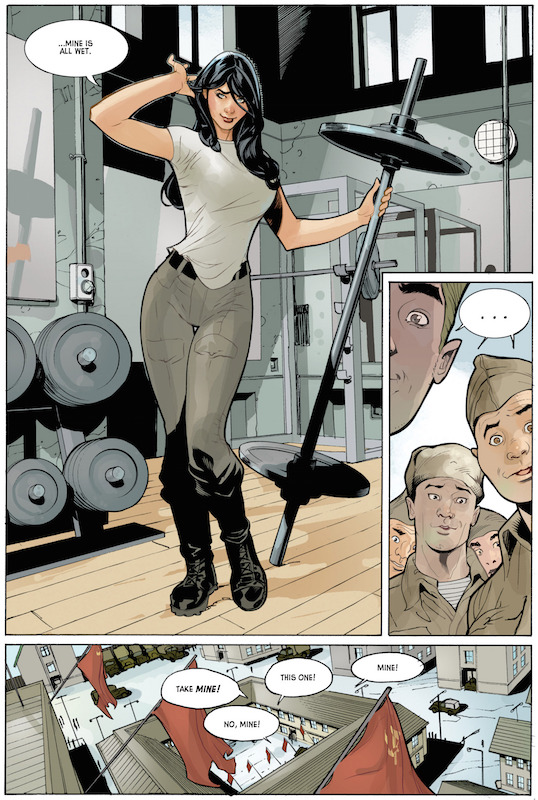
Red One starts from the conceit that America's neighbors from across The Pond are a far more enlightened and liberated lot. Or maybe that was just the 70s. At any rate those silly but highly dangerous Yanks are kind of childish for still believing in superheroes. Why, they even make movies about them. Something has to be done about that for the sake of world peace. The central premise of the series is absurd and over-the-top, but I'm not entirely sure from this debut if it's meant to work as a parody or a homage, or some clumsy marriage of both.

The art team of Terry and Rachel Dodson seem to be playing it straight, effortlessly capturing the kitschy atmosphere and cheesecake aspects of the decade like this comic was the script of one more exploitative action adventure film. The colors acquire a washed out, nostalgic glow when the setting moves to 1977 Southern California, imbuing the place with a certain dated glamour.

Where the comic disappoints is in the dialogue, which is clunky and unrealistic. This may have something to do with translating from the script of writer Xavier Dorison, but it sometimes feels like an over-earnest imitation of the informal speech patterns of most Americans. What Hollywood starlet vents her frustration at her critics by screaming "I'm going to smash their peasant heads in!"? This is exacerbated by half the word balloons being crowded by too much text. This again may be a translation issue, but it results in some very slapdash lettering which could have been solved by resizing or rearranging the balloons.

The comic's protagonist Vera Yelnikov could be described as a Rule 63-inspired, Soviet-era version of James Bond meets Captain America. She's a bombshell drawn by the very people who used to draw Wonder Woman during Allan Heinberg's aborted run. Which is to say that Vera's clearly meant to be ogled by the reader. But she's no vacuous sex symbol, she's the country's top operative. Smart, capable, and supremely athletic to the point of being possibly a super soldier. Vera's a free spirit involved in a polyamorous relationship with an expecting couple, plus a few other hanger-ons. She has no problem inducting complete strangers into the Mile High Club, but stops at sleeping with her co-workers and superiors at the Kremlin.

Red One #1 by Xavier Dorison, Terry Dodson, Rachel Dodson.

For all of these reasons, Vera is sent to infiltrate American Society in order to play the part of a superhero. A costumed vigilante called The Carpenter has been murdering disreputable Hollywood types. This has the party bosses worried that such criminal behavior might inspire a new wave of puritanism, which in turn could reignite the Cold War. So they assign Vera to masquerade as another local do-gooder so she can provide a more rational counterpoint.

Needless to say, the story is a not-so-subtle commentary on the connection between violence, sexual repression, and religious extremism, not to mention the rising tide of social and political conservatism that would come to dominate Reagan-era America in the 80s. And it panders to the view that Americans on the whole are somewhat naive in their idealism, making them a tad suggestible to things like men and women in tights. At the same time, there's an admiration for that very naïveté that comes across in Dodsons' love for recreating the seductive Californian milieu and in their portrayal of a fresh-faced Vera as an innocent abroad.

4/05/2015

Batman: The Jiro Kuwata Batmanga Vol. 1

Batman: The Jiro Kuwata Batmanga Vol. 1 by Jiro Kuwata.
By Jiro Kuwata, translated by Sheldon Drzka, lettered by Wes Abbott
Batman & Robin created by Bill Finger, Bob Kane, Jerry Robinson

Originally serialised from 1966-1967 in Shonen King magazine to capitalise on the popularity of the Batman television series, the Batman manga would be rediscovered in 2008 by Chip Kidd, who would make it the centerpiece of his book Bat-Manga!: The Secret History of Batman in Japan. Despite being well-received, Kidd was criticised for failing to credit the manga’s creator Jiro Kuwata. So for comic fans, it’s a little more gratifying to see DC release the first volume of a planned complete run for the manga in a format that more closely preserves the content of the original. But fans of the current incarnation of Batman or of today’s manga are probably going to find this comic slightly strange. This isn’t the brooding protagonist cloaked in black. Nor is the art going to remind anyone of today’s manga populated by delicately drawn bishonen and bishojo types. This is a solidly-executed boy’s action adventure of the period. But for someone like me, there’s something familiar and comforting about its simplicity.

To begin, this is a superhero comic that still displays the genre’s early circus roots. Batman and Robin don a variation of the traditional tights that they wore for decades before the duo started bulking themselves up with body armour. Long before superheroes were granted bodybuilder physiques, Batman and Robin were portrayed as lithe athletes. And this works for the kind of storytelling Kuwata employs. The duo are usually shown leaping off buildings, swinging on ropes, running at top speed, tossing and kicking their enemies, dodging bullets. This classic staging of fight choreography really helps to ground the characters in real physical exertion. By today’s standards Kuwata’s style is rather minimal. But it’s primary virtue is in how it captures the dynamism of its protagonists. The clarity and pacing of the action keeps what are sometimes wordy panels from slowing down the story.

The stories themselves, which mimic the 3-act structure of a television episode, are also fairly episodic, with Batman and Robin battling a succession of villains-of-the-week. Two of them (Lord Death Man and Doctor Faceless) were lifted from the manga’s American counterparts, but none of them could be described as an essential member of Batman’s rogues gallery. The plots and characterisations are now fairly predictable, with many of the tropes seen here having been used many times since the 60s. What I found surprising was the science-based nature of the antagonists. Like many readers, I’ve become accustomed to the horror/crime themed interpretation of Batman’s more popular arch-foes as well as Batman himself being portrayed as a psychologically scarred individual. But Kuwata’s stories reflect the post-War fascination with science and technology gone amuck. So the manga's always flamboyant villains tend to be hucksters, mad inventors, or freaks of nature rather than the more familiar assortment of mobsters, assassins, mass murderers, or serial killers. The only thing missing here are angst-ridden individuals transmogrified after being bathed in radiation.

This results in a very different kind of Batman. Rather than the urban avenger waging a one-man-war against crime in Gotham or the control freak who plans for every outcome, we have a Batman who initially stumbles when confronting a new villain’s MO for the first time. He starts out at a clear disadvantage dealing with their unfamiliar technology since he has no way to counter it. And while he eventually finds a way to win, he's far from infallible. This isn’t Batman the Dark Knight, but closer to Batman the problem-solving Science Hero. Admittedly, this plays to some of my more nostalgic instincts.

3/11/2015

R.I.P. Yoshihiro Tatsumi

Push Man and other Stories by Yoshihiro Tatsumi.
(Yoshihiro Tatsumi: June 10, 1935 - March 7, 2015) 

When you move to the metropolis, and you don’t know where you are, and you don’t have any work, I think that that can be a very alienating experience. Furthermore, I think that, when you’re living in those conditions, you start to envy other people that are around you, you start to imagine that everyone around you is living a better life than you are. I think that that’s a basic condition of living in the city. And when you’re with just one other person, and you envy them, you can just not see them. That’s fine. But that becomes very difficult when you are living in the city.
- From The Comics Journal

I tend to write about everything that’s happening in Japan. Socially, I’m inspired by that. Even if they’re good or bad incidents, I find myself interested in them, and then create stories. So before I write something, I’m always determined to include the things that are happening in society at the time.

So after the war, American troops came in, and got things settled in Japan. I drew this image of a Japanese man pulling a rickshaw – and there‘s a drunk American soldier waving around a bottle of alcohol around, getting kind of crazy. So just in that one panel, it sums up the exact situation of Japan after the war in that one panel.
- From About Manga

In Japan they weren't really making a lot of films at that time, so I watched a lot of European and American films. I pretty much watched everything from overseas. In American films, the bad guy always gets it in the end and justice wins. It was fun to watch American films, but everything was just so good, though. I thought there weren't very many people that could actually live like that.

In European films, the bad guy wins and justice loses out. That's when I started creating manga, where sometimes the bad wins and the good loses.
- From The Star