6/25/2013
Whale Wars: Viking Shores
Last time on Whale Wars, maritime crusader Paul Watson and the plucky volunteers who make up his organization Sea Shepherd had run the Japanese Whaling Fleet out of the Southern Ocean. Despite some doubt as to whether this truly meant the end for Antarctic whaling, Sea Shepherd celebrated, then cast about for another place where they could apply their high profile obstructionist tactics while being filmed for television consumption. Their new target would be the Faroe Islands off the coast of Denmark, where the natives observe an ancient whaling tradition called the grindadráp. Seems like the perfect cocktail of ingredients. The grind is a notoriously bloody spectacle and already the subject of considerable negative attention from several environmental groups. Sea Shepherd is already infamous for skirting the line between fervent activism and moronically executed violence. The setup looks like it would make for an explosive showdown. What we get instead for five episodes of Whale Wars: Viking Shores is an awkward social experiment were Sea Shepherd plays the role of general nuisance to the Faroese while psyching themselves up for a confrontation that never takes place.
Even Paul will admit that local attitudes towards the grind aren't uniform. And for reasons that have nothing to do with him. There are legitimate concerns about the rising toxicity levels found in whale meat. There's a growing generation gap between the old who see it as integral to their cultural identity and the young who find it a Medieval anachronism. And there's also a growing gender gap as young women are more likely to express ambivalence towards this traditionally male dominated activity. Only a few of those voices get to have their say, mainly a local doctor who's worried about the health effects of consuming whale meat. For their part, Sea Shepherd seems more interested in picking a fight than in fostering constructive dialogue. A group of volunteers disrupt a festival by playing whale songs over a loudspeaker until they're told to move their vehicle. I'm not sure if this behavior is the product of genuine obtuseness or a shameless ploy to drum-up some excitement for the camera. But it's almost cartoonish how the volunteers react with surprise and dismay when their activities predictably evoke a belligerent response from the locals. My guess is if anyone wanted to express doubts about the grind to the film crew, they would have been intimidated rather than empowered by the fear of an angry mob possibly forming around Sea Shepherd's finest.
Naturally, some low-level hostility accompanies Sea Shepherd's interactions with the Faroese wherever they go. Some of the locals even play-up their dislike for Paul to the camera. The irony of being the ones on the receiving end of such verbal harassment seems to be lost on the volunteers, and after awhile, they become a little paranoid. But the threat is overstated and there's no breakout of actual violence. And while that's a good thing, it also highlights the problematic nature of the series. In the past, the Japanese Whalers could be counted on to function as convenient antagonists who Sea Shepherd generally avoided confronting face-to-face. This made them far easier to demonize for the TV audience, not to mention exoticize for being the inscrutably foreign "other". Not so with the Faroese, who are even more whitebread than the activists themselves and eager to defend their views to the camera. They provide a counter-narrative missing in past seasons of the show. While they mostly come across as old-fashioned and even a little insular, the Sea Shepherd crew doesn't exactly help their own cause when some of them label the locals "ignorant" and "violent" during their own confessionals.
Given that Viking Shores substitutes the usual high seas adventure with a lot of pointless intrigue and onshore bickering, the series odd payoff only occurs when after six weeks the campaign ends a little prematurely so that Sea Shepherd can resume their war with the Japanese Whalers. Not that anyone is pleased to hear that the Japanese have begun whaling again, but at least with them Sea Shepherd is on more familiar footing. As they're making their way out of Faroese waters, the crew finally spots their first pod of pilot whales. After herding them away from the Islands, Paul declares the entire campaign a resounding success because of course he does. Perhaps the series producers weren't so impressed with his glowing assessment or the decision to take off and leave behind one subset of whales just to go rescue another subset, as it's noted in the show credits that 109 pilot whales were killed in a grind that took place exactly a week later.
6/19/2013
6/16/2013
More NonSense: Superman's 75th Anniversary Edition (Updated)
Entertainment Weekly celebrates the 75th Anniversary of the Man of Steel (via Kevin Melrose).
ComicsAlliance honors the artists who have given life to "Jerry Siegel and Joe Shuster's brilliant creation" these past decades.
Edward Helmore on the long legal battle to control the rights to Superman.
Siegel family attorney Mark Toberoff swears "This case is by no means over" (via Kevin Melrose).
Alan Moore on the seedy, disreputable comic book industry that profited from Superman's early popularity while ripping off its creative talent:
Joe Shuster draws Superman vs. a Grizzly Bear. Awesome.
Classic Superman Radio ads.
This town wants to be Smallville.
Tom Scioli thinks Jim Starlin’s brief stint on the character is the best Superman ever.
Jake Roper explains that Superman, or any superhuman for that matter, hitting an object with a fist that's traveling at 99% the speed of light would be really, really, really, really, really bad (via Kevin Melrose). I suppose that means that if you can take a punch from Superman, you're way beyond bulletproof.
Tom Bondurant on this week's Superman-related projects: Superman Unchained and Man of Steel.
Bully on the apocalyptic aspects of the movie.
Andrew Wheeler would like you to know that Henry Cavill is the latest in a line of unknown actors cast to play the Man of Steel. And if the pattern holds up, this role will be the high point of his entire acting career. It's a good thing then that he is one absurdly handsome man.
Marc Singer in his review of Man of Steel is irritated by the same elements that bother me, especially this particular pet peeve:
Michael May asks whether there is a meaningfully right or wrong way to interpret corporate-owned characters.
Tom Scioli on how Man of Steel is filled with 80s nostalgia for geeks.
ComicsAlliance honors the artists who have given life to "Jerry Siegel and Joe Shuster's brilliant creation" these past decades.
Edward Helmore on the long legal battle to control the rights to Superman.
Siegel family attorney Mark Toberoff swears "This case is by no means over" (via Kevin Melrose).
Alan Moore on the seedy, disreputable comic book industry that profited from Superman's early popularity while ripping off its creative talent:
The industry’s apologists have offered various glosses for the shameful act of theft upon which the vast business that supports them seems to have been founded. One of the more despicable of these constructions has it that Siegel and Shuster should have been more shrewd in signing contracts, which appears to be a variant on the well-known American proverbial advice regarding suckers and the inadvisability of giving them an even break. More lately there have been attempts to mitigate the industry’s offence with an appeal to half-baked mysticism and postmodernism, maintaining that Superman and the commercial children’s comic characters which followed him are all in some sense archetypes that hover in the ether, waiting to be plucked by any lucky idiot who passes by. Ingeniously, this sidesteps the whole Siegel and Shuster problem by insisting that creators in the superhero field aren’t actually creators after all, but merely the recipients of some kind of transcendent windfall fruit that should be freely shared around. Even if this were true, it’s difficult to see exactly how it justifies a perhaps gangster-founded company of fruiterers (just to continue the analogy) declaring that these profitable magic apples all belong to them in perpetuity. Still, one can see why such a morally-evasive brand of metaphysics might appeal to the large corporate concerns which steer the comic industry; to those amongst the readership whose primary allegiance is to a specific superhero rather than the ordinary non-invulnerable human who originated him; and to those loyally and profitably labouring at franchises, who know they’re in no danger of ever creating an original idea which would be valuable enough to steal."Five Superman Publications I Like Better Than The Movies" 1, 2, 3, 4, 5 by Tom Spurgeon and some other guys.
Joe Shuster draws Superman vs. a Grizzly Bear. Awesome.
Classic Superman Radio ads.
This town wants to be Smallville.
Tom Scioli thinks Jim Starlin’s brief stint on the character is the best Superman ever.
Jake Roper explains that Superman, or any superhuman for that matter, hitting an object with a fist that's traveling at 99% the speed of light would be really, really, really, really, really bad (via Kevin Melrose). I suppose that means that if you can take a punch from Superman, you're way beyond bulletproof.
Tom Bondurant on this week's Superman-related projects: Superman Unchained and Man of Steel.
Bully on the apocalyptic aspects of the movie.
Andrew Wheeler would like you to know that Henry Cavill is the latest in a line of unknown actors cast to play the Man of Steel. And if the pattern holds up, this role will be the high point of his entire acting career. It's a good thing then that he is one absurdly handsome man.
Marc Singer in his review of Man of Steel is irritated by the same elements that bother me, especially this particular pet peeve:
Like the ponderous Superman Returns, Man of Steel can't resist the cheap and easy Christ imagery. The subtext isn't helped when the villainous Kryptonian starts talking about how evolution always wins or how morality is an evolutionary weakness. Which I'm pretty sure is not how evolution works, but Snyder made his point.
(The Superman I love the most, the genial scientist and humanist who walked into a golden sunset in 1986 and reappeared for a dozen glorious issues in the mid-2000s, would no doubt respond with some gentle corrective about how morality is humanity's greatest evolutionary adaptation. And then knock Faora into orbit.)I'm rarely unequivocal when making recommendations, especially with superhero movies. And Man of Steel is not the greatest example of the genre. So for all the watered-down Nietzsche and muddled understanding of science, I still kinda like the movie, if for no other reason than on the strength of its cast. This off course in no way alters my skepticism of Zach Snyder.
Michael May asks whether there is a meaningfully right or wrong way to interpret corporate-owned characters.
Tom Scioli on how Man of Steel is filled with 80s nostalgia for geeks.
6/13/2013
6/12/2013
Farewell Commander Hadfield
6/04/2013
The History Of ComicsAlliance Explained
Go to: Comics Alliance, by Curt Franklin and drawn by Chris Haley
5/27/2013
Avatar The Last Airbender: The Search Part 1
Writer: Gene Luen Yang, Michael Dante DiMartino, Bryan Konietzko
Artist: Gurihiru
Letterer: Michael Heisler
Avatar: The Last Airbender created by Michael Dante DiMartino and Bryan Konietzko
Avatar The Last Airbender co-creators Mike DiMartino and Bryan Konietzko have become masters of stringing along their highly devoted fanbase. After revealing that Zuko's mother Ursa, who had been presumed dead throughout much of the series, might still be alive, the series ended while leaving that storyline conspicuously dangling in front of the audience. This set off much rabid speculation about her true fate. But whatever hopes that its spinoff Legend of Korra would provide some answers were dashed when Ursa was briefly mentioned in the series premiere only to be quickly forgotten. Mike would later explain that he and Bryan had unsuccessfully pitched the story of Ursa's fate as a TV movie. After Nickelodeon passed on it, they eventually decided to tell the tale in graphic novel format. Which leads us to The Search featuring the returning creative team of Gene Luen Yang and Gurihiru Studios.
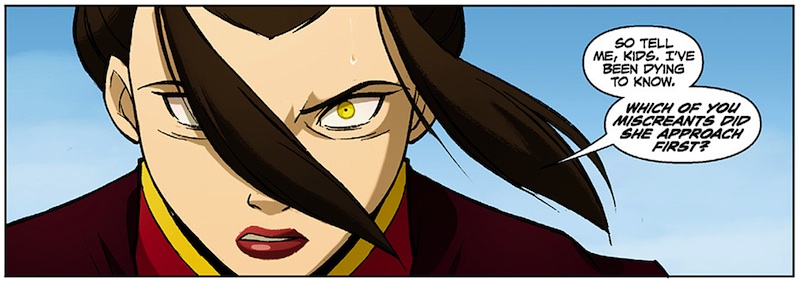
While smaller in scale, this book marks a return to the earlier quest structure that characterized the animated series. This is kind of a relief after having gone through the epic scope of The Promise, which suffered from a plot that was being pulled in multiple directions while often weighed down by its own political allegory. In fact, the shift to a more comedic tone is almost surreal. This time the narrative focuses on a smaller cast of characters, mainly Zuko and his insane sister Azula. This is not an exaggeration, as she has grown fully paranoid since her mental breakdown in the ATLA series finale. Yet it's curious how she and her father Ozai are still fully capable of manipulating Zuko just as easily as they did in the series. It's a bit too convenient how she manages to get her way, encountering little meaningful resistance even from Aang and the rest of the cast. Gene sometimes interprets Aang's circle of friends a little too broadly as a troupe of comic reliefs, which can be pretty annoying. By contrast, he seems to be having a ball with bad guys Azula and Ozai. Azula outshines everyone, particularly the often dour Zuko who's now suffering from a form of survivor's guilt. And there's something appealingly off-kilter about Gurihiru's visuals of her.
The narrative frequently, and abruptly, jumps back and forth between the present day and Ursa's past as a young woman engaged to the then prince Ozai. What we see of Ursa's youth in this volume conforms to the favorite ATLA trope of the suffering woman sacrificing her own happiness to a loveless marriage. The main difference being that she's being forced to marry Ozai, who is the proverbial dastardly, mustache twirling villain. While Gene often stumbled in capturing the changing but often ambiguous political realities of The Promise, here he's on more sure footing portraying the black and white melodrama of dysfunctional families, horrible father figures, fratricidal siblings, and opposing female archetypes as embodied by Ursa and Azula. This is one messed-up and unhappy world.
New information is gleamed from these flashbacks, such as the possible inspiration for Zuko's Blue Spirit alter ego. But at the very end the volume drops a bomb that threatens not only Zuko's position as leader of the Fire Nation, it also upends several seasons of character development. Indeed, the revelation feels a bit like reading someone's ATLA fan-fiction. This may, in all likelihood, prove to be a red herring. Nonetheless, this had the effect of making me a bit more wary of what's being planned for the rest of The Search.
5/26/2013
Star Trek: Into Darkness (2013)
Warning: This post contains major spoilers…
Let's get this out of the way first. Director J.J. Abrams spent so much time and energy denying the identity of the villain of Star Trek: Into Darkness that when it was revealed that Benedict Cumberbatch was indeed playing Khan [Noonien Singh], this seems to have engendered a bit of a backlash, judging from some of the negative reviews on the Web. I don't entirely blame Abrams for trying to keep this a secret. It's kind of a major plot twist. But once it was revealed in-movie, The Wrath of Khan references came in so thick and fast that it began to be a little distracting.
By casting Cumberbatch, TPTB have whitewashed one of the franchise's most compelling and ethnically daring casting choices. Avoiding a backlash for the whitewashing may have been another reason for keeping the villain's identity under wraps. But overall, I did enjoy Cumberbatch's performance. Instead of a charismatic, scheming warlord, nu Khan is more of a violent sociopath with a penchant for mesmerizing those around him with his intense gaze. The movie gets a lot of mileage out of that. But if the studio was going to alter Khan's racial profile, why couldn't they bother to update his origin? It's odd that in 2013 he's still a survivor of the 1990s Eugenics War exiled into space.
The opening scene kind of confused me. The Enterprise crew is trying to save the inhabitants of a planet without violating the Prime Directive (huh?) and their actions don't make much sense. Why did Captain Kirk steal something from the natives? Why did the Enterprise have to hide underwater instead of being in orbit? Why did Commander Spock have to jump into a volcano? It's kind of cool that the Prime Directive is even mentioned, though it's raised mainly as an example of why Kirk is such a reckless bastard, then quietly dropped once the story moves on to its central topic. As with Abram's first effort, off course is about Terrorism.
That terrorism is such an overwhelming concern is unsurprising coming from a major Hollywood production. It warps the traditional purpose of Star Fleet (not to mention the 60s-era progressivism underlying the franchise), and militarizes them, even more so than usual. Spock and Chief Engineer Scotty are troubled by this development and become vocal objectors. The Enterprise gets shot at more times than in all 3 seasons of the original Star Trek TV series. Downtown San Francisco is leveled in a suicide run involving a massive starship. And all the leads get to be in at least one action sequence were they're put in mortal danger. Trek fans looking for more introspective philosophical discussions might come away a little disappointed. Not that terrorism is the only contributing factor. The militarization of the Trek movie series has been going on ever since Captain Picard spent more time kicking ass than asking tough questions in The Next Generation films. The movies are designed to be spectacle aimed at pleasing the mass audience. Into Darkness is, if nothing else, gorgeous eye candy.
For what its worth the Klingons, what little we do see of them, look pretty intriguing.
Going back to The Wrath of Khan references, the film's climax is such egregious fan service that it pretty much robs it of its intended emotional impact. But it also doesn't help that nu Kirk and nu Spock don't have the easy camaraderie that comes from years of casual interaction. Maybe Kirk's self-sacrifice is consistent with his overall impetuous behavior. But Spock's anguished reaction feels strangely forced. And the less said about Kirk's ludicrously quick resurrection, the better.
While this did dampen my enthusiasm for the movie, I still consider myself well entertained. It ends with the sweet promise of a new five-year mission to explore strange new worlds, to seek out new life and new civilizations, and to boldly go where no one has gone before. Wouldn't it be wonderful if this was truly the case for Star Trek's next outing?
5/17/2013
Julio's Day
by Gilbert Hernandez
Gilbert "Beto" Hernandez is one of the comic medium's true humanists. Few of his colleagues can rival his ability to spin complex, sprawling sagas that are both deeply moving and full of genuine sympathy for an often flawed humanity. At just a hundred pages, Julio's Day is one of his most accessible works. But all the hallmarks of his personal style are there: The timeless quality, the fantastic bubbling just below the surface, a love for the rural, the occasional bursts of non-gratuitous sex and violence, the interconnected stories, the multicultural milieu, the multigenerational family saga, strong and independent women, fully rounded gay and minority characters, and of course all told in his minimal but expressionistic black and white cartoons.
Beto accomplishes this by breaking up the narrative into vignettes which last at most half a dozen pages. The story begins with the day of the titular character's birth to a working class Latino family in small-town America at the turn of the century. What follows are glimpses into his life as seen through various moments as he grows to adulthood. While much of his early childhood focuses on his immediate family, the cast naturally expands with his own evolving circle of friends, neighbors, acquaintances, random strangers, and fur flung relatives. Julio himself in not a particularly proactive individual, so the attention in the latter part of the book increasingly shifts to the various people who move in and out of his life. In fact, Julio is often emotionally and sexually repressed. He's the dull contrabass that hums steadily while other people around him experience the highs and lows: happiness, tragic loss, hatred and love. Some even leave to explore the wider world, and return to recount their varied experiences. As the focus pans back and forth between the characters and time moves forward in an unpredictable manner, what emerges is a highly contrapuntal representation of 20th century America, refracted through the lives of the citizens of one town. While never directly shown, the faint rumble of significant events can be vaguely felt like the gathering storm clouds that dominate the stark landscape.
And this is a surprisingly poignant story. The breezy pace doesn't allow the reader to tarry long with any one individual. In theory, each vignette could have been explored in greater detail. But the brevity touches on certain emotional points while deliberately leaving much to the imagination. Various connections are implied - Sexual denial being a recurring theme with Julio's family. It metastasizes in the form of the perverse behavior of one uncle who is eventually driven out of town. This leads years later into a quest for vengeance. And yet those events also lead to one member of Julio's extended family finding redemption and finally breaking free of those familial constraints.
It's a humble victory, but it's made more powerful by the absolute nothingness that bookends this economic but deeply affecting work.
5/16/2013
5/14/2013
Grant loves soap operas
They’re missing the full spectrum of these character’s emotional lives. The most important thing is the long-involved soap operas. It’s a type of narrative that you don’t get anywhere else except on very long-running soap operas, where characters can go into depth. 20 pages every month going into these characters lives over decades give you a lot more insight and a lot more involvement than say a two hour movie, even with Robert Downey Jr. - Grant MorrisonNot to be snide (Okay, I'm being snide), but is that why DC keeps trying to soft-reboot their decades of continuity?
I prefer not to confuse the superhero genre itself with its often associated soap opera elements and their accompanying virtues and shortfalls. With the theatrical success of the Marvel franchise, it's becoming more and more the case of "horses for courses" with different kinds of audiences forming outside of the traditional comic book fanbase. Those sprawling narratives are just not as essential as they once were, if that ever was the case. Overall, I think that's not a bad thing. In some ways, the finite stories in these movies are a return to the more widespread accessibility of the so-called Golden Age of comic book storytelling.
5/08/2013
5/05/2013
Honey and Clover Vol. 10
By Chica Umino
The conclusion to Honey and Clover comes with few real surprises. As the series is basically a towering monument to the majesty of unrequited love, it's no real shock that none of the main characters end up together. At least not in the way expected in more traditional romantic comedies. After all, the whole thing is narrated by Yūta Takemoto, the unluckiest guy in the gang. And the tone throughout the series strongly implies that they'll eventually drift apart. As pointed out in Vol. 8, the only two people to have something remotely resembling a relationship are Ayumi Yamada and Takumi Mayama, though not with each other. And even when the volume catches up with them for one final look, their respective narratives are far from settled. Coming from the series' more down-to-earth characters, this unfinished state feels appropriate to the story. It's how things are concluded between Yūta, Shinobu Morita and Hagumi Hanamoto where things start to get a little odd.
Shinobu and Hagu have been in love with each other for quite some time, and have been torturing each other like two shy Fifth Graders who can't quite admit to their mutual attraction. The last volume ended in an emotional high as they finally confessed to having those feelings. But could these two volatile geniuses ever compromise their gifts or their aspirations? I've always found Hagu to be the least relatable of the entire cast, though the inner strength and determination she's exhibited of late have gone a long way to making her a more sympathetic character. But in the end, artistic passion wins over love. Hagu isn't looking so much for a partner, but apparently more of a father figure to watch over her while she heals. And when one does show up in the one plot twist I didn't see coming, he's willing to fulfill this role even if his own feelings towards her are never returned. The self-sacrifice is meant to be seen as something wonderful. But I found this match incredibly depressing, and to be honest, even a little disturbing.* But at least Shinobu finds his niche working with fun lovin' gaijin who can keep up with his misfit persona.
And so, the series ends just as it began - Yūta alone with his own thoughts. Looking back on the last five years, he asks "… if love that never bears fruit means anything. If something that vanishes and is gone is the same as something that never was." I'd say that the vivid emotions engendered by his own recollections have answered the question. And his last meeting with Hagu is so bittersweet it absolutely floored me.
The latter part of this volume includes some ancillary material, including two bonus chapters that are more in line with the lighthearted humor of the earlier volumes. Not that the silliness was ever expunged from the series. Far from it...
___
* I guess that even adult romance stories must have at least one creepy pairing.
Labels:
Chica Umino,
comedy,
Honey and Clover,
josei,
manga,
moe,
Review,
romance,
ハチミツとクローバ
Cartoon: By Crom!
4/30/2013
4/22/2013
4/19/2013
Man Of Tomorrow
Did you know the never-ending battle began 75 years ago today? Comics would never the same.
Action Comics pages referenced here.
Cross-blogged here.
Update: DC confuses. Cleveland rocks.
![]() |
| Back then, Superman was a bit of a jerk to the rich and powerful. |
Joseph Shuster: We were both great science-fiction fans, reading Amazing Stories and Wonder Stories in those days.
Jerome Siegel: When Joe and I first met, it was like the right chemicals coming together. I loved his artwork... I thought he had flair - though he was a beginner - I thought he had the flair of a Frank R. Paul, who was one of the best science-fiction illustrators in the field.
Shuster: And I was an avid reader of H.G. Wells -
Siegel: Right... Joe as well as I; and we were both reading the same type of material.
Joanne Siegel: In fact, the three of us were destined to meet, because we were kids all playing at being grown up, trying desperately to be grown up. And since that first day of our friendship, we're still together.
― From a 1983 interview published in Nemo #2.
![]() |
| Lois Lane standing up to the Man. Well, a man. |
... So I ask you to please consider – do these mean spirited tactics meet with your approval? Do you really think the families of Superman’s creators should be treated this way?
As you know, DC and Warner Bros. have profited enormously from 72 years of exploiting Jerry and Joe’s wonderful creation. Superman is now a billion dollar franchise and has been DC’s flagship property for all this time.
― Joanne Siegel in a 2010 open letter to Jeffrey L. Bewkes of Time Warner Inc. regarding the corporation's actions directed towards the Shuster and Siegel families during their protracted legal battle to reclaim the rights to Superman.Superman and Lois Lane were created by Joe Shuster and Jerry Siegel. Lois was originally modeled by Joanne Siegel.
Action Comics pages referenced here.
Cross-blogged here.
Update: DC confuses. Cleveland rocks.
4/11/2013
Subscribe to:
Posts (Atom)