
Ugh, I can't eat that kind of spicy stuff
Azumanga Daioh Desktop Wallpaper

 |
| Shueisha's Shonen Jump characters |
Honestly, the situation in Japan where comics are released in weekly anthologies is a very abnormal one. Everyone has become accustomed to it and deals with it like it was nothing, but people overseas think that producing comics of this quality on a weekly basis is insane. ... Yeah, it really is insane.A bit more doom and gloom: More reports about the decline of the manga magazine industry. Simon Jones disagrees with the analysis that the industry's growing focus on its hardcore fans is the cause rather than a symptom of other causes.
- Naoki Urasawa


 Judas Kiss adopted from a story by David Hontiveros is plodding, literary, and didactic. It's the story of a man being haunted by the ghosts of his wife and brother, whom he murdered. It contains a twist ending that more experienced readers will see coming. The surreal imagery and day-glow secondary colors employed by artist Oliver Pulumbarit gives the impression that the protagonist is going through a really bad acid trip. This is the least successful story of the collection.
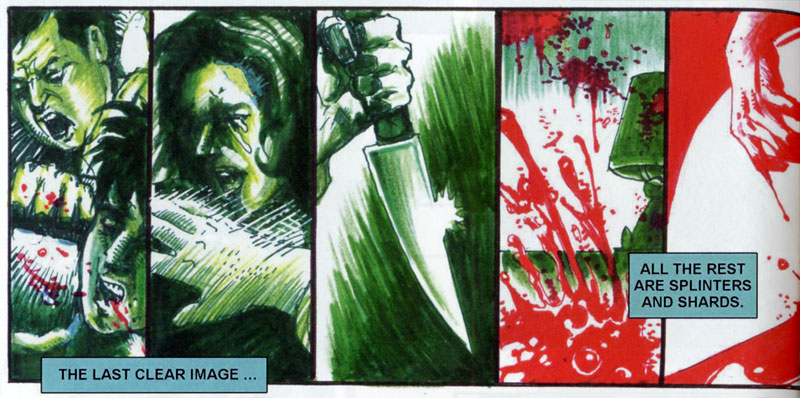 Katumbas, also by Hontiveros, is closer to fantasy-inspired superhero adventure of the Buffy or Trese kind. The story about a supernaturally empowered warrior battling demons and spirits is intriguing but feels incomplete as an episode of an ongoing series. The art supplied by Ian Sta. Maria is the slickest, most detailed, and most likely to appeal to mainstream tastes. But I need a bit more out of the narrative before I'm willing to commit.
 Speaking of Trese, The Clinic, by Trese co-creators Budjette Tan and Kajo Baldisimo is itself a shout out to one of their earlier stories. As the subject matter is about a supernaturally run clinic that performs illegal abortions (abortion is illegal in the Philippines) and collects the infant souls, this is no doubt the most unsettling and unpleasant story in the book.


 |
| Wizard Magazine |
For all the comic book philosophy of the superhero as the next stage of human evolution (really just a mutant iteration of the old "Fans are Slans" riff) creatively they've hit a dead end, save for the occasional irruption. The superhero genre may not be the Titanic, no icebergs in sight, but everyone's still just rearranging deck chairs now. That's how the companies want it, because they're no longer marketing creations. They're peddling brands. Branding is everything now, and it's almost always more profitable to cash in on a long-established brand than to create, develop and market a new one. The superhero as brand name might be with us until the end of time, now, but the superhero as expression of genuine creativity is pretty much dead.
On the one hand, you might argue I guess that Steven's tendency not to see the super-heroes all around him is of a piece with the status quo among the big two; that is, if they could only start to think about super-hero stories in different ways, maybe they wouldn't be so perpetually shitty. Perhaps they could finally start telling stories somebody cared about, and maybe even come up with some new heroes that were different from the old heroes in ways which would allow them to appeal to a broader audience.
But really, I think that's too harsh on Steven and not sufficiently harsh on DC and Marvel. The truth is, DC and Marvel seem pretty thoroughly irredeemable. Steven was right; they're creatively D.O.A. They're going nowhere and changing nothing, and the chances of either of them ever coming up with an exciting, marketable new concepts is roughly the same as the chances of a monkey crawling out of my butt and handing me a power ring. So, yeah, I think it's important to recognize that super-heroes are still popular, but not because doing so will help DC and Marvel. On the contrary, I think it's important because, until you realize that super-heroes are doing just fine, you can't really understand how truly lame Marvel and DC are.
Who says the Japanese don't do superhero comics? It surprises me how many manga, like X and SILENT MOBIUS, are thinly disguised superhero comics, and so is BASILISK, which glories in the simple plot of two Shogunate-era ninja clans whose chief members are all blessed with bizarre and idiosyncratic "techniques" (read: "superpowers) fight each other to the death for not much more reason than they're told to. Toss in heavy doses of sex/nudity, violence and weepy soul-searching, and voila! The best X-MEN story ever. And that's not a complaint; with its uncomplicated storytelling and extreme character explorations, it's growing on me.


 A weakness of the first two volumes of Budjette Tan and Kajo Baldisimo's popular series Trese was the lack of any particularly clear direction in the comic. Sure the confluence of traditional Filipino legends with modern urban settings might sound clever at first. But despite the Filipino setting, Trese conceptually and visually still stuck a little too close to its Hollywood and mainstream roots to feel original. Its creators seemed to be randomly tossing ideas left and right from zombies to drag racing tikbalang to test what worked. And the character designs were a bit empty and cliched: Whether it was the wisecracking sidekicks the Kambal or the unflappable hero Alexandra Trese (This became something of a personal pet peeve: Who the f#@k wears a dark trench coat in Manila?) There was energy and potential, but for the most part the stories felt a little erratic.
 And the choreographing of action scenes has become a lot more dynamic and economical:
 All of this is a good start for a healthy run. Whether Trese becomes the Pinoy equivalent of Hellboy or just another also-ran will depend on how well its co-creators can build on the work found inside this volume.
 |
| Anime adaptation of the Lucky Star yonkoma |
The big problem in Japan is that the bubble in the industry has definitely burst for both anime and manga. I think it's probably worse than many of the official statistics reveal. I was in Tokyo in May - and I go to Tokyo every year to watch trends - and the thing that drove the point home to me is that on the train, almost no one is reading manga. That's a huge, huge change from ten years ago, huge. On top of that, you have a new era in Japan where there's a declining population of young people, which is still the main readership and market for manga and anime. So publishers and producers of shows are confronting this very stark reality that fewer people are buying their products, and there are fewer people to buy their products. It's not only that they are buying less, but that there are fewer people to buy them! So no one knows what's going to happen yet.Which is reinforced by Jason Thompson:
But for all their cultural clout, weekly manga, like newspaper strips and network television, is a fading medium. Except for Weekly Comic Bunch (which skews towards an aging readership anyway), all the existing weekly magazines in Japan are at least 20 years old; recent attempts like Comic Gumbo have been failures. Publishing a weekly manga magazine requires tremendous resources, and with the fragmentation of media, perhaps the generalist audience required to sustain these massive magazines is dwindling. Oddly, there are no weekly shojo manga magazines (although there are several biweekly ones), possibly a sign of shojo's smaller economic footprint; a few weekly shojo magazines were published in the 1960s but never caught on.But on the other hand, this benefits yonkoma in much the same way that many American webcomics are gag strips that take advantage of the internet:
Yonkoma manga is easy to make, easy to read, and—surprisingly considering its low profile in the U.S.—very successful. While other manga magazines' circulations dwindle, yonkoma manga is the fastest growing area of the manga industry. Four-panel series such as Lucky Star are increasingly being adapted into animation and merchandise. There are many magazines devoted solely to four-panel manga. Online and cellphone manga is overwhelmingly four-panel-oriented, as it's the easiest type of manga to read on mobile devices, and some yonkoma webcomics, such as Hidekaz Himaruya's Hetalia Axis Powers, have even become hits and made it into the big time.
 |
| Anime adaptation of the Minami-ke yonkoma |

Over the past few years I've noticed smarter critical commentary on the Net, but it's scattered all over the place, buried in the usual mountain of frivolous, tepid, dimwitted, unreadable fanboy drivel. There's no single website you can visit and anticipate a range of interesting sensibilities on an equal footing, so one of my goals is to distill the best criticism and journalism we can into a single site. - Gary Groth
It's no secret that newspapers and magazines are suffering because so much of what they've traditionally done can be done on the web, faster and cheaper. We decided therefore to redesign the editorial and physical format of the magazine to take advantage of what print's best at -- upscale production values, longer prose, more permanent content -- and bring the Journal's mandate for criticism and commentary to the web with a vengeance. - Gary Groth
If the magazine's arrogance, whether a clever marketing ploy or come by honestly, wasn't much appreciated by publishers or talent, and often not even by most fans, it was the right approach, making THE COMICS JOURNAL indispensible reading for several years, and a bracing antidote to the sycophancy that by then increasingly earmarked other publications. Virtually nobody claimed to like the Journal, but virtually everyone read it.- Steven Grant
Among its reviewers the Journal has a contingent of solid, trust-worthy writers: Kent Worcester, Rich Kreiner, Shaenon Garrity, and Kristian Williams, but they tend to get drowned out by crankier and less-informed critics, writers who mistake abrasiveness for insight. The magazine’s review section does seem too diffuse and scattershot. I’m never quite sure why some books get reviewed and others don’t. There’s a lot of good critics on the web now – Rob Clough comes to mind right way. The most promising prospect for the next incarnation of the Journal is to recruit these writers (I know Clough has already signed on). - Jeet Heer
For me, I've been happiest with the Journal when it pursued other visions — Tom Crippen working out why super-heroes matter and why they don't, for example, or Dirk's marvelous shojo issue. The larger, bi-annual approach seems like an opportunity to go further down that road...I'd love, for example, to see what Kristy Valenti or Bill Randall would do if given carte blanche with an issue. Gary will always be the Journal, in some sense, but one of the things he's done right over the years, in my view, is to have the courage and the generosity to let other folks pursue their own idiosyncratic ideas and interests with his ink and his press. - Noah Berlatsky
Everything will be free. We’ll maintain an archival copy of the current website for our online subscribers — more on that soon, I promise — but the new site will have no “subscriber area” or special features that need a password to access - Dirk Deppey
 On the surface the Philippines retains a prudish attitude towards sex and public depictions of nudity. What this inevitably does is drive sexually-charged content behind its conservative facade. Since the 60s sexually oriented entertainment was labeled as "bomba" , and bomba komiks were sold on the sly. The Martial Law years initially saw a strict clampdown of the bomba genre, but this only led to a later resurgence of sexually oriented material now renamed "bold". But the bold movie genre continually faces pressure from the government body responsible for rating film and television, the Movie and Television Review and Classification Board (MTRCB), which oscillates between periods of prudery and leniency, depending on who's in charge of the agency and the presidential administration. They also have to deal with attacks from religious organizations who condemn them as immoral, particularly the powerful Catholic Church, and feminist groups criticizing the exploitative nature of many of these films.
"I think it's high time that people realize that comics has grown up in the last 20 years. People are making comics for adults now. Oh yeah, that's right. Comics are no longer just for kids, and to us in the comics industry, this is old news. This comic book is not for immature reading. That goes for children and adults with immature sensibilities.I personally think it's a bit embarrassing that this even has to be said at all.
The emotional and intellectual well being of children are the responsibility of the parents. It is their job to teach their children what they believe is wrong and what is right. That is not my job. My job is to write and draw stories, and to let myself go where that creativity takes me. That is my job as an artist. That is my reason for being. Do not pass that responsibility of raising your children to me, and to us artists as a whole..."


 |
| Syeri Baet, Jonas Diego, Gerry Alanguilan auctioning off an ELMER slipcase |
 |
| John A. Lent |


 |
| El Indio Booth |
 |
| Jun Lofamia and Danny Acuña |
 |
| Mangaholix booth |
 |
| Loop by Camille N. |


