

10/28/2008
10/27/2008
Film Nostalgia
My move from film-based to digital photography was not a pain-free one. Of course this would be true for any experienced photographer. Film and digital are different mediums. While they share some similarities, and in theory accomplish basically the same thing inside a camera body, their respective behaviors are different enough that the photographer has to learn a new set of rules for exposure and image processing. And then there's the need to become acquainted with digital technology itself, from PCs to RAW Image software. I'm no luddite, and I've been using PCs since forever. But trying to master digital photography forced me to learn more about how to use Adobe Photoshop than all the time spent dicking around with it in art school.
 After four years trying to figure this all out, I'm not convinced my digital photos are any better than my film-based photos. Part of the reason for this is that my transition to digital also marked a move into color photography. Up to that time, more than ninety percent of my photographs were taken with black and white film. I didn't have a lot of interest in shooting in color. But with the purchase of my first DSLR, I felt the time was right to dive into color photography. It was an opportunity to grow. I don't think I'm quite as accomplished with color as I am with black and white, and I've recently found myself missing the peculiar tonal qualities of Tri-X, HP5, and Neopan 1600.
None of this should be taken as sign to return to film, but as an indication of how much I still have to learn. I've recently updated all of my digital equipment, except for my computer, which makes working with 12 megapixel images something of a problem. Images shot since October on my photoblog are all on the new body. I'll be shooting digital for the foreseeable future.
What seems to have prompted my sudden desire to do a bit of film shooting were online discussions of a retro DSLR. I don't expect this to be manufactured anytime soon, but what I really want is a nice retro film body - one that doesn't require batteries to operate. I regret never purchasing the Nikon FM2 or FM3 when they were still being produced, and would love to acquire either one of these bodies as backup for occasional film shooting.
I have this sketchpad in my room which is still relatively brand new as I haven't touched it in over a year. Where did my motivation go?
That's enough personal digression for now.


10/24/2008

10/21/2008
Laika

Laika's story is the perfect hook to get children to read more about history. It's also an incredibly obvious example of how animals are often sacrificial offerings to the greater glory of man. The man in this case is Sergei Pavlovich Korolev - leader of the Soviet Union's space program. The book opens with him just released from the Gulag in the dead of winter. With no food and shelter, he keeps motivating himself to stay alive by repeating "I am a man of destiny. I will not die." Korolev's subsequent success in building the USSR's space program confirm his personal self-belief. But these also generate unrealistic higher expectations, which inexorably lead to him developing the project that would top all others - launching the world's first living space explorer.

While the repressive nature of the Soviet Union is alluded to, author Nick Abadzis concentrates on the personal rather than the political or scientific. As the dogs in the program were strays, there's no way to know the details of Kudryavka's (Laika's original name) background. So Abadzis fashions a fictional story full of the usual cliches about abandoned puppies, abusive masters, and sadistic dog catchers. It's clearly there to evoke compassion for the protagonist. But once she falls into the ownership of the government's space program, the story markedly improves. Several new characters take center stage: Oleg Georgivitch Gazenko, the person in charge of animal training, and his assistant Yelena Alexandrovna Dubrovsky. Both Oleg's personal dislike and resentment towards the overbearing Korolev, and Yelena's empathy towards her animal charges express doubt about the program's methods, and give voice to the otherwise mute test subjects. The stress caused by working on the project is further ramped up by the unspoken romantic tension between the two. In contrast Korolev, historically the most important figure, is comparatively less well developed.

Abadzis draws in a shorthand which, depending on readers tastes, is either somewhat incomplete and lacking, or refreshingly spontaneous. He has a tendency to cram as many panels as possible into the pages, especially during the talkative parts. This unfortunately can cramp his artwork, but when Abadzis opens-up the panels, the results can be extremely beautiful.
Laika is a work that wears its heart on its sleeve. It's not difficult to see where the author's sympathy lies. This could easily have wallowed in cheap sentimentality. But the historical realism of the setting, and the compelling characters of the second half of the story manage to keep the story grounded.
10/17/2008

10/15/2008
There's Nothing New

Superman getting smacked complements Superman is a dick and Crying Superman - A long-standing pattern of super-heroic self-mockery. This could be seen as a variation of The Worf Effect.
10/05/2008
Kerry Edwards Wants Your Vote

...And he's not afraid to tell you what he really thinks about you.
From Overcompensating by Jeffrey Rowland.
10/01/2008
Farewell Minx

While the closure of the Minx line doesn't come as any surprise (Given DC's dismal track record for developing alternate publishing imprints) it's still a great shame that the end came a mere 18 months since it's launch. Minx was created to establish a niche within the expanding market for younger female readers found in bookstores. Despite the somewhat reactionary overtones in editor Shelly Bond's statements, it made perfect sense for a prominent publisher to make an effort to pursue this very important demographic so as not to get left behind. It was a significant sign that DC was sincerely looking beyond their aging direct market audience of largely adult males.
 There's been a lot of online commentary about why Minx failed. In the end, the Minx books, despite some favorable reviews, never gained much momentum, nor generated much enthusiasm with the intended audience. In hindsight DC didn't seem to have a firm enough grasp of the market, and didn't publish books that would draw in a large enough readership, to recoup their enormous marketing costs. Minx could arguably still prove to be a success if DC is willing to stick with the process of nurturing the imprint with a more modest budget while paying closer attention to the tastes of their readers. Publishing more talent with a proven track record for attracting female readers wouldn't hurt either. But they've chosen to pull the plug instead, thus ending the company's most high profile attempt to reach past the traditional comic book audience.
For more on the end of Minx, check out Tom Spurgeon and Christopher Butcher.
9/09/2008

9/06/2008
Black Lagoon Vol 1

Japanese salaryman Rokuro Okajima gets kidnapped by a group of mercenaries piloting a modified PT boat called the Black Lagoon while transporting a disc containing sensitive information for his employers across the South Pacific. But he joins his kidnappers after learning that his company has left him for dead in order to retrieve the disc. He proves invaluable in getting the Lagoon crew out of a very tight spot, and receives the affectionate moniker "Rock."
The rest of the Black Lagoon crew is composed of the burly African American captain Dutch, the boat's mechanic and former university student from Florida named Benny, and the book's cover girl Revy - A sadistic Chinese American killer who functions as the crew's muscle as well as the reader's primary eye candy by sporting a form fitting tank top and cutoff jean shorts in all the fight scenes. As the team's resident hothead and most vocal cynic, she serves as a foil to Rock's basically decent behavior and level headed approach to any situation. Many non-action scenes involve Rock and Revy sparring verbally over ethical conundrums that arise during the Lagoon Company missions.
With the series having been set up, most of the rest of the volume concentrates on the Lagoon crew transporting the scion of a wealthy South American family while being pursued by Roberta - a seemingly unstoppable ex-FARC guerilla dressed as a bespectacled maid while carrying an umbrella machine gun and a suitcase full of weapons. It's a wacky concept that liberally borrows from El Mariachi and The Terminator, mixed with Japanese fetish. It shouldn't come as any surprise who she gratuitously dukes it out with at the end of the book.
Despite the potential for outrageous action found in these ideas, The action scenes are not particularly well executed. Ren Hiroe draws dynamic enough figures, but he obscures them with way too many awkwardly framed shots and flashy speed lines. The scenes are cut to make it difficult to follow the panel to panel continuity or to locate the characters relative location to one other. The backgrounds, when he bothers to draw them, tend to be pretty generic, which is unfortunate since the exotic setting should be part of the appeal of this series. After all the Lagoon crew gets to zip around South East Asia and interact with an ethnically diverse local population. It would be nice if Hiroe showed a little more interest in capturing the local milieu.
8/23/2008
Honey and Clover Vol 1-2

Honey and Clover sticks out amongst the various shojo manga translated into English. Creator Chica Umino draws in a scratchy pen and ink style, restrained in use of screentones and other effects, with minimal backgrounds. It almost like reading a sequentially arranged sketchbook. Most pages deviate wildly from the 4 panel or 6 panel grid - Umino can't seem to draw a normal square panel, as most are either tilted, warped, overlapping, or sent bleeding of the page. Sometimes they can seem overcrowded with many little word balloons and captions. This can look like it might be rather confusing, but fortunately the story isn't particularly difficult to follow. The characters themselves are appealingly cartoony and have an appearance of almost childlike innocence. The whole manga feels like it's set in a dreamlike world, seen through the eyes of an adult looking back on his naive youth. If there's any weakness to Umino's character design, it's that at times they appear to be a little too flat and simplified to stand out from the background.
Set in a Tokyo art school, the reader is introduced to the cast through the point of view character Yūta Takemoto, a second year student. The comic's episodic structure focuses on Yūta's peer group, and the one professor who manages to get dragged along to their various excursions. The comedy is derived from how they deal with the typical worries over money (They're impoverished college kids after all), getting enough protein to eat, partying, getting drunk, dealing with the holiday blues, working on assignments, passing courses, graduating, getting a job after graduation, and falling in love. It's all mundane slice-of-life material. But while the early humor never disappears, the tone of the story becomes increasingly bittersweet as the focus gradually turns more to the love lives of the cast. By the end of the 2nd volume, the two main love triangles are established, which presumably will dominate the proceedings of the rest of the series.
Both love triangles feature insecure males being drawn to emotionally traumatized females. On the one hand we have nice guy Yūta and talented jerkass Shinobu Morita falling for moe figure Hagu Hanamoto. Some readers are no doubt going to find their attraction to Hagu somewhat disturbing, as this 18 year old looks like someone ten years younger. She even behaves in an infantile way, playing with dolls, talking in simple phrases, walking around with a constantly distracted expression. But this combination of youthful appearance and prodigious talent has isolated her from the rest of her peers, which isn't helped by the overprotectiveness of her guardian, professor Shūji Hanamoto. While Yūta lacks the self-confidence to express his love directly, Shinobu expresses his by simultaneously bullying her into modeling for him while trying to outdo her as an artistic rival.

There are some other threads like Yūta's uneasy relationship with his stepfather, or Shinobu's unexplained absences. It's clear that he's involved in a scheme that's unrelated to the rest of the cast. But the interactions of the students are the central concern of the story. For all the youthfulness of that cast, the overall mood is one of nostalgic longing. Towards the end of vol. 2 Hagu goes out looking for a four-leaf clover. She is joined by Yūta, and eventually the rest of the gang. After an afternoon of fruitless searching, they settle down for a meal with professor Hanamoto. As they eat Yūta looks at the faces of his friends and thinks "I know the day will come...when all of this is past, and it all becomes a memory. But I know I'll remember it, over and over...That blue sky and the smell of the wind and the endless carpet of clover."
Ah, was I ever that ruminative?
8/03/2008
Some Thoughts on The Dark Knight
 |
| Heath Ledger as The Joker |
Anton Furst's highly stylized set designs for the Tim Burton Batman films have become so influential that it's something of a shock to see a real city skyline stand in for the fictional Gotham. The Spider-Man franchise was shot in the actual New York City, and that reflects the Marvel Comics approach of setting their characters in real cities. But DC's many fictional metropolises are fantasy fun-houses of adventure that mirror the personas of its super-hero residents. In The Dark Knight, Gotham is shot as a gritty decaying urban environment exuding gloomy elegance. Its muted realism eschews the gothic surrealism of most current comic book interpretations of the city.
Some reviewers, like Douglas Wolk writing for Salon, have criticized this version of Batman for not being brilliant enough. He's supposed to be fiendishly clever - The world's greatest detective and the most dangerous man in the world. Instead this Bruce Wayne/Batman (Played by Christian Bale) depends heavily on Lucius Fox to supply him with technological solutions to various problems, like James Bond does with Q. I find myself not particularly concerned about this issue. Batman's super-proficiency is a necessary compensating trait when working with the much more powerful teammates of the Justice League, and it's what keeps him a viable denizen of the DC Universe after more than sixty years. But I like my heroes (Like the relatively inexperienced character in Batman Year One) expressing some vulnerability. And this version of the DC franchise doesn't have to worry about taking down a rogue Superman, yet.
7/27/2008


7/14/2008
Manga's Future
I’m not sure that manga readers here are really manga readers and I would even go so far as to say that they’re not even comics readers. There’s a love for the medium, but only within the shojo or shonen genre. They love the anime, and honestly, while I was watching the Le Chevalier D’eon anime, I couldn’t help but thinking “this is cartoons. It’s for kids.”
- Kai-Ming Cha
I am outright terrified that the North American manga publishing industry is going to turn into a mirror of the superhero publishing industry; comprised of adult fans clamouring for vaguely more mature versions of children’s material, operating in a two-company system, growing steadily more insular and inaccessible to the world at large. I don’t think it has to happen, of course, and I’d like to think I’ve discussed a few of the ways in which it won’t, but there’re my fears. Hopefully they’re never realized.
- Christopher Butcher

His second point is also equally obvious - People's tastes change over time. The young readers who enjoy Naruto or Fruits Basket now are not necessarily going to like them when they become adults. This is one reason behind the arguments for a more diverse market: A wider selection of genres and styles attract a greater demographic range. However Kai overstates his case when he worries that the present generation of readers will outgrow manga, leaving only the next batch of incoming readers to take their place. How is the market's youthful bias different from other forms of entertainment? Most film and television is aimed at the lowest common denominator, so it doesn't surprise me that manga publishers market fantasies to a largely young audience. I don't see that changing in the foreseeable future. But one shouldn't underestimate the crossover appeal of some youth-targeted popular entertainment. So to me it's not at all a clear-cut case of manga readers only coming from a certain a juvenile age group.

Looking at it from a wider perspective, manga is here to stay. Other countries have been exposed to manga and anime before the English-speaking world caught on, and even if the worst case scenario happens and Japanese comics market collapsed in America, it would continue to thrive elsewhere. Like it or not, manga is at the center of the comics world.
7/13/2008

7/12/2008
Glamourpuss #1

"...I want to do photorealism pictures of pretty girls, so that's I'm going to do. The words were an aterthought. Okay, let's stick with that. " - Dave Sim

It's a curious project to say the least. Dave Sim is an accomplished comics artist - some would argue he's one of the industry's greatest living practitioners. So it's hard to ignore his retro choice of art style to impersonate from. The results are at first glance, very convincing. Sim uses as his reference various unnamed fashion magazine photos, which he draws in the photorealist manner. He also takes panels from the Rip Kirby comic strip out of their original context, redraws them, then juxtaposes them along with his fashion illustrations. Needless to say, the continuity between the pictures is nowhere near as seamless as in a more conventionally constructed comic. But then again Sim seems less interested in telling a story for story's sake than in educating the reader about a bit of comics history. His self-crticism reaches maniacal levels as he attempts to guess what lines to leave in, how to depict certain textures with a brush, or what areas to interpret as pure black.
The centerpiece of the book is a six page sequence entitled The Self-education of N'atashae. It's composed of a series of full page drawings of one fashion model, linked by heavy-handed narration detailing her thoughts and misguided attempts to achieve spiritual enlightenment. Sim is attempting to simultaneously do several things: He's trying to demonstrate the immense difficulty of constructing a story from disparate sources; Provide a kind of secret origin story for the comic; And he's poking fun at the vacuousness of the fashion industry as well as the shallowness of materialistic western consumer culture. Sim just can't help being didactic.

Glamourpuss is basically a hybrid product - Part black and white comic pamphlet, part illusrated essay, and part fashion magazine parody. Digressions about craft are interrupted by spoof articles and fake ads. While the shop talk will be of interest to history buffs and aspiring artists, the attempts at humor produce mixed results. Dim looking fashion models make an easy target, but Sim's jokes are a heavy blunt weapon he ungainly wields to make his point. One article titled Skanko's Dating Guide might remind people of Sim's past controversial statements.
It's not clear where all of this is headed. While the fashion drawings are beautifully rendered, they also reveal the underlying homogeneity of the source material. There's something cumulatively oppressive about the overall tone of the work that probably arises from the disjointed panels and text's attempts to impress its lessons on the reader. Sim's parody gets a bit tiresome by the end of the issue, but he intends to continue Glamourpuss for more that 20 issues. What more does he have to say? Then again, Dave Sim is the man who delivered on his promise that Cerebus would die, alone, unmourned and unloved after 300 issues. So I wouldn't be surprised if he has a master plan that will gradually reveal itself as the series unfolds.


6/29/2008
Larry Gonick Has a Blog

From Raw Materials by Larry Gonick for the Discovery Channel website. I enjoyed his past strips for Discover Magazine. I'd like to see those compiled.
6/22/2008
Poster Design: Explore. Just Protect Yourself
Two posters illustrated by DC cover artist James Jean for a European NGO. I doubt I'll ever see these plastered around Brisbane or Manila. Link by Mark Frauenfelder.

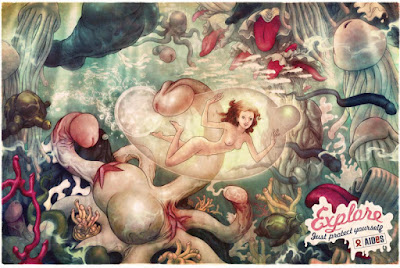
Update:
James Jean explains the creative process involved in the creation of these poster designs in his blog.


Update:
James Jean explains the creative process involved in the creation of these poster designs in his blog.

Subscribe to:
Posts (Atom)