
9/25/2010
9/23/2010


9/21/2010
Reviving our Industry
 |
| Image from Wikipilipinas |
1) Creating financial incentives to help efforts of komiks creators might sound like a good idea in general, but some of the language of the bills strikes me as a tad old-fashioned. From the later Senate bill:
Komiks has been the champion of the masses: political, sociological, and financial issues; the mirror of the country's times: dreams and disillusions, passions, and fashions; cultural anchor: a gentle reminder of our heritage and values; and a teacher as it contributes to the propagation of the Pilipino language in a country of more than 70 languages, thereby strengthening the Filipino race and the national language.
Sadly, with the advent of computer games, compact discs, digital video discs, and the internet, the local komiks industry suffered. Moreover, the best illustrators in the local komiks industry have been lured by the high pay they received in the United States. Thus, the joy of reading komiks has been set aside and, as a consequence, results in the twin evils of diminishing readership and illiteracy.
There's a bit of nostalgia for those good old days when komiks was a major publishing venture, mixed with economic protectionism, and a bit of nationalist boosterism for good measure. But nothing in the bill shows any forward thinking about how to respond to comics increased internet presence, its growth as a digital medium, the massive popularity of manga, or the protection of free speech and artistic expression. When looked in the context of the anti-child pornography bill passed last year, there's not a lot in the bill to prevent at least some komiks from being used as a form of government propaganda.
2) The mandating that 10% of printed educational material be komiks dredges up personal memories of attending elementary school religion classes: Komiks were a regular part, actually a big part, of moral and spiritual instruction. I don't know if that was a quirk of the particular school I attended, and in truth I remember next to nothing about the content of the stories. It's been awhile since I've been to a Filipino school. But I think they made more of an impression (both bad and good) than the regular textbooks. This was a private school, and most private schools are still religious in their affiliation.
3) Komiks was no more recognized as a legitimate artform during its heyday by the general public than when Jack Kirby was toiling away at Marvel Comics at the height of his professional career. Komiks continues to be a marginal presence, often obscured by the current influx of American and Japanese imports. And those foreign products in themselves aren't usually treated as legitimate artistic works. It's understandable if people act a little defensively about komiks vis-a-vis other comics traditions. But if komiks wants to be recognized as a worthy artistic medium, there needs to be some maturation within local fandom itself in their overall perception of the comics medium.
4) Given the heavy-handed, values-laden rhetoric that characterizes Filipino politics, I'm not sure I want the government too involved with my beloved medium. While I like the idea of tax breaks and other financial incentives, I'm concerned about the censorship that inevitably follows when local politicians become interested in mass media (Such as in the Filipino film industry, which the bill mentions as a sterling example of effective government support. Komiks has also had its own version of the Comics Code Authority). It's a dilemma that Filipino creators are going to be concerned about.


9/17/2010

9/12/2010
The Arrival
 To begin on a personal note, I'm surprised that I didn't read The Arrival when it first came out, considering how celebrated a figure Shaun Tan is in Australia. I do remember making a perfunctory search for his works at a few Brisbane comic book stores before losing interest. Shows how much I know. In retrospect, Tan's book now seems almost a timely response to the wave of xenophobia then sweeping the country. This is far from a polemical work. Rather, Tan chooses to address the history of modern diasporas in broadly universal terms.
Shaun Tan came to the comics medium from the completely different tradition of children's book illustration. So he was a virtual unknown to most comic book fans despite significant mainstream recognition, especially in his home country of Australia. It also may not have helped with certain segments of comics fandom that the children's book illustrator's approach to narrative art emphasizes divergent aesthetic qualities from most comic book art. Tan's use of graphite to draw photorealistic images, reminiscent of Chris Van Allsburg, is unusual for comics. But such lavish rendering is not atypical in children's picture books.

One consequence of Tan's illustrative style is that it prevents him from utilizing many of the narrative conventions and iconography found in comics. But I suspect that Tan is either too unlearned or uninterested in those techniques to have taken full advantage of them anyway. Instead, Tan employs the virtuosity of his art to draw sepia-toned images that are strongly suggestive of old passports and faded photos of immigrants coming to the New World. This creates an impression that one is looking into someone's past. But the art also has a sensuous quality, not just as a found object, but also within the images themselves. At the story's beginning various household objects are seen in isolation through a series of small panels before the view pulls back to reveal a family of three packing them into a suitcase. The quiet poignancy of the domestic scene is cut short when the trio steps outside into city streets full of crumbling tenement buildings being menaced by enormous, dragon-like coils. These objects have a powerful literal presence within the panels. But both the coils and buildings simultaneously work as metaphors for the dire conditions that are forcing the family to flee to a better place. The surreal imagery works to a great extent because of Tan's detailed artwork.
The father's exodus grows increasingly fantastical. The first part of this book heavily references contemporary photos of immigrants traveling to and being processed at Ellis Island: from the cramped conditions of ships steerage; the New York style skyline; and the bureaucratic nightmare immigrants experienced when being processed by the government. But the promised land they finally enter looks like a combination of a 20th century metropolis, an abstract expressionist landscape, and a child's play-land, with a hint of Jim Woodring's "The Unifactor". Elevators and mailboxes are carried by balloons, birds look like origami fold-outs, people commute on flying boats, and family pets all look like eccentric cartoon animals. This is a wondrous and somewhat frightening utopia where people from other parts of the world have fled from tyranny, slavery, and war - truly a "New World".

While Tan's page layouts and panel compositions are conventional, he has an intuitive grasp of comics-style pacing. Small square panels portraying little details and nondescript actions carry the reader along until the view expands with the use of page spreads to include a larger tableaux. The uniform simplicity of his panel arrangements and the photorealism of his art are sometimes reminiscent of cinematic storyboards and the sequences of Eadweard Muybridge. I particularly liked how the characters communicate through subtle movements and small gestures instead of more typical over-the-top posturing. His narrative is assured, controlled, and easily accessible to the mainstream reader.

I mentioned at the beginning that The Arrival almost seems like a response to the widespread anti-immigrant sentiment of the time. However, Tan neither directly addresses the casual or institutionalized racism that immigrants experience in reality. The story is primarily an aspirational tale, and the overall mood is one of hope. Needless to say, this is one that mitigates some of the negative consequences of personal displacement. There is no fear and hate in the New World. There is just some culture shock, temporary unemployment, and the drudgery of working in menial factory-based assembly line production. This makes the story less than totally convincing to adult readers. Some will probably find it a naive fantasy. But in choosing to concentrate on the personal rather than the political, Tan focuses on the transformative nature of the immigrant experience - Every person is in search for something better for themselves and their loved ones. Is it wrong to want that? Conveying this message to today's younger audience may actually be a better answer than writing a more vitriolic work. Maybe...

9/03/2010

Draw Muhammed Day
 |
| Go to: Muhammad Ali, The Champ by Michael Gaffney Muhammad Ali at Angelo Dundee's, Fifth Street Gym, Miami, FL More photos at Proud |
9/01/2010
Batman feels...
 |
| By Nate Bellegarde Go to: Theme Sketchbook: Batman Getting Hit in the Balls from Justin Stewart |
8/30/2010
Invincible #72
By Robert Kirkman, Ryan Ottley, Cliff Rathburn, FCO Plascencia, Rus Wooton
Tech Jacket backup story by Robert Kirkman, Audrey Sitterson, E.J. Su, Ron Riley, Rus Wooton
My futile attempts to keep up with the world of serial comic books continues. As you can see, I'm still way behind.
 Invincible is one of the more successful ongoing endevours to fashion something resembling a shared universe through the efforts of a single creator. Technically, Invincible belongs to the Image Universe. But no one's taken that idea seriously since the publisher's own muddled attempts in the early nineteen nineties left much of the Direct Market in shambles. Like those cantankerous Image founders, creator Robert Kirkman treats his comics creations like an autonomous fiefdom. Admittedly, his spin-off serials haven't fared as well. But within the pages of Invincible, he has managed to assemble a large cast of supporting characters that both pay homage and poke gentle fun at DC and Marvel's properties, while serving as a backdrop for the teen melodrama that is Mark Grayson's (a.k.a. Invincible) life.
Invincible is structured as a series of arcs that tracks Mark's growth as a superhero that starts out reminiscent of Marvel's early Spider-Man. And like a few Marvel comics from the seventies, there are numerous plot threads being advanced at any time. But the one that has propelled Invincible for most of its history is Mark's conflict with his father Nolan and the Viltrumite Empire. His showdowns with increasingly dangerous Viltrumite foes have pushed the overall tenor of the series towards the apocalyptic, making Mark more comfortable with using extreme measures in order to protect his family and loved ones. Mind you, this isn't the most subtle character development - Kirkman's dialogue tends to be a bit stiff and his characters are usually declaring their thoughts and intents for the benefit of the reader. But that to has its own retro charm, I guess.
As villains go, it's hard to beat an interplanetary-level threat like a race of bloodthirsty, world-conquering supermen given that only one is needed to crush all of Earth's armies. This also gives Kirkman an excuse to indulge in some extraordinarily brutal super-powered brawls. Since this is an Image Comics title, the blood flows more freely and doesn't shy away from depicting grisly disemboweling scenes. The series clearly shifted into higher gear when Nolan (a.k.a. Omni-Man) murdered the members of the Guardians of the Globe; then fought Mark to within an inch of his life. Mark's most involved battle so far was an epic multi-issue affair with the virtually unstoppable Viltrumite warrior Conquest - which left Mark, his half-brother Oliver, and his girlfriend Atom Eve badly hurt.

Issue 72 is the second part of the latest story arc The Viltrumite War. Kirkman organizes his stories so that the more exposition-heavy issues set up the proceeding action-oriented issues. In this case, Mark's reconciliation with Nolan in Issue 71 and preparations to take the fight to the Viltrumite Empire are interrupted by a sudden appearance of a small force led by Conquest himself. What follows in 72 is pure mayhem, dominated by Mark's rematch with Conquest.* it would be difficult, to say the least, to top that first fight. And yet Kirkman manages to do just that in one issue by upping the stakes and increasing the gross factor.
The rest of the creative team has settled-in into illustrating Kirkman's scripts. Since taking-over the pencilling duties from co-creator Cory Walker, Ryan Ottley has pretty much become the Invincible artist - his slightly exaggerated style imbues the characters with a certain muscular grace. And while this issue isn't the best example of the work of colorist FCO Plascencia, every drop of blood and gut spilled is rendered in loving detail - with bright reds and oranges.
Invincible is as solidly professional a comic to come out of the Direct Market, just as long as the reader doesn't mind getting a little queasy.
___
* Tech Jacket, another Kirkman creation, appears as a supporting character, and in a forgettable backup story.
Tech Jacket backup story by Robert Kirkman, Audrey Sitterson, E.J. Su, Ron Riley, Rus Wooton
My futile attempts to keep up with the world of serial comic books continues. As you can see, I'm still way behind.

Invincible is structured as a series of arcs that tracks Mark's growth as a superhero that starts out reminiscent of Marvel's early Spider-Man. And like a few Marvel comics from the seventies, there are numerous plot threads being advanced at any time. But the one that has propelled Invincible for most of its history is Mark's conflict with his father Nolan and the Viltrumite Empire. His showdowns with increasingly dangerous Viltrumite foes have pushed the overall tenor of the series towards the apocalyptic, making Mark more comfortable with using extreme measures in order to protect his family and loved ones. Mind you, this isn't the most subtle character development - Kirkman's dialogue tends to be a bit stiff and his characters are usually declaring their thoughts and intents for the benefit of the reader. But that to has its own retro charm, I guess.
As villains go, it's hard to beat an interplanetary-level threat like a race of bloodthirsty, world-conquering supermen given that only one is needed to crush all of Earth's armies. This also gives Kirkman an excuse to indulge in some extraordinarily brutal super-powered brawls. Since this is an Image Comics title, the blood flows more freely and doesn't shy away from depicting grisly disemboweling scenes. The series clearly shifted into higher gear when Nolan (a.k.a. Omni-Man) murdered the members of the Guardians of the Globe; then fought Mark to within an inch of his life. Mark's most involved battle so far was an epic multi-issue affair with the virtually unstoppable Viltrumite warrior Conquest - which left Mark, his half-brother Oliver, and his girlfriend Atom Eve badly hurt.
Issue 72 is the second part of the latest story arc The Viltrumite War. Kirkman organizes his stories so that the more exposition-heavy issues set up the proceeding action-oriented issues. In this case, Mark's reconciliation with Nolan in Issue 71 and preparations to take the fight to the Viltrumite Empire are interrupted by a sudden appearance of a small force led by Conquest himself. What follows in 72 is pure mayhem, dominated by Mark's rematch with Conquest.* it would be difficult, to say the least, to top that first fight. And yet Kirkman manages to do just that in one issue by upping the stakes and increasing the gross factor.
The rest of the creative team has settled-in into illustrating Kirkman's scripts. Since taking-over the pencilling duties from co-creator Cory Walker, Ryan Ottley has pretty much become the Invincible artist - his slightly exaggerated style imbues the characters with a certain muscular grace. And while this issue isn't the best example of the work of colorist FCO Plascencia, every drop of blood and gut spilled is rendered in loving detail - with bright reds and oranges.
Invincible is as solidly professional a comic to come out of the Direct Market, just as long as the reader doesn't mind getting a little queasy.
___
* Tech Jacket, another Kirkman creation, appears as a supporting character, and in a forgettable backup story.
8/29/2010

8/27/2010
Satoshi Kon (October 12, 1963 – August 24, 2010)
 |
| Scene from Tokyo Godfathers |
With feelings of gratitude for all that is good in this world, I put down my pen.
Well, I'll be leaving now.
- Satoshi Kon
8/26/2010

8/25/2010

8/22/2010
Burma Chronicles

As with his past works, Delisle blends political commentary with his own experiences working and living as an expat in these authoritarian states. There are strengths and limitations to this approach. Delisle isn't an investigative reporter, so his first-hand sources are mostly confined to street-level information acquired from co-workers, colleagues, friends and neighbors. But this has the advantage of making his commentary easier to absorb when the reader can observe how they affect Delisle and the ordinary people around him. During his yearlong stay in Rangoon, he accumulates a wealth a experience which he relates in vignettes composed anywhere from one page to half a dozen pages. For example, he mentions how the government literally cuts out offending material in foreign publications. He reveals that he lives near the home of celebrated opposition leader Aung San Suu Kyi and how she is referred to only as The Lady by the general population. He mentions seeing a Marilyn Manson t-shirt when out shopping, but that fans have to go to neighboring Thailand to buy his music recordings. He discusses the technical difficulties getting internet access when there are only two ISPs in the entire country: "...One belongs to a government minister, the other to his son.” All these anecdotes build-up to a picture of Burma as a country that despite its international isolation, its citizens are aware that they are being manipulated and have adjusted their behavior accordingly to deal with living inside a police state.* As with Pyongyang, Delisle conveys all this with his usual humorous and disaffected tone combined with an accessible drawing style which economically conveys actions, information and quick impressions to the reader.

One complaint I had with Pyongyang was that Delisle the character was never able to connect with the local population in any meaningful way. This could be explained by both the state's particularly hash form of totalitarianism and the nature of his job. But Delisle himself contributed to the problem with his own lassitude and sense of detachment. Delisle starts off being similarly ensconced within his expat bubble. He spends much of the early part of the book dealing with how his family settled into their new routine. As the book progresses, Delisle's world expands beyond his family, work colleagues, his fellow expats. He forms associations with local Burmese, particularly the community of Burmese cartoonists. He even begins to teach animation to some of them. The scope of the book also expands beyond seeing the country in purely political terms as Delisle takes a slightly bemused look at Burmese customs: from the incessant betel-chewing to the place Buddhism has in its culture. He also recounts through wordless interludes the various vacations he and his wife took during their stay. as a result, Burma Chronicles is far more rambling and episodic than Pyongyang. And some vignettes are more effective than others. While the political situation informs the entire book, it's obvious that this is primarily a memoir about Delisle's time in Burma.
This intersection between the personal and the political impacts the story in certain ways. The first is that for all the familiarity he develops with the local environment, Delisle remains a foreign visitor - namely a person from an affluent Western liberal democracy who can theoretically leave any time the situation becomes unpleasant. This is what actually happens towards the end as the junta makes the MSF mission virtually impossible to carry out.** Delisle travels to Burma secure in the knowledge that Nadège's position is just as temporary as all her previous MSF postings, and the reader naturally assumes that Delisle will come out of it more or less intact if he is to complete this book. The laid-back mood that permeates his travelogues keeps the reader at a slight distance from both the difficulties encountered within the host country, and Delisle himself.

The second is that even though Delisle gets to socialize with many Burmese in a more informal manner than with the North Koreans in Pyongyang, the book is unusually circumspect about them. He only directly names a few ordinary Burmese citizens, mainly his household staff. None of them are fleshed-out as his fellow expats. This inequality is a quite glaring omission in the book. The most generous interpretation of this is suggested by one incident: Delisle's of-the-cuff remarks to a visiting journalist come back to bite him when one of his animation students, a government employee, vanishes with no explanation. Delisle never feels like he's in danger. But he suspects that the student was punished for being associated with him. No one who makes critical remarks about the regime is ever identified within the book.
And this is where Burma Chronicles leaves the reader. It's entertaining and informative. It's not as forthright as a journalistic expose. Nor is it quite as intimate as it implies it could have been. But it's a tantalizing glimpse into a place that is little understood by many people from Delisle's background.
___
* On a personal note, the local conditions of Burma described in this book remind me of the Philippines under the Martial Law years, combined with the added burden of its pariah state status.
** In one of the more interesting conversations that Delisle records, an MSF employee offers several, not always flattering, explanations on why other international NGOs continue to work in Burma.
8/18/2010
Déjà Vu

 |
| Go to: Wonder Woman YA Pitch by Ben Caldwell |
Boy, was I late with this one.
8/17/2010
Far Out Conspiracy Theories
 |
| Go to: The Moon Hoax by by Darryl Cunningham |
Pretend for a moment you are an astronaut on the surface of the Moon. You want to take a picture of your fellow space traveler. The Sun is low off the horizon, since all the lunar landings were done at local morning. How do you set your camera? The lunar landscape is brightly lit by the Sun, of course, and your friend is wearing a white spacesuit also brilliantly lit by the Sun. To take a picture of a bright object with a bright background, you need to set the exposure time to be fast, and close down the aperture setting too; that's like the pupil in your eye constricting to let less light in when you walk outside on a sunny day.But the most entertaining part of the episode was watching Adam Savage replicate the low gravity conditions of the moon's surface via flying a plane through a series of parabolic arcs. Now that's a trip I'm curious enough to risk upchucking for.
So the picture you take is set for bright objects. Stars are faint objects! In the fast exposure, they simply do not have time to register on the film. It has nothing to do with the sky being black or the lack of air, it's just a matter of exposure time. If you were to go outside here on Earth on the darkest night imaginable and take a picture with the exact same camera settings the astronauts used, you won't see any stars!
8/14/2010
More NonSense: The Last Roll
It's been awhile since I did a photo-centric post, and dammit, I'm doing one right now. It's link-o-rama time:
Eastman Kodak rolled out their last roll of the venerable Kodachrome emulsion and gave it to Steve McCurry, of course. The photographic world wept, then moved on. Here are tributes from Matt Zoller Seitz, Mike Johnston, and NPR Radio's Brad Horn and Claire O'Neill. Oh, and National Geographic is going to produce a documentary on what McCurry shot with that precious last roll. Yeah, no pressure there. I loved that he used a digital camera to first check the exposure prior to using his film camera. Maybe I should do that next time.
Speaking of the past in color, the Denver Post Plog has a beautiful gallery titled Captured: America in Color from 1939-1943. It's a nice selection of images from the Library of Congress, shot by photographers from the Farm Security Administration/Office of War Information.
League One side Southampton banned all photographers from their stadium during a weekend football game. How does the local press respond? Why not send in someone to draw cartoons about it?
Satire: Do you know that even terrorists hate being treated like photographers? "I resent being treated like I’m some sort of photographer. The officer who stopped me had absolutely no evidence that mere photography was my intention, so what right did he have to detain me and delete my photographs."
They must have heard of Ron Galella. Andrew O'Hehir reviews the latest documentary about the infamous paparazzi photographer Smash His Camera.
Tech News:
German magazine Foto Digital reports presumably leaked information from Nikon about upcoming product releases. Reaction from Thom Hogan.
Ben Long explains why you should shoot RAW.
Not photography, but geeky nonetheless:
Reactions to the new Scott Pilgrim movie by Ben Kuchera and Matt Zoller Seitz. Are we all geeks now?
Eastman Kodak rolled out their last roll of the venerable Kodachrome emulsion and gave it to Steve McCurry, of course. The photographic world wept, then moved on. Here are tributes from Matt Zoller Seitz, Mike Johnston, and NPR Radio's Brad Horn and Claire O'Neill. Oh, and National Geographic is going to produce a documentary on what McCurry shot with that precious last roll. Yeah, no pressure there. I loved that he used a digital camera to first check the exposure prior to using his film camera. Maybe I should do that next time.
 |
| Faro and Doris Caudill, homesteaders. Pie Town, New Mexico, October 1940. Reproduction from color slide. Photo by Russell Lee. Prints and Photographs Division, Library of Congress |
League One side Southampton banned all photographers from their stadium during a weekend football game. How does the local press respond? Why not send in someone to draw cartoons about it?
Satire: Do you know that even terrorists hate being treated like photographers? "I resent being treated like I’m some sort of photographer. The officer who stopped me had absolutely no evidence that mere photography was my intention, so what right did he have to detain me and delete my photographs."
They must have heard of Ron Galella. Andrew O'Hehir reviews the latest documentary about the infamous paparazzi photographer Smash His Camera.
Tech News:
German magazine Foto Digital reports presumably leaked information from Nikon about upcoming product releases. Reaction from Thom Hogan.
Ben Long explains why you should shoot RAW.
Not photography, but geeky nonetheless:
Reactions to the new Scott Pilgrim movie by Ben Kuchera and Matt Zoller Seitz. Are we all geeks now?


More NonSense: AACK!

On August 11, local time, cartoonist Cathy Lee Guisewite announced that she will end her syndicated newspaper strip Cathy on October 3. To be honest I haven't given much thought to Cathy because I haven't payed much attention to newspaper strips, or spent much time reading newspapers, in the last decade. But whatever one thinks of the quality of the strip itself (Its art generally failed to impress me), one has to admire Guisewite's achievements with the cartoon. Cathy has lasted more than thirty years, appeared in more than 1400 newspapers, and has been collected into more than twenty books. Those are impressive numbers that few cartoonists ever garner within their lifetimes. And from what I can tell, Guisewite is ending the strip on her own terms. Now that is truly amazing.
Jessica Wakeman on Cathy as the precursor to several popular TV shows.
Tom Spurgeon shares his thoughts.
Alan Gardner ponders on the possible replacements to fill the gaping hole left when Cathy ends.
Mary Elizabeth Williams declares Cathy a feminist icon. Lindsay Beyerstein begs to differ.
Shaenon Garrity breaks down Cathy's favorite expression.
MPR News interviews Cathy Guisewite.
Shaenon Garrity explains Cathy's appeal to Baby Boomers.
R.C. Harvey narrates the history of Cathy: pt1, pt2, pt3,
A few cartoonists offer tributes to Cathy in comic strip form.
(links are added as they appear)
8/12/2010
Black Lagoon Vol 6
Anyone who follows this blog will notice that I'm consistently behind the curve when it comes to reviewing new comic book material. I make no apologies for that. This is strictly an amateur effort written from the other side of the world. But I have let July and much of June slip by, so I need to get back into the habit of writing reviews again. It's really more for maintaining my sanity than anything else.
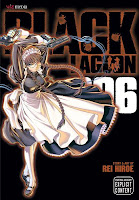 I thought I'd start with some manga since it's been awhile since I've actually read any, and picked Rei Hiroe's fan-favorite series Black Lagoon. Now, Black Lagoon easily stood out when it first popped-up in English translation in 2008. Aimed at a burgeoning market for young adults, it wasn't some shonen fight manga where the preternaturally gifted hero trains hard while spouting platitudes about peace, harmony, and that the only thing worth fighting for is to protect your loved ones. Nor was it some cutesy seinen title exploiting the moe angle. What Black Lagoon delivered was straight-up, testosterone-fueled, foul mouthed, hard drinking, gun-toting, John Woo styled action and mayhem. Definitely not for preteens, but perfect fantasy material for people who hate their jobs: Volume 1 is about a mild-mannered, Japanese salaryman named Rokuro "Rock" Okajima who quits his job to join the very band of American pirates who kidnapped him after he realizes that the corporation he loyally served was all too willing to sell him down the river. These pirates, known collectively as the Lagoon Traders, operate out of the fictional Thai city of Roanapur - your basic Southeast Asian den of iniquity populated by every conceivable lowlife from Chinese triads to the Russian mafia, each with their own representative badass for when things become inevitably hairy. This is a dude's idea of entertainment. But in true otaku fashion, most of the toughest badasses happen to fulfill some fanboy quotient. There's the Lagoon Trader's resident gunslinger Revy "Two Hands", a nihilistic Chinese-American assassin who wears tight tank-tops and even tighter cut-off shorts. The highlight of volume 1 was seeing her go toe-to-toe with Roberta, an ex-FARC guerilla who mops the floor with everyone while wearing thick eyeglasses and dressed in a maid's uniform. Similarly fetishistic characters are introduced in succeeding volumes along with the usual action movie types. In case this misleads unfamiliar readers, Black Lagoon is grounded in a facsimile of the real world, not in an alternate timeline populated with more fantastic elements. Its more ludicrous features operate within the parameters of the action movie genre.
Volume 6 marks the return of Roberta to Roanapur, after her exit in volume 1. But before we get to her, the book starts of with a story of the Lagoon Traders becoming embroiled with a counterfeiter on the run from her displeased clients. There's some high-tech skullduggery about the counterfeiting operation that complicates the plot. But it's not particularly well-explained before the guns are quickly bought out. The action first takes place in a church run by weapons-smuggling nuns; then to hotel rooms; a collapsing warehouse; and finally to the Lagoon Trader's own torpedo boat the Black Lagoon. Aside from the nuns carrying assault rifles, the scheme somehow manages to involve a motley assortment of characters including a cowboy from Florida (?), a recurring knife-throwing Chinese killer, a sadistic pyro, an androgynous pretty boy gunman, and a chainsaw wielding gothic lolita. It's all pretty mindless, fun, entertainment. And somehow it all gets resolved with judicious computer hacking.

The assassination of Roberta's wealthy patron prompts her to come back to Roanapur. This makes the local criminal warlords go into a tizzy, remembering how much collateral damage she caused last time. But before anyone can suss out her exact motivations, another maid also possessing deadly skills shows up and begins to tear up the place. It's at this point that the volume ends.
Rei Hiroe inculcates this volume of Black Lagoon with the usual frenetic energy and extreme action. But the book also showcases many of his weaknesses. His staging of fight scenes is always confusing: Filled with too many small panels, little foreground-background separation, oddly cropped compositions, too many close-ups, hard to follow sequences, and an over-dependence on speed lines. The art could be defended on the grounds that it enhances the over-the-top violence of the story. But while Hiroe is a more than a competent artist, his art isn't quite attractive enough or compelling enough to get away with it. This murkiness also extends to the pacing of his story. Despite being text-heavy for an action comic, the pacing tends to be relatively quick and relentless. The stories could do with a clearer set-up, and an occasional slowing down of the action. This volume also tends to suffer a bit from making Rock less of a in-panel presence - he's the only character to who isn't always trying to sound like a movie tough guy.

This isn't the strongest entry in the series. But pre-existing fans of Black Lagoon will find enough in this volume to enjoy.
Subscribe to:
Posts (Atom)