4/19/2015

Red One #1

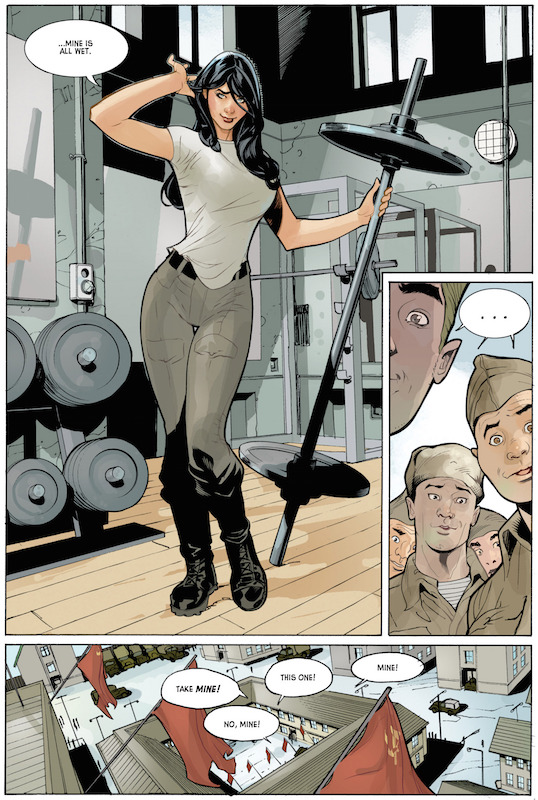
Red One #1 by Xavier Dorison, Terry Dodson, Rachel Dodson.
Story by Xavier Dorison
Pencils and Colors by Terry Dodson
Inks by Rachel Dodson
Letters by Clayton Cowles

Red One starts from the conceit that America's neighbors from across The Pond are a far more enlightened and liberated lot. Or maybe that was just the 70s. At any rate those silly but highly dangerous Yanks are kind of childish for still believing in superheroes. Why, they even make movies about them. Something has to be done about that for the sake of world peace. The central premise of the series is absurd and over-the-top, but I'm not entirely sure from this debut if it's meant to work as a parody or a homage, or some clumsy marriage of both.

The art team of Terry and Rachel Dodson seem to be playing it straight, effortlessly capturing the kitschy atmosphere and cheesecake aspects of the decade like this comic was the script of one more exploitative action adventure film. The colors acquire a washed out, nostalgic glow when the setting moves to 1977 Southern California, imbuing the place with a certain dated glamour.

Where the comic disappoints is in the dialogue, which is clunky and unrealistic. This may have something to do with translating from the script of writer Xavier Dorison, but it sometimes feels like an over-earnest imitation of the informal speech patterns of most Americans. What Hollywood starlet vents her frustration at her critics by screaming "I'm going to smash their peasant heads in!"? This is exacerbated by half the word balloons being crowded by too much text. This again may be a translation issue, but it results in some very slapdash lettering which could have been solved by resizing or rearranging the balloons.

The comic's protagonist Vera Yelnikov could be described as a Rule 63-inspired, Soviet-era version of James Bond meets Captain America. She's a bombshell drawn by the very people who used to draw Wonder Woman during Allan Heinberg's aborted run. Which is to say that Vera's clearly meant to be ogled by the reader. But she's no vacuous sex symbol, she's the country's top operative. Smart, capable, and supremely athletic to the point of being possibly a super soldier. Vera's a free spirit involved in a polyamorous relationship with an expecting couple, plus a few other hanger-ons. She has no problem inducting complete strangers into the Mile High Club, but stops at sleeping with her co-workers and superiors at the Kremlin.

Red One #1 by Xavier Dorison, Terry Dodson, Rachel Dodson.

For all of these reasons, Vera is sent to infiltrate American Society in order to play the part of a superhero. A costumed vigilante called The Carpenter has been murdering disreputable Hollywood types. This has the party bosses worried that such criminal behavior might inspire a new wave of puritanism, which in turn could reignite the Cold War. So they assign Vera to masquerade as another local do-gooder so she can provide a more rational counterpoint.

Needless to say, the story is a not-so-subtle commentary on the connection between violence, sexual repression, and religious extremism, not to mention the rising tide of social and political conservatism that would come to dominate Reagan-era America in the 80s. And it panders to the view that Americans on the whole are somewhat naive in their idealism, making them a tad suggestible to things like men and women in tights. At the same time, there's an admiration for that very naïveté that comes across in Dodsons' love for recreating the seductive Californian milieu and in their portrayal of a fresh-faced Vera as an innocent abroad.

4/05/2015

Batman: The Jiro Kuwata Batmanga Vol. 1

Batman: The Jiro Kuwata Batmanga Vol. 1 by Jiro Kuwata.
By Jiro Kuwata, translated by Sheldon Drzka, lettered by Wes Abbott
Batman & Robin created by Bill Finger, Bob Kane, Jerry Robinson

Originally serialised from 1966-1967 in Shonen King magazine to capitalise on the popularity of the Batman television series, the Batman manga would be rediscovered in 2008 by Chip Kidd, who would make it the centerpiece of his book Bat-Manga!: The Secret History of Batman in Japan. Despite being well-received, Kidd was criticised for failing to credit the manga’s creator Jiro Kuwata. So for comic fans, it’s a little more gratifying to see DC release the first volume of a planned complete run for the manga in a format that more closely preserves the content of the original. But fans of the current incarnation of Batman or of today’s manga are probably going to find this comic slightly strange. This isn’t the brooding protagonist cloaked in black. Nor is the art going to remind anyone of today’s manga populated by delicately drawn bishonen and bishojo types. This is a solidly-executed boy’s action adventure of the period. But for someone like me, there’s something familiar and comforting about its simplicity.

To begin, this is a superhero comic that still displays the genre’s early circus roots. Batman and Robin don a variation of the traditional tights that they wore for decades before the duo started bulking themselves up with body armour. Long before superheroes were granted bodybuilder physiques, Batman and Robin were portrayed as lithe athletes. And this works for the kind of storytelling Kuwata employs. The duo are usually shown leaping off buildings, swinging on ropes, running at top speed, tossing and kicking their enemies, dodging bullets. This classic staging of fight choreography really helps to ground the characters in real physical exertion. By today’s standards Kuwata’s style is rather minimal. But it’s primary virtue is in how it captures the dynamism of its protagonists. The clarity and pacing of the action keeps what are sometimes wordy panels from slowing down the story.

The stories themselves, which mimic the 3-act structure of a television episode, are also fairly episodic, with Batman and Robin battling a succession of villains-of-the-week. Two of them (Lord Death Man and Doctor Faceless) were lifted from the manga’s American counterparts, but none of them could be described as an essential member of Batman’s rogues gallery. The plots and characterisations are now fairly predictable, with many of the tropes seen here having been used many times since the 60s. What I found surprising was the science-based nature of the antagonists. Like many readers, I’ve become accustomed to the horror/crime themed interpretation of Batman’s more popular arch-foes as well as Batman himself being portrayed as a psychologically scarred individual. But Kuwata’s stories reflect the post-War fascination with science and technology gone amuck. So the manga's always flamboyant villains tend to be hucksters, mad inventors, or freaks of nature rather than the more familiar assortment of mobsters, assassins, mass murderers, or serial killers. The only thing missing here are angst-ridden individuals transmogrified after being bathed in radiation.

This results in a very different kind of Batman. Rather than the urban avenger waging a one-man-war against crime in Gotham or the control freak who plans for every outcome, we have a Batman who initially stumbles when confronting a new villain’s MO for the first time. He starts out at a clear disadvantage dealing with their unfamiliar technology since he has no way to counter it. And while he eventually finds a way to win, he's far from infallible. This isn’t Batman the Dark Knight, but closer to Batman the problem-solving Science Hero. Admittedly, this plays to some of my more nostalgic instincts.

3/11/2015

R.I.P. Yoshihiro Tatsumi

Push Man and other Stories by Yoshihiro Tatsumi.
(Yoshihiro Tatsumi: June 10, 1935 - March 7, 2015) 

When you move to the metropolis, and you don’t know where you are, and you don’t have any work, I think that that can be a very alienating experience. Furthermore, I think that, when you’re living in those conditions, you start to envy other people that are around you, you start to imagine that everyone around you is living a better life than you are. I think that that’s a basic condition of living in the city. And when you’re with just one other person, and you envy them, you can just not see them. That’s fine. But that becomes very difficult when you are living in the city.
- From The Comics Journal

I tend to write about everything that’s happening in Japan. Socially, I’m inspired by that. Even if they’re good or bad incidents, I find myself interested in them, and then create stories. So before I write something, I’m always determined to include the things that are happening in society at the time.

So after the war, American troops came in, and got things settled in Japan. I drew this image of a Japanese man pulling a rickshaw – and there‘s a drunk American soldier waving around a bottle of alcohol around, getting kind of crazy. So just in that one panel, it sums up the exact situation of Japan after the war in that one panel.
- From About Manga

In Japan they weren't really making a lot of films at that time, so I watched a lot of European and American films. I pretty much watched everything from overseas. In American films, the bad guy always gets it in the end and justice wins. It was fun to watch American films, but everything was just so good, though. I thought there weren't very many people that could actually live like that.

In European films, the bad guy wins and justice loses out. That's when I started creating manga, where sometimes the bad wins and the good loses.
- From The Star

2/28/2015

R.I.P. Leonard Nimoy (1913-2015)

In 1976, NASA's space shuttle Enterprise rolled out of the Palmdale manufacturing facilities and was greeted by NASA officials and cast members from the 'Star Trek' television series. From left to right they are: NASA Administrator Dr. James D. Fletcher; DeForest Kelley, who portrayed Dr. "Bones" McCoy on the series; George Takei (Mr. Sulu); James Doohan (Chief Engineer Montgomery "Scotty" Scott); Nichelle Nichols (Lt. Uhura); Leonard Nimoy (Mr. Spock); series creator Gene Roddenberry;  U.S. Rep. Don Fuqua (D.-Fla.); and, Walter Koenig (Ensign Pavel Chekov). NASA is mourning the passing today, Feb. 27, 2015, of actor Leonard Nimoy, most famous for his role as Star Trek's Vulcan science officer Mr. Spock. The sci-fi classic served as an inspiration for many at NASA over the years, and Nimoy joined other cast members at special NASA events and worked to promote NASA missions, as in this 2007 video he narrated before the launch of the Dawn mission to the asteroid belt. Nimoy also was there for the 1976 rollout of the shuttle Enterprise, named for the show's iconic spacecraft.
Photo courtesy of NASA

Star Trek/X-Men by by Scott Lobdell et al.


Double Self Portrait with Light Bulb by Leonard Nimoy.
Photo Courtesy of R. Michelson Galleries
Of all the souls I have encountered in my travels, his was the most human.
 - Star Trek II: The Wrath of Khan
In an era when nerd heroes were still in short supply, Mr. Spock was already there. Bon voyage Leonard Nimoy. You lived and prospered.

1/25/2015

André The Giant: Life and Legend

André The Giant: Life and Legend by Box Brown.
By Box Brown

I’ve never been more than a casual viewer of pro wrestling, but even as a kid I was aware of André René Roussimoff, more famously known by his wrestling handle André the Giant. Officially billed at a height of 7 ft. 4 in. and weighing in at 520 pounds, he was the image of what a wrestler should look like - a true giant of a man. Roussimoff’s manufactured rivalry as the heel to babyface wrestler Terry “Hulk Hogan” Bollea would culminate in their 1987 match at Wrestlemania III. The event would bring an unprecedented level of mainstream media attention to the World Wrestling Federation (now called World Wrestling Entertainment), the last pro wrestling promotion left in the United States after having absorbed all its rivals. Roussimoff’s iconic status was further enhanced by a few memorable film and television appearances, his early death at the age of 46 due to heart failure, and a viral street art campaign created by Shepard Fairey. If there’s any professional entertainer who’s identity has been completely subsumed by his own legend, it’s André the Giant.

As Box Brown tells it in André The Giant: Life and Legend, there’s a certain inevitable quality to Roussimoff’s involvement with pro wrestling. Born and raised in southern France, Rousimoff was neither brilliant, athletic, handsome or charismatic. But he was unusually large for his age. So large that the local school bus refused to take him as a passenger. The young Rousimoff had to be driven to class by riding on the back of the truck of his neighbour, Nobel Prize-winning playwright Samuel Beckett. After leaving school, he employed his tremendous strength while drifting between various odd jobs. So the choice to become a wrestler seems to have been arrived at by default. Where else could Rousimoff exploit his size to achieve a modicum of wealth and fame?

But once he fell into pro wrestling, Roussimoff became fully committed to its itinerant lifestyle. Much of the graphic novel portrays life outside the ring being spent hanging out at restaurants, airport and hotel lobbies, or squeezing into the cramped seats of airplanes and buses. This would be a lonely and difficult existence for anyone, let alone someone suffering from acromegaly. Brown’s art is particularly effective here because his representation of Roussimoff is both archetypical and humanizing. He’s drawn a bit larger than he was in reality, but this only heightens the character’s discomfort. He looks awkward in every panel trying to navigate a world not built to accommodate his size. His impressive bulk belying the physical fragility that would eventually contribute to his death.

André The Giant: Life and Legend by Box Brown.

Unsurprisingly, Rousimoff would inspire numerous anecdotes during his lifetime conveying contradictory impressions about him. Some would exaggerate his freakish power while others would portray him as a gentle spirit. Brown’s remarkable achievement is that he manages to pull together these disparate sources into a cohesive biography. Brown’s aesthetic is similar to that of Seth or James Kochalka. Minimally designed figures outlined with thick strokes and soft contours. This imbues not just Roussimoff, but all the other heavyset wrestlers with an oddly endearing appearance. I’ll assume that most of these stories are already familiar to hardcore fans, but Brown organizes them in such a way that doesn’t require much prior knowledge from the reader.

There’s indeed a great deal of fondness for the subject-matter that comes across the entire book. Brown patiently guides the uninitiated through the world of wrestling kayfabe. Roussimoof’s career spanned an era when the WWF and other promotions still insisted that its matches, and even its wrestlers' ludicrous personas were 100% genuine. Of course any savvy viewer, or anyone who’d been in a real scrap, could tell that the televised fights were staged (or a work, to use pro wrestling parlance), but the promotions had tasked their wrestlers to maintain the act whenever in public. As far as Brown can tell after examining his taped appearances, Roussimoff never broke character, even if it meant flipping someone’s car over when responding to a skeptical fan’s challenge (though Brown admits he’s unsure about the veracity of the story). As Hogan stated in an interview “He loved this business and he protected it.” Some of Brown’s best set pieces are his blow-by-blow analysis of Roussimoff’s more famous matches. They illuminate how wrestlers will sometimes put themselves into real danger in order to sustain the illusion of a true brawl.

Though Brown’s research is extensive, his book is far from the last word on André the Giant. Brown was mostly limited to examining 2nd and 3rd-hand sources, and the resulting biography’s emotional distance reflects his dependence on those sources. While Brown’s willing to streamline some events in order to smooth over conflicting testimonies and better fit the dramatic needs of the narrative, he isn’t able to penetrate far past Roussimoff’s tough exterior. Whatever private struggles he must have had with acromegaly and the rigorous demands of his profession are left off the page. And the reader is only vaguely informed about his soured domestic life. Ultimately, Bown’s André Roussimoff remains an enigmatic presence.

André The Giant: Life and Legend by Box Brown.

Brown adopts the same circumspect attitude towards the wrestling industry as a whole. When the WWF’s Vince McMahon admitted in 1989 that wrestling matches were artifice, he did so in order to keep state athletic commissions from imposing stricter standards (like conducting proper medical exams or hiring ringside doctors) or from more properly supervising the promotion’s events. The tactic worked to some degree. While some in the wrestling community bemoaned the death of kayfabe, the uncovering of one form of artifice simply allowed the promotion to continue kayfabe on a more subtle plane. What remains largely hidden from the public are the exploitive practices that take a huge toll on the wrestlers they market. Roussimoff cycles from the squared circle to heavy drinking sessions at hotel bars to the surgery table. But Brown's unvarnished account never calls into question the promotion’s ethical responsibility towards its employees. While he mentions that Roussimoff was the highest paid wrestler of the era, he leaves out how the WWF would build a massive "sports entertainment" empire based on his infamous reputation, even long after his death.

Brown does include one scene were a younger Roussimoff meets with Vince McMahon Sr. in New York, who outlines how he’ll turn the burgeoning talent into a legend. “You’re an unstoppable force!! No running dropkicks or leg scissors. You don’t move for nobody.” he commands. McMahon then decides to take Roussimoff on the road. “We keep moving him from town to town so he never gets overexposed… And we let the legend grow. By the time you get back to town you’re ten feet tall!!” However this might have impacted Roussimoff personally whether for better or worse, it certainly proved to be a most profitable strategy for the company.

André The Giant: Life and Legend by Box Brown.