By Box Brown
Box Brown has made a career uncovering the stories behind pop culture objects of a very specific milieu, namely early 80s Americana. He’s authored biographies about two infamous celebrities: pro wrestler André the Giant, and comedian Andy Kaufman. With last year’s Tetris: The Games People Play, Brown instead tackled a video gaming classic. The resulting graphic novel reveals that his approach to biography works just as well for talking about nonhuman subjects. After all, Tetris didn’t just emerge from the void like one of its signature puzzle pieces. Someone had to invent it, and others had to fall for its charms. Some people might be aware that the game was the brainchild of computer scientist Alexey Pajitnov, when he was still working at the Academy of Science in Moscow. Even fewer will know what measures were taken to export the game to the Western world during the final stages of the Cold War. Brown’s examination of the complex business machinations behind Tetris’ international success is very accessible because he keeps the attention centered on the personalities involved, and not on the technologies that made it possible.
Before getting into the story of Tetris, Brown lays out his thesis for the comic. His short examination of the history (and prehistory) of games leads him to conclude that they are an artistic enterprise, the creative fusion of the competitive spirit and the child’s act of playing. Games nurture analytical skills and model human behavior by connecting with the audience’s desire for diversion, whether it be the ancient board game of Senet, the 19th century Japanese card game Hanafuda, or the video game consoles manufactured by Nintendo and Atari during the early 1980s. Every games’ popularity is a reflection of their respective society. With Tetris, Alexey’s own contribution to history was to combine the pleasures of classic puzzle games with real-time problem solving made possible by video games into an endlessly iterating loop.
Alexey himself isn’t one of Brown’s more enigmatic protagonists. He’s portrayed as a Steve Wozniak type of figure who created Tetris in 1984, during his free time in order to give expression to his ideas and entertain his friends. He showed no interest in profiting from his creation. The game would soon become a viral hit in Moscow, shared through floppy discs. A version of Tetris would make its way to Hungary, where it would be discovered by Robert Stein of U.K.-based Andromeda Software.
From here, the story becomes a lot more complicated as Alexey gradually loses control of his own creation. Various American and Japanese companies would vie for the distribution rights to Tetris, and at some point had to negotiate directly with the Russian government agency named Elorg. Like many tales from the nascent personal computing and video gaming industry, many of the parties involved were stumbling over a mess of patent, copyright, and trademark issues. Tetris would be ported to virtually every popular computing platform even when the legality of its distribution was still far from settled. This confusing state of affairs would eventually culminate in a huge 1993 legal battle between Nintendo and Atari.
If Brown were appealing just to the gaming crowd, he’d get lost comparing the varieties of Tetris being produced during this time, and judging each on their technical merits. That would make for an unwieldy comic. Thankfully, he’s more interested in the various business personalities fighting for a piece of the game. His chapter breaks are structured around their involvement, each character being helpfully introduced with a formal portrait and accompanying caption, isolated on the page by inky black. His blocky cartoon style is even more minimalist than in Andre the Giant, all the better to facilitate his understated, third person narrative voice. The only thing keeping the art from becoming completely flat is Brown’s choice of vibrant yellow to add volume to his black and white forms. But Brown is first and foremost, a storyteller. The comic still proves to a page turner despite the large cast of characters and numerous plot twists.
With everything said, Brown’s sympathies lie ultimately with the humble Alexey. He sees him as a master of his craft. Alexey wanted more than anything for the world to know his beloved game. As he explained during a 2015 appearance: “If I made a big fuss about the money, they would immediately have crushed my efforts. They would have crushed Tetris. Tetris would have been left without a champion to stick up for it and guide it. We would not be here today.”
Showing posts with label computers. Show all posts
12/17/2017
2/01/2017
More NonSense: You’re gonna make it after all
Go to: Twitter, by Phil Noto (via Mark Seifert)
Punching Nazis in the face goes viral.
The comics community loudly and repeatedly responds to President Donald Trump's arbitrary immigration ban.
Zach Weinersmith pens an eloquent response to the ban.
Mark Medley on the recent closing of The Beguiling.
Heidi MacDonald on the history of the NYT graphic novels bestseller list and its recent cancellation. Abraham Riesman on the reaction from the comics community.
R.I.P. Mary Tyler Moore (December 29, 1936 – January 25, 2017). The 20th Century keeps slipping further back into the rear view. Tributes from Bobby Finger, Dana Stevens, Willa Paskin, Jennifer Keisbin Armstrong, Twitter, John Swansburg, Tatiana Baez.
R.I.P. John Hurt (January 22, 1940 – January 27, 2017), another beloved actor.
R.I.P. Jack Mendelsohn (November 8, 1926 – January 25, 2017).
R.I.P. Dan Spiegle (December 12, 1920 – January 28, 2017).
R.I.P. Masaya Nakamura (December 24, 1925 – 22, January 2017), video game pioneer.
David Harbour’s acceptance speech at the SAG Awards are the inspirational nerd-filled words of the month.
8/07/2016
Snotgirl #1
Story: Bryan Lee O’Malley
Art: Leslie Hung
Colors: Mickey Quinn
Letters: Maré Odomo
Bryan Lee O’Malley is again delving into the lives of pretentious twenty-somethings facing down a personal crisis. But Snotgirl is his first major work being serialised in the pamphlet format. He’s also sharing co-creator credit with the lead artist, newcomer Leslie Hung. This might be why the comic exhibits an emotional edge not usually found in O'Malley's previous stories, particularly noticeable in a main protagonist who could probably be described by many as monstrous.
O’Malley and Hung also get to explore a field that millennials can legitimately claim to have grown up around and actively shaped, which is online social media. Lottie Person is a self-described 25 ¾ year-old fashion blogger, and extremely proud of her effortlessly chic style. “On my blog, I’m perfect. My nose never runs. Every hair on my head is exactly where it’s supposed to be.” This makes Lottie stereotypically judgemental about other people’s fashion sense, even secretly giving her supposed friends nicknames out of spite. Lottie even dubs her regular get togethers with them as “haters brunch.”
Naturally, this masks a number of deep-seated insecurities. Like many people with popular social media profiles, Lottie finds most of her online relationships very superficial. “...my friends are all horrible people. And my boyfriend decided we’re on a break.” But what she really fears is her perfect image being completely shattered by a not so pretty alter ego. When her allergies act up, she becomes a total mess as her eyes and nose run over with tears and snot.
Snotgirl constantly critiques how technology has changed social interaction. Lottie considers the perfect version she projects on her blog to be truer than her allergy-ridden secret identity. It’s an easy belief to maintain since she spends most of her time texting the people she knows on her phone rather than talking to them directly. Lottie stalks her ex-boyfriend and the girl he left her for online, only to dismiss her as not being pretty enough. She tries to impress another women she recently met (whom Lottie dubs “coolgirl”) by texting her from the kind of hip bar she would never patronize, then taking a selfie from that location.
It’s easy to see why O’Malley wrote around Hung’s artistic talents instead of trying to tackle the story with his usual chibi style. Hung’s characters are drawn to resemble the elegantly elongated figures of josei manga. It’s perfect for a story critiquing the empty lives of glamorous looking individuals. Colorist Mickey Quinn completes the look with a washed-out palette of unrealistic tones such as pinks and greens.
Where the art falls short is towards the end. Snotgirl starts to move beyond merely lampooning popular culture and moves into darker territory with a melodramatic twist and a late self-realization from Lottie that tears down her carefully constructed world. But Hung’s depiction feels too glossy and emotionally restrained to deliver on the full force of this scene.
7/31/2016
Wizzywig: Portrait of a Serial Hacker
By Ed Piskor.
The cover for the graphic novel Wizzywig is slightly deceptive. The title is a play on the acronym WYSIWYG, which stands for the “What You See Is What You Get” feature of the modern graphic user interphase. The cover design for the Top Shelf edition (the comic originated as a serialized webcomic before being self-published in 3 volumes) evokes the case of an early model Apple Macintosh running MacPaint. But creator Ed Piskor is less interested in the birth of desktop publishing than in the world of phone phreaking, war dialing, and other activities associated with old-school computer hackers. Piskor’s art style descends from the line of satirical cartooning that began with the Underground Comix movement of the 60s and continued with the alt cartoonists of succeeding decades. So it’s well suited to drawing a clear parallel between the outsider status of cartoonists and hackers while pillorying those who persecute them.
Given its almost 300 pages of densely composed panels and scope of subject matter, the comic is not a quick read. Piskor channels the first 20-odd years of computer hacking through his main protagonist Kevin Phenicle, a composite of several famous real world hackers (namely Kevin Mitnick, Mark Abene and Kevin Poulsen, with a dash of Josef Carl Engressia, Jr). Going by the internet handle “Boingthump”, he occasionally runs into tech legends like Robert Morris or the pre-Apple Steve Jobs and Steve Wozniak. The comic begins with a series of talking heads giving contradictory opinions about Kevin. As people either vilify or idolize him, an overall picture emerges of a near-mythical figure who’s nonetheless deeply misunderstood by the public. The scene quickly shifts to a radio show hosted by Kevin’s childhood friend Winston Smith (a reference to Off the Hook, a radio show hosted by Emmanuel Goldstein). Winston informs his audience that Kevin is currently being imprisoned without trial and agitates for the government giving him his proper due process. The scene shifts again to reveal a much younger Kevin being bullied by two kids while waiting for the school bus.
Piskor uses these vignettes as the basic building blocks of his narrative. While Kevin’s formative years enfold in a mostly episodic manner, the comic regularly flash forwards to adult Kevin’s incarceration. Mixed in are excerpts of Winston’s radio show, more interviews with random people on the street, television news reports, and scenes involving other more relevant characters. This structure affords Piskor the ability to easily shift forwards and backwards in time. But it’s also calculated to make the esoteric subject of computer hacking more comprehensible to the layperson. Certain sections inevitably go into detail about Kevin’s exploits, whether that be discovering a security flaw in the punch card system used by bus lines, scamming a delivery place to score some free pizza, pirating computer games, pranking members of a local BBS, or undermining the monopolistic power of Ma Bell, the act that would finally earn Kevin the unwelcome scrutiny of the Powers-that-be. Piskor’s explanations are short, not too complicated to follow, and easily digestible to the non-technical reader.
Wizzywig is a pretty good showcase of how a cartoonist maintains narrative momentum even when the characters are engaged in fairly mundane tasks. Like Chester Brown in Louis Riel, Piskor mostly sticks to the highly readable 6-panel grid layout. Characters in conversation or deep in thought are often shown walking from place to place. Or drawn in different poses and shifting perspectives if they’re merely sitting. Piskor’s eye for gritty detail is quite efficient in conveying setting and mood, but it’s his gift for caricature that stands out. No one's physical features are flattered, no matter however attractive. People often seem to possess odd proportions or carry themselves with terrible body posture. Most of them have big noses, sallow skin, shaggy hair, beady eyes. In contrast, Kevin’s impossibly poofy hair and pupiless eyes (again recalling Riel and Little Orphan Annie) suggests a potent mixture of innocence and craftiness.
At first glance, Kevin would appear to be the stereotypical nerdy kid who’s a whiz with computers, but has no friends or can’t get laid. But he’s an orphan living with a grandmother who’s incapable of providing him with enough adult supervision, or dole out the kind of practical advice on how to deal with school bullies. Kevin’s hacking doesn’t just arise from boredom or intellectual curiosity, but also from an impulse to strike back at his oppressors. Hacking becomes a non-physical form of asymmetrical warfare. The irony is that for all his social awkwardness, Kevin becomes particularly adept at what the industry calls “social engineering,” manipulating the behavior of other people to obtain information and get them to do what he wants. But his cunning also belies a deep naivete that leads to his eventual undoing. An early sign of things to come is when Kevin illegally resells gaming software, but as a joke inserts a bit of extra code into the program which will display the message “Boingthump owns your soul, sucka!” after 100 plays. Unfortunately this renders the game unplayable, and Kevin earns the ire of local gamers. More ominously, the code’s ability to infect whatever system the game’s installed into also gains media attention, and the name Boingthump becomes associated with computer viruses.
Kevin becomes a fugitive from the law around the halfway point, living a day-to-day nomadic existence. It turns out that the resourcefulness he’s displayed are particularly useful to life on the run. Much of this part of the book is still spent on educating the reader about various hacks: how to assume a false identity, find temp work, and not draw attention to oneself. Kevin runs a number of hustles just to stay alive. One particular scheme involves rigging numerous radio contests and recruiting women to claim the prize, usually taking the cash items for himself. His social engineering takes on an even more mercenary overtone, and Kevin’s portrayal becomes somewhat dehumanized as a result.
This part of the comic is where Piskor’s satire is at full force. The mainstream media’s treatment of hackers is embodied by a muckraking television journalist whose thick mustache and ludicrous combover makes him look like an older, evil version of Kevin. His reports on Kevin’s alleged crimes become increasingly sensationalized, with both the FBI and the Ma Bell only too happy to participate in the vilification process. Winston becomes the sole voice of reason in this climate of media-induced paranoia.
A side effect of this shift in tone is that Kevin becomes more a symbol of systematic injustice than a fully fleshed out individual. The earlier part of the book helped establish him as a sympathetic, if flawed human being. But his character development stalls as he becomes a fugitive, and later a prisoner. It becomes less about Kevin himself than his mistreatment at the hands of his captors. This saps the story’s intended emotional impact when Kevin’s grim experiences are connected to the wider world and latter day whistleblowers, such as Pfc. Bradley Manning and Wikileaks. It’s the most glaring weakness in a highly ambitious work which actually has something relevant to say about the present-day terrifying state of American politics.
6/17/2016
5/18/2014
2/12/2014
Cartography: The Middle-Earth DEM Project
Go to: The Middle-Earth DEM Project (via Lauren Davis)
Arda as seen from space. What, no Mac Version?
10/31/2013
My Halloween
Go to: PC Weenies by Krishna M. Sadasivam
After a very long installation process (which included an eleven hour download), Mavericks is finally running on my MacBook. Almost all software but my scanner driver is compatible with the new OS. So hurry up with it Epson.
1/18/2012
The Resistance
Go to: The Joy of Tech by by Nitrozac and Snaggy
10/16/2011
Triumph of Steve
Go to: Babble by Justin Colussy-Estes
I became a full-time Macintosh user after realizing that I could make art and manipulate photos on a personal computer. I had used Macs before, but no more frequently than I had used machines running on DOS or Windows. And even after I had switched to Macs, I had a "live and let live" attitude about the whole Mac vs PC debate. I had my preferences, but I wasn't out to convert anybody. The same could be said with how I thought about Nikon vs Canon. I really didn't give a damn what SLR camera you used (The lens on the other hand was a different matter).
But I became a student of the graphic arts during the dark days of Apple, when everyone was predicting the company's demise. So I did feel a tad isolated. In the PBS documentary Triumph of the Nerds (which one instructor made his students watch), a bitter Steve Jobs in exile bemoaned the lack of taste in Microsoft's products. Just a few years later, In the Beginning was the Command Line was touting Linux and other Unix-like operating systems as the future of the desktop. The mood within campus computer labs could be summed-up by a defiant editorial cartoon tacked-up in a graphic design classroom. In it, a guy walks into a studio full of people working on Macs and demands "We need a cartoon illustrating how Macs are becoming irrelevant", or something to that effect. It was easy for some to feel misunderstood as artists and as computer users. Such was the self-indulgence of youth. When Steve returned to Apple and unveiled a Unix-like OS to run on Macs, I was only a tiny bit, cautiously, hopeful. Steve may have been brilliant, but he still retained his legendary reputation for being an overbearing egotist and a difficult boss to work with. It wouldn't have surprised me if he prematurely left the company he co-founded for a second time.
Oddly enough, that's actually what happened. Instead of a boardroom coup d'état though, it was Steve's own mortality that betrayed him, at the all-too-young age of 56. That he died from cancer is deeply saddening to me in very personal ways that I won't get into. But when I think of Steve Jobs, I find him such an improbable character. He wasn't an engineer, programmer, MBA, or artist of any note. Yet he had an impact on technology, consumerism, and popular culture like no one else. And he left a dynamic company imprinted with the best, and worst, aspects of his mercurial persona and utopian idealism. In the words of Scott McCloud , a creator who's expressed strong opinions about the marriage of technology and art: "Great design can and does change the world. Poor design can and does ruin lives." That's a line a certain aspiring student from a long time ago would have subscribed to.
10/06/2011
9/17/2011
Jason Thompson bends the ComiPo! EULA
Go to: Jason Thompson's House of 1000 Manga at Anime News Network
Jason Thompson reviews the ComiPo! manga-creation software, and uses it to create a comic "inspired by the recent case in which an American citizen, flying to Canada, was arrested and charged with possession of child pornography due to some dojinshi he had saved in digital form on his laptop."
8/29/2011
More Nonsense: Violence Against Creators (and Characters)
Syrian political cartoonist Ali Ferzat was abducted on Thursday by by a group of masked gunmen believed to be working for President Bashar al-Assad. He was beaten, his hands were broken, and then he was abandoned on the side of a road, his attackers saying that this was "just a warning." Ferzat is a critic of the present regime. His latest cartoon compares al-Assad to his Libyan counterpart, Colonel Muammar Gaddafi.
Tom Spurgeon has link roundup. He has his doubts over the authenticity of a self-portrait making the rounds on the Web. Given the severity of Ferzat's injuries, it would have been an impressive act of defiance. Needless to say, the countries that have come out in support of the "Arab Spring", and actively lent support to the rebellion that ousted Gaddafi, have condemned the attack.
Noah Berlatsky interviews Shaenon Garrity, Lillian Diaz-Przybyl, and J.R. Brown about the effect of the Borders liquidation on the manga industry.
Timothy Callahan has read the entirety of Cerebus.
Ah, Grant Morrrison. He plans to bring the sex back to Wonder Woman. I can certainly get behind that if he manages to execute it well. In a recent Rolling Stone interview, he criticizes everything from sexism in superhero comics, rape as an occurring phenomenon in Alan Moore stories, to Chris Ware's supposed "nihilism." While many praised Morrison's candidness, David Brothers isn't having any of it. He points out that Morrrison should look at his own work first, especially when making claims like "I managed to do thirty years in comics without any rape!". And he calls him out on his unwillingness to speak on behalf of creators' rights:
Speaking of Kirby, Tom Spurgeon and Paul Gravett celebrate his 94th birthday.
(As my small way of showing support for the Marvel boycott, I've suspended reviewing any new Kirby-related material coming from the company, for now.)
Kevin Melrose asks "Is Flashpoint DC’s deadliest (and bloodiest) event yet?" citing a post by Chris Eckert, which puts the death toll conservatively at 833 million. But it isn't that number that impresses (Crisis on Infinite Earths and The Infinity Gauntlet were statistically far worse), it's the outright sadism towards the characters that accumulate over the course of the event. His list of deaths is quite an eye opener for the variety of ways the characters meet their gruesome ends. This parade of gore and violence is so ludicrous it becomes tedious self-parody.
The Big Two's reliance of universe-wide events to hold on to their shrinking readership is kind of like the movie industry's reliance of expensive tentpole movies to hold on to movie theater patrons. Following the storylines through several ongoing titles is prohibitive and costly, as is the weekend movie goer being made to regularly watch effects-laden mega-blockbusters in 3D. As with the movie studios, there's a general willingness to blame this decline on anything else, rather than admit to the possibility that the audience is shrinking because the final product they release usually sucks. In an interview with the Los Angeles Times, co-publisher Dan Didio acknowledges the 52 relaunch is related to falling sales:
Speaking of crossovers, Jess Evins traces their literary and mythological roots.
James Sturm tells us how hard it is to get a cartoon into the New Yorker.
Ah Jim Shooter. According to him, Marvel almost published DC in 1984.
Derik Badman makes a webcomic of the sky with his digital camera.
Johnny Ryan plays Chester Brown in Paying For It
I babble on about the Hooded Utilitarian best of comics poll.
Other News:
Astrophysicists have made the most realistic depiction yet of spiral galaxy formation. Supercomputers are fun!
Linux, Linux, Linux!
Steve Jobs gives and takes way.
Tom Spurgeon has link roundup. He has his doubts over the authenticity of a self-portrait making the rounds on the Web. Given the severity of Ferzat's injuries, it would have been an impressive act of defiance. Needless to say, the countries that have come out in support of the "Arab Spring", and actively lent support to the rebellion that ousted Gaddafi, have condemned the attack.
Noah Berlatsky interviews Shaenon Garrity, Lillian Diaz-Przybyl, and J.R. Brown about the effect of the Borders liquidation on the manga industry.
Timothy Callahan has read the entirety of Cerebus.
Ah, Grant Morrrison. He plans to bring the sex back to Wonder Woman. I can certainly get behind that if he manages to execute it well. In a recent Rolling Stone interview, he criticizes everything from sexism in superhero comics, rape as an occurring phenomenon in Alan Moore stories, to Chris Ware's supposed "nihilism." While many praised Morrison's candidness, David Brothers isn't having any of it. He points out that Morrrison should look at his own work first, especially when making claims like "I managed to do thirty years in comics without any rape!". And he calls him out on his unwillingness to speak on behalf of creators' rights:
You know what Frank Miller did when he got a platform? He repped, and he repped hard. For Jack Kirby, for Bill Finger, for Steve Ditko, and for other creators who deserved to get their art back or to own their creations. For those who got screwed in the name of profit and cheap labor. Sin City letters pages are littered with shots fired at Marvel over how they treated Jack Kirby. The Big Fat Kill (#5, I think) was where I found out that Marvel screwed Kirby. He built a platform and then he used it for good. Is he perfect? Nah. Bill Finger’s name isn’t on DKSA, though it might have been shouted at as a street name or something. But he tried. He got an acknowledgement to Finger and Jerry Robinson into DKR. He didn’t hide behind mealy-mouthed corporate speak to justify two guys getting screwed so that he could write Action Comics with a clean conscience. Two guys who jumpstarted the genre that he loves so much, at that.Dan Nadel and J. Caleb Mozzocco also chime in.
Speaking of Kirby, Tom Spurgeon and Paul Gravett celebrate his 94th birthday.
(As my small way of showing support for the Marvel boycott, I've suspended reviewing any new Kirby-related material coming from the company, for now.)
Kevin Melrose asks "Is Flashpoint DC’s deadliest (and bloodiest) event yet?" citing a post by Chris Eckert, which puts the death toll conservatively at 833 million. But it isn't that number that impresses (Crisis on Infinite Earths and The Infinity Gauntlet were statistically far worse), it's the outright sadism towards the characters that accumulate over the course of the event. His list of deaths is quite an eye opener for the variety of ways the characters meet their gruesome ends. This parade of gore and violence is so ludicrous it becomes tedious self-parody.
The Big Two's reliance of universe-wide events to hold on to their shrinking readership is kind of like the movie industry's reliance of expensive tentpole movies to hold on to movie theater patrons. Following the storylines through several ongoing titles is prohibitive and costly, as is the weekend movie goer being made to regularly watch effects-laden mega-blockbusters in 3D. As with the movie studios, there's a general willingness to blame this decline on anything else, rather than admit to the possibility that the audience is shrinking because the final product they release usually sucks. In an interview with the Los Angeles Times, co-publisher Dan Didio acknowledges the 52 relaunch is related to falling sales:
"The truth is people are leaving anyway, they’re just doing it quietly, and we have been papering it over with increased prices,” DiDio said. “We didn’t want to wake up one day and find we had a bunch of $20 books that 10,000 people are buying."Von Allan's tracks the rise of comic book prices with the minimum wage, and his conclusions don't bare any good news for DC outside of a temporary spike in sales.
Speaking of crossovers, Jess Evins traces their literary and mythological roots.
James Sturm tells us how hard it is to get a cartoon into the New Yorker.
Ah Jim Shooter. According to him, Marvel almost published DC in 1984.
Derik Badman makes a webcomic of the sky with his digital camera.
Johnny Ryan plays Chester Brown in Paying For It
I babble on about the Hooded Utilitarian best of comics poll.
Other News:
Astrophysicists have made the most realistic depiction yet of spiral galaxy formation. Supercomputers are fun!
Linux, Linux, Linux!
Steve Jobs gives and takes way.
8/25/2011
I just got the news
![]() |
| Wozniak and Jobs |
This was a long time coming. Thanks Steve, and good luck.
Update: Richard Stevens pays tribute the Jobs. He also has been selling a shirt for would-be Mac hipsters.
7/17/2011
More NonSense: Monkey Talks
Ryan Holmberg on Tatsumi Yoshihiro’s "Black Rainbow".
Philipp Knall talks with Bryan Lee O'Malley, and Kentaro Takekuma and Koji Aihara, the creators of Even a Monkey Can Draw Manga.
Shaenon Garrity and the history of webcomics.
Tim Martin presents a mainstream view of the superhero comics industry.
Patrick Galbraith on the importance of the works of Osamu Tezuka now being made available on the iPad.
Kristy Valenti concludes her analysis of Kate Beaton's webcomic Hark! A Vagrant
7/15/2011
Join the dark side: +1 me
Go to: Diesel Sweeties by Richard Stevens
Should have posted this earlier. It does seem inevitable that for social networking sites, many users get sucked into the game of accumulating the largest possible number of online contacts. That's probably already the case with Google+, regardless of what kind of "circles" are being used to manage one's contacts. A hierarchy of sorts develops anyway based on popularity and name recognition. Doesn't Leo Laporte's ego get stoked from having so many hundreds of people placing him in their circles? In how many new ways is G+ going to end up fortuitously fostering this behavior?
The PC Weenies has its own funny take on the subject.
7/14/2011
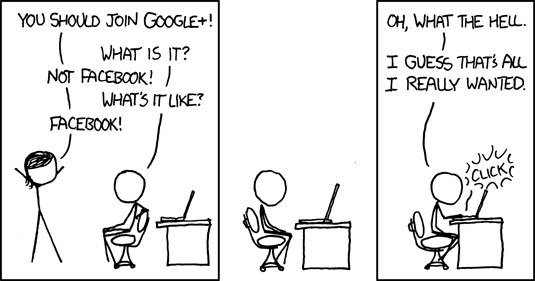
It's not Facebook
Go to: xkcd by Randall Munroe
When Google applied its programming expertise into cracking social networking, they came up with a social network that appeals to techno-geeks. What that means is that Google+ is a bit more discriminating in managing user's personal data than Facebook. Whether the control is just illusory is another matter.
10/31/2010
Nerd Heroes
You’re going to be successful and rich. But you’re going to go through life thinking that girls don’t like you because you’re a tech geek. I want you to know, from the bottom of my heart, that won’t be true: It’ll be because you’re an assholeI managed to watch The Social Network the other day, catching the last showing. Even in a country with short theatrical releases, the movie was initially slated to run in many nearby theaters for only three days. Did local distributors think the understated style, dense jargon, American patter, and techno-centric subject matter create a high barrier of entry? (internet usage is still comparitively low) But Manila is as cosmopolitan a city as any, with plenty of savvy internet users. Filipinos are avid consumers of Hollywood imports. And The Social Network was riding on a wave of critical acclaim. Or are films featuring geek/nerd protagonists perceived to be relatively less profitable by distributors, especially if they spotlight unlikeable characters? (For example, Scott Pilgrim vs. the World has yet to receive an official release date or audience rating)
- Description of Facebook co-founder Mark Zuckerberg, from The Social Network
There's something typically American about this mythologizing of Mark Zuckerberg - a maladjusted youth barely out of his teens and claiming to not care about the views of his peers, yet still smarting from the rejection of Harvard's prestigious final clubs. So he retaliates against tradition and class privilege by creating, carefully managing, and profiting from, a more inclusive virtual community. In a sense it's an updating of Revenge of the Nerds. The experience of social rejection is universal, but probably less so is the film's particular milieu. Then there's the choice to portray Zuckerberg as a Jay Gatsby-like figure pining after the girl that got away, even as he answers the siren call of Palo Alto. This makes him a little more intelligible. But like Gatsby, he's still primarily an enigmatic figure. This is a film that for all its dialogue, requires audiences to read between the lines. Ultimately, it says more about the views of filmakers David Fincher and Aaron Sorkin than about the real-life Zuckerberg.
Eh, whatever. I'm sure The Social Network still found an audience. Its success is too big to ignore at this point. And it makes for a great Halloween flick. Scream in horror at the slow death of your privacy dweebs!
9/03/2010
7/30/2010
Subscribe to:
Posts (Atom)