Showing posts with label slice-of-life. Show all posts

2/03/2018

Flying Witch Vol. 1

Flying Witch Vol. 1 By Chihiro Ishizuka Translation: Melissa Tanaka,
By Chihiro Ishizuka
Translation: Melissa Tanaka

On first hearing of its premise, Flying Witch sounded like secondhand Hayao Miyazaki. A teenage witch in training “packs up her belongings (including a black cat familiar) and moves in with her distant cousins in rural Aomori to complete her training and become a full-fledged witch.” But the manga is actually closer to the popular Yotsuba&!, with the lead character Makoto Kowata as the oddball outsider inserted into the lives of a nondescript family. The magic she occasionally demonstrates is mostly played for comedic effect. Every mundane thing is a source of wonder to her. Creator Chihiro Ishizuka even draws in a streamlined style reminiscent of Kiyohiko Azuma.

With a story like this, a lot depends on the lead character. This is where Flying Witch falls short. As mentioned above, Makoto doesn’t perform a lot of magic. She’s actually not supposed to talk about her abilities to the uninitiated. But the irrepressible Makoto immediately babbles to a classmate she only just met. And her one act of flying in this volume occurs when she puts a broom through its paces at the local market. Those particular scenes make an impact early on. But Makoto isn’t eccentric enough a personality to pull it off every time. Her primary character trait is that she easily gets lost. This plays to diminishing returns every time its used. And it doesn’t help that the people around her, especially most of the members of her host family, can be a little blasé about Makoto’s novice witch status.

Thankfully, the story picks up steam later when members of the magical community show up. A creature called the Harbinger of Spring looks like someone who came out of a Miyazaki feature. And a much more experienced witch drops by to demonstrate how to pull off an ancient spell to Makoto.

Flying Witch Vol. 1 By Chihiro Ishizuka Translation: Melissa Tanaka.

It's still not enough to enliven the ordinary setting. Ishizuka is sparing with the use of hyper-detailed backgrounds. The page layouts are pretty boring: rectangular panels composed mostly of talking heads, arranged in two or three tiers. The main characters are very similar in appearance and facial expression. Only Makoto’s ten year old cousin exhibits more varied reactions than the rest of her family. That’s because she’s the only one young enough to be still astonished by the revelation that witches are real, and one of them is now living under the same roof. As far as these opening chapters are concerned, Ishizuka still seems to be working out how to achieve the proper balance between the supernatural and the mundane.

11/18/2017

5,000 km Per Second

5,000 km Per Second, By Manuele Fior Translation: Jamie Richards Book Design: Michael Heck.
By Manuele Fior
Translation: Jamie Richards
Book Design: Michael Heck

5,000 km Per Second is a love story spanning the lives of two Italians named Lucia and Piero. The comic begins with their first teenage flirtation after Piero notices Lucy settling into an adjacent apartment and is immediately smitten by her appearance. Egged on by his best friend Nicola, the chapter ends with Piero making an awkward effort to catch Lucy’s attention. The narrative feels set to explore the unfolding tale of their first love. Instead, the start of the next chapter is set several years later and in a different country. Lucy and Piero have since broken up and are pursuing their separate careers. The succeeding chapters flit back and forth between their respective lives. And it ends with a bittersweet attempt to reconnect from the now two middle aged former lovers, significantly worn down by the intervening years. This is a story of how romantic relationships fail without showing the relationship itself, and without the plot contrivances usually employed in more glamourous Hollywood productions.

What compounds the deceptiveness is the ink and brushwork of Manuele Fior. The lush tones and bright palette are initially inviting and even indicative of a certain youthful naivete. And every change in location carries with it a sense of hopefulness. Fior’s expressionist figures are reminiscent of Paul Cezanne or a young Pablo Picasso. Their sensuous quality combined with the delicacy of Fior’s watercolors imbues every place with an exoticism that evokes the excitement of traveling to foreign places for the first time. Whether it’s Lucy studying the works of Henrik Ibsen while overlooking a lovely fjord in rural Norway, or Piero participating in an archeological dig in Aswan.

5,000 km Per Second, By Manuele Fior Translation: Jamie Richards Book Design: Michael Heck.

But the mood changes at the midpoint as Lucy and Piero slowly become disconnected from their environments. The initial excitement fades, only to be replaced by a sense of alienation. What once looked beautiful becomes oppressive. Time marches relentlessly forward, as expressed through the comic’s meticulous use of three-tiered rows of panels. The colors start to fade as if in response to their internal change. Lucy and Piero's attempts at cosmopolitanism only go so far. The local inhabitants remain mostly strangers or adversaries. The new country doesn’t become a second home. And returning to the old country doesn't provide any greater sense of belonging. When the much anticipated reunion finally takes place, Lucy and Piero’s accumulated life experiences and differing perspectives have created a vast gulf separating them. And yet, every relationship and heartbreak they’ve experienced separately is haunted by the shared memory of their first love. The memory which emerges from their meeting succeeds in interrupting the comic’s forward progress and allows for a flashback to circle the narrative back to the brightness of the first chapter.

But it’s only a momentary relief before life, in all its glorious indifference, forces them both to keep muddling forward.

11/11/2017

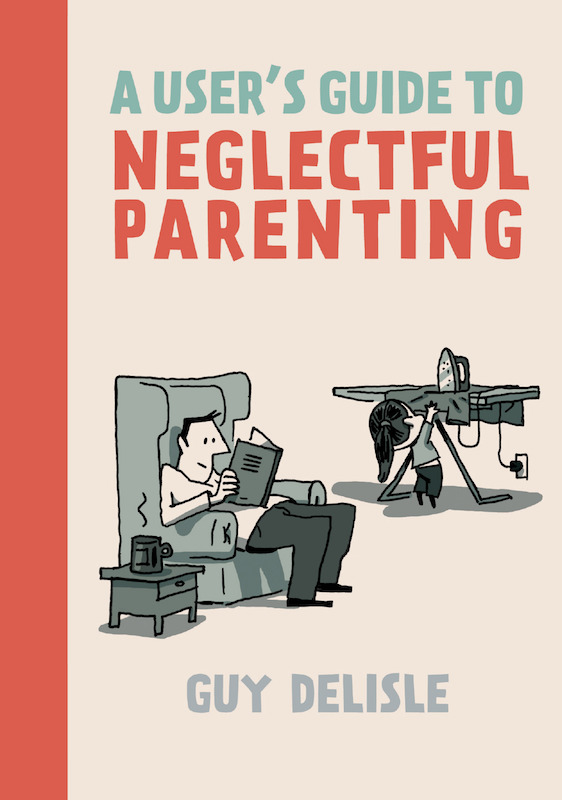
A User’s Guide To Neglectful Parenting

A User’s Guide To Neglectful Parenting, By Guy Delisle Translation: Helge Dasher.
By Guy Delisle
Translation: Helge Dascher

Guy Delisle has earned a reputation as a cartoonist who portrays himself as a hapless explorer. In my review of Jerusalem, I wrote “Noting the strangeness of a place may not be particularly insightful analysis, but it works perfectly for Delisle. His stockpiling of numerous insignificant details mirrors how most clueless Westerners experience the rest of the world. Delisle has become the spokesperson for early stage culture shock because he never achieves true mastery of his subject. Not that he seems to care.” I also observed how raising a family has been increasingly taking up more of Delisle’s time and energy, making his travelogues even more rambling and incidental. His post-Jerusalem work hasn’t shown an appreciable evolution in his basic narrative style, but his storytelling in books like A User’s Guide To Neglectful Parenting have become more manageable by tightening their focus on one aspect of the cartoonist’s life. In this particular case, Delisle collects random anecdotes about his less than stellar approach to caring for two precocious children. And unlike his travelogues, there isn’t an arc connecting these separate incidents.

Delisle adapts the same everyman persona he’s used in the past. This works just as well in conveying his cluelessness when it comes to communicating with kids as it did with the locals of foreign lands. Only this time, he gets to be demonstrably angry and intimidating as a supposably adult authority figure. His level of self-absorption is just enough to be relatable to other harried parents. This results in the kind of dismissive condescension and obliviousness mixed with annoyance the average adult normally exhibits towards children. In the book’s opening story, Delisle neglects to replace his son’s fallen out baby tooth with money for two nights in a row. When the son begins to suspect his parents are the real Tooth Fairy (or its French equivalent), Delisle lies with “If it was us putting the money under your pillow, do you really think we’d forget two nights in a row?” When his son seems unimpressed with the amount of money he received for yet another tooth, a visibly upset Delisle pulls out a one-cent coin and gives the game up by making the threat "Next time I'm gonna give you this here instead of two euros!" The son’s open mouthed reaction is subtle, and hilariously appropriate to the occasion.

A User’s Guide To Neglectful Parenting, By Guy Delisle Translation: Helge Dasher.

In addition to resorting to those kinds of white lies, Delisle engages in even more of the usual parental shenanigans. He pretends to be more informed about subjects where he knows nothing. He feigns interest in his children’s activities. He inadvertently (or deliberately) terrifies them. He occasionally harangues them, especially his son for not showing more interest in traditional manly activities like fixing the house plumbing. Anyone who’s survived their childhood and remembers the hurtful things parents casually heaped on them will understand the often impassive expressions of Delisle’s kids. But they’re also the straight man bearing witness to his inappropriate behavior. When free to write about characters he genuinely cares about without tying them to a larger, sprawling travelogue, Delisle’s humor shapes up to be sharper and funnier.

In the book’s most curious anecdote, Delisle gets to be the curmudgeonly artist reflecting on his own status in the industry. When his daughter brings him one of her drawings for inspection, Delisle does what is expected of any parent and praises her young efforts. But after a slight pause, his inner editor takes over and he begins critiquing the drawing like it’s another magazine submission. He points out all its various technical flaws, then gathers himself once again and launches into an extended rant about young cartoonists and their unwillingness to put in the work and learn proper drawing skills: “I know what you're going to say ... You're going to tell me it's your ‘style’ and that you did it on purpose. Well, kiddo, let me tell you, there's a hell of a difference between drawing like a hack and having some kind of style. Not everybody's Art Spiegelman, you know."

Heh. I wonder from where a younger Delisle heard that from?

10/21/2017

She and Her Cat

Story: Makoto Shinkai Art:Tsubasa Yamaguchi Translation: Kumar Sivasubramanian Original Story: She and Her Cat: Their Standing Points (1999) by Makoto Shinkai.
Story: Makoto Shinkai
Art:Tsubasa Yamaguchi
Translation: Kumar Sivasubramanian
Original Story: She and Her Cat: Their Standing Points (1999) by Makoto Shinkai

She and Her Cat is one of many tales told around the world about pets showering their owners with unconditional love. Expanding on a five minute animation created by Makoto Shinkai, the manga goes a bit beyond the usual portrait of animal companions and their owners. The titular cat Chobi isn’t the main point of focus, but a POV character who provides a peek into the life of his owner, a young woman named Miyu. Because Chobi is just your average house cat, he doesn’t truly comprehend her behaviour. As a creature of habit, he simply notices when Miyu is becoming more anxious and slowly deviating from her daily routine. Then one day, she doesn’t come home. Unlike Chobi, we the readers have already surmised that Miyu is undergoing a bout of depression brought on by pressures from work and her personal life. Though the specifics will mostly elude us.

Shinkai isn’t really able to maintain the illusion of seeing events through Chobi’s limited perspective. There are a couple of scenes with Miyu were Chobi is entirely absent. And Chobi sometimes resorts to human concepts which should be beyond the understanding of any cat. But as a framing device, Chobi allows us to view Miyu’s life as a series of vignettes. The story begins in spring and takes place over the course of a single year. Chobi’s narrative voice makes the most sense when the cat is paying a high degree of attention to the tiny details, particularly those details pertaining to the changing seasons. His loving description of his own surroundings evinces an unexpected sensuality which is complimented by the atmospheric artwork of Tsubasa Yamaguchi, who’s particularly attuned to the varying quality of ambient light as it’s filtered and diffused by the environment. When matched with Shinkai’s quiet narrative, Miyu’s descent into depression synchronizes with the looming cold around her in a way that almost feels inexorable.

Story: Makoto Shinkai Art:Tsubasa Yamaguchi Translation: Kumar Sivasubramanian Original Story: She and Her Cat: Their Standing Points (1999) by Makoto Shinkai.

As Miyu gradually withdraws from all human contact, it would seem that the ingredients are being gathered for the making of a desolate winter. And this tracks with Shinkai’s penchant for bittersweet endings. But for once, this is a sunnier conclusion from him. He swerves away at the last minute, thanks to a timely intercession from Chobi. Shinkai charts a new course which renews his characters, thanks to the healing power of pets.

10/04/2017

More NonSense: SPX 2017 Edition

SPX 2017 banner.
Go to: SPX

Heidi MacDonald on this year's SPX.

Rob Clough on this year's SPX.

Kat Overland on this year's Ignatz Awards.

Matthias Wivel on Jack Kirby’s late foray into autobiographical comics, Street Code.

Tom King and David Finch talk about their creative process when writing Batman.

Seth Simons on the current neglect of The New Yorker’s Cartoon Bank, which licensed cartoons for secondary use. Cartoon Bank was established by Editor Bob Mankoff in 1992, and bought by the New Yorker in 1997:
The Cartoon Bank was a windfall for cartoonists, who in the late ‘90s and early ‘00s witnessed the market for single-panel gag cartoons dwindle from a handful of publications to virtually only The New Yorker. “I remember one particular check early on, probably my second or third check from the Cartoon Bank, was close to $8,000,” said one longtime cartoonist who was involved in the Cartoon Bank’s earliest planning sessions, and who requested anonymity to speak candidly. “As time went on, the returns weren’t as great, but they were still good—they were still two or three thousand dollars a month.” Alex Gregory, a contributor since 1999, described similar numbers. “I would regularly get checks for one or two thousand dollars,” he said. Mankoff, who had a bird’s-eye view of the company’s financials, spoke of cartoonists receiving residual income to the tune of $30,000 to $40,000 annually. The 1998 Times report notes that one cartoonist, Peter Steiner, had by that point received more than $30,000 in royalties for a single cartoon. 
In 2008, Mankoff handed off leadership of the Cartoon Bank to Condé Nast, who, it quickly became apparent, planned to operate the business with a lighter touch. “I consulted with them for many years after I left, urging them to support this business and commit to this business,” Mankoff said. “For their own reasons they decided that they’re not supporting it. There aren’t really any employees left. And those people who used to do those things”—licensing, custom books, original art sales—“have been let go. The people there are absolutely well-meaning, but they have no real idea of what this business is, who the cartoonists are, how you might leverage and maximize it.” 
Over the following years, the well dried up. The cartoonist who described an $8,000 check he received early on said he now sees at most a few hundred a month. Gregory said the same, as did several other cartoonists who I spoke too.
Mimi Pond lists the top ten graphic memoirs.

Matt Furie takes legal action using the DMCA against various alt-right groups.

Steve Foxe explains why Marvel's latest initiative, Legacy, won't save the company from declining sales.

Chris Ware on writing characters who come from a different background from him.

Charles Pulliam-Moore points out that the X-Men and the Mutants are not an ideal analogy for race, something I've been saying for some time now.

David Lewis on Muslim representation in comics.

Hayao Miyazaki and his portrayal of the supernatural.

Kevin Smith profiled by Abraham Riesman. Smith's early films wedded the 90s slacker ethic with unapologetic geeky obsessiveness, foreshadowing our pop culture landscape. However, his particular brand of storytelling hasn't aged very well. But while Smith has fallen out of favour as a film auteur, he's successfully reinvented himself as an online presence.

The Big Bang Theory serves as a continual reminder that Hollywood is committed to perpetuating the geek stereotype. Unfortunately, this tends to highlight some of the more negative aspects of fandom to the television audience.

Anders Nilsen explains why senators should vote NO on "Graham-Cassidy, the latest Republican attempt to dismantle Obamacare and rob people of their health care."
Anyone who follows my work at all closely probably knows that I have published two books about a particular illness and death and its aftermath. In March of 2005 my girlfriend at the time, Cheryl Weaver, was diagnosed with cancer – Hodgkins Lymphoma. Despite an initially positive prognosis the disease failed to respond to treatment, and in November of that year the disease killed her. In my books I didn't delve too deeply into the details of our particular odyssey through the health care system, but one relevant fact is that Cheryl didn't have health insurance. For several months before her diagnosis she had been dealing with a variety of what felt like unrelated, inexplicable, minor health issues. She hadn't gone to see a doctor because, at the time we couldn't afford it. The simple fact is that had she had insurance she may well have had a chance. And her story is far from unique. Lack of health insurance literally kills people every single day in America. Wealth should not determine who gets care in this country any more than it should determine who has access to the justice system or the political process. It doesn't have to be this way.
Lynda Barry has an advice column.

Star Trek: The Next Generation premiered on September 28th, 1987. It bestowed upon our pop culture landscape the great Patrick Stewart, the finest actor to ever grace the hallowed franchise. He would immortalize "Make it so," "Tea Earl Grey," "Shut up Wesley," not to mention his patented "Picard Manoeuvre." TNG's first season was pretty rough. And by that I mean it was practically unwatchable. But even early TNG succeeded in expanding the franchise with ideas that would go on to become essential to its worldbuilding.

Inhumans sounds like a crappy show made 20 years ago.

RIP Len Wein (June 12, 1948 – September 10, 2017). The legendary comic book writer was the co-creator of popular characters such as Swamp Thing, Wolverine, Nightcrawler, Storm, and Colossus. Bronze Age creators like Wein were among the first working professionals to rise from the ranks of organized fandom, and their work expressed sensibilities which placed them a lot closer to our modern fan-driven market.

TCJ posts an interview with Len from The Comics Journal #48, August 1979.

Sean T. Collins et al. lists the top ten film performances of the late Harry Dean Stanton (July 14, 1926 – September 15, 2017).

RIP Hugh Hefner (April 9, 1926 – September 27, 2017), founder of Playboy magazine, notorious for its glamour pinup pictorials. But at its height, Playboy also published notable cartoonists such as Jack Cole, Harvey Kurtzman, Will Elder, Jules Feiffer.

9/30/2017

My Lesbian Experience With Loneliness

My Lesbian Experience With Loneliness, by Kabi Nagata.
By Kabi Nagata
Translation: Jocelyne Allen
Letters: Karis Page
Cover Design: Nicky Lim

My Lesbian Experience with Loneliness opens with mangaka Kabi Nagata attempting to have sex while inside a Love Hotel room with an escort she hired from a lesbian escort agency. She’s sitting on one end of the bed wearing a terrified expression on her face. Nagata is 28 years old, never been kissed, never been in a relationship, and has only recently come to the realization that she prefers women. She’s spent most of her youth suffering from bouts of depression, manifested in her life as eating disorders, acts of self harm, an inability to hold down a steady job, or form lasting friendships. So, off course she’s scared. The book’s opening (and its risque cover) initially produced an expectation that this would be a story of sexual hijinks, the stress of dating, and the difficulties of being single in the modern world. But I suspect that those thoughts were conditioned by the consumption of too much Hollywood entertainment. What actually follows is an extended and earnest bout of self-examination, gradually leading Nagata to the realization about how much she’s been suppressing her own sexuality in order to fulfill her own preconceptions about responsible adult behaviour.

Nagata’s focus is narrow. She talks about the toll depression took on her own health with great candor. By her own telling, the problems began when she dropped out of university. The resulting loss of a sense of direction would make her extremely anxious. But even securing a part-time job fails to deliver for Nagata the sense of belonging she desperately craves. On the contrary, her self-harm and eating disorders escalate to the point she has to be hospitalized. In one of the most harrowing moments in the manga, Nagata is overcome by an intense desire to eat while in the middle of her shift. She starts stuffing a bowl of uncooked instant ramen into her mouth, but is forced to stop when she notices how the hard noodles have torn into her gums and caused Nagata's mouth to bleed.

My Lesbian Experience With Loneliness, by Kabi Nagata.

But this isn’t a tell-all book. Nagata’s increasing self-awareness forces her to confront how her emotionally stunted relationship with her parents has shamed her into feeling completely inadequate as a functioning adult. There’s a lot of ground to be covered here which Nagata declines to explore in greater detail. She also keeps her portrayal of other supporting characters similarly nebulous. They’re mainly described as either being disapproving or supportive towards her. Every act of kindness shown to her tends to overwhelm the inexperienced Nagata. This includes the escort from the book’s opening. As a mangaka, her primary source of information about sex are the doujinshi she’s read. And as a client, Nagata prefers to ignore the economic nature of the transaction she initiated and would rather project an artificial intimacy to their encounter. But it’s arguably an illusion she needs to maintain just to make it through what is to her a new experience.

The loosely drawn chibi style Nagata employs is both very conventional and a little unusual. Mangaka often use it for the bonus material included at the end of a manga volume, and it helps establish a tone of breezy intimacy between author and reader. But it’s not something typically employed for the long-form narrative. The most eye-catching part of the book's design is the pleasant tri-color scheme (black and white, plus pink) which belies the subject matter within. Otherwise, this aesthetic can sometimes appear a bit too generic.

My Lesbian Experience With Loneliness, by Kabi Nagata.

But it’s not hard to feel for Nagata. Her vulnerability is genuine. And it’s painful to witness her toil so hard to achieve any sense of self-worth after a decade of feeling useless. Whatever Nagata’s particular circumstances, there’s something all-too familiar about the struggle to overcome loneliness.

8/27/2017

Solanin

Solanin, By Inio Asano Assistants: Yuichi Watanabe, Takashi Kondo Translation: JN Productions Touch-up/Letters: Annaliese Christman Design: Amy Martin.
By Inio Asano
Assistants: Yuichi Watanabe, Takashi Kondo
Translation: JN Productions
Touch-up/Letters: Annaliese Christman
Design: Amy Martin

It’s no longer an original observation to point out that the boundaries between adolescence and adulthood have become hopelessly blurred. Stories about contemporary youth working through the disappointment arising from quashed dreams, failed relationships, unsatisfying career trajectories, while wondering when they’ll grow up, are familiar territory, especially to an audience living in developed nations. Nowadays, personal crisis is simply to be anticipated with every major turning point. I blame the economy for our present melancholia. At any rate, when Solanin was first published in english back in 2008 (the year I began this blog), there weren’t any manga around that closely resembled it. Most manga being translated at the time could probably be stereotyped as being focused on the more juvenile end of the emotional spectrum: fantasies featuring rebellious boys showing off their cool fighting moves or doe-eyed girls immersed in maudlin romance. But manga readers were already growing up, and publishers had to keep up by dipping into a greater range of works from Japan. Solanin can be excruciatingly beautiful in its down-to-earth realism. It’s a manga that will most likely resonate with anyone who's ever been accused of being a slacker, a dreamer, a snowflake, or a man-child. At over 400 pages, it’s an extended meditation on youth struggling with the contradictions of a modern society that pays lip service to self-expression while demanding its members tamp down on all that nonsense and grit it out. Making his official english language debut, creator Inio Asano doesn’t attempt to find an answer. He just keeps it intimate and personal with a small cast.

Solanin arrived when Naruto and Fruits Basket were still defining the manga aesthetic to many western fans. Asano’s art (with help from his credited assistants Yuichi Watanabe and Takashi Kondo) could still be recognized as manga in appearance, but certainly less kawaii in execution. His youthful cast often look uncomfortable inhabiting their own bodies. They haven’t yet completely shed their baby fat, or the gangly forms of their teenage years. And there’s the half-assed facial hair found on the male characters serving as a constant reminder of oncoming maturity still delayed. The visuals are not only as detailed as anything found in manga, but realistic to the point that they’re clearly being photo referenced. The overall results are not exactly attractive. Sometimes the cluttered backgrounds can even be a little distracting to the action taking place in the foreground. But the Tokyo of Solanin definitely feels lived-in: an actual city haphazardly composed of narrow and overcrowded streets.

Solanin, By Inio Asano Assistants: Yuichi Watanabe, Takashi Kondo Translation: JN Productions Touch-up/Letters: Annaliese Christman Design: Amy Martin.

Asano’s meticulous approach is designed to convey the mundane existence of Meiko Inoue, a twenty something women stuck in a dead end job working as one of Japan’s countless office ladies. She cohabits her riverside apartment with her boyfriend Naruo Taneda, whom she calls Taneda. He’s also ensnared in his own thankless work routine he couldn't care less about. Meiko sees in her colleagues nothing but moral compromise. “Adults are made of ‘who cares?'... As long as I’m not caught, who cares?... They pay well here, so who cares?” When she finally can’t stand being surrounded by their mediocrity, she quits. Meiko’s now free to pursue her passions, only to discover she has no clue as what to do with all her free time. Her unemployed status makes Taneda the primary breadwinner of the household, something he gradually comes to resent. Asano’s careful tracking of the growing fiction in their relationship is one of the highlights of the manga. Taneda says all the right things wanted from a supportive boyfriend when Meiko announces her decision to quit. But the subtle sadness expressed by his face and body tells an entirely different story. Taneda fails to meet Meiko’s eyes whenever they begin to have a heartfelt conversation. Before long, his inability to communicate his true feelings causes Taneda to fall into a funk.

But Taneda finds likeminded company in the form of his friends Rip and Kato. The three had formed a rock band during their time in college, and they continue to maintain it as a hobby of sorts. In the meantime, Rip and Kato have each settled into their own respective rut. Neither of them believe they’ll ever achieve anything of great consequence with the band. However, it’s not long before Meiko begins to prod them into taking it more seriously. This sets up the principal thematic conflict: whether it’s better to reach for your dreams even when they’re obviously unrealistic. Or is it better to coast through life knowing your limitations?

Solanin, By Inio Asano Assistants: Yuichi Watanabe, Takashi Kondo Translation: JN Productions Touch-up/Letters: Annaliese Christman Design: Amy Martin.

Asano spends the first half of Solanin slowly ramping up the tension between his young quartet. It’s delightful low-key stuff built around elliptical conversations that first seem to be heading somewhere, only to veer off when something new catches their attention. The little arguments that Meiko and Taneda have are the kind of fights which stem when people circle around the main topic they’ve been studiously avoiding. These many interactions work because of the expressiveness of Asano’s character designs. But there’s a huge plot twist that occurs at the very middle of the story which slightly alters the tone of the manga. What began as a quiet slice-of-life narrative suddenly becomes more dependent on noticeable dramatic beats to propel it towards a slightly more conventional destination. The kind expected of any emotional account of the performing artist trying to make it big in the industry. It isn’t an unambiguously happy conclusion for Meiko and company. Far from it. But Solanin sacrifices some of its initial realism to arrive at it.

For all that, the manga’s climactic concert scene is a thing of beauty. Comics as a visual medium can’t reproduce the aural qualities of music. But Asano manages to capture the mood of the concert through a forceful series of wordless panels. Witnessing their kinetic release as the band powers through with their instruments is immensely gratifying since it comes after many pages of rehearsal sessions that seem to go nowhere. It’s the one glorious moment of clarity they've been seeking, knowing that the complications of their lives will inevitably overtake them again.

Solanin, By Inio Asano Assistants: Yuichi Watanabe, Takashi Kondo Translation: JN Productions Touch-up/Letters: Annaliese Christman Design: Amy Martin.