Showing posts with label Komiks. Show all posts

11/13/2012

Ninja Girl Ko! Indie Special #1-2 and Video Girl Ai Vol. 15

Today's reviews are all about the kind of girls shonen manga fantasizes having around the house - inexplicably loyal to the passive male whom they happen to share the same roof.

Ninja Girl Ko! Indie Special #1-2 by Marco Dimaano, Kriss Sison
Ninja Girl Ko! Indie Special #1-2
by Marco Dimaano, Kriss Sison

Ninja Girl Ko! began in the pages of the original pinoy manga anthology Mangaholix in 2007. With that magazine no longer an ongoing concern (as far as I can tell. Their website hasn't been updated lately), series creator Marco Dimaano has decided to go the self-publishing route, resulting in a big drop in production values. Succeeding the previous glossily colored work, NGK lives on as a pair of cheaply-printed minis. Ironically, this change brings the comic much closer to the look and feel of Japanese manga magazines.

NGK takes its cues from traditional shonen tropes from the Eighties. Filipino teenager Anton Alcazaren wanders into the woods during a school excursion, where he runs into Michiko Yamashita, a beautiful kunoichi and surviving daughter of a WWII-era Japanese soldier. At first enraging her with his patented clumsiness, he manages to earn her loyalty by saving her life. Michiko follows Anton back to Manila and becomes his bodyguard/housekeeper. But it isn't long before her presence attracts the unwelcome attention of a shadowy nativist organization called The Kamao. While the premise sounds like the setup to a domestic farce along the lines of Ranma 1/2 or Tenchi Muyo, both the artwork and preference for combat hews closer to later series like Naruto and Bleach.

Ninja Girl Ko! Indie Special #1-2 by Marco Dimaano, Kriss Sison

The story has not yet gotten too far, so the two indie specials are a suitable enough jumping on point for new readers. Prior events are summarized and things pick up where they left of. In order to pay to replace a previously wrecked bike, Michiko enters an underground cage-fighting tournament. She easily thrashes the competition, but is then attacked by an equally skilled escrimador. Naturally, she's also a cute teenage girl. Named Maya Luna, she's later revealed to be working for The Kamao. Much of these two issues is devoted to building her up as a worthy martial arts rival to Michiko. And she's contrasted as the short-haired, genki girl equivalent to Michiko's more reserved personality.

The change in format seems to have freed-up series artist Kriss Sison. He's more willing to break with the grid and utilize a more Japanese style of layout. The results are more elaborately staged fights scenes accompanied by more "decompressed" storytelling. And the computer coloring of the past is now replaced by more straightforward stippling. The upshot though is that the series is now paced like mainstream shonen manga, while subject to the irregular release schedule of an indie comic. This could get much more irritating with the passage of time.


Video Girl Ai Vol. 15 by Masakazu Katsura
Video Girl Ai Vol. 15
by Masakazu Katsura

Any knowledgeable fan who's read Video Girl Ai could have predicted that nonentity/wish fulfillment character Yota Moteuchi would end up with magical helper Ai Amano. That's how the formula goes. How the story arrives at that endpoint is what attracts the reader to a particular series. Masakazu Katsura accomplishes this through a mixture of tortuous personal growth and shameless fan service. Characters are often expressing their niggling insecurities through extended monologues. Then the scene suddenly shifts to someone staring at some cute girl's ass. The pain and suffering isn't always confined to people's headspaces. There are scenes involving actual torture, assault, and attempted rape. Then there's the fantasy elements embodied in Ai. Unlike other would-be magical girlfriends, she exudes spunk. Her tomboyish behavior doesn't make her immediately attractive to Yota, so it's a slight subversion when he begins to favor her over the more traditionally feminine love interest. Not that this hasn't been seen before in romantic comedies were the leads start out hating each other before they fall in love at the end. However, the meaning of Ai's very existence is tied to getting Yota a girlfriend. So when she begins to develop feelings for him, her mission is not only deemed a failure, her life becomes imperiled as well.

The saga of Yota and Ai lasts for an emotionally-laden thirteen volumes. But rather than ending there, the last two volumes of the series feature side stories involving a different cast of characters. I skipped reading Vol. 14, which forms the first part of "Len's Story". I didn't really find that I missed much, as the it mirrors a lot of the main narrative. Hiromu Taguchi is a Yota version 2.0, and is helped by new Video Girl Len Momono, whose personality and appearance is also very similar to Ai's. The main difference is that the emotional issues Hiromu faces are resolved a lot more quickly and with less fuss. The last volume apparently ended with Hiromu thrown into turmoil over rumors about his love interest Ayumi Shirakawa. Vol. 15 starts with Len berating Hiromu for thinking less of Ayumi just because she might not conform to his virginal fantasy of her. It's very candid for a shonen romance. But hey, it turns out that the rumors are lies being spread by Aumi's conniving ex-boyfriend. The ex is confronted. Problem solved. When Hiromu starts to take Ayumi for granted, triggering the couple's first big fight, Len tells him to rediscover what he loves about her through art. Len is a repository of practical dating advice, embodied in a cheerful and assertive teenage girl. It's a more lighthearted approach. But the relative brevity of "Len's Story"  doesn't allow much room for its cast to establish a stronger separate identity from the main cast.

The last story "Video Girl" is actually an early prototype for the entire series. The art is a lot less refined, the visual gags are a bit more obvious, the humor tends towards slapstick, and the characters' personalities are portrayed in broader strokes. Compared to what came after, it fares badly. So it's more of a curiosity than integral reading material.

10/28/2012

Komikon 2012

The Philippine comic industry's largest flea market held its annual Fall event yesterday. I didn't plan to attend, but was able to drop by during the morning rush. I didn't stay long, didn't purchase much, or take many photos, So I don't have much to say. Komikon was held at the Bayanihan Center again, and I noticed some changes to the event this year. Here are a few hasty observations:

Komikon has always had problems facilitating smooth foot traffic, even in the Bayanihan Center. The exhibitor tables are placed too close together. This year, they tried to alleviate some of this by exiling some of their exhibitors to the smaller conference rooms, namely the Indie Tiangge (Indie Comics) and Komiks Kalye (Artists Alley) sections. And the event still felt like it was at capacity.

I still don't see the point of Komiks Kalye, other than to sell pricey sketches. See my comments from last year.

Seriously, every nook and cranny of the building was being used for something. A whole bunch of local booksellers were crowded in the lobby, just outside the entrance to the main hall, next to the food vendors. I felt pretty bad for them.

Then there was a makeshift studio set up for attendees to pose as if they're characters on a comic book cover. Apparently there was some contest organized between the convention and the photo studio. Not sure about the point of that either.

They skimped on printing an event guidebook this year, or I didn't receive one. I did notice that they were handing out an official tote bag, free to the first one hundred attendees. 100 PHP for everyone else. No way was I paying for that.

The one thing I regret not buying was the Kate Beaton book. What can I say? Poverty sucks.

On to the photos. I saw the usual mixture of familiar faces and ambitious newcomers hawking their minis and graphic novels. I was unable to label the exhibitors for this year. But if you're one of the people pictured below, drop me a line and I'll identify you in this post.

Ninja Girl Ko!, Komikon 2012
Exhibit Hall, Komikon 2012
Kanto Inc., Exhibit Hall, Komikon 2012
Tepai Pascual, Exhibit Hall, Komikon 2012
Exhibit Hall, Komikon 2012
Callous, Exhibit Hall, Komikon 2012
Trese, Exhibit Hall, Komikon 2012
Exhibit Hall, Komikon 2012
Tondo Drift, Exhibit Hall, Komikon 2012

9/25/2012

Please Don't Browse

Comic Quest, SM Megamall, Ortigas

I'm in absolute agreement with Chris Schweizer when he states that one of the pleasures and advantages to visiting a bricks-and-mortar comic book store is the ability to peruse the comics before making the decision to buy them. I've also enjoyed the open-ended delights of wasting as much time as desired shopping at a well-stocked comic book store or bookstore. But that's not the case everywhere. His post made me reflect on how differently Filipino comic book stores deal with customers who like to browse. To put it bluntly, they kind of suck.

The first truly tangible Direct Market presence in the Philippines (as far as I can remember) was in the early Nineties, riding on the speculator-driven boom of the time. The most important retailers were Filbar's and Comic Quest. Business must have been good, because back then the two franchises dueled so fiercely it wasn't unusual to find competing branches at any large shopping center. Things haven't gone so well since, as both have scaled back their operations and diversified their offerings to the point were when one enters their stores, it either looks like a hobby shop or a newstand. But in terms of store layout, they were virtually identical. Both would bag or shrink-wrap their floppies and graphic novels, and put them behind the counter. Needless to say, this made it difficult for customers to examine the comics. They could if they wanted to, but that meant asking one of the uniformed salesladies (It was always a young woman) to pull a copy of the rack since they were the only people allowed access to them. So customers got a lot of individual attention, whether they wanted it or not. And as you can imagine, it's not easy finding enjoyment in a comic when someone's hovering over you. But at least the clerks (to steal a cliche from Tom Spurgeon) never had to yell at some no-good kid for messing-up the racks and not purchasing anything.

Things haven't changed that much. In the newer stores, the shelves are now located over-the-counter. But a lot of them still practice bagging and shrink-wrapping their comics. Or even funnier, putting them behind sliding glass displays. Oh well, I guess it keeps them safe and in good condition.

This is something I took for granted for a long time because that's just the general retail culture of the country. You can walk into any regular bookstore and expect to find that some of the books are bagged or shrink-wrapped. If National Bookstore doesn't exactly encourage leisurely browsing, don't expect anything different from the majority of comic book stores.

3/30/2012

School Run #2-4 and Dekada

Yay, more komiks reviewed.

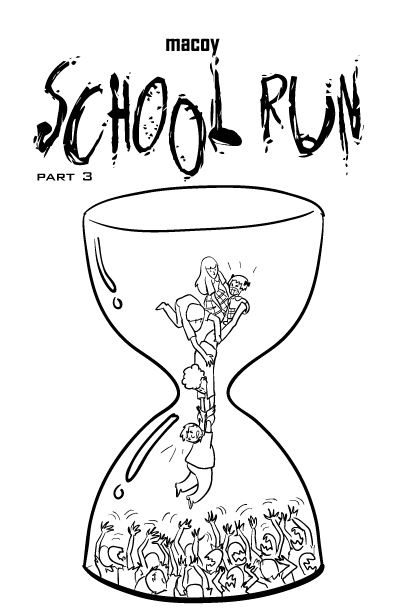
School Run #2 by Macoy TangSchool Run #3 by Macoy TangSchool Run #4 by Macoy Tang
School Run #2-4
by Macoy Tang

Go to my review of #1

Macoy's story of cute munchkins meeting flesh eating zombies escalates the gore and violence, and adds more twists and near-escapes. After having their school bus overrun by an unexpectedly large zombie horde, a handful of students race against time while navigating the treacherous urban terrain in order to make it to safe ground. Along the way they bear witness the best and worse of human nature. And more is revealed about the zombie plague.

The story moves at an economically fast clip, with plenty of emphasis on nonstop action and the zombie fighting. If I have one complaint, it's that the individual minis are so slight that there's not enough time to connect with the main characters or the world they inhabit. Hopefully the pace slows down a bit, but so far this is been an amusing, if at this point an all too quick ride.

Dekada by Lyndon Gregorio
Dekada
by Lyndon Gregorio

The popular Beerkada comic strip has been running in the Philippine Star since 1998, and this particular book compilation marked its tenth anniversary when it first came out. The cartoon's target demographic is mirrored by its young adult cast, and is meant to identify with their travails as they confront the usual growing-up experiences of college, dating, relationships, finding a job, or finding a life mate. And it's rendered in a streamlined, blocky style that many newspaper cartoons are drawn in these days.

The strip's main weakness is that the cast is often reduced to hooks used to hang its topical humor on, which contrary to the politically-charged cover, primarily addresses pop culture trends affecting Filipino youth that happen to interest creator Lyndon Gregorio.* They're mostly structured as three panel gags, with some extra material is thrown in to attract collectors. The gags themselves vary from occasionally insightful to plain forgettable (the majority of them leaning towards the latter), with a large number already becoming dated after only a few years removed from their original context. When read in large chunks instead of its original format of daily installments, they appear more chaotic than informative. And the usually oblivious behavior of its characters makes them come across less as distinct individuals than as a collection of annoying quirks.
____
* It also contrasts with a well-known novel with a very similar title.

3/15/2012

WIP #1 and Trese: Last Seen After Midnight

Hey, I finally read some komiks this year! Good for me. Now on to the reviews.

WIP (Work in Progress) #1 by Hub Pacheco and Teddy Pavon
WIP (Work in Progress) #1
by Hub Pacheco and Teddy Pavon

WIP first began as a webcomic before seeing print as a mini. Its first ten pages introduce the reader to the main protagonist Eli, a twenty-something slacker and principal narrator who often addresses the reader directly. In the beginning, he's rendezvousing with an attractive girl in front of a comic book store. This opening is the best part of the comic. But the story suddenly breaks away in order for Eli to talk more about his background.

While I wanted to to sympathize with his plight, Eli comes across as more ingratiating than interesting. This is because he's a fairly generic character. His constant patter of fanish in-jokes gets tiresome after awhile. And much of the comic's content can be described as him and his circle of friends rambling on about various geeky topics with little in the way of a strong connecting thread. One moment they're reminiscing about their failed comic book from their college days, next they're praising the Philippine comic industry while mocking mainstream crossover events. Did I mention that in addition to being an underemployed man-child, Eli complains a lot about his inability to hook a girlfriend?

The loose, gag-filled structure isn't compensated for by the anime-inspired art though. It isn't adroit enough to make the gags more compelling, or versatile enough with the characters' expressions to make them more varied and charming. And the story never quite returns to address the opening scene of the comic. Some judicious editing could have helped a lot to tighten the narrative.


Trese: Last Seen After Midnight by Budjette Tan and KaJo Baldisimo
Trese: Last Seen After Midnight
by Budjette Tan and KaJo Baldisimo

I believe it's been two years since the last volume featuring Alexandra Trese, Manila's renowned supernatural crime-fighter. Given how that book contained a story arc which engaged in some serious world-building, it's slightly disappointing that the series creators have gone back to the "corpse of the week" format. But the riffs on popular culture are entertaining in their own right. Their preferred mode is to blend well-known Manila landmarks with various local folklore and superstitions. The first story "Cadena de Amor" about elemental spirits haunting the darker recesses of Luneta Park is the most typical entry. "A Private Collection" is jarring in that the main antagonist is patterned after the stereotypical big game hunter who hunts more unusual creatures just for the thrill of it. This makes it feel more like a conventional superhero story. The more hip "Wanted: Bedspacer" in which a rash of student deaths taking place close to several college campuses is connected with another kind of spirit, seems derived from contemporary Asian horror cinema. This is the book's best-paced story and is the only one in which Alexandra doesn't come up with the right answer on her first guess, or resolve the problem with violence. That's countered with "The Fight of the Year", a rousing patriotic tale in which an analog of the famous boxer and local hero Manny Pacquiao battles the underworld on behalf of the nation. For once, Alexandra is a spectator and supporting character.

While the book doesn't break new ground, the level of skill and artistry on display shows significant improvement from earlier efforts. The stories themselves aren't particularly terrifying, although they can be creepy and oppressive at times. There are a few references made to past events to keep readers guessing about continuity. So it's a no-brainer for fans of Trese. But the stories are also self-contained enough that new readers could probably use them as a jumping on point, which might be the reason for the return to this format.

11/24/2011

Komikon 2011 Part 2

Go to PART 1 for more details.

Here are a few photos taken from the afternoon I spent at the 7th Annual Philippine Komiks Convention held at the Unilab Bayanihan Center.

Exhibit Hall, Komikon 2011

A few of the komik creators exhibiting at Komikon

Comic Odyssey, Komikon 2011Comic Odyssey, Komikon 2011

The section of the Comic Odyssey booth selling manga, and a few Western graphic novels from another vendor. Anyone looking to buy some defunct Tokyopop volumes could get them for a bargain.


Kurohiko, Komikon 2011

Pinoy manga from the Kurohiko table

Bayan Knights, Komikon 2011

The Bayan Knights superhero line from Sacred Mountain Publications

Trese, Komikon 2011Never Heard

Trese merch and a banner for Never Heard webcomics

Teddy Pavon, Work in Progress (WIP), Komikon 2011

Teddy Pavon selling print copies of his webcomic Work In Progress (WIP)

Happy Lockjaw, Komikon 2011

Komiks from the Happy Lockjaw table

Exhibit Hall, Komikon 2011

Another wide-angle shot of the Komikon exhibitor tables

Tony DeZuniga, Syeri Baet-Zamar, Komikon 2011

Tony DeZuniga being interviewed by Syeri Baet-Zamar

Tony DeZuniga, Komikon 2011

Tony DeZuniga prepares to leave the stage

Carlo Vergara, Komikon 2011

Carlo Vergara sketching

Tony DeZuniga, Komikon 2011Tony DeZuniga, Komikon 2011
Tony DeZuniga, Komikon 2011

Tony DeZuniga sketching with his portfolio

Gerry Alanguilan, Komikon 2011

Gerry Alanguilan signing copies of his award-winning graphic novel Elmer

Michael David and Melvin Calingo, Komikon 2011

Michael David and Melvin Calingo at the Point Zero Comics table

That's all for now folks. See you next year, or not.

11/21/2011

Komikon 2011 Part 1

Exhibit Hall, Komikon 2011


When I visited last year's Komikon, I noted the problems the growing convention had to confront. So how does the 7th Annual Philippine Komiks Convention stack up to what came before? The following are a few broad observations about the event based on the short amount of time I attended it:

The Venue

- Komikon changed venues for a third straight year as it tried to anticipate the logistics of running what is the biggest event of its kind in the country. This year it was held at the Unilab Bayanihan Center. With its high ceiling, wood paneling, and powerful air conditioning, this ballroom-sized hall was the largest and ritziest location to host Komikon to date. It's also the first to have decent bathrooms, which is a big plus. Clearly, Unilab takes good care with the upkeep of this place.

- As a facility owned by a pharmaceutical company, Bayanihan is located in a more industrial-looking part of the city. It's not too distant from the main commercial centers in Pasig, but it's far enough to limit casual foot traffic from dropping in. So it does feel a bit isolated and not the most accessible place without a car. Another problem with the location is that apart from a small supermarket across the road, there weren't many places to shop and eat. The convention had to organize several food vendors to cater for the event. So dietary options were sparse. There were no ATMs within the building, which limited attendees spending cash to what they had on hand, unless they wanted to hop in a car and drive around to the nearest mall.

Attendance

- Despite the more ample space, the hall was beginning to fill-up by noon. So its safe to say that the constantly shifting venues did not discourage most attendees. The overall vibe was positive and even enthusiastic. Komikon is a one day event. But how long will it be until future attendance increases to the point were it can be justifiably transformed into a weekend-long event? I believe that the entrance fee rose from last year's event held at Starmall, although my memory might be faulty.

Programming

- Like many American comic conventions, the showroom of Komikon had a certain flea market feel to it. Everyone was crammed into one big room. But it's a situation that can be alleviated by splitting-up the attendee crowd through the use of varied programming. In my experience, this is something Filipino conventions have yet to master. Komikon is no exception. Like last year, a stage was set up at the far end of the hall, which was used for a variety of purposes. And likewise, there was no seating to encourage attendees to listen attentively, or a partition to help block out the crowd. When the soft-spoken Tony DeZuniga took to the stage for a Q&A session, the only people who could make out his answers above the din were the people standing within ten feet of him. A screening of Comic Book Literacy was not only barely audible, but a mishap with the DVD player cut it off at around the halfway point. As film premieres go, that was a major faux pas.

Rommel J. Estanislao books, Komikon 2011

- These kinds of screw-ups demonstrate that Komikon is only beginning to grasp the effectiveness of varied programming. There's a lot of room for improvement before it can match its more established stateside counterparts. Multimedia presentations are nice, but if they're done half-assed, they'll completely suck. Hopefully in the future, Komikon will expand its Q&A panels and media programming to the point were they can justify placing them in separate rooms. This is one way to help alleviate the crowding in the showroom.

- I wasn't around for it, but at least the Komikon Awards were back.

The Showroom Floor

- Komikon instituted its first official "Artists Alley", which they dubbed "Komik Kalye". I honestly don't get why an event like Komikon even needs an Artists Alley, and the Komikon variant was a complete inversion of the concept. It was populated by young Filipino artists who made it big working for mainstream American publishers, and they were charging relatively exorbitant fees (Starting from ₱300) for sketches. Without an ATM nearby? No thank you.

- Two of Komikon's special guests, Tony DeZuniga and Gerry Alanguilan, are veterans of the American comics industry. Gerry is more or less a convention regular anyway, so whatever. But Tony flew in from the US, which was really cool of him. I hope he's enjoying the rest of his trip. At one point he started to talk about how local airport security hassled him about the metallic cane he uses to get around. But I'll be damned if I heard any of it (see "Programming" above).

- People who have attended events like MOCCA or SPX will find here a somewhat different take on what constitutes "indie" comics. Truth is, virtually everything local is indie when what dominates the market are foreign products from America and Japan. Walk around the showroom floor of Komikon, and between the Filipino superheroes, high fantasy, gag strips, and manga pastiches, an attendee has to squint hard to find something that resembles "alternative comix" as critics usually understand the term. The unspoken purpose of Komikon is to affirm that Filipinos can make comics at all, and the wide divergence of genres is used as a prop for this argument in order to help convince local fans to buy Pinoy.

- Maybe the presence of an Otaku Gear booth on the floor warped my perspective, but I felt that the manga contingent showed up more in force this year. I was certainly doing more double-takes because of the cosplayers I'd occasionally spot wandering the tables. Do all the creators working on their manga-inspired books even need Komikon as an event at this point? It was hard to ignore all the Pinoy manga because they had some of the most colorful covers populated by the cutest, moe characters.

- Webcomics continue to be an afterthought, but I noticed more creators hawking an actual webcomic, as opposed to a DeviantArt page, this year. But as with last year, most webcomics I saw tended to be comic strips that began in print before spawning a web incarnation.

- Retail chain Comic Odyssey took advantage of the Bayanihan and had the largest and most crowded exhibitor booth. They were making a brisk trade selling manga and mainstream graphic novels at steep discounts. The prices for old manga volumes were so cheap, they were actually a better value purchase than the minis being sold in the showroom.

In Conclusion

Komikon was crowded, noisy, and fairly chaotic. It's made a couple of steps to expand its offerings, but isn't a slick product by any stretch of the imagination. The convention continues to feel its way forward and feed off the energy and devotion of fans looking for a focal point for their passion.

Update: Go to PART 2 for more about Komikon.

Independent Made Manga, Komikon 2011