Showing posts with label Euro-Comics. Show all posts

1/24/2018

More NonSense: Election 2016

2016 Electoral Map by Randall Munroe.
Go to: xkcd

Alan Cole loves Randall Munroe's visualisation of the 2016 electoral map.

TCJ has an interview with NBM founder Terry Nantier.

The late Annie Goetzinger profiled by TCJ.

Christopher Priest and his work on Black Panther is profiled by Abraham Riesman.

An unnamed nursing company has accused Stan Lee of repeated sexual harassment; Lee has in turn claimed that he is the victim of a shakedown.

In the latest chapter of DC's deteriorating relationship with Alan Moore, his creation Promethea will be incorporated into the DC Universe. Neither Moore or co-creator J.H. Williams III were consulted:
So, this is without affording me the dignity hearing about it from proper channels. I've not brought this to Alan's attention, doubt he knew, until now. Besides that, I can't in good conscience condone this happening in any form at all.
Lea Hernandez has repeatedly apologised for her work on the defunct Marvel Mangaverse, calling it racist. Lea was the artist for the Mangaverse version of the Punisher. She the urged the publisher to stop reprinting the comics:
Speaking of being a casually racist asshole, I did art for the Marvel Mangaverse Punisher, written by Peter David. It’s racist, and I was uncomfortable when I drew it, but it had been written by Peter, a friend, and approved by an editor.

The main characters, Japanese-Caucasian sisters, were named Hashi Brown and Sosumi Brown. (Update: there’s also a female villain named “Skan Kee Ho.” There was exotification of Asians. I depicted Sosumi, the Punisher, in a sexy kimono alá manga art of “bad” women even as I was careful to dress Hashi in a “schoolgirl” uniform that was mid-thigh length shorts and a jacket, alá Utena. Because I was sick of the sexualization of children, but didn’t grasp that exotification needed to be off the table, too...  
To anyone who was hurt by the racism in Marvel Mangaverse Punisher, of which I was the artist, I offer my deepest apologies. I can’t change the circumstances that led me to be afraid of pushing back, but I am changing how I conduct myself going forward.
I also apologize for taking 17 years to fully comprehend an apology and being accountable for the work was in order... 
Since it’s been reprinted recently, it’s too late to ask Marvel to stop this reprinting Mangaverse Punisher. It’s not to late to ask them to quit reprinting it, though. Marvel, please quit reprinting Mangaverse Punisher. It’s racist.
Apparently, none of the major corporate interests are moving to extend copyrights, despite their imminent expiration as soon as next year.

12/31/2017

More NonSense: Best of 2017, Part 2

My Lesbian Experience With Loneliness, by Kabi Nagata.
The Verge considers them the 10 best comics of 2017.

Ars Technica rates 10 excellent comics that flew under the radar in 2017.

The Beat thinks these are the Best Comics of 2017.

io9 thinks these are the Best and Worst Moments in the Comics of 2017.

PW releases their 2017 Annual Graphic Novel Critics Poll.

The Nib looks back on 2017.

Ken Partille looks back at Ghost World.

C.B. Cebulski offerred an apology about masquerading as Akira Yoshida that many would characterise as a non-apology. Asher Elbein, Charles Pulliam-Moore, Tom Spurgeon, Brian Hibbs offer analysis.

Mark Hamill responds to the fan backlash empowered by his early comments about The Last Jedi. He's also expressed some disagreement with his last minute appearance in The Force Awakens in previous interviews, before walking back his comments.

It's now one year since Carrie Fisher's passing. Here are a compilation of her best interview quotes.

Apparently, some of the audience were confused by a pivotal scene in the movie were everything goes quiet.

The ecumenism of A Charlie Brown Christmas. Here's another one.

RIP Annie Goetzinger (18 August 1951 – 20 December 2017) celebrated French comics creator.

11/18/2017

5,000 km Per Second

5,000 km Per Second, By Manuele Fior Translation: Jamie Richards Book Design: Michael Heck.
By Manuele Fior
Translation: Jamie Richards
Book Design: Michael Heck

5,000 km Per Second is a love story spanning the lives of two Italians named Lucia and Piero. The comic begins with their first teenage flirtation after Piero notices Lucy settling into an adjacent apartment and is immediately smitten by her appearance. Egged on by his best friend Nicola, the chapter ends with Piero making an awkward effort to catch Lucy’s attention. The narrative feels set to explore the unfolding tale of their first love. Instead, the start of the next chapter is set several years later and in a different country. Lucy and Piero have since broken up and are pursuing their separate careers. The succeeding chapters flit back and forth between their respective lives. And it ends with a bittersweet attempt to reconnect from the now two middle aged former lovers, significantly worn down by the intervening years. This is a story of how romantic relationships fail without showing the relationship itself, and without the plot contrivances usually employed in more glamourous Hollywood productions.

What compounds the deceptiveness is the ink and brushwork of Manuele Fior. The lush tones and bright palette are initially inviting and even indicative of a certain youthful naivete. And every change in location carries with it a sense of hopefulness. Fior’s expressionist figures are reminiscent of Paul Cezanne or a young Pablo Picasso. Their sensuous quality combined with the delicacy of Fior’s watercolors imbues every place with an exoticism that evokes the excitement of traveling to foreign places for the first time. Whether it’s Lucy studying the works of Henrik Ibsen while overlooking a lovely fjord in rural Norway, or Piero participating in an archeological dig in Aswan.

5,000 km Per Second, By Manuele Fior Translation: Jamie Richards Book Design: Michael Heck.

But the mood changes at the midpoint as Lucy and Piero slowly become disconnected from their environments. The initial excitement fades, only to be replaced by a sense of alienation. What once looked beautiful becomes oppressive. Time marches relentlessly forward, as expressed through the comic’s meticulous use of three-tiered rows of panels. The colors start to fade as if in response to their internal change. Lucy and Piero's attempts at cosmopolitanism only go so far. The local inhabitants remain mostly strangers or adversaries. The new country doesn’t become a second home. And returning to the old country doesn't provide any greater sense of belonging. When the much anticipated reunion finally takes place, Lucy and Piero’s accumulated life experiences and differing perspectives have created a vast gulf separating them. And yet, every relationship and heartbreak they’ve experienced separately is haunted by the shared memory of their first love. The memory which emerges from their meeting succeeds in interrupting the comic’s forward progress and allows for a flashback to circle the narrative back to the brightness of the first chapter.

But it’s only a momentary relief before life, in all its glorious indifference, forces them both to keep muddling forward.

11/11/2017

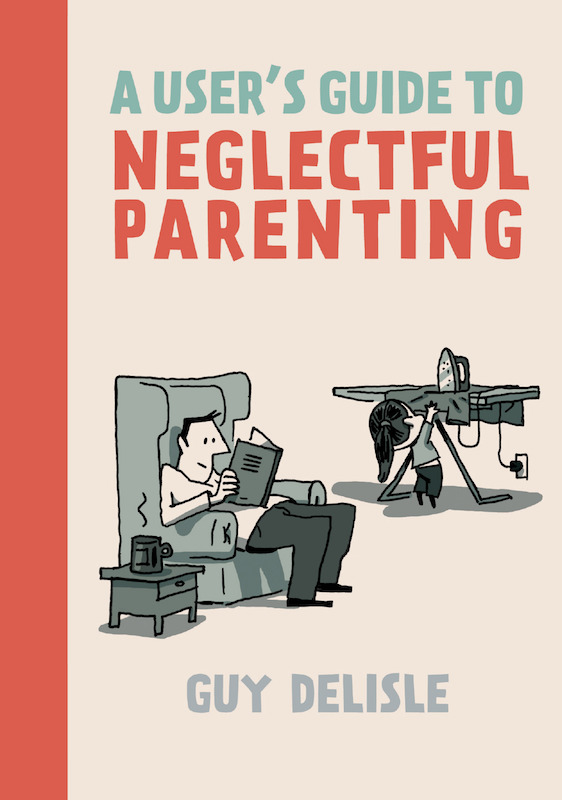
A User’s Guide To Neglectful Parenting

A User’s Guide To Neglectful Parenting, By Guy Delisle Translation: Helge Dasher.
By Guy Delisle
Translation: Helge Dascher

Guy Delisle has earned a reputation as a cartoonist who portrays himself as a hapless explorer. In my review of Jerusalem, I wrote “Noting the strangeness of a place may not be particularly insightful analysis, but it works perfectly for Delisle. His stockpiling of numerous insignificant details mirrors how most clueless Westerners experience the rest of the world. Delisle has become the spokesperson for early stage culture shock because he never achieves true mastery of his subject. Not that he seems to care.” I also observed how raising a family has been increasingly taking up more of Delisle’s time and energy, making his travelogues even more rambling and incidental. His post-Jerusalem work hasn’t shown an appreciable evolution in his basic narrative style, but his storytelling in books like A User’s Guide To Neglectful Parenting have become more manageable by tightening their focus on one aspect of the cartoonist’s life. In this particular case, Delisle collects random anecdotes about his less than stellar approach to caring for two precocious children. And unlike his travelogues, there isn’t an arc connecting these separate incidents.

Delisle adapts the same everyman persona he’s used in the past. This works just as well in conveying his cluelessness when it comes to communicating with kids as it did with the locals of foreign lands. Only this time, he gets to be demonstrably angry and intimidating as a supposably adult authority figure. His level of self-absorption is just enough to be relatable to other harried parents. This results in the kind of dismissive condescension and obliviousness mixed with annoyance the average adult normally exhibits towards children. In the book’s opening story, Delisle neglects to replace his son’s fallen out baby tooth with money for two nights in a row. When the son begins to suspect his parents are the real Tooth Fairy (or its French equivalent), Delisle lies with “If it was us putting the money under your pillow, do you really think we’d forget two nights in a row?” When his son seems unimpressed with the amount of money he received for yet another tooth, a visibly upset Delisle pulls out a one-cent coin and gives the game up by making the threat "Next time I'm gonna give you this here instead of two euros!" The son’s open mouthed reaction is subtle, and hilariously appropriate to the occasion.

A User’s Guide To Neglectful Parenting, By Guy Delisle Translation: Helge Dasher.

In addition to resorting to those kinds of white lies, Delisle engages in even more of the usual parental shenanigans. He pretends to be more informed about subjects where he knows nothing. He feigns interest in his children’s activities. He inadvertently (or deliberately) terrifies them. He occasionally harangues them, especially his son for not showing more interest in traditional manly activities like fixing the house plumbing. Anyone who’s survived their childhood and remembers the hurtful things parents casually heaped on them will understand the often impassive expressions of Delisle’s kids. But they’re also the straight man bearing witness to his inappropriate behavior. When free to write about characters he genuinely cares about without tying them to a larger, sprawling travelogue, Delisle’s humor shapes up to be sharper and funnier.

In the book’s most curious anecdote, Delisle gets to be the curmudgeonly artist reflecting on his own status in the industry. When his daughter brings him one of her drawings for inspection, Delisle does what is expected of any parent and praises her young efforts. But after a slight pause, his inner editor takes over and he begins critiquing the drawing like it’s another magazine submission. He points out all its various technical flaws, then gathers himself once again and launches into an extended rant about young cartoonists and their unwillingness to put in the work and learn proper drawing skills: “I know what you're going to say ... You're going to tell me it's your ‘style’ and that you did it on purpose. Well, kiddo, let me tell you, there's a hell of a difference between drawing like a hack and having some kind of style. Not everybody's Art Spiegelman, you know."

Heh. I wonder from where a younger Delisle heard that from?

5/25/2017

More Nonsense: Kung fu Kenny Edition

Go to: DNA, by Kendrick Lamar

Marvel had to release a statement to reassure fans, due to the backlash over its latest event Secret Empire.
At Marvel, we want to assure all of our fans that we hear your concerns about aligning Captain America with Hydra and we politely ask you to allow the story to unfold before coming to any conclusion.
1978 documentary The World of Comic Books is now available online. It's an interesting time capsule of the Bronze Age comics industry, complete with onomatopoeia (pow, swoosh, boom!), canned sound effects, and accompanying bombastic narration that could have been written by Stan Lee himself. The documentary even gets to throw shade at the casual sexism of comics fandom. But the best part is seeing artists such as Neal Adams, Jim Steranko and Trevor Von Eeden in their prime.

Nicola Streeten reports on two comics exhibitions: Shoah et bande dessinée and The Inking Women.

Jia Tolentino profiles G. Willow Wilson.

Christopher Butcher talks TCAF.

Tom Spurgeon reports from this year's TCAF.

It's time for the Jedi to end. And it just took 40 years.

Shawn Setaro on the connection between kung fu cinema and hip hop culture.

Robert Foyle Hunwick on the rise of Chinese fight clubs.

Maren Williams on the sedition charges brought against Fahmi Reza for portraying Prime Minister Najib Razak as a clown.

Charles Pulliam-Moore on the death threats levelled against transgender webcomic creator Sophie Labelle.

It boggles the mind that there are racist Star Trek fans who reject the cast of the latest series Discovery. It's Star Trek!

R.I.P. Roger Moore (October 14, 1927 –  May 23, 2017). He was the James Bond of my generation.

10/08/2016

Beautiful Darkness

Beautiful Darkness, By Fabien Vehlmann and Kerascoët (Marie Pommepuy and Sébastien Cosset) Translated by Helge Dascher.
By Fabien Vehlmann and Kerascoët (Marie Pommepuy and Sébastien Cosset)
Translated by Helge Dascher.


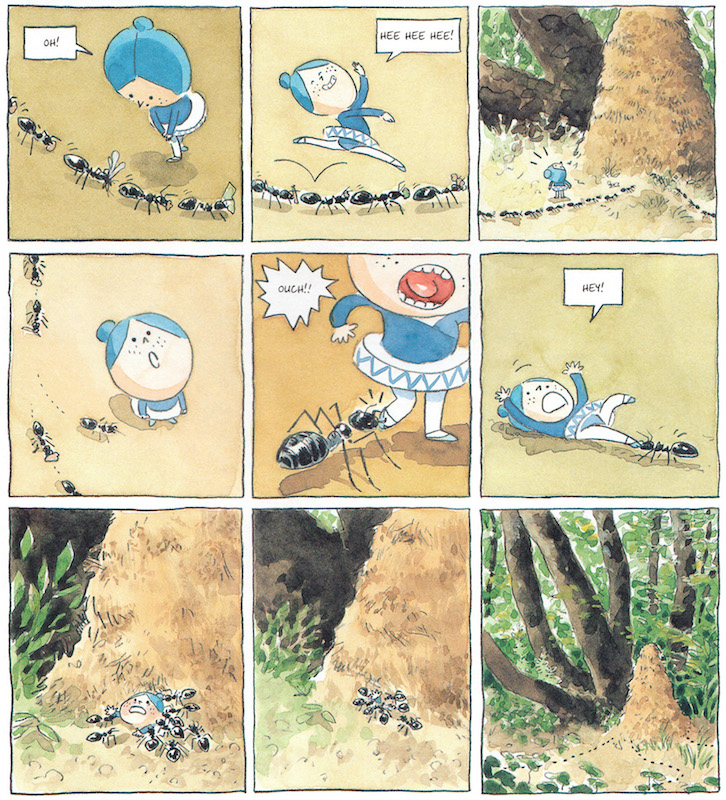
Beautiful Darkness is sort of a cruel joke played on readers who believe in the power of fairy tales. Or to be more precise the kind of fairy tales parents usually tell their kids when they want to assure them there is a higher power who punishes the wicked and rewards the innocent. In the later graphic novel Beauty (which was also drawn by Kerascoët in a completely different visual style), there are supernatural forces who interfere in the lives of mere mortals. No such beings exists here. Whatever magic is manifested is entirely earthbound and found only within human beings. But what happens when the moral order that guides them is dissolved and humanity’s constituent fragments are left to fend for themselves? BD explores in miniature what happens during the slow decay of civilized order and logic into the uncaring but much grander patterns of the natural world.

If this sounds very grim, the book’s narrative approach is disarmingly seductive. The story begins looking very much like a conventional children’s book illustrated in lush watercolors. A spritely blonde woman with large black eyes named Aurora is living a fantasy life as a princess. She’s having tea with her princely, redheaded beau Hector when their world suddenly begins to liquefy around them. As giant slimy globs fall, the denizens of this kingdom fight their way through the purification until they emerge into the open air. The reader is then made aware of the story’s first major twist: that their grand home is the body of a young girl who has died in the woods under mysterious circumstances.

Beautiful Darkness, By Fabien Vehlmann and Kerascoët (Marie Pommepuy and Sébastien Cosset) Translated by Helge Dascher.

The cause for the girl’s sudden death is never fully revealed, through an ominous full-sized adult figure keeps hovering in the background and will come to play an important role later on. Led by the irrepressible Aurora, the sprites attempt to rebuild their world around the girl’s rotting corpse like survivors eking out a living near the ruins of a crumbling city. The entire project starts out in good spirits, and everyone appears to be more-or-less cooperating with each other. But cracks soon appear as each character starts pursuing their own competing agendas.

BD’s narrative possesses a deceptive episodic structure. Everything starts out with an air of naive optimism. The incidents are mostly comical and seemingly inconsequential. But as the mistakes accrue, each mishap and misadventure pulls the sprites inexorably towards some terrible doom. Halfway through, there’s a growing sense that events have reached a point of no return. The sprites increasingly turn on each other and blood is spilled on a more regular basis. What starts out as an impromptu society has broken up into factions.

Beautiful Darkness, By Fabien Vehlmann and Kerascoët (Marie Pommepuy and Sébastien Cosset) Translated by Helge Dascher.

What enhances that dread is the cartoonishly cute manner of the sprites. This gives them a sense of vulnerability which stands in stark contrast to the humans and the natural setting, which are drawn with detailed realism. This visual contrast underlies a difference in scale. The magical beings are dwarfed by their surroundings, making them appear to be constantly in danger from attacks from the local fauna and exposure to the elements. But that scale mostly emphasizes the overall indifference that greets the sprites. For the most part, nature simply ignores them. And that kind of cosmic insignificance is so much worse.

The cartoony style is also key to making the sprites into instantly recognizable archetypes. There’s the shy wallflower, the manipulative queen bee, the eager sidekick, the self-sufficient loner, the squabbling triplets, the cutie doll, etc. Hector is a foppish aristocrat with little depth to him. As they all emerged from a dead girl’s corpse, it’s easy enough to suppose that they might embody different facets of her psyche. If this is the case, then Aurora is the heart of the girl. Sweet and trusting, the image of unassuming feminine beauty, she’s the only person who seems emotionally invested in keeping everyone together. And her reaction to her own failures makes for some of the book’s most unsettling passages.

Beautiful Darkness, By Fabien Vehlmann and Kerascoët (Marie Pommepuy and Sébastien Cosset) Translated by Helge Dascher.

Given BD’s premise and increasingly gloomy tone, I’m not entirely surprised that the book has drawn comparisons with Lord of the Flies. Both map out how altruism eventually loses out to the Will to Power. It’s certainly possible to see in BD’s subversion of fantasy imagery a nihilistic critique of the illusory nature of morality and futility of civilized modernity. This could be the most accurate interpretation of the tale, given the creators’ cultural milieu.

But there’s something about the lovely portrayal of verdant nature that reminds me of the Sea of Corruption in Nausicaä of the Valley of the Wind. Just as humanity fights a losing battle against the world-spanning toxic forest, the sprites are slowly being consumed by the incomprehensibly vast woods. The story begins in spring and follows the imperceptible rhythm of nature’s seasonal changes. BD ends on a down note, during the depth of winter. But just as Nausicaä saw a vision of a world cleansed of man-made pollution, maybe there’s a new, beautiful spring beyond the last page of this book? Or maybe not.

Beautiful Darkness, By Fabien Vehlmann and Kerascoët (Marie Pommepuy and Sébastien Cosset) Translated by Helge Dascher.

3/11/2016

If You Steal

If You Steal By Jason Colors: Hubert Cover Design: Keeli McCarthy.
By Jason
Colors: Hubert
Cover Design: Keeli McCarthy

If You Steal is the third compilation of short stories from Norwegian cartoonist John Arne Sæterøy, aka Jason, to be published for the English language market. In many ways, this is his most accessible book. Almost all of the eleven stories use some kind of hook based on popular genre conventions. His  treatment to these elements is playful, at least for a Jason comic. On display is his usual inimitable style: The anthropomorphic characters with the deadpan expressions and hunched poses. The middle distance perspective. The unvarying four panel grid. Decompressed silent panels. The sparse detail of his clear line. All the stories make for a quick read. But the variety of subject matter and execution on display hints at the inventiveness that belies his outwardly uncomplicated drawings.

Take the lead story “If You Steal”, A crime drama about a lowlife forced to commit to one more heist in order to pay off some huge gambling debts - the usual setup. The melancholic tone and sense of inevitable tragedy will be familiar to readers of his past collections. But the entire narrative is broken down into one page vignettes recounted out of sequence. Each page is an example of economic storytelling. But put together, they give the reader just enough information, not to mention a few ambiguous Magritte imagery, to piece together the broad stroke of events.

The playfulness continues with “Karma Chameleon”, a homage to those 1950s sci-fi B-movies featuring giant monsters which are actually just normal animals being obviously enlarged through the era’s cheap film effects. The story features the usual cast of characters: the hero, the local sheriff, an eccentric scientist, and his beautiful daughter. And there’s the predictable showdown between monster and military. But the eccentric scientist can’t even keep on topic, preferring to talk about masturbation to anyone he can corner.

If You Steal By Jason Colors: Hubert Cover Design: Keeli McCarthy.

Jason then turns his attention in "Lorena Velazquez" to another 1950s movie tradition - Mexican films starring lucha libre wrestlers like Santo battling all manner of supernatural horrors, because why not? The story is fairly straightforward, with the masked hero entering a castle to rescue a damsel in distress. He takes out a couple of hooded henchmen. But things quickly become chaotic as he confronts a vampire, a Frankenstein monster, a horde of mummies, a wolfman, all manner of aliens, even Adolph Hitler himself. It’s absolutely nuts.

Come to think about it, many of the stories riff off famous mid-20th century figures: Frida Kahlo is an assassin who works for the mob, a mashup of Brigitte Bardot and Samuel Beckett’s famous play Waiting for Godot, the Van Morrison album Moondance reimagined as a series of 1950s horror comic book covers, a story about jazz musician Chet Baker, or the most ludicrous theory linking the assassination of John F. Kennedy to 9/11. It’s a fairly wide sampling of pop culture, all of which may have shaped Jason’s sensibilities.

Jason’s visuals are usually so consistent that I couldn't discern if these stories were originally published together, or if they were assembled from disparate sources. Unfortunately, Fantagraphics doesn't supply any information within the book's pages. Whatever the case, this is as good an introduction as any to the artist’s peculiar blend of surface kitsch and sardonic humor. Though in the closing story “Nothing”, Jason seems to do away with any outside reference in order to tell a humane and disturbing tale of frailty.

If You Steal By Jason Colors: Hubert Cover Design: Keeli McCarthy.

2/14/2016

Lulu Anew

Lulu Anew by Étienne Davodeau Translation: Joe Johnson Letters: Ortho.
by Étienne Davodeau
Translation: Joe Johnson
Letters: Ortho

The central conceit of the midlife crisis is that it's often used as an excuse to engage in melodrama. The protagonist chucks their stifling responsibilities and rigidly defined social roles in order to indulge in the kind of youthful indiscretions that they’ve generally avoided in the past. Or in more recent stories, as a chance to launch into a personal quest for self-actualization. Throw in some unsympathetic parents, small-minded acquaintances, or an uncomprehending spouse/significant other, and the elements are in place to send the hero on their merry way. The eponymous protagonist of Lulu Anew starts out in the usual pattern. Lulu is a French housewife and mother of three attempting to return to the workforce. But after going through another unsuccessful job interview, something about coming back to her lout of a husband causes her to hesitate. Before long, she's gone on a walkabout to the Coast without any concrete plans and without informing anyone.

If this sounds like the setup for American Beauty or Eat Pray Love, Lulu Anew couldn’t be further away from those predecessors. Unlike her American counterparts, Lulu isn't trapped in some materially comfortable but emotionally hollowed out middle class existence. Affluence is definitely not an issue for her. From all appearances, she needs the money to support her family. And a job would allow her to escape the confines of her claustrophobic domestic situation as a put upon housewife. But Lulu can’t actually afford to run away from home. She only manages to survive by relying on the kindness of strangers.

And unlike Hollywood’s screen idols, there’s nothing glamorous about Lulu. Étienne Davodeau draws in the Franco-Belgian tradition, which grounds the otherwise unlikely story in a naturalistic setting. Most of his adult characters look like they’re at least middle aged, with eye bags, wrinkles, frown lines, and flabby bodies. Lulu herself is hardly the vision of beauty with her flat unattractive features, drab clothes and unkempt hair tied back into a utilitarian knot. There’s an unmistakable working class bearing to Davodeau’s cast. At some point, Lulu acquires a love interest in the form of an ex-con trailer park groundskeeper named Charles. He vaguely recalls a schlubby Harvey Pekar as drawn by Robert Crumb, but with the addition of a pair of unfortunate sideburns. That’s nothing compared to his hairier two brothers who live in the park with him.

Lulu Anew by Étienne Davodeau Translation: Joe Johnson Letters: Ortho.

The book’s other main character is the placid French coastline. Drawn with virtuosity by Davodeau, the setting’s warm orange and cool blue color washes define the overall palette. While the book's page layout uses the twelve panel grid, Davodeau often employs silent action sequences to punctuate the narrative. The further Lulu travels, the more often the panels open up to wide angle shots of the distant horizon. The natural beauty of the landscape beckoning her into a state of wordless introspection as she watches the waves quietly roll onto land.

This tranquil mood keeps the book from wallowing in cheap sentimentality. Lulu doesn’t betray any unambiguous emotions about her rash decision to leave her family such as guilt, remorse, or joy and relief. She doesn’t pursue any unfulfilled ambitions, engage in bucket-list inspired feats of daring, or travel to exotic places. Her interactions with the locals are a lot more low key, and the personal revelations about what drives her come gradually.

The narrative is actually told from the perspective of Lulu’s friends and family. The story begins with several of them gathered around a table at dusk, for reasons only revealed at the end of the book, trying to piece together the events into a cohesive whole. While some convey the fallout from Lulu’s sudden disappearance, one particular friend named Xavier and Lulu’s teenage daughter Morgane supply much of the story’s spine. They’re generally a relaxed group. And their attitude exerts a powerful pull on the book’s mood. While they don’t all necessarily agree with Lulu’s behavior, they approach the events from the standpoint of inquiry rather than of judgement. As the conversation unfolds, each member drops subtle hints about the unhappiness that might have contributed to the commencement of Lulu’s journey.

Regardless of where the reader falls on the wisdom (or lack) of her actions, Lulu Anew taps into a strain of discontent that comes from living a circumscribed life, and the need to occasionally rebel against it by searching for the liminal.

Lulu Anew by Étienne Davodeau Translation: Joe Johnson Letters: Ortho.

1/23/2016

Just So Happens

Just So Happens by Fumio Obata.
by Fumio Obata

In the debut graphic novel of Fumio Obata Just So Happens, Japanese transplant Yumiko has made the city of London her home for the last several years while working at a design firm. As she walks to work, she monologues about preferring the “noise, chaos, busyness, energy, and openness…” , and in being immersed in a place crammed with different lives “with different roots and cultures.” To emphasize her point, Obata (he is also a Japanese transplant living in Great Britain) pulls back to reveal a bird’s eye view of Yumiko surrounded by London’s varied denizens. Yumiko exultantly proclaims “And somehow I managed to create my own little space too.” This is the familiar claim of any immigrant who has done good. But there’s a price to pay for her successful assimilation. Whenever she spots her compatriots on those crowded streets, Yumiko subconsciously recoils from their presence. It takes her boyfriend innocently pointing this out for Yumiko to notice, and she becomes flustered at her own behavior. Soon enough, Yumiko is forced to confront her discomfort when a sudden death in the family forces her to return to her home country in this elegant and understated story about how hybrid cultural identity functions within a globalized framework.

These themes have been tackled before by Adrian Tomine and Gene Luen Yang. But there’s less interest in how racial discrimination divides mainstream society from immigrant communities which looms large with Obata’s American counterparts. Neither does he explore the politics of escaping from the repression of the old world found in Marjane Satrapi. Obata eschews those stark binaries. What is going on in his story is much more mundane and personal. At first glance, Yumiko has very little in the way of defining characteristics. Her ability to blend into her environment has made her fairly unremarkable. But as she performs her duties during the funeral service, her experience of reverse culture shock leads to some very subtle changes over the course of the book. She looks on with dismay at the many petty details of the ceremony she has to deal with, initially rejects the customs of a culture now alien to her, only to later reassess how her relationship with her separated parents contributed to her decision to study, then later work abroad. In the end, there are no overt changes or melodramatic conflicts. Just a quiet rapprochement with the country and family Yumiko had long believed she had long outgrown. In its interiority, JSH possesses a meditative autobiographical quality.

Just So Happens by Fumio Obata.

If the story sounds a little too thin, much of its emotional impact comes from the wonderful art which combines European-style illustration with Japanese aesthetics and subject matter. Obata’s meticulous ink lines are overlaid with luminous watercolor washes to produce an impressionistic effect. Once the story moves to Japan, the results are almost magical. The setting is rendered with a quiet dreamlike quality, particularly the abstract-looking mountainous landscapes. As much as Yumiko feels disconnected from her surroundings, it’s virtually impossible not to feel a little captivated by the country’s natural and architectural beauty. Obata does like to regularly pull away from his characters and view them from overhead. This transforms the ordinary urban settings they inhabit into a strange floating world.

Given that much of the story takes place inside Yumiko’s head, the most important character after her, not to mention its most prominent visual motif, is a masked Noh theater performer whose act she once witnessed during a summer festival. Drawn to the performer’s ability to balance stillness and dynamism, fierceness and control, Yumiko is haunted by its ghost when she returns to Japan. Her own detached sorrow during the funeral becomes mirrored by the anonymity of the performer’s mask, as well the slow, mournful and ambiguous gestures. The theater's restrained beauty and codified movements exquisitely captured by Obata are an expression of a search for a transcendental realm which subsumes the individual ego. As she struggles to separate her own desires from the conflicting advice offered by her mother and father on how to live her life, the performer invades her space, and she intermittently enters into the spiritual plane where she comes face-to-face with not just the performer, but her own previously unacknowledged emotional turmoil. These are the most intense scenes within the book, and Obata’s otherwise cool palette becomes warmer, harsher and more vivid.

And afterwards, Obata offers no grand theories or sweeping statements addressing the turmoil experienced by many transplants arising from their liminal status. Only simple observations perhaps drawn from his own life. These are lessons he finds best explored through the eclectic language of a visual artist.

Just So Happens by Fumio Obata.

12/27/2015

Beauty

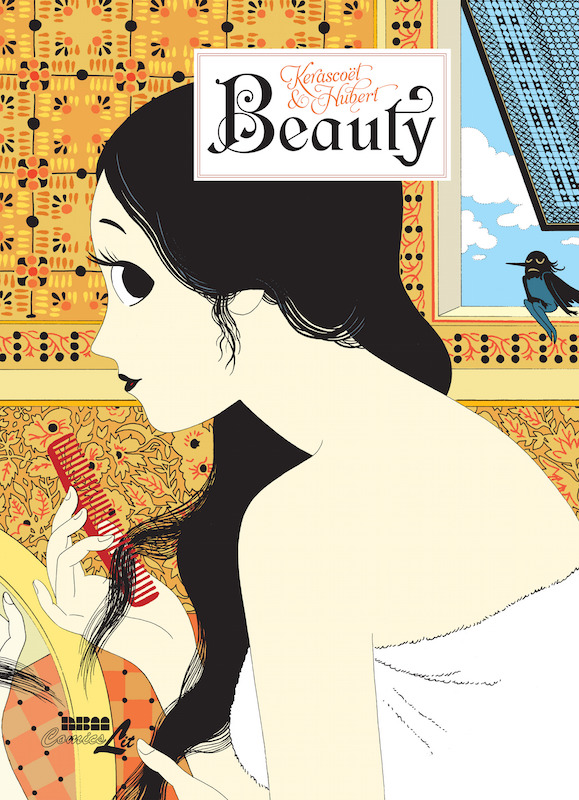
Beauty, Story: Hubert Boulard Art: Kerascoët (Marie Pommepuy and Sébastien Cosset) Letters: Ortho Translation: Joe Johnson.
Story: Hubert Boulard
Art: Kerascoët (Marie Pommepuy and Sébastien Cosset)
Letters: Ortho
Translation: Joe Johnson

At first glance, Beauty looks like a classic “Be careful what you wish for” story. In these type of stories, the protagonist comes to regret a wish that has come true because its fulfillment exposes terrible unforeseen consequences. Or something essential has to given up in the bargain. Or the manner in which the wish has come true was less than ideal. This usually leads to either a tragic ending, or more innocuously a successful reversal of the wish. In the latter, the hero comes away chastened by the experience. It's ultimately a genre with a conservative message. The graphic novel Seconds was a modern use of this trope. In comparison, Beauty contains more traditional elements. It starts out as a mashup of the myth of King Midas with Cinderella. But writer Hubert and husband and wife art team of Kerascoët subvert the morality of the tale and turn the wish into a catalyst for personal growth and eventually greater actualization. Though not before the experience puts our heroine through the wringer.

The comic’s setting is the pseudo-medieval Europe of most fairy tales and fantasy novels. Kerascoët brings this world to life with the characteristic use of Ligne claire, bold, flat colors, and nonlinear perspective images, neatly composed on each page as a four panel high-tiered grid. The effect is a dense visual narrative which is far more iconic than realistic. This enhances the impression of an exotic world populated by mysterious magical forces. The character designs conveniently fit into easily-recognized archetypes: the poor peasant, the handsome knight, noble king, beautiful queen, or violent warlord.

Beauty, Story: Hubert Boulard Art: Kerascoët (Marie Pommepuy and Sébastien Cosset) Letters: Ortho Translation: Joe Johnson.

This artistic choice serves the comic’s key narrative device. The heroine is a poor, put-upon girl named Coddie who is on the verge of womanhood. One day, she inadvertently frees the fairy Mab from a magical prison and is granted one wish as a reward. Coddie wants to be beautiful, but Mab cannot change her. Instead, she imparts on Coddie a glamour which creates the illusion of beauty to whoever sets eyes on her. As such, the story is constantly shifting between Coddie’s true form and her idealized appearance. Coddie is aware of her physical imperfections every time she sees her own reflection, but this also highlights her pettiness, superficiality, and shortsightedness. To everyone else, her ethereal visage simply disarms any valid objections to her questionable behavior. Kerascoët’s art easily conveys how when even in the company of other attractive people, Coddie’s illusory charm makes her seem otherworldly in comparison.

The disadvantages of being an incarnation of the feminine ideal becomes quickly apparent when shortly after her encounter with Mab, Coddie is spotted by several of her male neighbors and they later try to gang rape her. The women react to this incident by driving Coddie out of the village. It doesn’t take long for Coddie to become a Helen of Troy object of desire as people either woo, worship, and fight for her approval. Or alternately attempt to manipulate, capture, imprison, possess, or consume her. As her legend grows, so does the chaos accompanying her until it threatens to engulf the entire kingdom.

Beauty, Story: Hubert Boulard Art: Kerascoët (Marie Pommepuy and Sébastien Cosset) Letters: Ortho Translation: Joe Johnson.

But Coddie isn’t an impassive figure. The granting of her wish connotes an obvious sexual awakening. So she behaves like an adolescent who suddenly becomes aware of the power she holds over the opposite sex. Coddie seduces a succession of powerful men as she moves up the social ladder. But unsurprisingly, she exhibits poor judgement and self-control. And her naive understanding of love and adult relationships causes greater misery for her lovers and the people around her.

Hubert and Kerascoët infuse the story with a number of modern touches. They don’t ignore the harsh social inequalities between peasant and nobility, not to mention the patriarchal nature of the feudal system of government. As a commoner, Coddie is easily tempted by the lavish lifestyle of the aristocracy. But unlike the typical fairy tale heroine, she doesn’t live happily ever after once she marries into royalty. Two other noble women in the story are forced to treat Coddie as a rival or a threat because of the inordinate amount of influence she exerts over the men. At some point, even the peasants (or at least the peasant women) turn on her after her attempts to alleviate their suffering backfires. There’s only so much one can accomplish when being viewed more as an object than a person. While not as blunt as Game of Thrones, the book's depiction of violence and misery can be fairly graphic at times.

Beauty, Story: Hubert Boulard Art: Kerascoët (Marie Pommepuy and Sébastien Cosset) Letters: Ortho Translation: Joe Johnson.

Indeed, everything has gone wrong for Coddie past the midway point. But where most traditional storytellers would have been content to leave off with a cautionary tale about accepting one’s limitations, this is when Coddie begins to apply the harsh lessons of her life and gradually fights back. By the end she attempts to turn the tables on her tormentors and strikes a crucial balance. The results don’t necessarily violate the rules of the comic’s fantastic milieu, but the story's concluding point is persuasively up to date.

8/15/2015

Girl in Dior

Girl in Dior By Anne Goetzinger. Letters: Ortho Design: Philippe Ravon Translated by Joe Johnson.
By Annie Goetzinger.
Letters: Ortho
Design: Philippe Ravon
Translated by Joe Johnson.


As with many notorious figures, Christian Dior has become such an institution today that it's often very difficult to relive the freshness of his initial impact on the wider world. Paris during 1947 was still reeling from the climate of wartime austerity when the soon to be notorious designer held his first fashion show. The assembled crowd of media, wealthy socialites, and celebrity guests were so taken with Dior's daring use of fabric that he was quickly hailed as a significant new creative voice, even as the proletariat were less than impressed by what looked to them as nothing more than wasteful opulence. The event would anticipate the pageantry of modern fashion shows, not to mention the high-low divide in people's reaction to haute couture. But the avant garde nature of Dior's show and his decade-long body of work is what veteran French cartoonist Annie Goetzinger impresses on the reader. It's a world she so meticulously illustrates that her graphic novel Girl in Dior could just as well be characterized as a beautiful art book about women's clothes.

The designer himself remains inscrutable, though he cuts a dashing figure as portrayed by Goetzinger. His refined aquiline profile and serene manner forms the nexus point of a highly-involved process which begins with the sketches he creates at his country house just outside the city, translated into a series of linen prototypes until the designs are finalized, and the models are bought in to become accustomed to wearing them for the eventual fashion show. For Goetzinger, the creative process of making a dress involving the efforts of many passionate individuals, is just as fascinating as the dress itself. More importantly, they work happily under Dior's steadfast leadership. No one feels they're being exploited.

By Annie Goetzinger. Letters: Ortho Design: Philippe Ravon Translated by Joe Johnson.

The POV character that allows the reader to peer into the House of Dior is the fictional Clara Nohant, who starts out as a cub reporter hired to write about the 1947 show. She quickly becomes an enthusiastic Dior proponent and organizes a photo op. But after it's ruined by an impromptu protest, Clara is fired from her job. Fortunately, this misadventure gains the attention of Dior, who meets with her, then hires her. The dowdy Clara is transformed into a glamorous Audrey Hepburn lookalike, becomes one of Dior's top models and also a close confidant.

On paper the plot reads as a most generic kind of wish fulfillment. Clara herself remains fairly two dimensional throughout. But the hero of the story isn't really her or the great man himself. Visually, the stars of the show are Dior's magnificent dresses. Goetzinger's figures have a sensual Art Nouveau quality to them, which is perfect for capturing the ambiance of high fashion. Her models all assume that expression of studied insouciance in order to not distract from the clothes. They take the stage in a series of lushly painted page spreads. Goetzinger's delicate linework and brush strokes absolutely shines in capturing the flow, weight, texture and form of every item of clothing. Whatever one thinks of the fashion industry as a whole, these painstakingly designed, crafted, and beautifully worn dresses are the embodiment of Dior's sentiment "dressmaking is one of the last refuges of the human, the personal, the inimitable."

Girl in Dior By Annie Goetzinger. Letters: Ortho Design: Philippe Ravon Translated by Joe Johnson.

6/01/2015

Archie vs. Predator #2 and Red One #2

Archie vs. Predator #2 by Alex de Campi, Fernando Ruiz, Robert Hack, Stephen Downer, Rich Koslowski, Jason Millet, John Workman
Archie vs. Predator #2
Writer: Alex de Campi
Artist: Fernando Ruiz, Robert Hack, Stephen Downer
Inker: Rich Koslowski
Colorist: Jason Millet
Letters: John Workman

Archie et al. created by Bob Montana
Sabrina created by George Gladir and Dan DeCarlo
Predator created by Jim Thomas, John Thomas, Stan Winston

This is the part where the comic actually delivers on its promise. The Predator follows the Archie gang back to Riverdale and quickly commences with his slaughter of the town. The hilarity of the resulting bloodbath reveals the stupid brilliance of conveying the tale within the confines of the Archie Comics house style. Both the action movie tropes of the Predator franchise and the comic stylings of the Riverdale cast offset each other nicely, lampshading the ludicrousness of their respective conventions. Once the guys realize what they're dealing with, they respond not by calling in the National Guard or any other agency equipped to handle the threat. Rather, the responsible adults pass out assault rifles to gung-ho teenagers so that they can finish off the unstoppable alien killing machine themselves. There's a lot of macho grandstanding that inevitably ends in disaster. But because of the humorous manner in which these deaths are portrayed, there's something deeply satisfying about how everyone meets their end. And the story is paced so effectively that the impact of each death is often quite startling when it actually takes place.

The only part where the narrative drags a bit is an exposition-heavy middle section that connects several plot threads, primarily the incidents within the Predator films with the events that took place last issue. This sets up Betty and Veronica as the comic's main protagonists rather than the titular Archie, who mostly stays in the background at least for now. As pointed out last time, these are slightly more abrasive versions of the cast who are more willing to engage in physical violence. If there's one glaring weakness, it's that some people are obviously beneficiaries of plot armour or heroic death exemption despite the dumb choices they make here. But that's not entirely unexpected given the nature of the crossover.

Red One #2 by Xavier Dorison, Terry Dodson, Rachel Dodson, Clayton Cowles
Red One #2
Writer: Xavier Dorison
Pencils and Colors: Terry Dodson
Inks: Rachel Dodson
Letters: Clayton Cowles

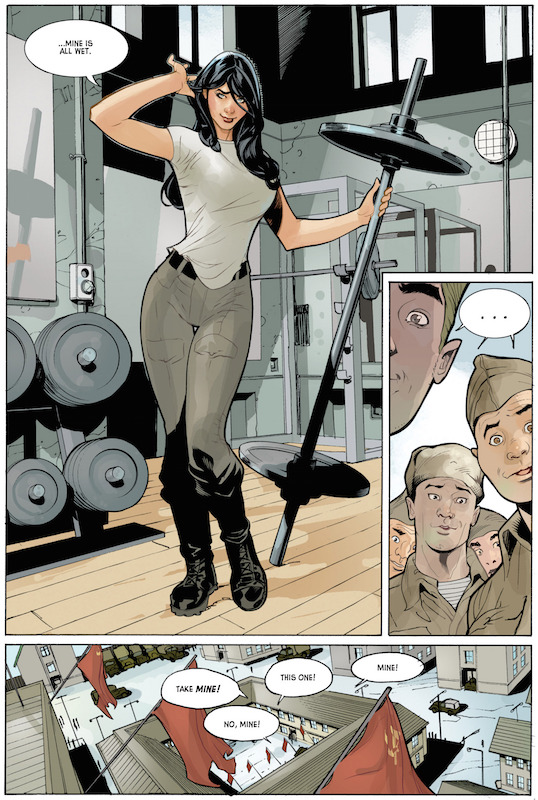
What happens in this oversized issue is that Vera Yelnikov beats up a lot of bad guys while trying to fit into her new environment as well as settling into her new secret identity. The former is entertaining as heck, the latter is a little less so. The Dodsons staging of action sequences is slick, dynamic, and sensually charged when Vera displays her uncanny parkour and kung fu skills while attired in a form-fitting crimson jumpsuit and wielding nothing more than a hammer and sickle. Red One isn't exactly subtle. The hero's basically a liberated Soviet superwoman exacting revenge on behalf of the would-be victims against a group composed of violent, religious extremist, socially conservative, male chauvinist hicks, even if said victims are treated mostly as an afterthought. But the gorgeous visuals, which manage to compress a lot of narrative into every page, are clearly the comic's main draw.

Even the dialogue sounds less grating than in the last issue, mainly because Vera now has a verbal sparring partner in her American boss Lew Gardner. Admittedly, he's the stereotypical curmudgeon who's actually a big softie. And assuming he sticks around, it's only a matter of time before he uncovers the truth about Vera and becomes her reluctant ally. But Vera's mixture of flirtatiousness and fish out of water naïveté continues to awkwardly straddle the line between camp and social commentary. One scene has Vera and Lew attend a party which is meant to develop her credentials as a free spirit. But it doesn't really say anything new about the character, so it just comes across as gratuitous. Vera visits her first supermarket, and her amazed reaction to its bounty is too much of a well-worn cliche. Such behaviour stretches credulity that the stuffed shirts at the Kremlin are so much more hip than their Yankee counterparts that they can afford to send their most capable agent to save America from itself.

However, the biggest obstacle for readers of American comics will be the European album publishing schedule which favors lavish production values at the expense of a quick turnaround. The next installment won't be out till next spring, an awfully long time for an ongoing action story.

4/19/2015

Red One #1

Red One #1 by Xavier Dorison, Terry Dodson, Rachel Dodson.
Story by Xavier Dorison
Pencils and Colors by Terry Dodson
Inks by Rachel Dodson
Letters by Clayton Cowles

Red One starts from the conceit that America's neighbors from across The Pond are a far more enlightened and liberated lot. Or maybe that was just the 70s. At any rate those silly but highly dangerous Yanks are kind of childish for still believing in superheroes. Why, they even make movies about them. Something has to be done about that for the sake of world peace. The central premise of the series is absurd and over-the-top, but I'm not entirely sure from this debut if it's meant to work as a parody or a homage, or some clumsy marriage of both.

The art team of Terry and Rachel Dodson seem to be playing it straight, effortlessly capturing the kitschy atmosphere and cheesecake aspects of the decade like this comic was the script of one more exploitative action adventure film. The colors acquire a washed out, nostalgic glow when the setting moves to 1977 Southern California, imbuing the place with a certain dated glamour.

Where the comic disappoints is in the dialogue, which is clunky and unrealistic. This may have something to do with translating from the script of writer Xavier Dorison, but it sometimes feels like an over-earnest imitation of the informal speech patterns of most Americans. What Hollywood starlet vents her frustration at her critics by screaming "I'm going to smash their peasant heads in!"? This is exacerbated by half the word balloons being crowded by too much text. This again may be a translation issue, but it results in some very slapdash lettering which could have been solved by resizing or rearranging the balloons.

The comic's protagonist Vera Yelnikov could be described as a Rule 63-inspired, Soviet-era version of James Bond meets Captain America. She's a bombshell drawn by the very people who used to draw Wonder Woman during Allan Heinberg's aborted run. Which is to say that Vera's clearly meant to be ogled by the reader. But she's no vacuous sex symbol, she's the country's top operative. Smart, capable, and supremely athletic to the point of being possibly a super soldier. Vera's a free spirit involved in a polyamorous relationship with an expecting couple, plus a few other hanger-ons. She has no problem inducting complete strangers into the Mile High Club, but stops at sleeping with her co-workers and superiors at the Kremlin.

Red One #1 by Xavier Dorison, Terry Dodson, Rachel Dodson.

For all of these reasons, Vera is sent to infiltrate American Society in order to play the part of a superhero. A costumed vigilante called The Carpenter has been murdering disreputable Hollywood types. This has the party bosses worried that such criminal behavior might inspire a new wave of puritanism, which in turn could reignite the Cold War. So they assign Vera to masquerade as another local do-gooder so she can provide a more rational counterpoint.

Needless to say, the story is a not-so-subtle commentary on the connection between violence, sexual repression, and religious extremism, not to mention the rising tide of social and political conservatism that would come to dominate Reagan-era America in the 80s. And it panders to the view that Americans on the whole are somewhat naive in their idealism, making them a tad suggestible to things like men and women in tights. At the same time, there's an admiration for that very naïveté that comes across in Dodsons' love for recreating the seductive Californian milieu and in their portrayal of a fresh-faced Vera as an innocent abroad.

12/12/2014

Today is the Last Day of the Rest of Your Life

Today is the Last Day of the Rest of Your Life By Ulli Lust.
By Ulli Lust
Translated by Kim Thompson.

[this review contains spoilers]

Back in 1984, cartoonist Ulli Lust was a rebellious Austrian teenager unwilling to go down the conventional path of graduating from a good school, finding a secure job, and settling down to raise a family. So she drops out of art school, hangs out at her older sister’s Vienna apartment, and joins the punk movement - that era's fashionable counterculture. “I’m an anarchist” she proudly proclaims, “I’m going to get myself a tattoo - maybe.” Like many adolescents, she’s convinced of her own worldliness, and assured of her own personal invincibility. It doesn’t take much to persuade her to sneak into Italy with travelling companion Edi during the summer. Much of Today is the Last Day of the Rest of Your Life is spent recounting that eventful trip. On the surface, her experience reads like a "sex, drugs, and rock 'n' roll” type of story. But what remains long after is the impression of hard-won knowledge about how class and gender function in the real world.

Her excursion commences with the usual high spirits. Ulli and Edi illegally cross the border into Italy on foot (needless to say, this isn’t the present-day E.U. open market) with a sleeping bag, no money or passports, and the clothes on their back. They’re relieved to be free of the oppressive atmosphere in Austria and enjoying the pleasant climate of the Italian countryside. The two soon settle into a bohemian lifestyle. As befitting their punk cred, they’re casually nihilistic - they have no problem conning money off strangers or using their femininity to get them a free meal or a place to stay for the night. Ulli does get to experience some wonderful things such as visiting some of the country’s most beautiful attractions, sleeping under the stars, swimming in the Mediterranean, attending a Clash concert, or a performance of Carmen. She and Edi meet other transients, and they receive from them a practical education on how to survive in Italy on next to nothing. Lust draws all this in a roughly-hewn style, mostly contained in the traditional grid layout and filled-in by olive-colored duotones. It looks rather unrefined at first glance, but this belies an artist fully confident in her abilities. Lust is a very capable caricaturist, easily managing her large cast of supporting and incidental characters. And she exhibits no difficulty in capturing the book’s varied and ever-changing setting, whether it be the humble backstreets of Verona or the pomp of Saint Peter’s Basilica.

Today is the Last Day of the Rest of Your Life By Ulli Lust.

But events gradually take a darker turn as the summer wanes. Ulli begins to fall into a rut as she tires of the cold and the unwanted attention of her Italian admirers. But her rejection of their advances only emboldens them further. The Virgin/Whore dichotomy found in this very masculine and Catholic-conservative culture comes to the foreground (Edi and Ulli are even explicitly described in this manner at one point). Lust’s art beautifully captures the ravenous expressions of the men who eye her and the psychological toll it takes on her, illustrated by a number of surreal fantasies. She transforms into a wraith, bursts into flame, or is engulfed in complete darkness. Ulli feels relentlessly under attack from an alien society which places far greater weight on a man’s honor than on a woman’s dignity, were any unaccompanied foreigner is viewed as fair game. Unfortunately, the pressure eventually becomes too much even for her to resist.

The advancing gloom also creates a rift between Ulli and Edi. While the two were initially linked by the yearning to escape their mundane lives back in Vienna, their opposing reactions to adversity force Ulli to confront the personal differences between them. Edi responds to the street-level violence and rampant sexism around her with wilful ignorance and extreme self-indulgence. Her craving for excitement ultimately steers the two on a self-destructive course, almost trapping them in a brutish existence under the control of Italy's more unsavoury criminal elements. This leads to the fraying of the bond between Ulli and Edi. Combined with a thousand other trivial struggles and little betrayals from other fair weather friends, and Ulli finds herself without a desperately-needed safety net. When Italy finally loses all appeal and she senses that it’s time to return to Austria, the quiet realization is deflating. “I was going to rejoin the land of the living” Ulli admits to herself.

Lust’s recollection of her youthful indiscretions is as similarly detached as the events themselves are outrageous, the voice of a self-possessed narrator looking back at her turbulent past. She’s hesitant to editorialize her actions other than deciding what to include in the book. Her older self never intrudes into the narrative to comment on, or express an opinion, let alone claim to be smarter or wiser since that time in her life. There’s no trite moralizing about her failings, and her homecoming is shorn of the cheap sentimentality expressed when a prodigal daughter is welcomed back with open arms. Ulli is instead greeted by a barrage of recriminations from her confused and exasperated parents. But battered as she is by life, her final act in the book indicates that she still retains the defiant streak that inspired her to leave home in the first place, not to mention the resilience that sustained her through tough times.

Today is the Last Day of the Rest of Your Life By Ulli Lust.

8/24/2014

More NonSense: Ferguson Edition

The Militarization of Officer Joe by Desmond Devlin.  From MAD Magazine.
The Militarization of Officer Joe
Go to: MAD Magazine, by Desmond Devlin (via Kevin Melrose)

The militarised response to protests over the police killing of unarmed African-American teenager Michael Brown in Ferguson, Missouri has provoked outrage among many in the comics community. Brett Shenker collects a sampling of their tweets.

On the other hand, Casey Johnston notes how Facebook's tendency to filter for uncontroversial feel-good content makes it more difficult to discover Ferguson-related posts.

Everyone else is linking to this Jon Kudelka cartoon.

Mike Dawson muses on the Kajieme Powell police shooting.

Sean Howe's profile of Frank Miller, who's currently in the spotlight for Sin City: A Dame to Kill For, is the best comics-centric summary of his career so far. His portrait of the man paints the rise, fall, and possible redemption of one of the industry's most influential, not to mention outspoken, figures from the last 30 years.

According to Alan David Doane, the accompanying photos taken by Richard Burbridge have generated speculation about Miller's health. Bill Sienkiewicz quashes the rumours. I really admire how Miller has successfully retained his firebrand persona. It's something that animates everything he draws. But my one takeaway from these articles is how much he's weathered as a person and as an artist. 9/11 galvanised Miller in a thoroughly unpleasant way. His divisive rant on the Occupy Wall Street movement exhibits no empathy towards the concerns of people half his age.  And that's a little disheartening for even a curmudgeon like me.

Milo Manara's alternate cover to Spider-Woman #1 has sparked outrage for its suggestive pose, dredging up the usual issues of female representation and the industry's systematic failure to attract a larger female audience. Manara's own confused response did him no favours by ranging from the "women are naturally sexy" excuse to mentioning Ferguson, the current Ebola crisis, and Islamic fundamentalism. Meanwhile Tom Brevoort defends the publication of the cover. Tom Spurgeon and Amy Reeder each give a more nuanced response.

The marriage of Manara's sensibilities to American superheroes is actually rather atypical. The resulting image is erotic, but in a freakish rather than a seductive way. I'm not sure if I like it. But if Manara was trying to emphasise the inherent weirdness of superheroes, I think he might have succeeded.

Yale Stewart has put his webcomic JL8 on hiatus after admitting to sending unsolicited photos (NSFW) of himself fondling his privates to two women with whom he was involved. Before that, Stewart was threatened over the phone. He has since apologised for his gross behaviour.

What's interesting is the indirect manner in which the social media firestorm arose in the first place. Ulises Farinas initially accused Stewart of cynically capitalising on tragic events as a means to self-promotion, most recently the selling of his Ferguson desktop wallpaper. This prompted references to the existence of various "dick pics." Now, sending erotically-tinged messages isn't odd in this day and age, but the practice turns ugly when its unasked for. Stewart's actions can't be condoned, but neither should the making of threatening phone calls. Turns out the Web is still a very clumsy tool when wielded as a means to mete out justice. Who'd have thunk?

Only Stewart knows what was on his mind when he fashioned the Ferguson wallpaper, so I'll give him the benefit of doubt. But given the circumstances, employing the military-style Green Lantern Corps to call for unity might not have been the best choice.

Chris Sims on the splendid mess that is "Crisis on Infinite Earths." Even I could tell back then that the motive behind the series was editorial's desire to mold its diverse properties into a much more homogeneous unit. In retrospect, that it didn't succeed wasn't all that surprising. Not that it stops DC from continuing to shoehorn Batman, Superman, and Wonder Woman into the same milieu.

I contribute to Twitter Nation.