Bright Lights: Starring Carrie Fisher and Debbie Reynolds
Directors: Alexis Bloom, Fisher Stevens
Starring: Carrie Fisher, Debbie Reynolds, Todd Fisher
Even in a media landscape where reality TV stars are willing to have their private lives exposed for any measure of fleeting fame, the relationship between Debbie Reynolds and her daughter Carrie Fisher is truly the stuff of legends. Together they represent two very different eras of Hollywood. Fisher has memorialized their often difficult relationship in her writings. One of them was the semi-autobiographical novel Postcards from the Edge, which was made into a film rather fittingly starring Shirley MacLaine and Meryl Streep. And yet they were practically inseparable, living as next door neighbors in their Beverly Hills compound for decades. When the two died within a day of each other almost a year ago, the legend seemed to be complete. Fisher would pass away on December 27 after suffering a massive heart attack. Reynolds followed her soon after, almost as if she couldn't bear to be without Fisher. According to Carrie’s brother Todd Fisher, Reynolds said before dying that she "wanted to be with Carrie."
Bright Lights was filmed from 2014-15, well before their passing. But it feels like a fitting capstone to their careers. It breezily mixes present day and archival footage in a nonlinear order, producing a lively and affectionate portrait of the two. Their conversations are often filled with inside references and zingers which hint at a much more adversarial past, but which has since mellowed out with time. The pair is a study in contrasts. Reynolds is dignified and polite in front of the camera. And she always dresses immaculately. Fisher expresses herself through a combination of acerbic wit and humorous self-depreciation. Reynold’s house is tastefully decorated. Fisher’s house is cluttered with more recent pop culture memorabilia. Even their pet dogs reflect their different personalities. But they’re united in their mutual love for musical numbers and classic Hollywood cinema. And of course their status as showbiz goddesses. Or as Fisher states in response to a reporter’s question at a red carpet event., “We are always on a red carpet.”
The claim isn’t too hyperbolic. The documentary shows both Fisher and Reynolds being kept busy interacting with their adoring fans. Fisher is an active participant of fan conventions. She refers to these appearances as a “celebrity lap dance” while prepping in the autograph area during one such event, After a full day of signing autographs and posing for photo ops, Fisher can still express a mixture of awe, befuddlement, and acceptance. “They love her”, referring to her Princess Leia role, “and I’m her custodian, and I’m as close as you’re going to get.” Despite having retired from film, Reynolds still tours the country performing in lounge acts to a mostly aging audience. This is a source of tension between mother and daughter, since these performances leave Reynolds with barely enough energy to function. The first scene of the film catches Fisher after she’s failed to talk Reynolds out of one of these gigs. Fisher compares her mother to a force of nature, a “tsu-mommy.” Then she goes to help her pack. Despite the toll touring takes on her body (she almost collapses as she hobbles of the stage), it’s easy to see what Reynolds gets out of it. The reception she receives is ecstatic. Fisher recognizes the sustenance it gives to Reynolds. "Performing gives her life. It feeds her in a way family cannot."
Reynold’s work ethic is no surprise. She was a product of the Hollywood studio system of the late 1940s. It was a system that always demanded a cheerful professionalism out of its charges, like a manic version of kayfabe. It was also still the golden age of the movie musical. But more importantly, Reynolds went through three failed marriages, the first one ending in a huge scandal at the time when husband and celebrated crooner Eddie Fisher left her for actress Elizabeth Taylor. Through it all, Reynolds kept up a semblance of dignity and wholesome sweetness. Bright Lights suggests this wasn’t an act resulting from shallowness or ignorance. It was a display of inner strength. A way of showing the world that she wouldn’t be brought down by such difficult circumstances.
Needless to say, this is unlike the more outspoken Carrie Fisher. Old homemade movies give the impression that Todd and Carrie had an idyllic childhood. Yet Todd admits to a surreal family life being raised by such a famous mom. The siblings began smoking weed as teenagers, though Carrie would go on to stronger stuff and develop a serious drug habit. They came of age in the freewheeling 70s, when Hollywood was being colonized by a new generation of auteurs. One of those auteurs, a young George Lucas, would soon give Fisher her big break. There’s one remarkable clip from 1971 which foreshadows a more unstable future. Reynolds is in the middle of one of her shows when she coaxes, perhaps bullies, Fisher to perform onstage. It’s a very typical parent-child dynamic where the former is setting up the latter to either succeed or fail. The clearly embarrassed teenager grins through it all and belts out a soulful rendition of “Bridge Over Troubled Water,” her outward cheerfulness bleeding over into defiance. “I love that voice” remembers a tearful Reynolds. “Isn’t that a great voice? Wish I had it.” But Fisher would disappoint her mother by not pursuing a singing career. In a few years, she would land the role of Leia for Star Wars, then go on to have a tumultuous marriage with Paul Simon.
When the film catches up with the present, Fisher’s inner demons haven’t vanished. She can’t quite quit her personal vices even as she prepares to film The Force Awakens. But the angry recriminations that characterized the mother-daughter dynamic from a few decades ago have already been replaced by a more genteel schtick. A comedic performance where the characteris have come to recognize each other’s limitations. Fisher keeps insisting that Reynolds retire her lounge act, while Reynolds worries about her daughter’s bipolar disorder. They find in familial bonds a happiness they couldn’t obtain with their romantic male partners. The final part of Bright Lights has the entire clan coming together to ensure that the increasingly frail Reynolds will be on hand to accept a lifetime achievement award. It’s an emotionally tense occasion that causes Fisher to despair a few times. But when it’s all over, the two collapse on the couch when they're back safe at the compound, and amuse everyone with an impromptu version of "There's No Business Like Show Business" as if they were casually conversing about their own lives.
It’s a brilliant scene, and it makes for a sadder realization that these two remarkable women aren’t around anymore.
Showing posts with label documentary. Show all posts
12/11/2017
9/17/2016
50th Trek: Trekkies (1997)
In honour of Star Trek's 50th anniversary, I'm writing a series of posts discussing a favorite example of Star Trek related media.
Trekkies (1997)
Director: Roger Nygard
Host: Denise Crosby
Star Trek created by Gene Roddenberry.
Trekkies quickly latches on to cosplay as a signifier of the more eccentric fan. Family man David Greenstein has a Star Trek-themed man cave and bathroom at home. To his wife’s horror, he admits to wanting to modify his earlobes in order to appear more Vulcan. Alas, he can’t afford the operation. Denis Bourguignon runs a sci-fi themed dental office, complete with staff wearing blue science officer uniforms. He and wife Shelly admit, to the embarrassment of the film’s host Denise Crosby (Tasha Yar from The Next Generation), that cosplay plays a significant part in their sex life. Richard Kronfeld is fascinated by Trek’s fictional technology. He’s seen motoring down a road to the local Radio Shack using a homebuilt replica of the Total Life Support Unit used by Captain Pike. But the most charming example is the teenager Gabriel Köerner, who would go on to become the film’s most recognised character after Adams. Always filmed in costume, Köerner is the kind of passionate, nerdy, self-aware kid who proves to be an eloquent spokesperson. He’s the one who when his interview is interrupted by an unexpected phone call, responds with the immortal line "Peter, this is the worst time you could have called! Go away! ... ok bye."
Naturally, the Klingons take things a step further. They write sex manuals and enact their mating rituals, learn the Klingon language, and translate everything from the Bible, William Shakespeare, popular theme songs, to sports terminology. Some of them even have time to be heavily involved with charitable work. Other fans are also inspired to follow different creative paths. Köerner proudly displays the CGI models he made for a fan film being produced by his club. Filk (science fiction folk singing) gets only a brief mention. As do several female fans who read and write “slash” fiction (erotic fan fiction), though Debbie Warner is singled out as a member of an anonymous mailing list and author of “The Secret Logs of Mistress Janeway.” This is juxtaposed with a scene of Crosby showing off her personal fan art collection, which includes several risqué illustrations of Tasha and Data (played by Brent Spiner in TNG) captured in flagrante delicto.
However, the true weirdos are only mentioned in passing. There’s the guy who wants to collect James Doohan’s (Montgomery “Scotty” Scott) blood. Another who paid $40-60 to drink the “Q-Virus.” Another who wanted Ethan Phillips (Neelix from Voyager) to help him ease his way into death. Or the guy who keeps sending brochures addressed to “Star Trek.”
It’s this fixed component of amused ogling that seems to have upset fans at the time. Still, it would be a huge mistake to think that Trekkies goes out of its way to mock its subject matter. The cast and crew being interviewed consistently express awe and admiration for Trek’s enduring popularity. A recurring motif is how Trek’s progressive message has inspired a lot of people, including women and minorities. And many of the actors (though William Shatner [James Kirk] is noticeably absent) can recall positive interactions with their fans, whether they were media personalities, NASA astronauts, or most notably, a suicidal woman who was gently coaxed by Doohan to turn her life around.
What’s become more obvious since is that Trekkies blend of carnival sideshow and joyous celebration is a product of a different era. While geek culture was becoming ascendent in the 90s, it was nowhere as ubiquitous as it is today. A throwaway line from Köerner and a fansite created by superfan Anne Murphy serve as a reminders that geeks were still in the early stages of colonising the World Wide Web in 1997. As such, the film is informed by the need to expound on the nature of fandom to non-fans. Some viewers will unfortunately see these people as stupid or hopelessly deluded. But there’s a certain underdog quality that shines through. Many of the interviewees come across as erudite and cognisant of their outsider status. For the most part, they seem happy to pursue a hobby the world doesn’t get. And In our highly polarised environment where Gamergate, the backlash against Miles Morales, and other stories that serve as a reminder that sexist and racist attitudes exist within fandom, the pro-science, inclusive world view expressed in Trekkies is almost salutary, if a little earnest at times. Or as Spiner puts it “I don’t think I’ve ever met anyone, Star Trek fan or not, who wasn’t peculiar…. We’re all peculiar.”
Another thing that stands out is the film’s focus on the convention as a defining characteristic of fandom. Apparently, not everyone knew back then what basically goes on during a convention. So Trekkies takes time to point out that people mingle with friends and other like-minded individuals, buy and sell a lot of merchandise, meet some of the personalities involved with the franchise, and take lots of pictures. When compared to the massive Hollywood presence seen in Comic-Con Episode IV: A Fan's Hope, these conventions possess far humbler production values, and are more local in reach. Not that it stops anyone from spending thousands of dollars on, say, a genuine Klingon forehead prosthetic. But that sense of "I have found my tribe" is a constant. As one attendee speaking for herself and her friends recalls "The first convention we went to... we were all accepted. And when we left and went back home, we had to act normal again." Several Hollywood representations of fan conventions have since taken their cue from Trekkies.
While surveying a broad spectrum of modern fan pursuits, Trekkies is smart enough not to over-explain Star Trek itself. The film doesn’t go into any detail about Trek’s fictional universe, and only mentions a few of the people behind its creation. The references and technical jargon will be appreciated by the initiated. But the viewer isn’t punished for not knowing the meaning behind “The Emissary”, “saucer separation capability”, “Romulan Star Empire”, or for not caring about the never-ending debate over who is Trek’s favourite captain (thankfully, Captain Archer wasn’t in the running at the time).
One particular debate that actually hasn’t aged very well is whether fans should refer to themselves as Trekkies or Trekkers. The film’s participants express a range of opinions favouring one term over the other, but what underlies all their arguments is a wish for greater respectability. What all of them fail to recognise is how little control anyone has over the popular use of language. In an age where Internet memes are easily co-opted by an opposing side, the idea that a simple word change could alter the prevailing perception surrounding an entire subculture can feel a little naive. But then again, the same could be said of Star Trek.
Trekkies (1997)
Director: Roger Nygard
Host: Denise Crosby
Star Trek created by Gene Roddenberry.
“I don’t know, I hope it lasts forever … As long as it’s thoughtful, it’s a good thing."One of the early criticisms levelled at Trekkies from the very community it was portraying was that it spent way too much time parading a more extreme version of Star Trek fandom instead of representing the majority composed of more “normal” fans. The documentary’s most infamous character was and continues to be Barbara Adams, an alternate juror for the Whitewater trial of Governor Jim Guy Tucker who achieved nationwide notoriety for wearing her Starfleet uniform to the courtroom, tricorder, rank pips and all. When discussing her actions, she referred to her fellow fans, “I don’t want my officers to ever feel ashamed to wear their uniform.” On the face of it, it’s pretty ridiculous to compare a homemade costume to a military uniform. But she insisted on people showing respect for her rank of Lieutenant Commander, even at the printing press where she worked from within its binding and finishing department.
- Leonard Nimoy (1931-2015)
Trekkies quickly latches on to cosplay as a signifier of the more eccentric fan. Family man David Greenstein has a Star Trek-themed man cave and bathroom at home. To his wife’s horror, he admits to wanting to modify his earlobes in order to appear more Vulcan. Alas, he can’t afford the operation. Denis Bourguignon runs a sci-fi themed dental office, complete with staff wearing blue science officer uniforms. He and wife Shelly admit, to the embarrassment of the film’s host Denise Crosby (Tasha Yar from The Next Generation), that cosplay plays a significant part in their sex life. Richard Kronfeld is fascinated by Trek’s fictional technology. He’s seen motoring down a road to the local Radio Shack using a homebuilt replica of the Total Life Support Unit used by Captain Pike. But the most charming example is the teenager Gabriel Köerner, who would go on to become the film’s most recognised character after Adams. Always filmed in costume, Köerner is the kind of passionate, nerdy, self-aware kid who proves to be an eloquent spokesperson. He’s the one who when his interview is interrupted by an unexpected phone call, responds with the immortal line "Peter, this is the worst time you could have called! Go away! ... ok bye."
Naturally, the Klingons take things a step further. They write sex manuals and enact their mating rituals, learn the Klingon language, and translate everything from the Bible, William Shakespeare, popular theme songs, to sports terminology. Some of them even have time to be heavily involved with charitable work. Other fans are also inspired to follow different creative paths. Köerner proudly displays the CGI models he made for a fan film being produced by his club. Filk (science fiction folk singing) gets only a brief mention. As do several female fans who read and write “slash” fiction (erotic fan fiction), though Debbie Warner is singled out as a member of an anonymous mailing list and author of “The Secret Logs of Mistress Janeway.” This is juxtaposed with a scene of Crosby showing off her personal fan art collection, which includes several risqué illustrations of Tasha and Data (played by Brent Spiner in TNG) captured in flagrante delicto.
However, the true weirdos are only mentioned in passing. There’s the guy who wants to collect James Doohan’s (Montgomery “Scotty” Scott) blood. Another who paid $40-60 to drink the “Q-Virus.” Another who wanted Ethan Phillips (Neelix from Voyager) to help him ease his way into death. Or the guy who keeps sending brochures addressed to “Star Trek.”
It’s this fixed component of amused ogling that seems to have upset fans at the time. Still, it would be a huge mistake to think that Trekkies goes out of its way to mock its subject matter. The cast and crew being interviewed consistently express awe and admiration for Trek’s enduring popularity. A recurring motif is how Trek’s progressive message has inspired a lot of people, including women and minorities. And many of the actors (though William Shatner [James Kirk] is noticeably absent) can recall positive interactions with their fans, whether they were media personalities, NASA astronauts, or most notably, a suicidal woman who was gently coaxed by Doohan to turn her life around.
What’s become more obvious since is that Trekkies blend of carnival sideshow and joyous celebration is a product of a different era. While geek culture was becoming ascendent in the 90s, it was nowhere as ubiquitous as it is today. A throwaway line from Köerner and a fansite created by superfan Anne Murphy serve as a reminders that geeks were still in the early stages of colonising the World Wide Web in 1997. As such, the film is informed by the need to expound on the nature of fandom to non-fans. Some viewers will unfortunately see these people as stupid or hopelessly deluded. But there’s a certain underdog quality that shines through. Many of the interviewees come across as erudite and cognisant of their outsider status. For the most part, they seem happy to pursue a hobby the world doesn’t get. And In our highly polarised environment where Gamergate, the backlash against Miles Morales, and other stories that serve as a reminder that sexist and racist attitudes exist within fandom, the pro-science, inclusive world view expressed in Trekkies is almost salutary, if a little earnest at times. Or as Spiner puts it “I don’t think I’ve ever met anyone, Star Trek fan or not, who wasn’t peculiar…. We’re all peculiar.”
Another thing that stands out is the film’s focus on the convention as a defining characteristic of fandom. Apparently, not everyone knew back then what basically goes on during a convention. So Trekkies takes time to point out that people mingle with friends and other like-minded individuals, buy and sell a lot of merchandise, meet some of the personalities involved with the franchise, and take lots of pictures. When compared to the massive Hollywood presence seen in Comic-Con Episode IV: A Fan's Hope, these conventions possess far humbler production values, and are more local in reach. Not that it stops anyone from spending thousands of dollars on, say, a genuine Klingon forehead prosthetic. But that sense of "I have found my tribe" is a constant. As one attendee speaking for herself and her friends recalls "The first convention we went to... we were all accepted. And when we left and went back home, we had to act normal again." Several Hollywood representations of fan conventions have since taken their cue from Trekkies.
While surveying a broad spectrum of modern fan pursuits, Trekkies is smart enough not to over-explain Star Trek itself. The film doesn’t go into any detail about Trek’s fictional universe, and only mentions a few of the people behind its creation. The references and technical jargon will be appreciated by the initiated. But the viewer isn’t punished for not knowing the meaning behind “The Emissary”, “saucer separation capability”, “Romulan Star Empire”, or for not caring about the never-ending debate over who is Trek’s favourite captain (thankfully, Captain Archer wasn’t in the running at the time).
One particular debate that actually hasn’t aged very well is whether fans should refer to themselves as Trekkies or Trekkers. The film’s participants express a range of opinions favouring one term over the other, but what underlies all their arguments is a wish for greater respectability. What all of them fail to recognise is how little control anyone has over the popular use of language. In an age where Internet memes are easily co-opted by an opposing side, the idea that a simple word change could alter the prevailing perception surrounding an entire subculture can feel a little naive. But then again, the same could be said of Star Trek.
2/27/2014
Video: Life After Pi
Go to: HollywoodEndingMovie (via Lauren Davis)
Poster: Stripped
Go to: ArtsBeat by George Gene Gustines (via Tom Spurgeon)
Stripped by Dave Kellett and Fred Schroeder. Art by Bill Watterson.
8/03/2013
7/27/2013
More NonSense: Post Comic-Con 2013 Edition
Just a small sampling of San Diego Comic-Con 2013 links. Better than being there yourself? Uh-huh, whatever you say.
Words:
Megan Byrd
Heidi MacDonald
Tom Spurgeon 1, 2, 3, 4, 5
Glen Weldon 1, 2, 3, 4, 5, 6
Nicholas Eskey
Robot 6
The Beat
Torsten Adair
Annalee Newitz
Bleeding Cool
I09 1, 2
Eisner Award Winners
Audio:
Jamie Coville
Photos:
Jamie Coville
ComicsAlliance The Creators
ComicsAlliance The Publishers
ComicsAlliance Best Cosplay Ever 1, 2, 3, 4
Bleeding Cool Cosplay Photos 1, 2, 3, 4, 5
The Beat: 1, 2, 3, 4, 5
Robot 6
I09 1, 2
Video:
Superman 75th Anniversary Panel
Marvel Universe Panel
Racebending Panel
Legend of Korra Panel
Agents of S.H.I.E.L.D. Panel
Spider-Man 2 Panel
X-Men/Wolverine Panel
Batman/Superman Movie Logo
Game of Thrones Panel
Words:
Megan Byrd
Heidi MacDonald
Tom Spurgeon 1, 2, 3, 4, 5
Glen Weldon 1, 2, 3, 4, 5, 6
Nicholas Eskey
Robot 6
The Beat
Torsten Adair
Annalee Newitz
Bleeding Cool
I09 1, 2
Eisner Award Winners
Audio:
Jamie Coville
Photos:
Jamie Coville
ComicsAlliance The Creators
ComicsAlliance The Publishers
ComicsAlliance Best Cosplay Ever 1, 2, 3, 4
Bleeding Cool Cosplay Photos 1, 2, 3, 4, 5
The Beat: 1, 2, 3, 4, 5
Robot 6
I09 1, 2
Superman 75th Anniversary Panel
Marvel Universe Panel
Racebending Panel
Legend of Korra Panel
Agents of S.H.I.E.L.D. Panel
Spider-Man 2 Panel
X-Men/Wolverine Panel
Batman/Superman Movie Logo
Game of Thrones Panel
7/06/2013
Comic-Con Episode IV: A Fan's Hope
It seems like I'm the oddball in a world of very normal people. But when I dream about going to a place like Comic-Con, it's got to be, like, nirvana, it's got to be the closest thing there is to heaven, because other people there are just as much of a nerd as I am. - Eric HensonI last went to Comic-Con International just as the convention was beginning to grow into its present-day form. I was playing it by ear the day I took the train down to San Diego, and for the first time in my life the hotels in the downtown area were fully booked. But I could still line up and purchase a 4-day pass. By contrast, tickets for this year’s event sold out in just over 90 minutes, which is now becoming typical since attendance was capped in 2008. Social media plays a bigger role in reporting what happens at the Con. Everyone online complains about the endless queues to get into some panels, the overcrowded halls, or the smell of 130,000 sweaty people in close proximity to each other during the height of summer. Then there’s the resentment over how much space, both literally and figuratively, Hollywood occupies at the convention. Comic-Con’s late founder Shel Dorf said back in 2002: "It's become too big and too depressing... The last time there, I could barely find any comic books." The situation has hardly improved for devotees of the medium. But you know what? Given half the chance, I’d attend Comic-Con again in a heartbeat.
Documentary film maker Morgan Spurlock is known for putting himself front-and-center during his satirical takedowns of Western consumerism. So it was with some trepidation that I first approached the rather annoyingly titled Comic-Con Episode IV: A Fan's Hope. It’s ironic verbosity is second only to POM Wonderful Presents: The Greatest Movie Ever Sold, which is a good example of how Spurlock's social critiques are premised on executing an elaborate stunt. But to my surprise, there are no stunts here and Spurlock himself is nowhere to be found in front of the camera. And while the observation that geek subculture has finally ascended the heights of mainstream entertainment still fits within Spurlock’s wheelhouse, the positive message that geeks are people too is a delightful twist.
Spurlock has lined-up a huge list of nerd idols to function as talking heads guiding the audience through Comic-Con’s 2010 event, including the film’s producers Harry Knowles, Joss Whedon, and Stan Lee. Combined with a random sampling of the diverse range of fans wandering the convention hall, this collection serves to emphasize just how much Comic-Con mirrors the popular landscape. Sure, not all of them are there for the comic books. But rather than seeming a depressing sight, there’s a powerful feeling of euphoria that envelops this motley crew. This is summed up by Whedon’s comment:
“I've brought people who'd never been to the Con and seen the look on their face that was on my face, which is, 'My tribe! I have found my tribe!’ Like, it is a time when these people can express themselves in a totally safe environment and it doesn't matter what they're a fan of."The narrative's meat is supplied by six attendees: Two aspiring artists, an aspiring costume designer, a longtime comics retailer, and a romantically involved couple. As someone who’s been there and done the whole portfolio review process, I quickly identified with the two artists, who could not have been more different from each other. Young hopeful Skip Harvey, who tends a geek-themed bar, is the closest thing to a stereotypical fanboy of the main cast. He’s first shown engaged in a debate on who would win a fight between Black Cat and Longshot which concludes with the two characters having sex. His parents were active trekkies. He sports a Flash Tattoo. He sleeps on a Spider-Man themed pillowcase. I wanted to yell at him to lose the hat and kiddie Marvel backpack where he stuffs his artist portfolio. This is a fuckin’ job interview, man. Was I ever that naive? The more clean-cut Eric Henson is stationed at a military base in the middle of nowhere. But he admits to living a double life as a nerd. He draws a mean Hulk and dreams of working for Marvel Comics. But going to Comic-Con is a big adjustment for someone unused to city living, let alone the California lifestyle. And it means temporarily leaving his adorable daughter and supportive wife, who's nonetheless perplexed with his decision. There’s no denying their passion for drawing comics, and their experiences brought back for me the personal dread that comes from the long waits and terse silence that commences every critique.
Holly Conrad is the film’s most charming character, and her “suicide mission” to get her cosplay troupe to Comic-Con’s Masquerade provides the film with it’s most exciting buildup as well as its most satisfying emotional payoff. It’s the kind of triumphant moment fans dream of. I love her amusing description of the piss-town she lives in as a place “where people stop to go to the bathroom on their way to go skiing” and her good-natured characterization of her neighbor’s misguided view of her as a meth head.
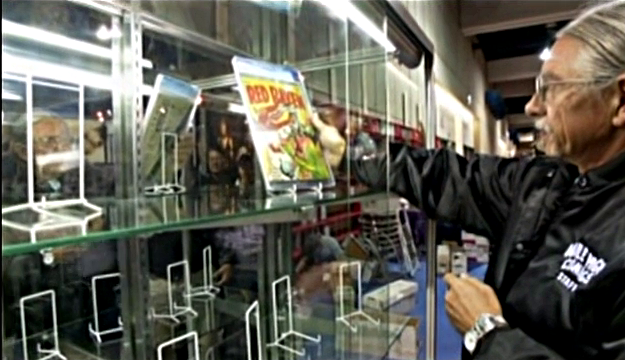
Veteran exhibitor and Mile High Comics proprietor Chuck Rozanski represents Comic-Con's old guard. His story is presented as a struggle to keep his business afloat as the annual event becomes less a true comics convention. This is news to me given how much of a fixture Mile High is at Comic-Con. Much hay is made out of whether or not he'll sell a personal treasure - an ultra-rare copy of Red Raven #1, though I never doubted the eventual outcome. While there’s not much that actually happens to him, Chuck is the most eloquent main character in the film and the only one to view the Con from a long term perspective.
James Darling and Se Young Kang began dating at last year’s Comic-Con. James plans on proposing to Se Young during the Kevin Smith panel. But he runs into a few obstacles along the way. While their plotline is actually uncomplicated, it’s a cute way to round out the cast. And Kevin proves to be a gracious host.
While the use of visual gimmicks like comic book panel transitions, caption boxes written in comic-style typeface, and superhero code names are a tad cliche, they serve to help delineate and juggle the different plot threads. Spurlock makes the clever choice not to so much fixate on his cast’s interests and Geeky obsessions but on their aspirations and personal struggles. The film follows them from their respective homes, families and dayjobs, to their experiences during the 4 days at the Con, to the time they’re about to leave. The results are cathartic. Though their individual stories are small, the audience gets to root for them and share in the fruits of their labor, whether for good or bad.
This approach sounds straightforward enough, but it’s remarkable how rarely it’s used whenever any kind of geek-oriented subculture is being covered by the mainstream press. It’s more typical to gawk at their strange pursuits, then characterize them as losers or loners. Trekkies was infamous among fans for exposing the audience to a number of eccentric and occasionally deluded individuals. This led to the inescapable conclusion that some of them were being set up to be mocked by the film makers. These attitudes can be internalized by the fans themselves, as anyone will attest after reading any issue of Wizard magazine. And sometimes the worst offenders are fans who attack other fans because they hold divergent views. So it’s kinda amazing that Spurlock accomplishes the fine balancing act of showing respect for his cast without necessarily becoming enmeshed in their worlds. He consistently maintains the stance of documentarian to avoid becoming an insider. And this emotional distance keeps him from falling into the more familiar patterns of showing contempt for his subject or pandering to the hardcore. This isn’t to say that Spurlock doesn’t employ some gentle humor from time to time. It wouldn’t be a Spurlock movie without him proverbially winking at the audience. But overall, this is as warm, sympathetic and very human a portrayal as any. No one comes across as being insipidly foolish or deeply unlikeable.
Given that Spurlock’s usual M.O. involves subjecting himself to a drawn-out process in order to expose a ridiculous excess of modern capitalism, it probably wouldn’t work within the confines of a 4-day event. So unlike his other films, satire takes a back seat. But the darker side of the triumph of the geek can be seen in the invasion by corporate Hollywood of Comic-Con, a phenomena that not a few comic professionals have felt ambivalent about. Accompanying a montage of celebrity actors from Chris Evans to Harrison Ford greeting cheering crowds, Marc Guggenheim notes “You have literally the entire fan base for your movie or TV show here in one concentrated place. So it's basically the world's largest focus group.” But it’s Chuck, channelling an angrier version of Shel, who delivers the best lines. Having witnessed the gradual takeover by film and television during his 38 years as a convention exhibitor, he observes:
“Even though they have 'comic' in name of the event, very little of the convention anymore is actually comics. We can't use the loading docks anymore, 'cause fricking Lucas films owns the loading docks. You know, that kind of pisses you off. It really does, 'cause IT'S OUR HOUSE!”What ultimately shines through isn’t so much the anger or cynicism, but Chuck's love for the place. It's that sense of belonging from having found an accepting tribe that has him coming back to Comic-Con.
3/09/2008
Budo
Cultural Stereotypes
Before the latest anime and manga explosion in the West unleashed the sailor-suited schoolgirl on so many impressionable teenagers, there was the sword-wielding, high screeching, side-kicking, martial-arts hero. This was one of the most familiar images I saw perpetuated by popular media in the eighties: from film, television, comic books, to literature and video games. Japan's martial reputation is an element of the West's general wariness towards the country dating from the last World War (and going back even further). The typical view of Japan could be described as: a geographically isolated country, racially and culturally homogenous, its people raised in cramped, austere conditions to be obedient to authority, conformist, polite, disciplined, hardworking, patriotic, militaristic, inscrutable. Can't forget inscrutable. The qualities which supposably made Japanese soldiers capable of fighting to the last man helped push Japan's post-war growth. Not surprisingly the country's economic success was met with trepidation and xenophobia in some quarters, exacerbated by worry about America's possible declining status as a world power.[1]
Fiction and Reality
Off course the Japanese romanticize their heritage as much as anyone else, and their bushi,[2] whether it's the 47 Ronin or Zatoichi, get the glitzy media treatment just as much as cowboys or medieval knights in Hollywood. Fiction is one thing. What about the reality behind the larger-than-life image?
One of my early influences spurring my nascent interest in legitimate Japanese (and East Asian) martial culture was the Japanese film Budo (Einaru Budo).[3] It's been a long time since I first saw it but I recently happened to watch it again. Interestingly my memories of the movie are different from the version distributed by cult label Synapse Films: First, in line with their catalogue of horror and exploitation flicks, its title was changed to the rather unfortunate Budo: The Art of Killing. Second, a voice-over narrative track has been added that I don't recall hearing those many years ago. Both of these changes, in my opinion, have macekred the product. But I'll elaborate on this later.
Someone hearing the Synapse title might get the impression that what they're about to witness will be some kind of slaughter-fest. Nothing close to that happens. There are only two scenes of simulated death: The first one, which actually begins the movie, is a discreet theatrical reproduction of seppuku.[4] But the bulk of the picture is taken-up by demonstrations of practitioners of the sword, the halberd, miscellaneous Okinanwan weaponry, judo, sumo, aikido and karate-do. It's not comprehensive, just a survey of the more well-known disciplines. Not surprisingly, the sword (kendo, iado etc.) receives the most exposure, while karate-do receives the most attention among the empty-handed combat forms.
The film is of interest to enthusiasts because of the content and the personalities that appear in it. First, to anyone interested in what actual budo looks like, what's being exhibited here is far more authentic than what's shown in popular entertainment like, oh say, Naruto. But I suspect that most lay-people would be turned-off by the lack of flashy acrobatics or various special effects that regularly accompany fictional onscreen hand-to-hand combat. The demos by themselves are fairly typical: Budoka are either performing solo, attacking inanimate objects (sandbags, wooden boards, bamboo stalks, tree trunks etc.), or performing together in various choreographed or improvised fight sequences. No one is getting intentionally hurt.
Second, the producers managed to round-up a couple of highly respected budoka to perform some of the demos. Yoshinkan aikido founder Gozo Shioda gets to throw-around three partners in his free fighting demo. Famous shito karate exponent Teruo Hayashi shows-off his skills with the tonfa, kama, and nunchaku[5], and performs a few karate kata.[6] Modern-day swordsman Taizaburo Nakamura slices bales of straw with a katana. Takamiyama, the first foreign sumo champion, trains with his fellow wrestlers. It's a not unimpressive list.
But watching an hour and a half or demonstrations would become pretty tedious to the uninitiated. The film tries to break the monotony by taking the budoka outdoors. kendoka cross swords in rice fields, at night, in forest groves, on temple grounds, in front of the majestic Mount Fuji. Karate-ka train in the snow and on the beach. In one bizarre scene, one of them is conditioning his hands by repeatedly striking a locomotive.
Interspersed between the various demos are scenes of Japanese life. Some of them bear a direct connection to budo, such as actual classes and training sessions, tournaments, equestrian events, a smith forging swords, or sword polishing scenes. Others like religious festivals or Zen Buddhist monks meditating are more obtuse in their connection. Others like Noh dances blended with various kata simply look cool. Using Japan as a backdrop may seem cliche now, but it's used to great effect here to heighten the exotic beauty of the fighting disciplines. They're all attractively shot like some commercial from Japan's board of tourism.
In the end Budo isn't so much a documentary as a promotional video. It takes no critical stance about its subject matter, supplies no real historical information, offers no analysis, makes no attempt to differentiate between koryu bujutsu and the gendai budo,[7] shows no candid interviews with the personalities that appear in it. The film makes no attempt to dispel the mystique associated with the Japanese martial arts. While it's nice to watch, its spiritual lessons do not cut too deep.
The Art of Killing
For me the most cringe-inducing part of Budo: the Art of Killing is the voice-over narration. I can understand why it was added. For afficianados like me, watching famous budoka in action can be very engrossing. But for everyone else a film with neither plot nor dialogue, and a seemingly endless succession of demonstrations would probably get repetitive after fifteen minutes. Judiciously placed narration could inform and educate the audience about what they are watching. But the narration in this case does neither. In fact it's peppered with many half-truths and generalizations.
For one thing the narrator goes overboard in selling the deadliness of these various fighting arts. During an early kendo kata performance he intones "As real swords are used, great skill is required as the least mistake means certain death." How many times does that happen? During the filming of a judo free fighting session one judoka passes-out after being successfully choked. The narrator warns "Should one loose consciousness...he will die if left alone." Throughout the film, words like "severe", "cruel", "pain" and "death" are repeatedly used to emphasize the severity of the training, which lasts a lifetime since no one ever achieves perfection. Wow, a lifetime of pain and misery. They must be dropping by the hundreds everyday in Japan. Why would anyone want to send their kids to karate class after listening to this?
Then there's the usual self-aggrandizing claims made on behalf of their respective disciplines: Judo allows the smaller man to defeat the bigger man. With aikido, the person can defeat the opponent without raising a single blow. But The karate expert can kill a man with a single blow. The most historically inaccurate statement made in the film is when the narrator basically says that karate (and Okinawan weapons) was designed to fight against the sword. Seriously now. At the time the movie was produced the relative novelty of Japanese budo gave them a certain invincibility that still tends to persist today even as decades of exposure have made them less strange, and their assertions less credible.
The narration falls into the trap of cultural stereotyping when it conflates bushi philosophy with Japanese values: "The samurai lived to die a beautiful death. In this life philosophy of the samurai lies the typical mind of the Japanese man. he seeks after truth, through the sword, the soul of the samurai and cultivates his heart to be a sharp as the blade..."
Really? Well somewhere along the way, the Japanese man got tired of his spartan existence, decided to become an otaku, and hang-out at maid cafes in Akihabara.
Without the narration, Budo is a rather pretty, if noncritical portrait of the Japanese fighting arts. With the narration Budo: the Art of Killing becomes cheap and exploitative, and begins to feel a bit like a recruitment video for an eighties new-age cult.
______
[1] The Rise and Fall of the Great Powers by Paul Kennedy was a seminal academic work published at the time. Published in 1987, it traces the rise and fall of the great colonial empires and predicts the rising influence of China, Japan and the European Economic Community (EEC) as well as the decline of the Soviet Union and the United States.
[2] Bushi (武士) is a Japanese word for warrior. It combines bu (武) meaning war or martial, and shi (士), meaning gentleman. The warrior-class is more commonly known as samurai outside of Japan.
[3] Budo is a term for the Fighting Arts - bu (武), meaning war or martial; and dō (道), meaning path or way. The latter is a Buddhist term referring to a "way of life" or a "path to enlightenment" connoting that Budo is a spiritual discipline with the purpose of defeating the ego.
The other term for fighting arts is Bujutsu - combining bu (武) with jutsu (術), meaning art, science, or craft. The word emphasis the practical objectives of combat and war rather than achieving spiritual goals.
[4] Sepukku is the term for the ritual suicide practiced by the bushi. Popularly known as hara-kiri.
[5] Tonfa, kama, and nunchaku are various Okinanwan weapons.
[6] Kata is a preset pattern of techniques executed solo or with a partner/s. the term is usually translated into English as "form."
[7] Koryu Bujutsu generally refers to the classical military arts practiced during Japan's feudal era. These include kenjutsu, naginata-jutsu, sojutsu, kyujutsu, bojutsu, jojutsu, ninjutsu etc. Alternately called kobujutsu or kobudo.
Gendai Budo refers to the Japanese modern fighting systems developed since the Meiji era (1868–1912). These include aikido, judo, karate-do, kendo, naginata-do, kyudo etc.
Subscribe to:
Posts (Atom)