Showing posts with label Frank Miller. Show all posts

5/08/2016

More Nonsense Jon Snow Lives!

Game of Thrones - Home

Sean T. Collins on nerd rage and the future of Game of Thrones.

Paula Young Lee and Arthur Chu on the Hollywood whitewashing of Asian comic book characters.

Harris Publications shuts down

March has been optioned as an animated series.

Comics professionals pay tribute to Shelley Bond.

Atena Farghadani was freed from Evin prison on May 3.

Zulkiflee Anwar Ul-Haque, aka Zunar, received the 2016 Cartooning for Peace Award.

James Harvey colors the recent work of Frank Miller, sparking a discussion on the decline in quality of the artist's work. But Harvey does convincingly demonstrate that in a collaborative project, the right partners have an impact on the final product.

Bryan Bishop on the evolution of the unofficially produced high-end lightsaber, which parallels the evolution of lightsaber combat as a martial art.

8/24/2014

More NonSense: Ferguson Edition

The Militarization of Officer Joe by Desmond Devlin.  From MAD Magazine.
The Militarization of Officer Joe
Go to: MAD Magazine, by Desmond Devlin (via Kevin Melrose)

The militarised response to protests over the police killing of unarmed African-American teenager Michael Brown in Ferguson, Missouri has provoked outrage among many in the comics community. Brett Shenker collects a sampling of their tweets.

On the other hand, Casey Johnston notes how Facebook's tendency to filter for uncontroversial feel-good content makes it more difficult to discover Ferguson-related posts.

Everyone else is linking to this Jon Kudelka cartoon.

Mike Dawson muses on the Kajieme Powell police shooting.

Sean Howe's profile of Frank Miller, who's currently in the spotlight for Sin City: A Dame to Kill For, is the best comics-centric summary of his career so far. His portrait of the man paints the rise, fall, and possible redemption of one of the industry's most influential, not to mention outspoken, figures from the last 30 years.

According to Alan David Doane, the accompanying photos taken by Richard Burbridge have generated speculation about Miller's health. Bill Sienkiewicz quashes the rumours. I really admire how Miller has successfully retained his firebrand persona. It's something that animates everything he draws. But my one takeaway from these articles is how much he's weathered as a person and as an artist. 9/11 galvanised Miller in a thoroughly unpleasant way. His divisive rant on the Occupy Wall Street movement exhibits no empathy towards the concerns of people half his age.  And that's a little disheartening for even a curmudgeon like me.

Milo Manara's alternate cover to Spider-Woman #1 has sparked outrage for its suggestive pose, dredging up the usual issues of female representation and the industry's systematic failure to attract a larger female audience. Manara's own confused response did him no favours by ranging from the "women are naturally sexy" excuse to mentioning Ferguson, the current Ebola crisis, and Islamic fundamentalism. Meanwhile Tom Brevoort defends the publication of the cover. Tom Spurgeon and Amy Reeder each give a more nuanced response.

The marriage of Manara's sensibilities to American superheroes is actually rather atypical. The resulting image is erotic, but in a freakish rather than a seductive way. I'm not sure if I like it. But if Manara was trying to emphasise the inherent weirdness of superheroes, I think he might have succeeded.

Yale Stewart has put his webcomic JL8 on hiatus after admitting to sending unsolicited photos (NSFW) of himself fondling his privates to two women with whom he was involved. Before that, Stewart was threatened over the phone. He has since apologised for his gross behaviour.

What's interesting is the indirect manner in which the social media firestorm arose in the first place. Ulises Farinas initially accused Stewart of cynically capitalising on tragic events as a means to self-promotion, most recently the selling of his Ferguson desktop wallpaper. This prompted references to the existence of various "dick pics." Now, sending erotically-tinged messages isn't odd in this day and age, but the practice turns ugly when its unasked for. Stewart's actions can't be condoned, but neither should the making of threatening phone calls. Turns out the Web is still a very clumsy tool when wielded as a means to mete out justice. Who'd have thunk?

Only Stewart knows what was on his mind when he fashioned the Ferguson wallpaper, so I'll give him the benefit of doubt. But given the circumstances, employing the military-style Green Lantern Corps to call for unity might not have been the best choice.

Chris Sims on the splendid mess that is "Crisis on Infinite Earths." Even I could tell back then that the motive behind the series was editorial's desire to mold its diverse properties into a much more homogeneous unit. In retrospect, that it didn't succeed wasn't all that surprising. Not that it stops DC from continuing to shoehorn Batman, Superman, and Wonder Woman into the same milieu.

I contribute to Twitter Nation.

4/24/2012

Frank Miller's Holy Terror


Frank Miller's Holy Terror
"I hope this book really pisses people off... It's a reminder that we are in the midst of a long war. The enemy we are up against is pernicious, deceptive, merciless and wants nothing less than our complete and total destruction." - Frank Miller

I've heard the label "propaganda" attached to Frank Miller's latest graphic novel Holy Terror, his personal response to 9-11. To me, this conjured up old fashioned images of America's overwhelming military might, Captain America socking Adolph Hitler in the jaw, or Chen Zhen kicking the Japanese occupiers in the face to the adulation of Chinese audiences. But Miller's own stylistic predilections don't lend themselves to that kind of obvious flag waving and chest thumping. Anyone familiar with his proficiency with pulp conventions or his libertarian leanings will not be surprised to learn that Holy Terror is a noire revenge fantasy were the resolute anti-hero single-handedly takes down al-Qaeda instead of the usual powerful crime syndicate. There's not a whole lot that's subtle about the premise or in Miller's execution. But one question I had coming to the book is how much of this is meant to be taken seriously as being applicable to the real world?

Reading Miller's own public statements, he seems determined to be taken seriously as a provocateur. His over-the-top approach to storytelling has already split reader opinions down the middle. And that's when he was mainly sneering at superhero tropes. When exercised on actual events, the results are no less controversial. It also makes a literal reading of Holy Terror problematic. The narrative is bare bones - Analogs for Batman (Fixer) and Catwoman (Natalie) go after al-Qaeda after someone commits a suicide bombing. They torture a member for information and infiltrate the enemy lair. They kill them. The end. The bad guys are ludicrous evil archetypes: Cobra Command led by a preening James Bond villain. Unlike the real al-Qaeda, they're well-equipped to launch a succession of rapid, coordinated attacks. Heck, one of the good guys has the Star of David tattooed to his face in case no one could figure out where the book's politics lies. These action movie cliches might make unsympathetic readers roll their eyes at the whole thing. But despite this exaggerated portrayal, Miller's reactionary ideology is evident throughout. One that's underlined by the angry, snarling tone permeating the book. At no point does he distinguish between religious extremists, Islam, or Arabic and Middle Eastern culture in general. Unlike Craig Thompson, he isn't here to understand. He isn't here to bridge cultures. Miller's "postmodern diplomacy" just wants to search and destroy.

Frank Miller's Holy Terror

And the fantasy of Holy Terror is oddly seductive because Miller's art is more kinetic than 99% of the art found in American mainstream comics. Holy Terror is drawn in the panoramic format that made 300 an effective visual showcase. But the sweeping compositions are contrasted with sometimes awkward figures and some of the ugliest caricatures I've ever seen Miller draw. The ugliness affects both good and evil characters alike. And it's something that blunts the black and white morality of much its supposed propaganda. Actually, the curious experiments in color and odd background details more often seem to be virtuoso display for it s own sake. Not that there's anything wrong with that.

Miller has often referenced his own works and of his colleagues in the past, but Holy Terror's metatexuality seems designed to avoid constructing a complex narrative. It's kind of a lazy shorthand. The emotional resonance of the main characters comes entirely from readers investment in Miller's interpretations of Batman and Catwoman. These characters grunt unoriginal lines like "my city" or "not in my watch". There's the impact of 9-11 itself, the common stereotypes of Muslims and Arabs. And there's the mute portraits of various public figures being counterposed next to panels depicting miscellaneous acts of violence, as if they were ineffectually reacting to these events. The apparent point of relying on these metatextual devices is to facilitate the revenge fantasy. The reader is exposed to familiar images of terrorists doing bad things, then they see Batman going out and killing them.

Frank Miller's Holy Terror

And in the end, Holy Terror doesn't necessarily deliver a cogent message. On one hand, there's the grim satisfaction of hurting the bad guys who to tried to hurt us. An eye for an eye and all that. But at the very last page is the portrait of a lone man forever terrified by the prospect of fighting an endless war with an enemy he cannot see and cannot understand. He only knows that they want to annihilate his way of life. There doesn't seem to be much hope in this version of the post 9-11 world with a fantasy that both empowers and tyrannizes.

Frank Miller's Holy Terror

11/14/2011

A Fair and Balanced Viewpoint

Batman: Year One
From Frank Miller's Batman: Year One


Go to ComicsAlliance, io9, Bleeding Cool, The Comics Reporter, Kim Thompson, Ty Templeton, Robot 6, TCJ, David Brin, Ann Nocenti, Mark Millar, Laura Hudson, Franklin & Chris Haley, Richard Pace, Chris Sims, Matt Seneca, Alan Moore, for reactions to Frank Miller's blog post slamming the OWS movement as "a pack of louts, thieves, and rapists, an unruly mob, fed by Woodstock-era nostalgia and putrid false righteousness." I suddenly feel old for not playing "Lords of Warcraft" (hah!) or not owning an iPhone, but feel nowhere near as cranky, nor this much of a schmuck.

But I still want you kids to stop stealing my WiFi and get off my lawn.

Update: All kidding aside, I've been under the impression that Miller was beginning to hold right-of-center Libertarian views ever since I read The Dark Knight Returns, and people who thought otherwise because he made fun of Ronald Reagan were missing the point. And it wouldn't surprise me if 9/11 nudged him to openly espouse more extreme opinions if his own beliefs had already become more uncompromising with the passage of time. So I find the shock expressed in some quarters over this unambiguous expression of ultra-conservative politics a bit odd. The one thing about Miller's post that caught me of guard was that the talented writer penned such a poorly worded, hippy-bashing, cliche-ridden response. The language he used is so crude it sounds more like self-parody than a serious statement. But I shouldn't, since this is admittedly what passes for thoughtful political punditry these days. So this paranoid screed fits right in with the rest. When placed next to his latest work Holy Terror or even 300, this looks like the genuine article without any outside editorial input filtering Miller's words.

2/03/2009

No Spirit

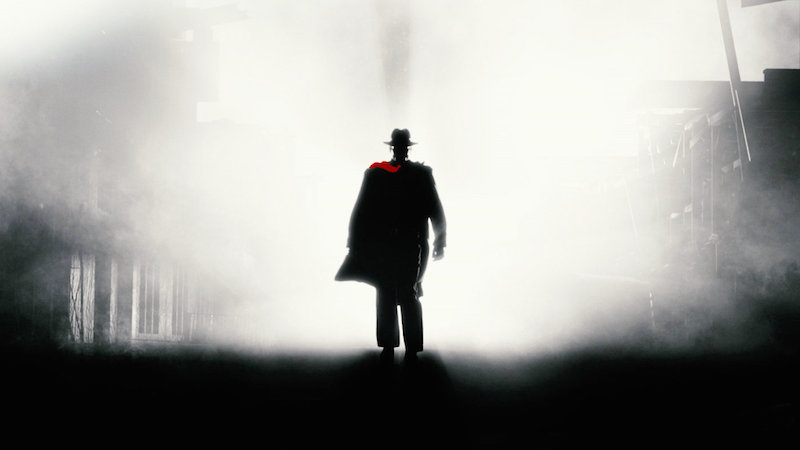
The Spirit (2008) directed by Frank Miller.
via aceshowbiz
Speaking of film adaptations...

I finally saw Frank Miller's version of The Spirit this weekend. While I never believed that Miller had it in him to stay faithful to comic book creation, I wasn't prepared to be so bored with the experience. A lot of that could be blamed on the indifferent acting and poor characterization: Whether it was Gabriel Macht's interminable monologues as The Spirit, Samuel Jackson's overacting as the villainous Octopus, Dan Lauria's grousing as the disapproving Commissioner Dolan, or the several interchangeable femme-fatales, the movie's characters are nothing but tedious and cliched.

There was never any great demand for a Spirit movie. The character doesn't have the name recognition of more famous comic book heroes. And unlike other properties adapted into film, The Spirit has always been attached to a very specific milieu. That this film ever saw the light of day was probably due to Frank Miller being involved with it - Which is the point when things became problematic. Not only do Miller's present stylistic ticks conflict with Eisner's humanism despite sharing superficial similarities, Miller is also a rookie director. His stark visual design and framing of shots is similar to the comic panels he draws. But that doesn't mean he knows how to handle actors or pace his story. The result is a monotonously told narrative.

The Spirit not only shares little in common with its source material (No Ebony White, the hero has a healing factor) but shows a lack of synergy between its interpretation and the current comic book re-imagining being published by DC. While comic book fans would like to see this movie buried and forgotten, it's unfortunate that the movie, not the comic, will be for many their first and only exposure to the character.