5/27/2013

Avatar The Last Airbender: The Search Part 1

Avatar The Last Airbender: The Search Part 1: Writer: Gene Luen Yang, Michael Dante DiMartino, Bryan Konietzko Artist: Gurihiru Letterer: Michael Heisler  Avatar: The Last Airbender created by Michael Dante DiMartino and Bryan Konietzko
Writer: Gene Luen Yang, Michael Dante DiMartino, Bryan Konietzko
Artist: Gurihiru
Letterer: Michael Heisler

Avatar: The Last Airbender created by Michael Dante DiMartino and Bryan Konietzko

Avatar The Last Airbender co-creators Mike DiMartino and Bryan Konietzko have become masters of stringing along their highly devoted fanbase. After revealing that Zuko's mother Ursa, who had been presumed dead throughout much of the series, might still be alive, the series ended while leaving that storyline conspicuously dangling in front of the audience. This set off much rabid speculation about her true fate. But whatever hopes that its spinoff Legend of Korra would provide some answers were dashed when Ursa was briefly mentioned in the series premiere only to be quickly forgotten. Mike would later explain that he and Bryan had unsuccessfully pitched the story of Ursa's fate as a TV movie. After Nickelodeon passed on it, they eventually decided to tell the tale in graphic novel format. Which leads us to The Search featuring the returning creative team of Gene Luen Yang and Gurihiru Studios.

While smaller in scale, this book marks a return to the earlier quest structure that characterized the animated series. This is kind of a relief after having gone through the epic scope of The Promise, which suffered from a plot that was being pulled in multiple directions while often weighed down by its own political allegory. In fact, the shift to a more comedic tone is almost surreal. This time the narrative focuses on a smaller cast of characters, mainly Zuko and his insane sister Azula. This is not an exaggeration, as she has grown fully paranoid since her mental breakdown in the ATLA series finale. Yet it's curious how she and her father Ozai are still fully capable of manipulating Zuko just as easily as they did in the series. It's a bit too convenient how she manages to get her way, encountering little meaningful resistance even from Aang and the rest of the cast. Gene sometimes interprets Aang's circle of friends a little too broadly as a troupe of comic reliefs, which can be pretty annoying. By contrast, he seems to be having a ball with bad guys Azula and Ozai. Azula outshines everyone, particularly the often dour Zuko who's now suffering from a form of survivor's guilt. And there's something appealingly off-kilter about Gurihiru's visuals of her.
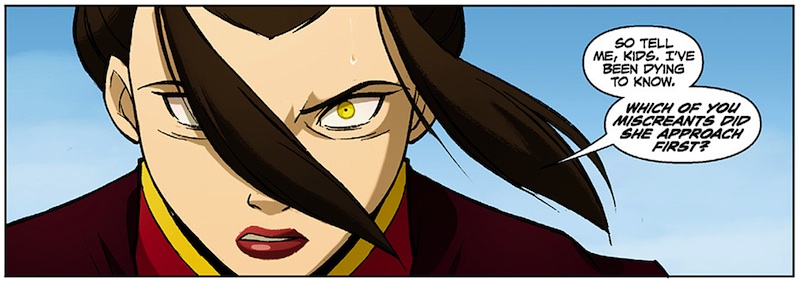
Avatar The Last Airbender: The Search Part 1: Writer: Gene Luen Yang, Michael Dante DiMartino, Bryan Konietzko Artist: Gurihiru Letterer: Michael Heisler  Avatar: The Last Airbender created by Michael Dante DiMartino and Bryan Konietzko

The narrative frequently, and abruptly, jumps back and forth between the present day and Ursa's past as a young woman engaged to the then prince Ozai. What we see of Ursa's youth in this volume conforms to the favorite ATLA trope of the suffering woman sacrificing her own happiness to a loveless marriage. The main difference being that she's being forced to marry Ozai, who is the proverbial dastardly, mustache twirling villain. While Gene often stumbled in capturing the changing but often ambiguous political realities of The Promise, here he's on more sure footing portraying the black and white melodrama of dysfunctional families, horrible father figures, fratricidal siblings, and opposing female archetypes as embodied by Ursa and Azula. This is one messed-up and unhappy world.

New information is gleamed from these flashbacks, such as the possible inspiration for Zuko's Blue Spirit alter ego. But at the very end the volume drops a bomb that threatens not only Zuko's position as leader of the Fire Nation, it also upends several seasons of character development. Indeed, the revelation feels a bit like reading someone's ATLA fan-fiction. This may, in all likelihood, prove to be a red herring. Nonetheless, this had the effect of making me a bit more wary of what's being planned for the rest of The Search.

Avatar The Last Airbender: The Search Part 1: Writer: Gene Luen Yang, Michael Dante DiMartino, Bryan Konietzko Artist: Gurihiru Letterer: Michael Heisler  Avatar: The Last Airbender created by Michael Dante DiMartino and Bryan Konietzko

5/26/2013

Star Trek: Into Darkness (2013)

Star Trek: Into Darkness (2013)

Warning: This post contains major spoilers…

Let's get this out of the way first. Director J.J. Abrams spent so much time and energy denying the identity of the villain of Star Trek: Into Darkness that when it was revealed that Benedict Cumberbatch was indeed playing Khan [Noonien Singh], this seems to have engendered a bit of a backlash, judging from some of the negative reviews on the Web. I don't entirely blame Abrams for trying to keep this a secret. It's kind of a major plot twist. But once it was revealed in-movie, The Wrath of Khan references came in so thick and fast that it began to be a little distracting.

By casting Cumberbatch, TPTB have whitewashed one of the franchise's most compelling and ethnically daring casting choices. Avoiding a backlash for the whitewashing may have been another reason for keeping the villain's identity under wraps. But overall, I did enjoy Cumberbatch's performance. Instead of a charismatic, scheming warlord, nu Khan is more of a violent sociopath with a penchant for mesmerizing those around him with his intense gaze. The movie gets a lot of mileage out of that. But if the studio was going to alter Khan's racial profile, why couldn't they bother to update his origin? It's odd that in 2013 he's still a survivor of the 1990s Eugenics War exiled into space.

The opening scene kind of confused me. The Enterprise crew is trying to save the inhabitants of a planet without violating the Prime Directive (huh?) and their actions don't make much sense. Why did Captain Kirk steal something from the natives? Why did the Enterprise have to hide underwater instead of being in orbit? Why did Commander Spock have to jump into a volcano? It's kind of cool that the Prime Directive is even mentioned, though it's raised mainly as an example of why Kirk is such a reckless bastard, then quietly dropped once the story moves on to its central topic. As with Abram's first effort, off course is about Terrorism.

That terrorism is such an overwhelming concern is unsurprising coming from a major Hollywood production. It warps the traditional purpose of Star Fleet (not to mention the 60s-era progressivism underlying the franchise), and militarizes them, even more so than usual. Spock and Chief Engineer Scotty are troubled by this development and become vocal objectors. The Enterprise gets shot at more times than in all 3 seasons of the original Star Trek TV series. Downtown San Francisco is leveled in a suicide run involving a massive starship. And all the leads get to be in at least one action sequence were they're put in mortal danger. Trek fans looking for more introspective philosophical discussions might come away a little disappointed. Not that terrorism is the only contributing factor. The militarization of the Trek movie series has been going on ever since Captain Picard spent more time kicking ass than asking tough questions in The Next Generation films. The movies are designed to be spectacle aimed at pleasing the mass audience. Into Darkness is, if nothing else, gorgeous eye candy.

For what its worth the Klingons, what little we do see of them, look pretty intriguing.

Going back to The Wrath of Khan references, the film's climax is such egregious fan service that it pretty much robs it of its intended emotional impact. But it also doesn't help that nu Kirk and nu Spock don't have the easy camaraderie that comes from years of casual interaction. Maybe Kirk's self-sacrifice is consistent with his overall impetuous behavior. But Spock's anguished reaction feels strangely forced. And the less said about Kirk's ludicrously quick resurrection, the better.

While this did dampen my enthusiasm for the movie, I still consider myself well entertained. It ends with the sweet promise of a new five-year mission to explore strange new worlds, to seek out new life and new civilizations, and to boldly go where no one has gone before. Wouldn't it be wonderful if this was truly the case for Star Trek's next outing?

5/17/2013

Julio's Day

Julio's Day by Gilbert Hernandez
by Gilbert Hernandez

Gilbert "Beto" Hernandez is one of the comic medium's true humanists. Few of his colleagues can rival his ability to spin complex, sprawling sagas that are both deeply moving and full of genuine sympathy for an often flawed humanity. At just a hundred pages, Julio's Day is one of his most accessible works. But all the hallmarks of his personal style are there: The timeless quality, the fantastic bubbling just below the surface, a love for the rural, the occasional bursts of non-gratuitous sex and violence, the interconnected stories, the multicultural milieu, the multigenerational family saga, strong and independent women, fully rounded gay and minority characters, and of course all told in his minimal but expressionistic black and white cartoons.

Beto accomplishes this by breaking up the narrative into vignettes which last at most half a dozen pages. The story begins with the day of the titular character's birth to a working class Latino family in small-town America at the turn of the century. What follows are glimpses into his life as seen through various moments as he grows to adulthood. While much of his early childhood focuses on his immediate family, the cast naturally expands with his own evolving circle of friends, neighbors, acquaintances, random strangers, and fur flung relatives. Julio himself in not a particularly proactive individual, so the attention in the latter part of the book increasingly shifts to the various people who move in and out of his life. In fact, Julio is often emotionally and sexually repressed. He's the dull contrabass that hums steadily while other people around him experience the highs and lows: happiness, tragic loss, hatred and love. Some even leave to explore the wider world, and return to recount  their varied experiences. As the focus pans back and forth between the characters and time moves forward in an unpredictable manner, what emerges is a highly contrapuntal representation of 20th century America, refracted through the lives of the citizens of one town. While never directly shown, the faint rumble of significant events can be vaguely felt like the gathering storm clouds that dominate the stark landscape.

Julio's Day by Gilbert Hernandez

And this is a surprisingly poignant story. The breezy pace doesn't allow the reader to tarry long with any one individual. In theory, each vignette could have been explored in greater detail. But the brevity touches on certain emotional points while deliberately leaving much to the imagination. Various connections are implied - Sexual denial being a recurring theme with Julio's family. It metastasizes in the form of the perverse behavior of one uncle who is eventually driven out of town. This leads years later into a quest for vengeance. And yet those events also lead to one member of Julio's extended family finding redemption and finally breaking free of those familial constraints.

It's a humble victory, but it's made more powerful by the absolute nothingness that bookends this economic but deeply affecting work.

5/14/2013

Grant loves soap operas

Flashpoint #5 by Geoff Johns, Andy Khubert, Sandra Hope, Jesse Delperdang, Alex Sinclair, Nick J. Napolitano, Jose Luis Garcia-Lopez, Rob Reis
They’re missing the full spectrum of these character’s emotional lives. The most important thing is the long-involved soap operas. It’s a type of narrative that you don’t get anywhere else except on very long-running soap operas, where characters can go into depth. 20 pages every month going into these characters lives over decades give you a lot more insight and a lot more involvement than say a two hour movie, even with Robert Downey Jr. - Grant Morrison
Not to be snide (Okay, I'm being snide), but is that why DC keeps trying to soft-reboot their decades of continuity?

I prefer not to confuse the superhero genre itself with its often associated soap opera elements and their accompanying virtues and shortfalls. With the theatrical success of the Marvel franchise, it's becoming more and more the case of "horses for courses" with different kinds of audiences forming outside of the traditional comic book fanbase. Those sprawling narratives are just not as essential as they once were, if that ever was the case. Overall, I think that's not a bad thing. In some ways, the finite stories in these movies are a return to the more widespread accessibility of the so-called Golden Age of comic book storytelling.

5/05/2013

Honey and Clover Vol. 10

Honey and Clover Vol. 10 By Chica Umino
By Chica Umino

The conclusion to Honey and Clover comes with few real surprises. As the series is basically a towering monument to the majesty of unrequited love, it's no real shock that none of the main characters end up together. At least not in the way expected in more traditional romantic comedies. After all, the whole thing is narrated by Yūta Takemoto, the unluckiest guy in the gang. And the tone throughout the series strongly implies that they'll eventually drift apart. As pointed out in Vol. 8, the only two people to have something remotely resembling a relationship are Ayumi Yamada and Takumi Mayama, though not with each other. And even when the volume catches up with them for one final look, their respective narratives are far from settled. Coming from the series' more down-to-earth characters, this unfinished state feels appropriate to the story. It's how things are concluded between Yūta, Shinobu Morita and Hagumi Hanamoto where things start to get a little odd.

Shinobu and Hagu have been in love with each other for quite some time, and have been torturing each other like two shy Fifth Graders who can't quite admit to their mutual attraction. The last volume ended in an emotional high as they finally confessed to having those feelings. But could these two volatile geniuses ever compromise their gifts or their aspirations? I've always found Hagu to be the least relatable of the entire cast, though the inner strength and determination she's exhibited of late have gone a long way to making her a more sympathetic character. But in the end, artistic passion wins over love. Hagu isn't looking so much for a partner, but apparently more of a father figure to watch over her while she heals. And when one does show up in the one plot twist I didn't see coming, he's willing to fulfill this role even if his own feelings towards her are never returned. The self-sacrifice is meant to be seen as something wonderful. But I found this match incredibly depressing, and to be honest, even a little disturbing.* But at least Shinobu finds his niche working with fun lovin' gaijin who can keep up with his misfit persona.

Honey and Clover Vol. 10 By Chica Umino

And so, the series ends just as it began - Yūta alone with his own thoughts. Looking back on the last five years, he asks "… if love that never bears fruit means anything. If something that vanishes and is gone is the same as something that never was." I'd say that the vivid emotions engendered by his own recollections have answered the question. And his last meeting with Hagu is so bittersweet it absolutely floored me.

The latter part of this volume includes some ancillary material, including two bonus chapters that are more in line with the lighthearted humor of the earlier volumes. Not that the silliness was ever expunged from the series. Far from it...

Honey and Clover Vol. 10 By Chica Umino

___
* I guess that even adult romance stories must have at least one creepy pairing.

Cartoon: By Crom!

By Crom! by Rachel Kahn
Go to: By Crom! by Rachel Kahn (via Lauren Davis)

4/19/2013

Man Of Tomorrow

Did you know the never-ending battle began 75 years ago today? Comics would never the same.

Action Comics #1 (1938): Superman by Jerry Siegel and Joe Shuster
Back then, Superman was a bit of a jerk to the rich and powerful.
Joseph Shuster: We were both great science-fiction fans, reading Amazing Stories and Wonder Stories in those days.

Jerome Siegel: When Joe and I first met, it was like the right chemicals coming together. I loved his artwork... I thought he had flair - though he was a beginner - I thought he had the flair of a Frank R. Paul, who was one of the best science-fiction illustrators in the field.

Shuster: And I was an avid reader of H.G. Wells -

Siegel: Right... Joe as well as I; and we were both reading the same type of material.

Joanne Siegel: In fact, the three of us were destined to meet, because we were kids all playing at being grown up, trying desperately to be grown up. And since that first day of our friendship, we're still together.

― From a 1983 interview published in Nemo #2.
Action Comics #1 (1938): Superman by Jerry Siegel and Joe Shuster
standing up to the Man. Well, a man.
... So I ask you to please consider – do these mean spirited tactics meet with your approval? Do you really think the families of Superman’s creators should be treated this way?

As you know, DC and Warner Bros. have profited enormously from 72 years of exploiting Jerry and Joe’s wonderful creation. Superman is now a billion dollar franchise and has been DC’s flagship property for all this time.
― Joanne Siegel in a 2010 open letter to Jeffrey L. Bewkes of Time Warner Inc. regarding the corporation's actions directed towards the Shuster and Siegel families during their protracted legal battle to reclaim the rights to Superman.
Superman and Lois Lane were created by and .  Lois was originally modeled by .

Action Comics pages referenced here.

Cross-blogged here.

Update: DC confuses. Cleveland rocks.

4/06/2013

Carmine Infantino: May 24, 1925 – April 4, 2013

Showcase #4 (1956):  Carmine Infantino cover, penciler  Joe Kubert cover, inker  John Broome writer  Julius Schwartz editor
The Flash #115 (1960):  Carmine Infantino penciler  Joe Giella inker  Murphy Anderson
The Flash #123 (1961):  Carl Gafford colorist  Carmine Infantino penciler  Gardner Fox writer  Joe Giella inker  Julius Schwartz editor  Murphy Anderson inker
The Flash #139 (1963):  Carmine Infantino penciler  Joe Giella inker  John Broome writer  Julius Schwartz editor  Murphy Anderson inker Characters
The Brave and the Bold #67 (1966):  Bob Haney writer  Carmine Infantino cover, penciler  Charles Paris inker  Joe Giella cover, inker  Murphy Anderson
Batman #181 (1966):  Carmine Infantino cover  Gardner Fox writer  Gaspar Saladino letterer  Joe Giella inker  Julius Schwartz editor  Murphy Anderson cover  Sheldon Moldoff
Batman #183 (1966):  Carmine Infantino penciler  Gardner Fox writer  Gaspar Saladino letterer  Joe Giella inker  Julius Schwartz editor  Murphy Anderson cover  Robert Kanigher writer  Sheldon Moldoff penciler
Batman #195 (1967):  Carmine Infantino cover  Gardner Fox writer  Gaspar Saladino letterer  Joe Giella inker  Murphy Anderson inker  Sheldon Moldoff penciler
Detective Comics #359 (1967):  Carmine Infantino cover, penciler  Gardner Fox writer  Henry Boltinoff inker, letterer, penciler, writer  Julius Schwartz editor  Murphy Anderson cover, penciler  Rudolph Belarski artist  Sid Greene inker
Strange Adventures #205 (1967):  Arnold Drake writer  Carmine Infantino artist, cover, penciler  George Roussos artist, cover, inker  Jack Miller editor
Star Wars Annual #2 (1982):  Carmine Infantino penciler  Rudy Nebres inker
Spider-Woman #8 (1978):  Al Gordon inker  Carmine Infantino cover, penciler  Françoise Mouly colorist  Jim Shooter editor  John Costanza letterer  Marv Wolfman editor, writer  Steve Leialoha
Spider-Woman #12 (1979):  Al Gordon inker  Bob McLeod cover, inker  Bob Sharen colorist  Carmine Infantino cover, penciler  Jim Shooter editor  John Costanza letterer  Mark Gruenwald writer  Roger Stern editor
Superman vs. the Amazing Spider-Man (1976):  Bob Wiacek inker  Carmine Infantino cover, penciler  Dick Giordano cover, inker  E. Nelson Bridwell editor  Gaspar Saladino letterer  Gerry Conway writer  Jack Kirby editor, writer  Jerry Serpe colorist  Joe Rubinstein inker  John Romita penciler  Marv Wolfman editor  Neal Adams penciler  Ross Andru cover, penciler  Roy Thomas editor  Stan Lee editor, writer  Terry Austin inker
Supergirl #17 (1974):  Carmine Infantino cover, penciler  Dick Giordano cover, inker  Julius Schwartz editor  Paul Kupperberg writer  Todd Klein letterer  Tom Ziuko colorist
Supergirl #20 (1984):  Bob Oksner inker  Carmine Infantino artist, cover, penciler  Dick Giordano cover, inker  E. Nelson Bridwell editor  Gene D'Angelo colorist  Julius Schwartz editor  Paul Kupperberg writer  Rod Ollerenshaw letterer
Go to: Comics Reporter by Tom Spurgeon for a nice summation of his career

Carmine Infantino was one of the true greats of the Silver Age. He will be missed.

4/04/2013

Honey and Clover Vol. 9

Honey and Clover Vol. 9 By Chica Umino
By Chica Umino

As expected, vol. 9 of Honey and Clover advances the individual story lines of Hagumi "Hagu" Hanamoto and Shinobu Morita in a manner that is comparatively more melodramatic than those of the rest of the cast. We're finally let into what exactly Morita and his older brother have been up to all this time, and their actions retroactively explain Shinobu's prolonged periods of absence from school and his often fanatical obsession with accumulating vast sums of money while still remaining exceptionally miserly towards everyone.

Both Shinobu and Hagu have been largely defined as the series resident geniuses. In many ways, this role has hemmed them in. While most of Shinobu's friends, classmates and teachers have tolerated his selfishness on account of the brilliant work he supposably turns in from time to time, they've handled Hagu with kid gloves. She's the delicate flower whose extraordinary gifts must be carefully nurtured lest they wilt. At the beginning these surface differences resulted in much comic relief as the two butted heads for alpha-artist status, despite an obvious mutual attraction developing between them. But for the most part they're remained enigmatic figures, and after awhile this gets kind of boring to read. Something needed to be done to shake them up, which is what happens here.

What this volume demonstrates more clearly is how being labelled a genius has isolated these two characters. We learn that throughout the series Shinobu has been assisting his brother in a personal vendetta against the people who've wronged their late father. Shinobu is compassionate and loyal to a fault, but he's beginning to manifest some dissatisfaction over being perceived primarily through his incredible talent. Nevertheless he doesn't reveals his quest to the rest of the cast, further increasing his separation.

Honey and Clover Vol. 9 By Chica Umino

Hagu can't avoid being infantilized for her childlike stature and mannerisms. It doesn't help that she's supremely timid. Hagu claims that she wants to return to her childhood home once she graduates from art school. But she's at the cusp of admitting that she might actually want more out of life. The central event of this volume is a horrible accident that pushes her to grow up a little. While Hagu has demonstrated amazing powers of concentration in the past, this is the first time she's had to apply herself in ways that are well outside her comfort zone.

As for the third person in their love triangle, Yūta Takemoto is left mainly on the sidelines. He briefly considers abandoning his career plans to care for Hagu, before realizing how disastrous a choice that would be for everyone. As the POV character, Yūta is the primary voice for the series deeply nostalgic tone. He's a guy who expresses regret that the cast wasn't able to go on a certain beach excursion, and he conjures up an imaginary beach episode in his mind. It sure does suck to be Yūta. While the last volume focused on some of his friends moving on with their romantic relationships, not only does his five-year long infatuation remain unrequited, he'll be moving away after graduation and lose regular contact with everyone. No wonder the entire manga's narration is so wistful.

Getting back to Shinobu and Hagu, the accident is the catalyst that finally compels them to confront their shared anxieties, and someone raises the possibility of leaving it all behind. Can these two escape their respective reputations? Could these two volatile personalities even function well together?

Cartoon Strip: Borb

Borb by Jason Little