Yay, more komiks reviewed.
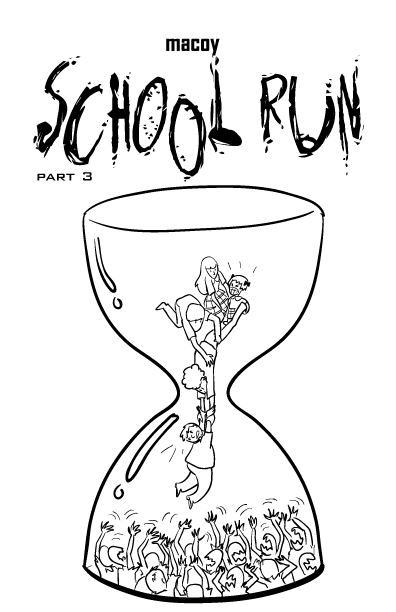
School Run #2-4
by Macoy Tang
Go to my review of #1
Macoy's story of cute munchkins meeting flesh eating zombies escalates the gore and violence, and adds more twists and near-escapes. After having their school bus overrun by an unexpectedly large zombie horde, a handful of students race against time while navigating the treacherous urban terrain in order to make it to safe ground. Along the way they bear witness the best and worse of human nature. And more is revealed about the zombie plague.
The story moves at an economically fast clip, with plenty of emphasis on nonstop action and the zombie fighting. If I have one complaint, it's that the individual minis are so slight that there's not enough time to connect with the main characters or the world they inhabit. Hopefully the pace slows down a bit, but so far this is been an amusing, if at this point an all too quick ride.
Dekada
by Lyndon Gregorio
The popular Beerkada comic strip has been running in the Philippine Star since 1998, and this particular book compilation marked its tenth anniversary when it first came out. The cartoon's target demographic is mirrored by its young adult cast, and is meant to identify with their travails as they confront the usual growing-up experiences of college, dating, relationships, finding a job, or finding a life mate. And it's rendered in a streamlined, blocky style that many newspaper cartoons are drawn in these days.
The strip's main weakness is that the cast is often reduced to hooks used to hang its topical humor on, which contrary to the politically-charged cover, primarily addresses pop culture trends affecting Filipino youth that happen to interest creator Lyndon Gregorio.* They're mostly structured as three panel gags, with some extra material is thrown in to attract collectors. The gags themselves vary from occasionally insightful to plain forgettable (the majority of them leaning towards the latter), with a large number already becoming dated after only a few years removed from their original context. When read in large chunks instead of its original format of daily installments, they appear more chaotic than informative. And the usually oblivious behavior of its characters makes them come across less as distinct individuals than as a collection of annoying quirks.
____
* It also contrasts with a well-known novel with a very similar title.
3/30/2012
Fickle Scientists
Go to: Cul de Sac by Richard Thompson
Petey's been reading some pretty old books or watching Ray Harryhausen movies, because he should be too young to remember that era.
Update: Dinosaurs just got insufferably cuter. Deal with it!
Come to think of it, Petey reminds me of Michael Crichton complaining about those weak-minded, liberal scientists through his mouthpiece Ian Malcolm in The Lost World:
"Dinosaurs were now seen as caring creatures, living in groups, raising their little babies. They were good animals, even cute animals... And that new sappy view produced people ... who were reluctant to look at the other side of the coin, the other face of life."
3/25/2012
3/21/2012
3/19/2012
John Carter
· The advanced word of mouth on Disney Studio's John Carter was that it was a flop. No one was willing to give a film based on Edgar Rice Burroughs' classic character half a chance. That's a shame, for while it won't win any major awards for acting or screenwriting, this is as good way to waste two hours as any. And frankly, I was interested to see how the movie would be able to update Burroughs' work.
· I should mention that I've never read the Barsoom book series. But I grew up when luminaries like Carl Sagan were promising that manned missions to Mars were just around the corner. So I'm a sucker for anything that recaptures that spirit of wonder. And the sword-fighting action doesn't hurt.
· Given that John Carter established the template for fictional works from Flash Gordon to Avatar, the plot is already well-worn. An Earthling, preferably a white male, goes to alien planet and becomes a hero to the natives. The racial overtones must have stood out even more in the original books. John is a former Confederate soldier who encounters green-skinned aliens and "Red Men". The movie naturally tames much of that. John is played as a disillusioned man who is sick of war rather than as a belligerent imperialist. But the movie also reinforces the subtext in it's own unoriginal way. The more "civilized" human characters of Mars (all of them of aristocratic lineage) talk with British accents while the more tribal nonhuman Thark speak with non-Anglicized accents.
· John Carter isn't self-consciously campy, but it doesn't take itself too seriously either. The Jokes emerging from the material don't feel forced. The cast in general is pretty competent. And there's just enough world-building to impart a sense of a longstanding struggle involving nations possessing different technological levels, and varied complex cultures. It's by no means perfectly paced or wholly cohesive, probably a byproduct of adopting the source material to the filmic structure. But it went by quickly enough. Even the disorientating parts were fun.
· Dejah Thoris is easily the best-written character in the movie. It's obvious that she's cut from the classic "damsel in distress" mold, and that her falling in love with the hero is inevitable. But whatever was done to update her doesn't fall into the "strong female character" cliche either. She's fully capable - strong, fierce, intelligent, and cunning. But she's understandably driven by desperation, as she's the only person in the story who comprehends just how bad things will get if she's forced to marry the power-hungry Sab Than. She lies to the non-committal John because this is the only way to convince him to take up her cause.
· I watched the 3D screening, and found that it didn't add anything to the movie. If anything, it made the Depth-of-Field framing shots look noticeably worse.
· This isn't a particularly violent movie. But making the blood blue was an effective way to portray some of the gorier scenes.
· Woola is cute.
· The Barsoom series marks the general public's early fascination with the planet Mars. Unfortunately for the movie, this fascination is at a low point right now. And while the movie isn't bad, its story would feel familiar to fanboys, because it it is.
· I should mention that I've never read the Barsoom book series. But I grew up when luminaries like Carl Sagan were promising that manned missions to Mars were just around the corner. So I'm a sucker for anything that recaptures that spirit of wonder. And the sword-fighting action doesn't hurt.
· Given that John Carter established the template for fictional works from Flash Gordon to Avatar, the plot is already well-worn. An Earthling, preferably a white male, goes to alien planet and becomes a hero to the natives. The racial overtones must have stood out even more in the original books. John is a former Confederate soldier who encounters green-skinned aliens and "Red Men". The movie naturally tames much of that. John is played as a disillusioned man who is sick of war rather than as a belligerent imperialist. But the movie also reinforces the subtext in it's own unoriginal way. The more "civilized" human characters of Mars (all of them of aristocratic lineage) talk with British accents while the more tribal nonhuman Thark speak with non-Anglicized accents.
· John Carter isn't self-consciously campy, but it doesn't take itself too seriously either. The Jokes emerging from the material don't feel forced. The cast in general is pretty competent. And there's just enough world-building to impart a sense of a longstanding struggle involving nations possessing different technological levels, and varied complex cultures. It's by no means perfectly paced or wholly cohesive, probably a byproduct of adopting the source material to the filmic structure. But it went by quickly enough. Even the disorientating parts were fun.
· Dejah Thoris is easily the best-written character in the movie. It's obvious that she's cut from the classic "damsel in distress" mold, and that her falling in love with the hero is inevitable. But whatever was done to update her doesn't fall into the "strong female character" cliche either. She's fully capable - strong, fierce, intelligent, and cunning. But she's understandably driven by desperation, as she's the only person in the story who comprehends just how bad things will get if she's forced to marry the power-hungry Sab Than. She lies to the non-committal John because this is the only way to convince him to take up her cause.
· I watched the 3D screening, and found that it didn't add anything to the movie. If anything, it made the Depth-of-Field framing shots look noticeably worse.
· This isn't a particularly violent movie. But making the blood blue was an effective way to portray some of the gorier scenes.
· Woola is cute.
· The Barsoom series marks the general public's early fascination with the planet Mars. Unfortunately for the movie, this fascination is at a low point right now. And while the movie isn't bad, its story would feel familiar to fanboys, because it it is.
3/15/2012
WIP #1 and Trese: Last Seen After Midnight
Hey, I finally read some komiks this year! Good for me. Now on to the reviews.
WIP (Work in Progress) #1
by Hub Pacheco and Teddy Pavon
WIP first began as a webcomic before seeing print as a mini. Its first ten pages introduce the reader to the main protagonist Eli, a twenty-something slacker and principal narrator who often addresses the reader directly. In the beginning, he's rendezvousing with an attractive girl in front of a comic book store. This opening is the best part of the comic. But the story suddenly breaks away in order for Eli to talk more about his background.
While I wanted to to sympathize with his plight, Eli comes across as more ingratiating than interesting. This is because he's a fairly generic character. His constant patter of fanish in-jokes gets tiresome after awhile. And much of the comic's content can be described as him and his circle of friends rambling on about various geeky topics with little in the way of a strong connecting thread. One moment they're reminiscing about their failed comic book from their college days, next they're praising the Philippine comic industry while mocking mainstream crossover events. Did I mention that in addition to being an underemployed man-child, Eli complains a lot about his inability to hook a girlfriend?
The loose, gag-filled structure isn't compensated for by the anime-inspired art though. It isn't adroit enough to make the gags more compelling, or versatile enough with the characters' expressions to make them more varied and charming. And the story never quite returns to address the opening scene of the comic. Some judicious editing could have helped a lot to tighten the narrative.
Trese: Last Seen After Midnight
by Budjette Tan and KaJo Baldisimo
I believe it's been two years since the last volume featuring Alexandra Trese, Manila's renowned supernatural crime-fighter. Given how that book contained a story arc which engaged in some serious world-building, it's slightly disappointing that the series creators have gone back to the "corpse of the week" format. But the riffs on popular culture are entertaining in their own right. Their preferred mode is to blend well-known Manila landmarks with various local folklore and superstitions. The first story "Cadena de Amor" about elemental spirits haunting the darker recesses of Luneta Park is the most typical entry. "A Private Collection" is jarring in that the main antagonist is patterned after the stereotypical big game hunter who hunts more unusual creatures just for the thrill of it. This makes it feel more like a conventional superhero story. The more hip "Wanted: Bedspacer" in which a rash of student deaths taking place close to several college campuses is connected with another kind of spirit, seems derived from contemporary Asian horror cinema. This is the book's best-paced story and is the only one in which Alexandra doesn't come up with the right answer on her first guess, or resolve the problem with violence. That's countered with "The Fight of the Year", a rousing patriotic tale in which an analog of the famous boxer and local hero Manny Pacquiao battles the underworld on behalf of the nation. For once, Alexandra is a spectator and supporting character.
While the book doesn't break new ground, the level of skill and artistry on display shows significant improvement from earlier efforts. The stories themselves aren't particularly terrifying, although they can be creepy and oppressive at times. There are a few references made to past events to keep readers guessing about continuity. So it's a no-brainer for fans of Trese. But the stories are also self-contained enough that new readers could probably use them as a jumping on point, which might be the reason for the return to this format.
WIP (Work in Progress) #1
by Hub Pacheco and Teddy Pavon
WIP first began as a webcomic before seeing print as a mini. Its first ten pages introduce the reader to the main protagonist Eli, a twenty-something slacker and principal narrator who often addresses the reader directly. In the beginning, he's rendezvousing with an attractive girl in front of a comic book store. This opening is the best part of the comic. But the story suddenly breaks away in order for Eli to talk more about his background.
While I wanted to to sympathize with his plight, Eli comes across as more ingratiating than interesting. This is because he's a fairly generic character. His constant patter of fanish in-jokes gets tiresome after awhile. And much of the comic's content can be described as him and his circle of friends rambling on about various geeky topics with little in the way of a strong connecting thread. One moment they're reminiscing about their failed comic book from their college days, next they're praising the Philippine comic industry while mocking mainstream crossover events. Did I mention that in addition to being an underemployed man-child, Eli complains a lot about his inability to hook a girlfriend?
The loose, gag-filled structure isn't compensated for by the anime-inspired art though. It isn't adroit enough to make the gags more compelling, or versatile enough with the characters' expressions to make them more varied and charming. And the story never quite returns to address the opening scene of the comic. Some judicious editing could have helped a lot to tighten the narrative.
Trese: Last Seen After Midnight
by Budjette Tan and KaJo Baldisimo
I believe it's been two years since the last volume featuring Alexandra Trese, Manila's renowned supernatural crime-fighter. Given how that book contained a story arc which engaged in some serious world-building, it's slightly disappointing that the series creators have gone back to the "corpse of the week" format. But the riffs on popular culture are entertaining in their own right. Their preferred mode is to blend well-known Manila landmarks with various local folklore and superstitions. The first story "Cadena de Amor" about elemental spirits haunting the darker recesses of Luneta Park is the most typical entry. "A Private Collection" is jarring in that the main antagonist is patterned after the stereotypical big game hunter who hunts more unusual creatures just for the thrill of it. This makes it feel more like a conventional superhero story. The more hip "Wanted: Bedspacer" in which a rash of student deaths taking place close to several college campuses is connected with another kind of spirit, seems derived from contemporary Asian horror cinema. This is the book's best-paced story and is the only one in which Alexandra doesn't come up with the right answer on her first guess, or resolve the problem with violence. That's countered with "The Fight of the Year", a rousing patriotic tale in which an analog of the famous boxer and local hero Manny Pacquiao battles the underworld on behalf of the nation. For once, Alexandra is a spectator and supporting character.
While the book doesn't break new ground, the level of skill and artistry on display shows significant improvement from earlier efforts. The stories themselves aren't particularly terrifying, although they can be creepy and oppressive at times. There are a few references made to past events to keep readers guessing about continuity. So it's a no-brainer for fans of Trese. But the stories are also self-contained enough that new readers could probably use them as a jumping on point, which might be the reason for the return to this format.
3/08/2012
Unintentional
Go to: SuperMutant Magic Academy by Jillian Tamaki
No teenage boy wants to be compared to Georgia O'Keeffe! Amiright?
3/03/2012
2/24/2012
2/22/2012
Avatar The Last Airbender: The Promise Part 1
Writer: Gene Luen Yang
Art: Gurihiru
Avatar: The Last Airbender created by Michael Dante DiMartino and Bryan Konietzko
This latest comic adaptation of the popular animated series Avatar The Last Airbender functions as a bridge between the original and its upcoming sequel Legend of Korra. Writer Gene Luen Yang is a huge fan of the series, and was a highly vocal critic of its controversial film adaptation. The Promise could be described as almost a mini fourth season, with the narrative picking up right were the TV series left off. While this best serves the interests of its already established fanbase, Yang does try his best to get new readers up to speed with a short recap, as well as employing dialogue that keeps them informed about character backstories without becoming too obnoxious.
But fans will be pleased to know that the comic hews fairly close to the tone of the cartoon, which is to say that it feels like a natural progression of what came before. The art supplied by Gurihiru studios ages the characters slightly, but otherwise it looks like it could have been lifted from the series itself (minus the sound and motion off course). Yang also gets the comic banter between them just right.
Where Yang has to inject some original content is in the maturation of the cast. At a certain point the story jumps forward a year as they try to deal with the fallout from the century-long war they've managed to end. The protagonists are well into puberty and now have established certain romantic pairings. But this is still a children's book. So a conversation between one couple implies that they are not having sex, while another couple's PDA gets the "icky" reaction from the rest of the cast. Yeesh!
Yang seems to read into ATLA parallels to real-world history. His approach here mirrors the Star Trek method of using the fantasy setting to deliver political commentary. In this case he tackles a favorite topic of his - race and postcolonial identity. Having won the war, the heroes set about dismantling the Fire Nation colonies in the Earth Kingdom. They even come up with the euphemistic label "Harmony Restoration Movement" to describe the undertaking. It's ironic that the intentions behind this policy are truly sincere. And it goes about as well as any forced relocation of communities that have lived in one place for a long time. This starts to muddy the Avatar's original M.O. of maintaining peace between the nations by keeping them separate. Multi-cultural heterogeneity is suddenly inserted into the ATLA universe. Even one of the main characters is on the receiving end of a racial slur from an angry anti-foreigner mob. This jives with Yang's own concerns, but also works as a lead-up to Korra. Either way it's a "darkening" of the original concept.*
Unsurprisingly, this ambiguity personally affects the cartoon's resident anti-hero Zuko the most. While now allied to the good guys, he's still prone to making extremely poor off-the-cuff decisions, which in turn, drives the narrative conflict. So his groupies will at least be delighted to hear that their favorite troubled teenager still hasn't shed certain bad habits. Some people just never learn.
Update: Go to my review of Part 2
___
* Speaking of darkening, the book's title partially refers to a grim oath Zuko secures from Aang near the beginning. But given how Aang was able to successfully resolve the TV series' central conflict while avoiding extreme measures, this seems like an unnecessarily idiotic move. Emo bastard!
Art: Gurihiru
Avatar: The Last Airbender created by Michael Dante DiMartino and Bryan Konietzko
This latest comic adaptation of the popular animated series Avatar The Last Airbender functions as a bridge between the original and its upcoming sequel Legend of Korra. Writer Gene Luen Yang is a huge fan of the series, and was a highly vocal critic of its controversial film adaptation. The Promise could be described as almost a mini fourth season, with the narrative picking up right were the TV series left off. While this best serves the interests of its already established fanbase, Yang does try his best to get new readers up to speed with a short recap, as well as employing dialogue that keeps them informed about character backstories without becoming too obnoxious.
But fans will be pleased to know that the comic hews fairly close to the tone of the cartoon, which is to say that it feels like a natural progression of what came before. The art supplied by Gurihiru studios ages the characters slightly, but otherwise it looks like it could have been lifted from the series itself (minus the sound and motion off course). Yang also gets the comic banter between them just right.
![]() |
| The Earth King: master statesman |
Where Yang has to inject some original content is in the maturation of the cast. At a certain point the story jumps forward a year as they try to deal with the fallout from the century-long war they've managed to end. The protagonists are well into puberty and now have established certain romantic pairings. But this is still a children's book. So a conversation between one couple implies that they are not having sex, while another couple's PDA gets the "icky" reaction from the rest of the cast. Yeesh!
Yang seems to read into ATLA parallels to real-world history. His approach here mirrors the Star Trek method of using the fantasy setting to deliver political commentary. In this case he tackles a favorite topic of his - race and postcolonial identity. Having won the war, the heroes set about dismantling the Fire Nation colonies in the Earth Kingdom. They even come up with the euphemistic label "Harmony Restoration Movement" to describe the undertaking. It's ironic that the intentions behind this policy are truly sincere. And it goes about as well as any forced relocation of communities that have lived in one place for a long time. This starts to muddy the Avatar's original M.O. of maintaining peace between the nations by keeping them separate. Multi-cultural heterogeneity is suddenly inserted into the ATLA universe. Even one of the main characters is on the receiving end of a racial slur from an angry anti-foreigner mob. This jives with Yang's own concerns, but also works as a lead-up to Korra. Either way it's a "darkening" of the original concept.*
![]() |
| Sokka: minister of propaganda |
Unsurprisingly, this ambiguity personally affects the cartoon's resident anti-hero Zuko the most. While now allied to the good guys, he's still prone to making extremely poor off-the-cuff decisions, which in turn, drives the narrative conflict. So his groupies will at least be delighted to hear that their favorite troubled teenager still hasn't shed certain bad habits. Some people just never learn.
![]() |
| Toph: chief of public safety |
Update: Go to my review of Part 2
___
* Speaking of darkening, the book's title partially refers to a grim oath Zuko secures from Aang near the beginning. But given how Aang was able to successfully resolve the TV series' central conflict while avoiding extreme measures, this seems like an unnecessarily idiotic move. Emo bastard!
2/20/2012
2/15/2012
2/10/2012
2/09/2012
2/03/2012
Slowing Down
Due to ongoing difficulties accessing the Web, I haven't been blogging as actively as I'd like to. This will continue for sometime to come, maybe until summer. I haven't put my blog on hiatus yet. But I suppose I'll use the extra time to catch up on my reading.
Jeez, it's been four years, as of today, already?
1/24/2012
Who lives in their workspace, and can you eat of the floor?
Go to: ComicsAlliance, by Lauren Davis
I'm always a little curious about the level of organization, or chaos, maintained within different artist studios.
1/20/2012
1/18/2012
Webcomic: Get Your Censor On
Go to: Get Your Censor On by David Rees (via Aaron Colter)
Update: Comics creators and bloggers hate SOPA.
Subscribe to:
Posts (Atom)


