Yay, more komiks reviewed.
School Run #2-4
by Macoy Tang
Go to my review of #1
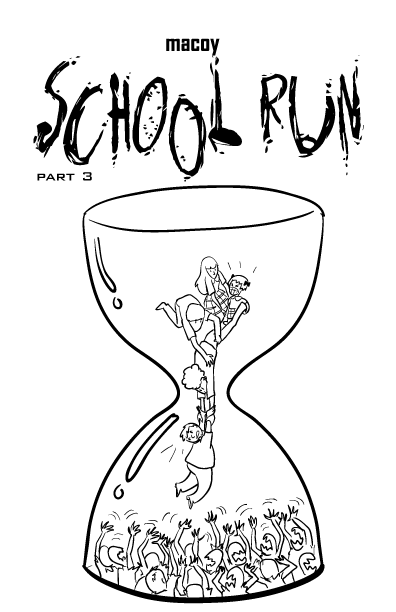
Macoy's story of cute munchkins meeting flesh eating zombies escalates the gore and violence, and adds more twists and near-escapes. After having their school bus overrun by an unexpectedly large zombie horde, a handful of students race against time while navigating the treacherous urban terrain in order to make it to safe ground. Along the way they bear witness the best and worse of human nature. And more is revealed about the zombie plague.
The story moves at an economically fast clip, with plenty of emphasis on nonstop action and the zombie fighting. If I have one complaint, it's that the individual minis are so slight that there's not enough time to connect with the main characters or the world they inhabit. Hopefully the pace slows down a bit, but so far this is been an amusing, if at this point an all too quick ride.
Dekada
by Lyndon Gregorio
The popular Beerkada comic strip has been running in the Philippine Star since 1998, and this particular book compilation marked its tenth anniversary when it first came out. The cartoon's target demographic is mirrored by its young adult cast, and is meant to identify with their travails as they confront the usual growing-up experiences of college, dating, relationships, finding a job, or finding a life mate. And it's rendered in a streamlined, blocky style that many newspaper cartoons are drawn in these days.
The strip's main weakness is that the cast is often reduced to hooks used to hang its topical humor on, which contrary to the politically-charged cover, primarily addresses pop culture trends affecting Filipino youth that happen to interest creator Lyndon Gregorio.* They're mostly structured as three panel gags, with some extra material is thrown in to attract collectors. The gags themselves vary from occasionally insightful to plain forgettable (the majority of them leaning towards the latter), with a large number already becoming dated after only a few years removed from their original context. When read in large chunks instead of its original format of daily installments, they appear more chaotic than informative. And the usually oblivious behavior of its characters makes them come across less as distinct individuals than as a collection of annoying quirks.
____
* It also contrasts with a well-known novel with a very similar title.
Showing posts with label Macoy. Show all posts
3/30/2012
2/23/2011
Sulyap (Part 2)
Go read: Part 1
Lipad by Rommel J. Estanislao
Loosely adapted from the popular song Pipit, Lipad is a parable of young idealism literally laid low by the banal cruelty of adults. The symbolism employed by both the song and Rommel Estanislao's comic are easy enough to comprehend, and it's object lessons could be conveniently transferred to the conditions faced by the present generation of komiks creators. With its outpouring of sincere sentiment, Lipad would make it a perfect anthem for the Sulyap anthology.
Maktan 1521 by Tepai Pascual
The Battle of Mactan is one of those military victories that tend to get retold and given further embellishment in order to inflame patriotic fervor. The particular version printed here is only the opening of a longer graphic novel, so it suddenly cuts off at mid-scene. But the first sixteen pages do provide an ample preview of Tepai Pascual's storytelling: There's a chilling magical-realist vision of the Spanish conquest of the Philippines which sets the tone for the story. The soldiers appear as menacing as a squad of stormtroopers. This foreboding is further intensified in the next scene with a group of worried natives looking at the enormous black vessels of the Spaniards docked at a trading port (This is a black and white comic). The story ends prematurely with a meeting between the Spaniards and three datus, in which the latter are presented with an ultimatum - submit or be attacked.
While it's difficult to gauge anything about the originality of its message or viewpoint from just this sampling, what separates Maktan 1521 from other retellings is the art of Pascual. Her strong sense of design bolsters the heroic proportions of her angularly drawn figures, as well as her preference for chiaroscuro to outline them. It's a beautiful comic to look at, to say the least. This isn't a naturalistic interpretation of the historical events but a romanticized one, informed by Pascual's comic influences from Frank Miller to Hiromu Arakawa. In terms of scope, this is the most ambitious story in the collection.
Taal Volcano Vs. Evil Space Paru-Paro by Macoy
I've already reviewed what looks like a cross between Japanese kaiju an tamagotchi here in its original mini-comic form, so I'll just add that the visuals look much more polished with the superior production values of this anthology.
Windmills: Bearkdowns by Josel Nicolas
Josel Nicolas is the only creator in Sulyap whose art and subject matter largely mirrors the influence of American alternative comix from the nineteen eighties and early nineties. His art is deliberately rough and crude so as not to distract from the narrative. He makes use of surrealist devices such as dream/fanstasy sequences, and anthropomorphic characters. He eschews linear narrative for formalist experimentation. And most stereotypically, he's abandoned pulp formula for literary expression, i.e. autobiography (Or in this case, semi-autobiograhy).
Bearkdowns is a partial reprint of Windmills: Bearkdowns - the first mini in the creator's series. The main protagonist is a talking bear who struggles with writer's block, all the while visiting his parents, and dealing with death in the family. This is an extremely dense story crammed with metaphors centering around creativity and mortality, making it the most challenging comic in this anthology. The crowded panels aren't always easy to look at, let alone decipher, especially within the book's small print size. And the stream-of-conscious approach doesn't bother with clear scene transitions to help make it easier to follow. And in keeping with the arbsurdist nature of the story, the end swerves away from any unambiguous punchline. That's not entirely true, as Bear does seem to find evidence of some mysterious symmetry in life towards the end.
I'm unsure as to whether Bearkdowns can be considered an artistic success. But even if it is a failure, in many ways it's still the one komik in Sulyap that goes out on a limb.
Part 3 will wrap-up my overview of Sulyap.
11/21/2010
Taal Volcano Monster and School Run #1
Taal Volcano Monster vs. Evil Space Paru-Paro
School Run #1
As I noted in my post on the last Komikon, There's no shortage of young talent self-publishing their own mini-comics. They're entirely reliant on good word-of-mouth to generate sales at conventions and the comic stores willing to stock them. The Web is an essential part of their self-promotional efforts. Most will use a free blog service or a DeviantArt gallery. But there's so far no critical mass of creators who've taken the vital next step and produced fully featured websites running under a proprietary domain. There's still a lot of hesitancy to devote more of the time and money needed for creating a larger body of webcomics. So a lot of indie activity is still aimed at finding readers for their homemade black and white aschans. Philippine comics may not be dead. But outside of the medium's devotees, not too many know about it.
One indie komiks artist to recently emerge is Macoy Tang, whose mini Ang Maskot (The Mascot) garnered critical acclaim last year. Macoy draws in a stripped down, big-headed, cartoony style, that looks suitable for children's book illustration. It's an appropriate style, as his comics use humor to tap into the collective memory of a generation of Filipinos who wasted their time watching too much TV. He tweaks popular genres by placing them within a Filipino context.
Taal Volcano Monster vs. Evil Space Paru-Paro is a fond tribute to Japan's classic kaiju films. But this comic's Godzilla-like character doesn't live at the bottom of the Pacific Ocean or on Monster Island. Instead it lives within the caverns deep below Taal Volcano, a popular national landmark. And it doesn't surface to attack humanity because of nuclear weapons testing. Rather, it's disturbed by the noise pollution due to the increase in tourism to the area. Monsters need their sleep too. So it ascends to the surface (via a giant elevator) and incinerates the tourists with its "lava breath". After a little bickering, the army and navy agree that the air force should get to die first at the hands of the Taal Volcano Monster.
At a modest twenty pages, Taal Volcano Monster isn't so much a story as an extended gag strip. A Mothra stand-in shows-up for no good reason other than that's what happens in the movies. And the requisite knock-down drag-out battle takes place. Both monsters are drawn to look like cuddly plush toys, while the humans are mostly just tiny stick figures. Mass destruction rarely looked so cute.
While entertaining in it's own right, it's too slight to stand on its own as a professionally printed work. But as part of the newly published Sulyap anthology, it's a much better value.
On the other hand, School Run is a longer and more ambitious project. An ongoing series that's on its third issue, it's set in a near-future Philippines infested by zombies. No explanation is given as to what bought them into existence, though it's implied that the cause is viral in nature. The twist is that humanity has come to take them for granted, like at the end of Shaun of the Dead. People may live behind fortified houses and drive around in heavily armored vehicles. But that doesn't stop them from carrying on like they normally do. The zombies are blown in like the typhoons that regularly batter the country. As with any real-world inclement weather, they've just become another part of everyday life.
Unfortunately, the weather bureau underestimates the severity of one ultra-powerful "intertropical zombie convergence zone". People commuting to work and school are caught off guard and the death toll climbs to the millions. The story focuses on a group of elementary school students traveling by bus when the zombies reach Manila. Their driver is killed in the usual gruesome manner. And the first issue's cliffhanger ending raises questions on who will be around in the next installment. They may be kids, but if the comic follows the formula, the cast will get whittled down to just a few of the more resourceful and stronger characters. The smart money is on the thoughtful little girl who senses that something is amiss from the very beginning. But the other characters have yet to establish any emotional connection with the reader.
The first issue isn't particularly graphic by the genre's standards, although the possibility of baby-faced munchkins dying horribly one by one might disturb some readers. But that didn't stopped The Drifting Classroom. The departure from the usual horror movie casting is what's intriguing about the comic. So as perverse as this sounds, I'll be disappointed if no blood is spilled in the future.
Subscribe to:
Posts (Atom)


