2/03/2013

Five Years Ago...

Some thoughts and musings about making things for the web by Matthew Inman
From The Oatmeal by Matthew Inman

I think I should mention that today marks five years since I've started blogging on this site, which might be the longest that I've been able to sustain any kind of online activity. It's at best a meager achievement. And I'm not the most prolific or talented blogger in this field. But it's probably helped keep me sane throughout. And I've enjoyed doing something productive with my free time, for the most part. Hopefully, I've become a better writer since I begun this blog. There you have it.

1/30/2013

Adventure Time with Fionna and Cake #1

Adventure Time with Fionna and Cake #1 Story and Art: Natasha Allegri, Noelle Stevenson Letters: Britt Wilson Covers: Jen Bennett, Lisa Moore, Joe Quinones, Vera Brosgol, Ethan Rilly, Becky Dreisdadt, Frank Gibson, Sina Grace, S. Steven Struble, Colleen Coover, Natasha Allegri, Penelope Gaylord, Emily Warren, Stephanie Gonzaga, Yssa Badiola, Kassandra Heller  Adventure Time created by Pendleton Ward
Story and Art: Natasha Allegri, Noelle Stevenson
Letters: Britt Wilson
Covers: Jen Bennett, Lisa Moore, Joe Quinones, Vera Brosgol, Ethan Rilly, Becky Dreisdadt, Frank Gibson, Sina Grace, S. Steven Struble, Colleen Coover, Natasha Allegri, Penelope Gaylord, Emily Warren, Stephanie Gonzaga, Yssa Badiola, Kassandra Heller

Adventure Time created by Pendleton Ward

The highly popular Adventure Time television episode "Fionna and Cake" functioned as affectionate commentary on the often-used fan fiction device of gender-swapping well-liked characters (as well as a critique to fans who habitually insert themselves as a Mary Sue character into their own fiction). So it was probably inevitable that the publisher would release a comic book adaptation of this premise once the cartoon was determined to be successful in its comic book incarnation. Written and drawn by Natasha Allegri,  the character designer for that very episode, the comic seeks to be a worthy companion to the Ryan North penned series.

At its core, AT accurately maps out a kid's imagination at work. The viewer could simply accept at face value the idea that Finn the human and Jake the dog are heroes who thrive in a post-apocalyptic world. But at the meta-level, they could just as easily be thought of as the daydreams of a young boy playing in the backyard with his dog, or a group of friends entertaining themselves with their favorite fantasy-based RPG. The Land of Ooo is a comforting place where its young protagonist faces, and usually defeats, all varieties of monsters and demons while attempting to understand the mysteries of the opposite sex. The series is known for the large array of princesses Finn often interacts with, most notably by rescuing them from the clutches of the socially maladjusted Ice King. Then there's the unobtainable Princess Bubblegum whom Finn pines after, and the bewitching Marceline the Vampire Queen, whose friendship is the closest thing he has to a platonic relationship with a girl. Given how Finn-centric the show is, gender-swapping the roles significantly changes the dynamic of the stories.

Natasha does a very good job modulating the characters away from their familiar TV series portrayals. This comic begins with a bittersweet fairy tale about the origin of volcanoes which is drawn with a sensuous line not often seen in the show. Her color palette of warm reds and oranges balanced out by deep blues and pale grays is exquisite. And the type employed by Britt Wilson effectively compliments her art. The scene shifts to Cake narrating this tale to a dour Fionna, who objects to the lack of  "butt-punching" within the story. There's a lovely intimacy between them demonstrated in the humor and the body language. Cake enfolds her friend like a motherly serpent with her elastic body while an upset Fionna tightly hugs a Cake doll. While their camaraderie is similar to that of Finn and Jake, there's a certain emotional intensity that sets Fionna and Cake apart. Fionna comes across as slightly more subdued and introverted. Cake on the other hand isn't as relaxed and easygoing as Jake, and possesses a rather intimidating appearance when she bares her fangs. The funniest scene in the comic is when Cake tries to convince Fionna to choose from several unreliable-looking swords she handcrafted for her. Ever dubious, Fionna tentatively asks if the kitty litter sword still has poo in it, which sets off a comical overreaction.

The main story ends all-too abruptly with a cliffhanger as the duo is about to engage the Ice Queen in combat. However, Noelle Stevenson's silly backup story is delightful to look at, and fans will be amused at the indignant expressions on the faces of Prince Gumball and Vampire King Marshall Lee complaining about the relative value of sweaters. And hey, those two will appear in an upcoming episode to facilitate more gender-bending goodness.

1/23/2013

Superior Spider-Man #1

Writer: Dan Slott Art: Ryan Stegman Colors: Edgar Delgado Letters: Chris Eliopoulus  Spider-Man created by Stan Lee and Steve Ditko
Writer: Dan Slott
Art: Ryan Stegman
Colors: Edgar Delgado
Letters: Chris Eliopoulus

Spider-Man created by Stan Lee and Steve Ditko
[Spoilers Ahead]

So longtime nemesis Doctor Octopus/Otto Octavius is Spider-Man/Peter Parker now? That's an unexpected development, especially for a lapsed reader like myself. But it's no sillier than any of the other recent attempts to shake-up his comic book status quo. And frankly, it's pretty obvious from page one that this won't be permanent. Otto is such a barely disguised bad guy that it's a wonder his cover hasn't been blown yet.

For one, this Peter being secretly possessed by Otto's mind is such a douche towards his colleagues, friends, and Mary Jane Watson. That's really the heart of what makes this arrangement so objectionable to Marvelites, isn't it? That the dirty old man is now sleeping with their hero's main squeeze. The dinner scene where Otto's not listening to a word M.J. says because he's too busy monitoring criminal activity while leering at her cleavage... Isn't that the very image of fanboy creepiness? And it's kind of odd that none of the cast seems to comment on the change in Peter's behavior. He uncharacteristically calls someone a "dolt". He also grins, sneers, snarls, and lurks in the shadows like so many a miscreant. He wears a darker shaded version of his uniform, and he's rendered with rougher-looking art, just in case the reader still doesn't get it.

Then there's the ruthless approach he displays when battling the new Sinister Six. Once a mastermind, always a mastermind? There's a point in the confrontation when he acts like the villain revealing his masterplan while cackling at his own brilliance. And like many villains, he has to share his triumph with the public. Only now, he's boasting about capturing super criminals. So it's apparent that this Spider-Man is no selfless do-gooder, but the vainglorious vigilante Peter has been accused off being so many times in the past. While the world gawks, it takes the supervillains to notice that Spidey isn't acting like his usual self.

Writer: Dan Slott Art: Ryan Stegman Colors: Edgar Delgado Letters: Chris Eliopoulus  Spider-Man created by Stan Lee and Steve Ditko

And finally there's the twist ending which reveals that whenever Otto's better nature gets, well, the better of him, it's actually Peter's disembodied spirit pulling the strings. So in a way, Peter's still the true protagonist of the story, with Otto playing Jean-Paul Valley to his Bruce Wayne. This isn't about Otto adjusting to his new role as hero, it's about Peter finding his way back. I'd like to say that coming back from the dead is harder than coming back from a broken spine, except that this is superhero comics we're talking about.

It took Bruce more than a year to make his way back to donning the familiar cape and cowl. So in the meantime, get used to the idea of Otto brandishing those web-shooters. Breath deep. Relax. Maybe even try to enjoy the transition. Then witness the eventual unravelling of his new life.

1/17/2013

The Massive #7 and Mara #1

Today's post looks at two alternate futures recently penned by the prolific comics creator Brian Wood. Let's get to it then.

The Massive #7  Writer: Brian Wood Art: Garry Brown Colors: Dave Stewart Letters: Jared K. Fletcher Cover Art: J.P. Leon
The Massive #7

Writer: Brian Wood
Art: Garry Brown
Colors: Dave Stewart
Letters: Jared K. Fletcher
Cover Art: J.P. Leon

So far, The Massive has been a bit of a let down. It has a fascinating premise: A smarter, less WASPy-ish version of Sea Shepherd called the Ninth Wave finds itself in a world swamped by rising sea levels and a whole host of ecologically devastating knock-off effects, collectively referred to as "The Crash". In all the ensuing chaos, one of the organization's vessels "The Massive" has mysteriously vanished. Ninth Wave founder and leader Callum Israel and the crew of sister ship the Kapital spent the first two issues chasing down a false lead, but since then seem to have all but given up on the search. The series has them meandering from Alaska to the Antarctic with little in way of a clear purpose. There's a considerable amount of world building that takes place as the Ninth Wave faces a new local power base at every turn. But there's very little forward momentum to the plot and hardly any emotional connection being developed with any of the main characters. It's hard to care about a group of unseen people whom the actual cast barely seems to miss. And for all of Callum's exhortations that his crew continue to practice pacifism, he doesn't bother to formulate any specific policy that would help redefine Ninth Wave's mission in a post-Crash world (e.g. what is the official Ninth Wave position now that rising sea levels have flooded much of the world's coastlines?). One unfortunate side effect of the lead protagonist's passivity is that he's constantly being upstaged by his two feuding lieutenants Mary and Mag Nagendra.

In this issue, the Kapital visits yet another port, a collective of hundreds of linked oil platforms situated in the middle of the Indian Ocean called Moksha, which has recently declared independence. Brian Wood continues to work the world building angle as this would-be nation's leader explains to Callum and Mary their origins in the Indian subcontinent's longstanding conflicts, which were being exacerbated by The Crash. Hints are dropped to indicate how much of the old world continues to exist: The UN is casually mentioned as still an ongoing concern. And in another verbal exchange, the Sri Lankan Mag encounters ethnic and religious-based prejudice from some of Moksha's residents.

The Massive #7  Writer: Brian Wood Art: Garry Brown Colors: Dave Stewart Letters: Jared K. Fletcher Cover Art: J.P. Leon

While the series continues on in its episodic course, this is the first time the crew has disembarked at one place for a considerable period. The plot plays to the formula that beneath the surface, the natives are hiding some very troubling secrets. This gets picked up on by both Mary and Mag, who begin to act  out in accordance to their own separate agendas, and right under Callum's nose. This is the most ineffectual he's looked in the entire series. But I'm just hoping the payoff for this story arc leads to something that eventually ties all of the disparate experiences the Ninth Wave has gone through.

Mara #1  Writer: Brian Wood Art: Ming Doyle Colors: Jordie Bellaire
Mara #1

Writer: Brian Wood
Art: Ming Doyle
Colors: Jordie Bellaire

The dystopian future of Mara is a largely recognizable one which closely resembles the media-saturated landscape of the present day United States. It's one where sports-entertainment is closely associated with capitalism, the military, and imperialist propaganda. World news coverage often relates the government's latest foreign intervention in a far away land that usually ends with the suffix "stan". Any broadcast of a high-profile match is preceded by a reading of a long list of corporate sponsors. Sports are "bread and circuses" used to appease the general population, as well as a form of military recruitment. And celebrity athletes are richly compensated for performing this task. They're also naturally obsessed with their social media status.

Now none of this is necessarily relevatory.What's a bit atypical for this type of dystopian fantasy is the complete lack of bloodsports that have become standard to the subgenre (For a recent example, read America's Got Powers). Brian shies away from such overtly warlike diversions. His choice for the country's most beloved athlete isn't some stone-faced gladiator who secretly longs to be free of the system, but a wholesome-looking seventeen year old girl named Mara, who plays indoor volleyball. Using such a tame sport might seem odd to sci-fi fans, but it does lend the story some verisimilitude since it more accurately reflects what kind of sporting event actually succeeds in drawing the largest audiences. The mainstream prefers watching basketball or baseball to mixed martial arts. Or if you prefer games with more global appeal, football or tennis. And they like their athletes looking clean-cut, not battle-scarred. To underline the point, the comic's omniscient narrator mentions that Mara even dabbled in MMA before finding her true calling in volleyball. That even her attractive but ethnically ambiguous physical features are exploited as a powerful marketing tool only adds to the believability of the premise.

Mara #1  Writer: Brian Wood Art: Ming Doyle Colors: Jordie Bellaire

It's a pleasure to see the art of Ming Doyle grace the pages of a more mainstream project. Her style has a certain awkward charm not usually found in artists showcasing a slicker look. When combined with Jordie Bellaire's saturated colors, this particular future setting is bright and colorful, even a little childlike. It's quite a ways from the more gritty urban environments that tend to accompany these kind of stories. If anything, it's ambiance is almost reminiscent of classic futuristic shows like Star Trek or Space 1999.

The thing that creates a great deal of uncertainty is a twist that suddenly interjects superpowers into the equation. My concern is that this comic could end up being a lot more conventional in the end if it goes down any of the already well-trod paths featuring tales of youngsters or celebrities in possession of superpowers.

1/09/2013

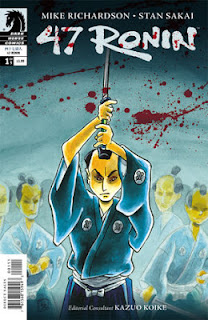
Martial Myths: 47 Ronin #1-2

47 Ronin #1 Writer: Mike Richardson Artist: Stan Sakai Colors: Lovern Kindzierski Letters: Tom Orzechowski, Lois Buhalis 47 Ronin #2 Writer: Mike Richardson Artist: Stan Sakai Colors: Lovern Kindzierski Letters: Tom Orzechowski, Lois Buhalis
Writer: Mike Richardson
Artist: Stan Sakai
Colors: Lovern Kindzierski
Letters: Tom Orzechowski, Lois Buhalis

“To know the story of the 47 Ronin is to know Japan.” says the tag line to this retelling of an oft-repeated tale. Which brings up a salient question. Don't we already know Japan through this narrow perspective? Before the country was known to the West as the land of cosplay-obsessed otaku, it was more traditionally known as the land of honor-obsessed warriors. This image was fueled for decades by a long line of works for popular entertainment, such as the best-selling novel Shogun or the more recent film The Last Samurai. They're primarily distortions of history which helped feed into some very powerful and longstanding racial stereotypes. But I suppose nothing beats the original, home-grown product to get the point across. There's something to be said about not seeing Japan again filtered through the actions of another bewildered-looking gaijin.

The actual events go something like this: a young daimyo named Asano Naganori used his sword to attack the elderly court official Kira Yoshihisa (Yoshinaka) within the grounds of Shogun Tokugawa Tsunayoshi's palace when its staff was busy dealing with an official visit from the Emperor's envoys. The exact nature of Asano's grievance with Kira has never been definitively pinpointed. But he failed to land a killing blow. And for his rash actions, Asano was quickly sentenced to death by the Shogun, his lands seized, and his family dispossessed. In response to this severe punishment, over forty of Asano's most faithful (but now masterless) bushi led by chief retainer Oishi Kuranosuke hatched a plan to complete the job. They bided their time for almost two years. Then on a cold winter night they raided Kira's house, slaughtered his servants, and took his life. The ronin carried Kira's head to Asano's grave at Sengakuji temple as an offering. There they waited for the Shogun's judgement, who stayed true to form and condemned them all to death.

47 Ronin #1 Writer: Mike Richardson Artist: Stan Sakai Colors: Lovern Kindzierski Letters: Tom Orzechowski, Lois Buhalis

Kira's murder was extremely controversial to its contemporaries,* but it also captured the public's imagination. The event would be retold many times, with further details added and embellished. In what could be thought of as a case of blaming the victim, Kira was vilified in future versions as a cowardly figure who provoked the noble Asano into attacking him, while the criminal behavior of the 47 ronin (the number of retainers finally settled on) was justified by the code of bushido, making them the embodiment of the virtues of duty, honor, and loyalty. When the office of the shogun was finally abolished, the tale acquired the status of patriotic myth within a rapidly modernizing Japan.

For all the years of supposed research and trips to Japan, Mike Richardson has chosen mythical retelling over history, which when taken on its own terms is a valid storytelling option. The tale has a certain noire appeal with its band of would-be criminals defying the law in order to follow a more violent personal code. Besides, who doesn't like to see the underdog overcome the odds to beat the high and mighty, or at least die trying? And on a more universal level, it's a rousing, manly tale of good vs. evil.

If there's a weakness with his version, it's the cut-and-dried quality of the narrative. The characterizations are archetypical: Kira is vain, corrupt, greedy, and vindictive. Asano is unpretentious, noble, a devoted family man, and righteous. Oishi is loyal to a fault. The pacing is a steady slow-burning dramatic arc. Part one is devoted to building up the conflict between Asano and Kira, while part two focuses on the palace intrigue leading up to Asano's execution. Dates and place names are clearly labelled with captions. And everyone, even the kids, talks in a very formal manner, which sometimes makes me wonder if Mike was trying to mimic the language of classical Japanese theater.

47 Ronin #2 Writer: Mike Richardson Artist: Stan Sakai Colors: Lovern Kindzierski Letters: Tom Orzechowski, Lois Buhalis

An artist with more baroque, sensuous, or dynamic sensibilities could have probably served to better counteract the stiffness of the script. Sadly, this job isn't quite suited to Stan Sakai. I can see why Mike describes him in the afterword as the right artist for the comic. He's a brilliant cartoonist, and he respects the setting of the story. Probably more than most artists. There's nothing exaggerated or manifestly inaccurate about his portrayal of 18th century Japan. This is clearly a labour of love for Mike. But I still feel that Stan's style would have better complimented a more satirical retelling of the myth. Mike's approach is too humorless and reverent to completely mesh with Stan's whimsical style.

Two issues into its five part run, this is a agreeable, if not wholly original, exploration of well-trod territory. It's fairly conventional and somewhat flat, and would be even duller if not for some lovely details supplied by Stan's amazing work. But so far, there's just a dearth of energy which leaves me underwhelmed.

___
* The samurai Yamamoto Tsunetomo questioned the motives of Oishi's group when he wrote this passage in the Hagakure:
"Concerning the night assault of Lord Asano’s ronin, the fact that they did not commit seppuku at the Sengakuji was an error, for there was a long delay between the time their lord was struck down and the time when they struck down the enemy. If Lord Kira had died of illness within that period, it would have been extremely regrettable."
Strongly implying that the underhanded methods used in the revenge plot exhibited far less honorable motives than had the ronin promptly and openly challenged Kira after Asano's execution.

1/01/2013

Happy New 2013

New Year's Eve 2013
And surely you’ll buy your pint cup!
and surely I’ll buy mine!
And we’ll take a cup o’ kindness yet,
for auld lang syne.
- Robert Burns, Auld Lang Syne
Cross-posted with photoblog

12/27/2012

Avatar The Last Airbender: The Promise Part 3

Avatar The Last Airbender: The Promise Part 3, Writer: Gene Luen Yang, Michael Dante DiMartino, Bryan Konietzko Artist: Gurihiru Letterer: Michael Heisler  Avatar: The Last Airbender created by Michael Dante DiMartino and Bryan Konietzko
Writer: Gene Luen Yang, Michael Dante DiMartino, Bryan Konietzko
Artist: Gurihiru
Letterer: Michael Heisler

Avatar: The Last Airbender created by Michael Dante DiMartino and Bryan Konietzko

Go to my reviews of parts one and two.
[Warning: Spoilers ahead]

The Promise occupies the gray area between The Last Airbender and Legend of Korra. As it stands, it often feels like an additional season of the the former. And it contains plenty of the requisite fanservice. But whereas the TV series tended to meander a lot, the graphic novel is far more succinct, often to the point of feeling truncated at times. Supporting characters don't always receive equal attention. And just as the narrative's primary conflict is quickly introduced, it's just as quickly expedited in the last volume.

The common theme found in the two TV serials is that of diversity. The Last Airbender had a simple fairy tale premise that supported the idea that diversity was preserved through the separation of the four "nations". Not that this principle was strictly observed when the hero travelled the world with a multinational gaggle in tow. But Aang did treat the territorial boundaries between them as inviolable, and the basis for rejecting the Fire Nation's conquest of the Earth Kingdom. Legend of Korra takes place in a historically grounded setting where boundaries, both external and internal, are more realistically portrayed as fluid. It's the task of The Promise to link the two in such a way that the fairy tale, with its quasi-mythical racial divisions, and the postcolonial adventure, composed of a multicultural pastiche, are seen as belonging to the same timeline. It accomplishes this on the surface level by supplying all kinds of fanservice-friendly filler material foreshadowing the birth of the airbender acolytes, the metalbending police force, the United Republic of Nations, the recorded union of Aang and Katara. But the third volume also does most of the heavy lifting regarding the evolution of the beliefs and philosophies of its youthful cast, particularly that of Avatar Aang and Fire Lord Zuko.

That the strife ultimately revolves around  the psychodrama between these two characters should not come as a surprise to fans. What is different is the lack of an obvious archvillain to externalize the narrative's conflict, something both TV serials used as a convenient scapegoat and as a way to bring the issues into stark relief. And without a villain to rally against, it turns out that Aang functions as the role of principal antagonist while the usually impetuous Zuko is proven to actually be on the right side for once. Aang is the rigid traditionalist worried about safeguarding cultural purity, while Zuko is desperately seeking a logical way to avoid an impending second world war between the Fire Nation and the Earth Kingdom. Aang's promise to Zuko, which was given in part one, serves to further raise the stakes by personalizing the dilemma.

Avatar The Last Airbender: The Promise Part 3, Writer: Gene Luen Yang, Michael Dante DiMartino, Bryan Konietzko Artist: Gurihiru Letterer: Michael Heisler  Avatar: The Last Airbender created by Michael Dante DiMartino and Bryan Konietzko
Aang carries out his Avatar-defined duties

I've felt however from the beginning that this plot point was a weakness of the story. That Aang would even seriously consider offing his good friend Zuko, let alone quickly assenting to carrying out such a grim oath if it ever became necessary, seems less likely than the possibility that he would have actually killed his mortal enemy Fire Lord Ozai in the TV series finale. Not even some mystically-infused dream at the beginning of this volume could convince me otherwise. Didn't Aang already surpass those methods after communing with this guy? So the eventual showdown between the two felt anticlimactic, repetitive, and unoriginal. Another scene that particularly irked me was a conversation where Aang describes the compassion he exhibited throughout the ATLA series as a kind of character "flaw". Coming from him, the statement rings false and the message being conveyed comes across as a little too on-the-nose to me.

In case I've given the wrong impression that this is an introspective work, this volume is packed with more action than the last two parts, with the battle between the Fire Nation and Earth Kingdom armies and the colonists forming its centerpiece. The series unique mixture of hand-to-hand combat and humor is very much still in force, with the trio of Sokka, Toph, and Suki using similarly disruptive guerrilla tactics to what they did in the ATLA finale to very much the same comic effect. Mind you, the juvenile quips don't always work, especially with older readers. One character is reduced to a running joke about how he managed to land a total babe for a girlfriend. That gets old real fast. And there is a downside to cramming so many characters within a graphic novel. Some of them, like Ozai and Mai, simply vanish from the story. Others, like Earth King Kuei and Iroh, make only brief, perfunctory appearances. But the biggest disappointment is how Katara gets transformed from independently minded badass to Aang's supportive girlfriend. I get that she needs to hang out with her beau, but she doesn't get to do anything cool on her own time anymore. Not even to chew out Sokka and Toph for behaving like idiots.

Avatar The Last Airbender: The Promise Part 3, Writer: Gene Luen Yang, Michael Dante DiMartino, Bryan Konietzko Artist: Gurihiru Letterer: Michael Heisler  Avatar: The Last Airbender created by Michael Dante DiMartino and Bryan Konietzko
Kataang wins again!

But wait! Is that queen bee Azula staging her big comeback? Maybe fans will finally get to see another rematch in the future.

12/22/2012

The Hobbit: An Unexpected Journey

The Hobbit: An Unexpected Journey (2012)
The Hobbit: An Unexpected Journey has the difficult task of adapting to screen a much-loved book, functioning as a prequel to Peter Jackson's established Lord of the Rings film trilogy, and laying the groundwork for yet another film trilogy. Needless to say, something had to give when trying to navigate these varied and sometimes conflicting goals. Fans of the book will note the many liberties taken to the plot in order to make it fit with the preexisting films. Fans of the film trilogy will enjoy the sensation of revisiting a familiar world. Not everyone will be satisfied with the attempts to balance the lighthearted quest story of The Hobbit with the world-spanning epic of Lord of the Rings. The film is rife with flashbacks and jump cuts, and most of the scenes feel drawn out and repetitive, especially the action set pieces. After awhile, the orc attacks start blending into one another. The dinner party near the beginning in particular seemed to go on forever. Protagonist Bilbo Baggins comes across as the everyman hero he's supposed to be, and the confrontation between him and Gollum is everything I had hoped for. But his personal story often gets lost in the shuffle. All that additional material results in a rambling story that constantly shifts back and forth between the Dwarves quest to kill the dragon Smaug and the White Council's investigation of the Necromancer threat. I'm not sure if Jackson's desire to cram the film with so much minutiae or the studio's hunger to profit from the franchise was more important in the final decision to produce a trilogy, but the film ends at about halfway through the book, leaving me to wonder just how effectively can Jackson stretch things out to have enough material to produce two more films.

But this franchise is still a veritable juggernaut, and it's going to perform well enough at the box office to earn its keep. And for all it's flaws, I enjoyed The Hobbit. I'm admittedly too much of a Tolkien fan not to want to watch every film twice.

12/21/2012

"Then I guess this is it"

Crisis on Infinite Earths #1 Writer: Marv Wolfman, Robert Greenberger, Pencils: George Pérez, Inks: Dick Giordano, Colors: Anthony Tollin, Letters: John CostanzaCrisis on Infinite Earths #1 Writer: Marv Wolfman, Robert Greenberger, Pencils: George Pérez, Inks: Dick Giordano, Colors: Anthony Tollin, Letters: John Costanza
From Crisis on Infinite Earths #1

If the apocalypse began today, so far it's proven to be a massive disappointment. We're missing out on a cool ending.

12/18/2012

Get Jiro!

Get Jiro! Written by: Anthony Bourdain and Joel Rose  Pencilled and Inked by: Langdon Foss Colored by: José Villarrubia and Dave Stewart Lettered by: Todd Klein
Written by: Anthony Bourdain and Joel Rose 
Pencilled and Inked by: Langdon Foss
Colored by: José Villarrubia and Dave Stewart
Lettered by: Todd Klein

As a disinterested reader, I initially wondered if Anthony Bourdain's graphic novel debut Get Jiro! would turn out to be the kind of vanity project too abstruse with its particular obsessions to enjoy. As it turns out, I was only half right. The comic does indulge in the kind of topics Bourdain deeply cares about, and it eventually looses me before the end. But it's a tale told using a medium with a reputation for geeky obfuscation.  So what's wrong if the foodies and gourmets bring their eccentricities and obnoxious tics into the comics community? Get Jiro! is the kind of story that could not have been conceived anywhere else.

The story works to suck the reader in by framing itself with traditional pulp conventions found in spaghetti westerns, crime dramas, and samurai epics, most central being the anti-hero taking on the establishment. Naturally, the whole comic is steeped in the ethos of rugged individualism. In a dystopian version of Los Angeles, pop culture has become dominated by food culture. Imagine if in the real world the Food Network was the only television station around, and the only true celebrities were celebrity chefs. For everyone but foodies, that sounds like a nightmare scenario. But the real horror as far as the book is concerned are the social inequalities being perpetuated in the name of good food. Located at the city center are the finest dining establishments patronized by the glitterati, who willingly line up for hours. The further one travels from the center, the cheaper and dirtier the eateries get, and the more ethnic the composition of the neighborhoods. There is some form of strict segregation being enforced which prevents easy access to the inner part of the city for the residents of the outer rings, although it's never really explained how it came into existence or how it exactly works.

The unofficial rulers of Los Angeles are two chefs who command their own factions like mob bosses, with each faction ruling its own turf. The two chefs could be conveniently labelled as the "snob" and the "hippie". The former demands the highest standards and finest ingredients, the latter supports a number of social causes like veganism and using only locally grown organic produce. Despite being mortal enemies, they've managed to maintain a fragile truce. I've had very little exposure to Bourdain's TV shows. But I'm left with the strong impression that these two figures embody his pet peeves, because they're basically straw men shown to be hypocrites who quickly betray their beliefs to obtain wealth and power. The snob is willing to finance his empire of sophisticated dishes with trashier fare, while the hippie conveniently contradicts the nonviolent core of her ideals for the same ends. The satire throughout is fairly heavy handed.

Get Jiro! Written by: Anthony Bourdain and Joel Rose  Pencilled and Inked by: Langdon Foss Colored by: José Villarrubia and Dave Stewart Lettered by: Todd Klein

Into this setting arrives Jiro, a sushi chef with the aloof bearing of a Japanese warrior, who sets up his sushi bar at the edge of the city. He's a finicky type who literally cuts down his customers for not observing the proper table etiquette, which reminded me of the "Soup Nazi" from Seinfeld. The difference is that Jiro's devotion to perfection is held up as an admirable trait, and his reputation spreads so far and wide that the snob and the hippie try to recruit him to their side. What happens next will be familiar to anyone who's seen Yojimbo or A Fistfull of Dollars. Jiro isn't about to give up his independence, so he manipulates both sides for his own benefit while befriending other indie chefs who are fed up with the status quo. Eventually the whole city is engulfed in a war between the big two. Through it all, Jiro remains an enigma. We never learn much about his background or his motives beyond wanting to be left alone to practice his profession. If this story contains any official message, it would be that real chefs should be free to be chefs.

Get Jiro! is far more clever than it is compelling. Between the avarice of its villains, the quest for culinary purity of its protagonist, and a barely repressed contempt for the poor saps who have the bad taste to order something as vulgar as California Rolls, there's not much room to maneuver, let alone arrive at a middle ground. And there's no denying that the text engages in so much inside baseball that it never fully transcends its own self-involvement. The closest thing the story has to a sympathetic portrait of the ordinary consumer are two fat cops who possess such impeccable taste that I doubt they would ever be caught scarfing down a box of donuts. One of them even worries about loosing his restaurant reservation as the gang war erupts all around them. That's actually kind of funny.

The art has its own way of appealing to the reader that surpasses the text. Obviously, the book has many scenes devoted to food porn. Whether it's frying baby eels in olive oil, demonstrating the proper technique for cutting into a fish to paralyze it without killing it, or displaying all the raw ingredients needed to make a pot au feu. Langdon Foss draws in a clear line style which is complemented by the saturated color palette of José Villarrubia and Dave Stewart. The end product is superficially reminiscent of the look and feel of many a Heavy Metal short story. Only this time, the characters aren't just hacking each others limbs, they're slicing animal parts as well. Scenes of detailed food preparation are often juxtaposed with scenes of extreme violence in which the same kitchen implements are being used to maim and kill humans. The results are sumptuous in appearance, but also kind of repulsive. Whatever personal philosophy being endorsed, ideology being preached, or traditional cuisine being championed as more authentic, cooking is always portrayed as a bloody vocation. And more often than not, this is used to reinforce very masculine forms of self-expressions.

Get Jiro! Written by: Anthony Bourdain and Joel Rose  Pencilled and Inked by: Langdon Foss Colored by: José Villarrubia and Dave Stewart Lettered by: Todd Klein

If you've already read Get Jiro! and want to get rid of the aftertaste with something more sweet, go read Kitchen Princess or Antique Bakery.

12/13/2012

More NonSense: The Earth is F**ked Edition

Occupy Comics -by Anna Muckcracker, from Godkiller image for Atari Teenage Riot's Black Flags video
Occupy Comics Black Flag

The title is obviously taken from Brad Werner's presentation at the American Geophyiscal Union conference in San Francisco: "Is Earth F**ked? Dynamical Futility of Global Environmental Management and Possibilities for Sustainability via Direct Action Activism". Coming from a group of scientists and academics, this is an uncharacteristic call to arms against the status quo. And with that, we count down to the end of the world as told by believers in the Mayan calendar.

Speaking of activism, here is Alan Moore’s Essay for the Occupy Comics Anthology.

Watch the anime-inspired Greenpeace video for their Detox our Future campaign.

Climate change deniers are hard to convince. What else is new.

In one of the odder moves to jump on the 2012 bandwagon, Australian prime minister Julia Gillard issued her own tongue-in-cheek announcement.

The second season of Doomsday Preppers recently began airing on Nat Geo Asia. I wander about the tenuous grasp on reality exhibited by some of the people in the first two episodes. Here's my review of season one.

Alex Kane notes the sillier side of this December 21st hullabaloo.

Watch Decay, a zombie movie filmed by physics PhD students at CERN's Large Hadron Collider facility. I can't even begin to imagine how cool that must have been to film.

Know what? If the doomsayers are right, my fat ass will be among the first to fall to the starving cannibal horde.

Here are Hollywood's dumbest apocalypses put on film.

In case you're not frightened enough, here are the ways technology can run amuck and kill us all.

The Chinese government is treating 2012 believers as serious threats.

Watch this lovely video based on Carl Sagan's Pale Blue Dot.

Annalee Newitz gives school survival tips to young geeks. I wish someone had given me this advice when I was younger. It could have helped.

I missed the memo stating that geek dads are the new MILFs.

Batman is superhumanly tough. How else could he still be fighting crime, despite enduring a long injury-prone career.

Is Superman Boring? No more than most superheroes who've been around for decades.

12/10/2012

Sundome Vol. 1

Sundome Vol. 1 Created by Kazuto Okada
Created by Kazuto Okada

I've read enough harem and magical girlfriend comedies to notice how creators love to write about romantic couplings that begin from a vantage of inequality. Whether it's the tsundere uppercutting her would-be boyfriend. Or the alien goddess lowering herself to the role of a mere mortal's loyal servant. Or other playful variations of Japan's intricate social hierarchy. But the unconventional relationship in Sundome comes closest to a dominant/submissive sexual partnership. Not that anything explicit actually takes place. The book can be described as one big tease. The title itself when translated into english is "stopping the moment before", which is a generally accurate description of the events in the volume.

Hideo Aiba is your standard wimpy male protagonist found in shonen manga. He's a member of the Roman Club, a group devoted to seeking out boyish adventures such as investigating ghosts, UFOs, and other paranormal mysteries. The members must remain virgins in order to preserve the club's youthful vision. To the rest of the high school's student body, they're just a bunch of otakus. But the club members also maintain high marks in order to get into a good college and have a successful future career. The club's "Old Boys" (school alumni) give out scholarships to members who manage to graduate with their virginity intact. But they also make this goal virtually impossible to achieve by sending "assassins" to strip them of it. Needless to say, these actions foster a certain degree of paranoia.

Then one day the beautiful Kurumi Sahana transfers into Hideo's class. She becomes immediately popular with all the boys in school. Hideo is no exception, and almost quits the club to pursue Kurumi. But when she expresses an interest in joining, he reconsiders. The other members naturally suspect that she might be another assassin, but are too flustered in her presence to object.

Sundome Vol. 1 Created by Kazuto Okada

This silly premise in itself doesn't necessarily separate it from other rom-coms aimed at young readers. But the sexualized imagery certainly does. The story is characterized by juvenile fascination with prurient subject matter. Hideo's infatuation when first meeting Kurumi is expressed through his massive erection, drawn as a fairly obvious bulge in his pants. What perks Kurumi's interest in the club is their secret book on masturbation techniques. And when she confronts Hideo about it, she first asks him to demonstrate how to jerk-off, then rather bluntly states "Even if we were the last two people on Earth, I'd still never have sex with you. No matter how much you beg or cry, I’d never let you come". Hideo accepts these terms as long as it doesn't mean outright rejection. And he happily describes agreeing to this  arrangement as putting on a "collar".

So begins an erotically charged, yet oddly chaste affair. Hideo is so desperate to please Kurumi at every turn that he often performs tasks that are well outside his comfort zone. He willingly courts injury and humiliation to keep himself within Kurumi's good graces, and for the small yet titillating "rewards" she doles out to keep him happy. Kurumi scolds him for showing weakness and praises him when he completes a task. The extremity of this behavior is going to be off-putting to a lot of readers. Manga fans who prefer their rom-coms be more innocent are going to balk at the level of abuse Hideo tolerates. Kazuto Okada doesn't use any of the usual manga tricks to glamorize his characters. While they might be sexualized, they aren't exactly sexy. Kurumi's emaciated form in particular is a gloomy mirror image of the petite figure ideal found in moe manga. All the characters look awkward and twisted, and the mood is exacerbated when they're surrounded with oppressive black stippling. The situations Hideo and the Roman Club face parody conventional manga tropes e.g. the constant panty shots, the indirect kiss, standing up to the school bully, the "test of courage", and other school club hijinks. But they're drained of much of their usual cuteness. And without the PG-13 filters, this brings to the fore the teenage cast's angst and obsession with sex.

Sundome Vol. 1 Created by Kazuto Okada

Towards the end, the promise is held out that there may be more to Kurumi torturing Hideo than mere self-amusement. But the overall mood of this volume is one of abasement punctuated with moments of real intimacy, raunchy humor, and intense slapstick. Most of the adults who read this are going to wonder why Hideo puts up with Kurumi, and it would be hard to argue against the idea that what he needs most is to grow a spine. But beneath the surface, Sundome is a work that adolescents can relate to. Lurking within it's emotionally clumsy narrative is the dawning realization that nurturing a deeper, more mature connection with another human being sometimes involves the discharge of bodily fluids.