Go to: The Village Voice illustrations by Ward Sutton (via Andy Khouri)
11/15/2011
The JSA are a bunch of jerks!
Go to: May Contain Content by Kerry Callen (via Andy Khouri)
Superman uses his cape as a napkin? Priceless.
11/14/2011
A Fair and Balanced Viewpoint
![]() |
| From Frank Miller's Batman: Year One |
But I still want you kids to stop stealing my WiFi and get off my lawn.
Update: All kidding aside, I've been under the impression that Miller was beginning to hold right-of-center Libertarian views ever since I read The Dark Knight Returns, and people who thought otherwise because he made fun of Ronald Reagan were missing the point. And it wouldn't surprise me if 9/11 nudged him to openly espouse more extreme opinions if his own beliefs had already become more uncompromising with the passage of time. So I find the shock expressed in some quarters over this unambiguous expression of ultra-conservative politics a bit odd. The one thing about Miller's post that caught me of guard was that the talented writer penned such a poorly worded, hippy-bashing, cliche-ridden response. The language he used is so crude it sounds more like self-parody than a serious statement. But I shouldn't, since this is admittedly what passes for thoughtful political punditry these days. So this paranoid screed fits right in with the rest. When placed next to his latest work Holy Terror or even 300, this looks like the genuine article without any outside editorial input filtering Miller's words.
11/10/2011
The League of Extraordinary Gentlemen, Century: 1969
By Alan Moore, Kevin O'Neill, Todd Klein, Ben Dimagmaliw
Comics may not have been the first medium to exploit the crossover, but it's become attached to this storytelling device like no other. Appropriating disparate ideas, forcing them to interact with each other, and essentially re-contextualising them in the process, is pretty much a hallmark of comics geek appeal. So it's no surprise that the protean Alan Moore has become contemporary comics most famous writer. Of his creations from ABC, The League of Extraordinary Gentlemen has remained his most ambitious ongoing project. What started out as an attempt to weave together various fictional characters into a Victorian-era superhero team, has come to absorb a ridiculous array of literary and popular influences. With Century: 1969, his cunning appropriation hits a new high, threatening to overwhelm the rest of the story. Panels are crammed with incidental details referring to one thing or another. Characters drop in and out while making cryptic pronouncements. As for the story itself, the book assumes that the reader is aware of the League's previous history, not really bothering to explain the setup or the main characters who are involved. The backstory within LOEG would be daunting to the uninitiated. Imagine trying to read the 4th Harry Potter book without prior knowledge of the Philosopher's Stone, or dementors, or Neville Longbottom.
The League in this case is composed of Wilhelmina (Mina) Murray, Allan Quartermain, and the immortal Orlando, a character synthesized by Moore from several sources, such as Virginia Woolf's novel of the same name. Since Century: 1910, the League has been waging a war of attrition against the cult of the villainous Oliver Haddo, an Aleister Crowley analogue. He's intent on unleashing dark magical forces upon the world. The story jumps forward to London in 1969, after events dealt with in The Black Dossier have rendered Mina and Allan also immortal. This generates an interesting personal crisis. As the prospect of an endless future begins to dawn on Mina, she tries unsuccessfully to cope with the changing times by acting like one of the young and hip. There's pathos to the predicament that could have been explored further. But Moore doesn't dwell on this for long before returning to the larger milieu they occupy. London in 1969 is literally a brighter, more saturated place, ably rendered by colorist Ben Dimagmaliw and Kevin O'Neill. But despite the many nods to contemporaneous popular entertainment, this version of the 60s doesn't conform to the typical image of the era. It still feels a lot like the gloomy 19th century city where Mina and Allan hail from. To begin with, the hidden occult threat they're uncovering imbues the proceedings with an inescapable sense of dread. Moore's ramping-up of the cynicism, violence and sleazy behavior somewhat undercuts the whole "free love" ethos of the period. If anything, the numerous impersonal depictions of sex only seems to subvert the freewheeling counterculture of the 60s. And as with past LOEG stories, there's an important but disturbing scene involving a sexual assault on a major character that sours the overall mood. For all its clever world-building, I'm not exactly sure what the comic says, if anything, about the actual social and political ferment of the decade.
The comic culminates in a fictionalized version of the Rolling Stones Hyde Park tribute concert to Brian Jones, now reinterpreted here as an occult ritual which the League attempts to stop. But Mina accidently drops acid and endures a bad trip. She enters the astral plane and battles the spirit of Haddo. It's at this point that O'Neill cuts loose with his art. The rectangular panel layouts give way to irregular and organic shapes. The psychedelic visions Mina experiences are dazzling in the Peter Max mode, while simultaneously retaining the grotesque caricatures O'Neill has always drawn. It's erotically charged imagery without being remotely attractive or titillating. When the battle concludes, the end result is calamitous for the League, and the contrast between these pages with the coda that follows is gut-wrenching.
So the League leaves the year 1969 far more embittered than when they first entered it. One of the pleasures of reading crossovers is seeing how the writer is able to combine what are otherwise mutually exclusive stories into a convincing narrative. This latest chapter of LOEG certainly demonstrates that Moore is still very capable of fashioning intriguing alternate realities. But somewhere along the way he seems to have lost the desire to humanize, or to a least make his protagonists more comprehensible to readers. Meanwhile, Moore's propensity to shock and perturb only continues to grow. What remains is a certain meanness unleavened by humor. I wonder if hidden in this story of immortal but impotent heroes, Moore is commenting on the continued publication of classic comic book characters whose time has long passed. Or is he just becoming more pessimistic? If he's this cold-blooded with them in 1969, how much worse will things get for Mina, Allan, Orlando, and the world as a whole when the story moves into the next millenium?
11/04/2011
11/03/2011
11/02/2011
What was known 150 years ago
![]() |
| Illustration from General Atlas of the World |
Go to: io9.com by Robert T. Gonzalez
Unemployed Man and OWS
![]() |
| Gan Golan, left, author of Unemployed Man, poses as the title character from his graphic novel and Robert Segal poses as Krug Man for a superheroes march to the New York Stock Exchange on Halloween. |
![]() |
| Alan Yang dresses up as Captain Generica for Monday's superheroes march to the New York Stock Exchange. |
![]() |
| Betsy Richards dresses up as Wonder Mother for Monday's superheroes march to the New York Stock Exchange. Richards is a working mother of two children. |
Go to: Underwire by Nicole Martinelli. Photos by Bryan Derballa/Wired.com
11/01/2011
10/28/2011
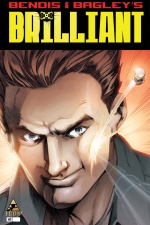
Brilliant #1
By Brian Michael Bendis, Mark Bagley, Joe Rubinstein, Nick Filardi, Chris Eliopoulos, Tim Daniel
Fiction that tries to answer the "what if superheroes were real" question tends to follow one of two broad approaches.* In the first, ordinary people put on costumes and try to act like superheroes despite an absence of superpowers or impossible blend of skill sets. This happens to have some currency due to the activities of Real-life Superheroes. But with all due respect to Phoenix Jones and his ilk, only the second approach piques my inner scientist. Those are the stories that speculate on the real-world possibility of metahumans. Sure it might be interesting to explore what motivates mere mortals to fight crime. But without the powers or ludicrous training, they're still basically vigilantes who cosplay. Another advantage of the latter approach is that the protagonist doesn't have to conform to the narrow requirements of the superhero genre. After all, just because someone can fly, it doesn't make her morally obligated to fight crime.
Brian Michael Bendis and Mark Bagley's creator-owned series Brilliant uses the latter. It follows a bunch of ordinary, if very smart, college students researching the possibility of developing real-world superpowers. Since Bendis and Bagley were the original creative team behind the Ultimate Spider-Man, familiar readers might expect them to bring their particular brand of teen drama into this project. They do, but unfortunately, this inaugural issue ends up showcasing the weaknesses to their Marvel-honed style.
The comic begins with a young man named Amadeus robbing a bank in broad daylight. During the heist, he exhibits a number of paranormal abilities. But just as things are about to get interesting, the scene suddenly shifts. Now another man named Albert is entering what appears to be a college dorm. He's welcomed back by the other residents, as he took the previous semester off. What follows is twenty pages of Bendis' staccato dialogue. We're treated to gems like this:
So that's it. Two disjointed scenes with not much to latch onto. I realize it's now common practice to use the first issue as a setup for a larger story arc. But even by those standards, this is a pretty slow intro. Actually, it feels more like the prelude to the intro proper. It's a frustrating read, and not the most compelling way to hook skeptical readers.
____
* The seminal Watchmen naturally uses both.
Fiction that tries to answer the "what if superheroes were real" question tends to follow one of two broad approaches.* In the first, ordinary people put on costumes and try to act like superheroes despite an absence of superpowers or impossible blend of skill sets. This happens to have some currency due to the activities of Real-life Superheroes. But with all due respect to Phoenix Jones and his ilk, only the second approach piques my inner scientist. Those are the stories that speculate on the real-world possibility of metahumans. Sure it might be interesting to explore what motivates mere mortals to fight crime. But without the powers or ludicrous training, they're still basically vigilantes who cosplay. Another advantage of the latter approach is that the protagonist doesn't have to conform to the narrow requirements of the superhero genre. After all, just because someone can fly, it doesn't make her morally obligated to fight crime.
Brian Michael Bendis and Mark Bagley's creator-owned series Brilliant uses the latter. It follows a bunch of ordinary, if very smart, college students researching the possibility of developing real-world superpowers. Since Bendis and Bagley were the original creative team behind the Ultimate Spider-Man, familiar readers might expect them to bring their particular brand of teen drama into this project. They do, but unfortunately, this inaugural issue ends up showcasing the weaknesses to their Marvel-honed style.
The comic begins with a young man named Amadeus robbing a bank in broad daylight. During the heist, he exhibits a number of paranormal abilities. But just as things are about to get interesting, the scene suddenly shifts. Now another man named Albert is entering what appears to be a college dorm. He's welcomed back by the other residents, as he took the previous semester off. What follows is twenty pages of Bendis' staccato dialogue. We're treated to gems like this:
I'm OK. It's all okay.And so on and on. I get the impression that Bendis is trying hard to capture the nervous energy of the college milieu. Such cryptic shorthand might convey the casual intimacy between freinds, but it doesn't leave much room for adequate characterization. There are about half a dozen characters being introduced, including Amadeus and Albert, but they share one personality between them. Only Bagley's and Joe Rubinstein's art allows the reader to separate their individual voices. To their credit, the multi-ethnic cast is easily distinguishable. But without colorful costumes, fight scenes, and requisite poses to work from, the art only rates slightly above average. It's only towards the end when the conversation gets around to discussing the viability of creating genuine superpowers. And the scene cuts off again. There's no cliffhanger or natural chapter break.
No, really?
Really.
Did they talk to you yet?
About what?
So that's it. Two disjointed scenes with not much to latch onto. I realize it's now common practice to use the first issue as a setup for a larger story arc. But even by those standards, this is a pretty slow intro. Actually, it feels more like the prelude to the intro proper. It's a frustrating read, and not the most compelling way to hook skeptical readers.
____
* The seminal Watchmen naturally uses both.
Sketchblog: Hanie Mohd
Go to: My Hand Moves Funny by Hanie Mohd (via Project: Rooftop)
10/26/2011
Subscribe to:
Posts (Atom)