Go to: Bart Aalbers Illustration (via Andy Khouri)
9/16/2011
9/14/2011
T-Shirts: Almost a Superhero
9/12/2011
More NonSense: To Explore Strange New Worlds
![]() |
| USS Enterprise, image courtesy of Memory Alpha |
Last week marked the 45th anniversary of the television premiere of Star Trek. I've loved this show since I first watched it on late night television reruns in the 80s. It still remains an enduring passion after all this time. Star Trek was escapist fantasy in the best sense; A constant reminder that there was a larger universe out there than I could ever imagine. And I continue to believe in the value of space exploration and scientific research. While I have come to recognize the limitations of the show itself, its progressive tone, utopian vision, and ethnically diverse cast continue to be a source of inspiration. Star Trek was the first television series to impress on me that science fiction could intelligently address contemporary socio-political issues. And while the formula it originally employed has become stale to downright embarrassing from overuse, Trek's influence can still be felt within the television industry, popular science fiction, and popular culture in general.
Other commentary: David Alan Doane, They Boldly Went, Ryan Paul, Charlie Jane Anders, Ty Templeton,
While it might be awhile before we have a better overall understanding of the influence of 9-11, it would be equally hard to deny that it has had an impact on popular fiction. The event certainly raises questions about the nature of evil, the uses and abuses and limits of power, human rights, and it has inspired new apocalyptic scenarios. I'm of the opinion that the superhero genre would have been popular even if 9-11 didn't happen, but Charlie Jane Anders lists the various ways in which the present glut of superhero movies refer to it. Annalee Newitz does the same with science fiction. Andrew O'Hehir notes how some of the most sucessful film franchises only obliquely refered to 9-11. Matt Zoller Seitz lists various works that were inluenced by 9-11, starting with In the Shadow of no Towers. Paul Gravett discusses two works by Joe Sacco and David B.
Manga Out Loud podcast with Rob McMonigal, Brigid Alverson, Alex Hoffman, & Lissa Pattillo, discussing digital manga.
Dustin Harbin on digital comics.
Rob Steibel on the origins of the "Kirby Crackle".
Chris Sims points out that at least some fans also hated the 1987 Batman reboot by Frank Miller.
It's become cliche to argue that superheroes are modern myth, except that they're owned by faceless corporations. Charlie Jane Anders presents a chart tracking this ownership.
Video: How do we know for sure that we live in three dimensions?
Video: Charles Schulz draws Charlie Brown
Dave Uzumeri explains what's changed within DC continuity with this week's crop of DC issue #1s.
Jess Nevins on the early history of the shared universe.
9/11/2011
9/10/2011
9/09/2011
In the Shadow of No Towers
In the Shadow of No Towers was always going to be a somewhat disappointing comic book. For many Americans, 9-11 was an event that defied comprehension. And for those reasons, Art Spiegelman was percieved by some as the go-to guy to write about it, due to his reputation as the creator of Maus. He's even a native New Yorker who was around during the attacks. So when "No Towers" proved to be a far less notable achievement than Maus, it only added fuel to critics who already believed that Spiegelman was a one-trick pony who had no compelling narratives to tell, beyond recounting his father's suffering during the Holocaust. In contrast, Spiegelman's own experiences during 2001 were never going to be as overpowering.
The format probably didn't help either. "No Towers" is a series of ten Sunday-style comic strips, designed to fit a broadsheet. They were initially published from 2002-2003 in the German newspaper Die Zeit, then collected into a hardcover in 2004. The presentation in itself is an object worthy of attention. The cover design is beautifully minimal. Each page is printed on thick, glossy, cardboard stock. Spiegelman's strips only comprise half the book. The rest is devoted to supplementary material, including reprints of the cartoons Spiegelman mined for reference and inspiration. At the time, I thought everything about the book felt padded in order to justify the printing of such a slim series.
And looking at the content of the strips themselves, there's not a lot going on. The first three deal directly with the events of 9-11 from Spiegelman's perspective. The remaining material chronicles his descent into paranoia and depression. To anyone looking for greater insight into the events that day, Spiegelman has none. He develops a Cassandra Complex early on, but doesn't present any research to back up his opinions. His complaints becoming increasingly shrill over time. He often resorts to visual and verbal cliches (“waiting for the other shoe to drop”, “sticking your head in the sand”, children wearing gas masks) to get his point across. This gets tiresome after awhile. Spiegelman becomes enamored with the imagery of the glowing steel skeleton of the World Trade Center as it collapses. It forms the backdrop for all his strips. But whatever poetry he finds in it doesn't translate onto the printed page. Why is that? Is it due to Spiegelman's own limitations as an artist? The whole thing ends up looking like a giant, glowing, neon sign.
But the truly distinctive part of "No Towers" is Spiegelman's use of cartoon imagery. I've already mentioned his implementation of the broadsheet format, which he divides into roughly three separate tiers, each reinforcing one another. In addition to autobiographical bits, Spiegelman often repurposes classic comic strips. For example: the Katzenjammer Kids are drawn as the burning twin towers of the WTC. They run around helplessly until "Uncle Screwloose" intercedes by poring a drum of oil on them. Or Spiegelman visualizes himself as Little Nemo falling out of bed, after dreaming of John Ashcroft shoving him out the window. It's far from subtle, and often not very funny. Certainly not funny enough to counter the gloomy atmosphere pervading the book. Spiegelman makes the remarkable claim "The only cultural artifacts that could get past my defenses to flood my eyes and brain with something other than images of burning towers were old comic strips; vital, unpretentious ephemera from the optimistic dawn of the 20th century... they were just right for an end-of-the-world moment." Putting aside my own doubts (or personal ignorance) about the spiritual power of these strips, I don't feel that Spiegelman effectively makes the case for them. I suppose an argument can be made for their broad humor about the foibles of Americans, and its relevance to understanding the behavior of Americans during 9-11. But Spiegelman's use of them is too heavy handed, and he doesn't demonstrate that he possesses the necessary chops to capture the stylings of these strips.
In the end, "No Towers" lacks the universal appeal of Maus. Rather than trying to express something about the human condition, Spiegelman is content to let loose his own anger and pessimism about the post 9-11 political landscape. The comic is strongly tied to a very specific context. And for those who do not share the assumptions that Spiegelman makes, they will have a harder time getting through this book.
Having said that, I have become more appreciative of the urgency of the comic's message after all these years. Re-reading it for this review helped me recall that as a foreign resident at the time, I was developing a milder form of paranoia, and feelings of helplessness, from listening to all the post 9-11 rhetoric. I kept my head down, became sensitive to anything vaguely xenophobic hurled in my general direction, hoped that Ashcroft would never notice me, and secretly cringed at all the speeches calculated to make everyone conform to some collective filled with sorrow and unreflective resolve. The superhero comics of the day only served to deepen my disconnect:
So yeah, I've become far less disgruntled over the slightness of "No Towers", more forgiving of its obvious self-indulgence, and far more sympathetic to the sentiments that buttress it, including the impertinence needed to express them to the largely hostile audience of the period.
The format probably didn't help either. "No Towers" is a series of ten Sunday-style comic strips, designed to fit a broadsheet. They were initially published from 2002-2003 in the German newspaper Die Zeit, then collected into a hardcover in 2004. The presentation in itself is an object worthy of attention. The cover design is beautifully minimal. Each page is printed on thick, glossy, cardboard stock. Spiegelman's strips only comprise half the book. The rest is devoted to supplementary material, including reprints of the cartoons Spiegelman mined for reference and inspiration. At the time, I thought everything about the book felt padded in order to justify the printing of such a slim series.
And looking at the content of the strips themselves, there's not a lot going on. The first three deal directly with the events of 9-11 from Spiegelman's perspective. The remaining material chronicles his descent into paranoia and depression. To anyone looking for greater insight into the events that day, Spiegelman has none. He develops a Cassandra Complex early on, but doesn't present any research to back up his opinions. His complaints becoming increasingly shrill over time. He often resorts to visual and verbal cliches (“waiting for the other shoe to drop”, “sticking your head in the sand”, children wearing gas masks) to get his point across. This gets tiresome after awhile. Spiegelman becomes enamored with the imagery of the glowing steel skeleton of the World Trade Center as it collapses. It forms the backdrop for all his strips. But whatever poetry he finds in it doesn't translate onto the printed page. Why is that? Is it due to Spiegelman's own limitations as an artist? The whole thing ends up looking like a giant, glowing, neon sign.
But the truly distinctive part of "No Towers" is Spiegelman's use of cartoon imagery. I've already mentioned his implementation of the broadsheet format, which he divides into roughly three separate tiers, each reinforcing one another. In addition to autobiographical bits, Spiegelman often repurposes classic comic strips. For example: the Katzenjammer Kids are drawn as the burning twin towers of the WTC. They run around helplessly until "Uncle Screwloose" intercedes by poring a drum of oil on them. Or Spiegelman visualizes himself as Little Nemo falling out of bed, after dreaming of John Ashcroft shoving him out the window. It's far from subtle, and often not very funny. Certainly not funny enough to counter the gloomy atmosphere pervading the book. Spiegelman makes the remarkable claim "The only cultural artifacts that could get past my defenses to flood my eyes and brain with something other than images of burning towers were old comic strips; vital, unpretentious ephemera from the optimistic dawn of the 20th century... they were just right for an end-of-the-world moment." Putting aside my own doubts (or personal ignorance) about the spiritual power of these strips, I don't feel that Spiegelman effectively makes the case for them. I suppose an argument can be made for their broad humor about the foibles of Americans, and its relevance to understanding the behavior of Americans during 9-11. But Spiegelman's use of them is too heavy handed, and he doesn't demonstrate that he possesses the necessary chops to capture the stylings of these strips.
In the end, "No Towers" lacks the universal appeal of Maus. Rather than trying to express something about the human condition, Spiegelman is content to let loose his own anger and pessimism about the post 9-11 political landscape. The comic is strongly tied to a very specific context. And for those who do not share the assumptions that Spiegelman makes, they will have a harder time getting through this book.
Having said that, I have become more appreciative of the urgency of the comic's message after all these years. Re-reading it for this review helped me recall that as a foreign resident at the time, I was developing a milder form of paranoia, and feelings of helplessness, from listening to all the post 9-11 rhetoric. I kept my head down, became sensitive to anything vaguely xenophobic hurled in my general direction, hoped that Ashcroft would never notice me, and secretly cringed at all the speeches calculated to make everyone conform to some collective filled with sorrow and unreflective resolve. The superhero comics of the day only served to deepen my disconnect:
![]() |
| Even the supervillains must join in the collective breast beating. From Amazing Spider-Man #36, written by J. Michael Straczynski. Art by John Romita Jr. and Scott Hanna |
So yeah, I've become far less disgruntled over the slightness of "No Towers", more forgiving of its obvious self-indulgence, and far more sympathetic to the sentiments that buttress it, including the impertinence needed to express them to the largely hostile audience of the period.
9/05/2011
More NonSense: Relaunch Edition
So the DC relaunch took place this week. Some predictions/reactions:
Tom Spurgeon, Steve Sunu, Greg McElhatton, Johanna Draper Carlson, MGK, Mike Sterling, KC Carlson, Alan David Doane, J. Caleb Mozzocco, Matt Seneca, Bart Beaty, Christopher Allen
And there's mine, of course.
Dan Didio and Jim Lee on the relaunch.
Ty Templeton on Superman's red pants. I thought they were shorts.
Dave Uzumeri tries to answer some questions of the new DC universe. It's already this confusing?
Chris Sims on the JLA lineups through the years.
Rob Salkowitz on comic's digital dilemma.
Jim Smith on why reboots don't work.
Johanna Draper Carlson has 12 Horrible Superhero Comic Stories for Women.
Rachel Edidin on the problem of women in tthe comics industry.
Michael Fiffe on superheroes and the mainstream/alt comics divide.
Charlie Jane Anders on the success of the Iron Man film vs.the failure of Green Lantern.
Sean T. Collins on feminism in George R.R. Martin's A Song of Fire and Ice.
Rob Clough lists his top 50 books of 2010.
Ryan Holmberg on the effect the tsunami and earthquake have had on the manga industry.
Caleb Goellner reports that Naruto will have simultaneous print and digital releases.
Nadim Damluji: Survey of Contemporary Arab Comics
Blog: One Thousand Ferzats
9/03/2011
Flashpoint #5 and Justice League #1
Flashpoint #5
by Geoff Johns, Andy Khubert, Sandra Hope, Jesse Delperdang, Alex Sinclair, Nick J. Napolitano, Jose Luis Garcia-Lopez, Rob Reis
Justice League #1
by Geoff Johns, Jim Lee, Scott Williams, Alex Sinclair, Patrick Brosseau, David Finch, Richard Friend, Peter Steigerwald
Well, that sucked...
Every time DC gets around to revamping their shared universe, the outcome only underlies the limitations of this course of action. The company tears its universe apart, sifts through the rubble for anything useful, ends up using most of it to rebuild, then stands back and acts surprised when the structure starts to crack under its own weight. As a story, Flashpoint bears the imprint of those past initiatives. There are plenty of nods to Crisis on Infinite Earths. But Flashpoint is easily their worst effort, and a sign that pushing the reset button one too many times only results in diminishing returns.
This enormous undertaking was accomplished by torturing Barry Allen a.k.a. the Flash. This is the guy who died saving the multiverse in 1985, stayed dead for so long that readers were beginning to think it would be permanent, only to come back to life and make life a living hell for everyone else. That's the big reveal of issue 5 - it's all Barry's fault.
throughout Flashpoint, Barry is presented a nightmare vision of a DC Universe that's out of control. It's portrayed in the most gratuitous, joyless, and morbid way imaginable. Everyone dies or becomes a broken shell of themselves: Hal Jordan never becomes Green Lantern and dies, Superman was never raised by the Kents, Bruce Wayne never becomes Batman because he dies in the alley where his parents were supposed to be murdered, Wonder Woman and Aquaman become genocidal world conquerors. And that's just scratching the surface.
All of this is laid at the feet of Barry because he was trying to stop a time-altering murder perpetuated by his greatest foe, Eobard Thawne a.k.a.the Reverse Flash. It's a ludicrous burden to accept. And what's frustrating is that Flashpoint never delivers a believable argument for why Barry should be culpable, or more culpable than Thawne. And even if I were to buy into the idea that Barry is to blame, it offers no good reason for why he couldn't eventually come up with a solution that produces the best possible outcome and returns things to what they were. The only explanation to be found is on the metafictional level - the much hyped DC 52 relaunch. But it's demoralizing that this newly revised superhero universe is being built on the impotence and cynicism found in Flashpoint. I call bullshit on it.
Arriving on the heels of the final issue of Flashpoint is the first issue of Justice League. They meet again, for the first time! Yes it's as by-the-numbers as it sounds. The now familiar cover portrays the team's core members, but the story within only introduces about half the lineup. Most of the issue is devoted to Batman and Green Lantern arguing about their respective crime-fighting methods. Is that just convenient to the story, or is DC pushing them as some kind of heroic team-up? It does quickly establish characterization: Hal is still brash and Bruce is still a jerk. They spend the first half of the issue chasing a super-powered mook. When it reveals that it's working for Darkseid, it just gets used as a setup for a lame joke. Way to inspire a sense of dread in your readers!
As for the character designs of Jim Lee, I can't really say I care for them. They're mostly tweaks to their more traditional looks, filled with a lot of extraneous lines. I'm not the first to think that those neck collars look ridiculous, especially on Superman. But there's also something oddly clumsy about how they're rendered. The way that Lee gives everyone pseudo-shoulder pads and chest plates make his characters look less like people and more like reticulated action figures, or puffed-up gridiron players. And then, there are the sketches at the back of the book which show how truly bad it could have been.
This issue is basically your standard meet n' greet, and on its own terms it's not terrible. But Justice League #1 is the first comic of DC's relaunch. And as an introduction to the new status quo, it doesn't exactly impress either. There isn't anything here that would sway someone still on the fence. Wasn't the whole point of the relaunch to bring in new readers and find a new approach? Or am I misreading the intent? What I find in these pages is not significantly different from what DC has been publishing just before the relaunch, except it's now conveniently reset so that newbies don't have to worry about catching up to the story. But then again, look at who wrote it. And it's this sense that nothing has changed that makes for an underwhelming experience.
by Geoff Johns, Andy Khubert, Sandra Hope, Jesse Delperdang, Alex Sinclair, Nick J. Napolitano, Jose Luis Garcia-Lopez, Rob Reis
Justice League #1
by Geoff Johns, Jim Lee, Scott Williams, Alex Sinclair, Patrick Brosseau, David Finch, Richard Friend, Peter Steigerwald
Well, that sucked...
Every time DC gets around to revamping their shared universe, the outcome only underlies the limitations of this course of action. The company tears its universe apart, sifts through the rubble for anything useful, ends up using most of it to rebuild, then stands back and acts surprised when the structure starts to crack under its own weight. As a story, Flashpoint bears the imprint of those past initiatives. There are plenty of nods to Crisis on Infinite Earths. But Flashpoint is easily their worst effort, and a sign that pushing the reset button one too many times only results in diminishing returns.
This enormous undertaking was accomplished by torturing Barry Allen a.k.a. the Flash. This is the guy who died saving the multiverse in 1985, stayed dead for so long that readers were beginning to think it would be permanent, only to come back to life and make life a living hell for everyone else. That's the big reveal of issue 5 - it's all Barry's fault.
throughout Flashpoint, Barry is presented a nightmare vision of a DC Universe that's out of control. It's portrayed in the most gratuitous, joyless, and morbid way imaginable. Everyone dies or becomes a broken shell of themselves: Hal Jordan never becomes Green Lantern and dies, Superman was never raised by the Kents, Bruce Wayne never becomes Batman because he dies in the alley where his parents were supposed to be murdered, Wonder Woman and Aquaman become genocidal world conquerors. And that's just scratching the surface.
![]() |
| Diane Nelson wants her new universe NOW! |
All of this is laid at the feet of Barry because he was trying to stop a time-altering murder perpetuated by his greatest foe, Eobard Thawne a.k.a.the Reverse Flash. It's a ludicrous burden to accept. And what's frustrating is that Flashpoint never delivers a believable argument for why Barry should be culpable, or more culpable than Thawne. And even if I were to buy into the idea that Barry is to blame, it offers no good reason for why he couldn't eventually come up with a solution that produces the best possible outcome and returns things to what they were. The only explanation to be found is on the metafictional level - the much hyped DC 52 relaunch. But it's demoralizing that this newly revised superhero universe is being built on the impotence and cynicism found in Flashpoint. I call bullshit on it.
Arriving on the heels of the final issue of Flashpoint is the first issue of Justice League. They meet again, for the first time! Yes it's as by-the-numbers as it sounds. The now familiar cover portrays the team's core members, but the story within only introduces about half the lineup. Most of the issue is devoted to Batman and Green Lantern arguing about their respective crime-fighting methods. Is that just convenient to the story, or is DC pushing them as some kind of heroic team-up? It does quickly establish characterization: Hal is still brash and Bruce is still a jerk. They spend the first half of the issue chasing a super-powered mook. When it reveals that it's working for Darkseid, it just gets used as a setup for a lame joke. Way to inspire a sense of dread in your readers!
As for the character designs of Jim Lee, I can't really say I care for them. They're mostly tweaks to their more traditional looks, filled with a lot of extraneous lines. I'm not the first to think that those neck collars look ridiculous, especially on Superman. But there's also something oddly clumsy about how they're rendered. The way that Lee gives everyone pseudo-shoulder pads and chest plates make his characters look less like people and more like reticulated action figures, or puffed-up gridiron players. And then, there are the sketches at the back of the book which show how truly bad it could have been.
![]() |
| This is why Batman hates reboots |
This issue is basically your standard meet n' greet, and on its own terms it's not terrible. But Justice League #1 is the first comic of DC's relaunch. And as an introduction to the new status quo, it doesn't exactly impress either. There isn't anything here that would sway someone still on the fence. Wasn't the whole point of the relaunch to bring in new readers and find a new approach? Or am I misreading the intent? What I find in these pages is not significantly different from what DC has been publishing just before the relaunch, except it's now conveniently reset so that newbies don't have to worry about catching up to the story. But then again, look at who wrote it. And it's this sense that nothing has changed that makes for an underwhelming experience.
Labels:
Flash,
Flashpoint,
JLA,
Justice League,
Review,
superhero
8/30/2011
8/29/2011
More Nonsense: Violence Against Creators (and Characters)
Syrian political cartoonist Ali Ferzat was abducted on Thursday by by a group of masked gunmen believed to be working for President Bashar al-Assad. He was beaten, his hands were broken, and then he was abandoned on the side of a road, his attackers saying that this was "just a warning." Ferzat is a critic of the present regime. His latest cartoon compares al-Assad to his Libyan counterpart, Colonel Muammar Gaddafi.
Tom Spurgeon has link roundup. He has his doubts over the authenticity of a self-portrait making the rounds on the Web. Given the severity of Ferzat's injuries, it would have been an impressive act of defiance. Needless to say, the countries that have come out in support of the "Arab Spring", and actively lent support to the rebellion that ousted Gaddafi, have condemned the attack.
Noah Berlatsky interviews Shaenon Garrity, Lillian Diaz-Przybyl, and J.R. Brown about the effect of the Borders liquidation on the manga industry.
Timothy Callahan has read the entirety of Cerebus.
Ah, Grant Morrrison. He plans to bring the sex back to Wonder Woman. I can certainly get behind that if he manages to execute it well. In a recent Rolling Stone interview, he criticizes everything from sexism in superhero comics, rape as an occurring phenomenon in Alan Moore stories, to Chris Ware's supposed "nihilism." While many praised Morrison's candidness, David Brothers isn't having any of it. He points out that Morrrison should look at his own work first, especially when making claims like "I managed to do thirty years in comics without any rape!". And he calls him out on his unwillingness to speak on behalf of creators' rights:
Speaking of Kirby, Tom Spurgeon and Paul Gravett celebrate his 94th birthday.
(As my small way of showing support for the Marvel boycott, I've suspended reviewing any new Kirby-related material coming from the company, for now.)
Kevin Melrose asks "Is Flashpoint DC’s deadliest (and bloodiest) event yet?" citing a post by Chris Eckert, which puts the death toll conservatively at 833 million. But it isn't that number that impresses (Crisis on Infinite Earths and The Infinity Gauntlet were statistically far worse), it's the outright sadism towards the characters that accumulate over the course of the event. His list of deaths is quite an eye opener for the variety of ways the characters meet their gruesome ends. This parade of gore and violence is so ludicrous it becomes tedious self-parody.
The Big Two's reliance of universe-wide events to hold on to their shrinking readership is kind of like the movie industry's reliance of expensive tentpole movies to hold on to movie theater patrons. Following the storylines through several ongoing titles is prohibitive and costly, as is the weekend movie goer being made to regularly watch effects-laden mega-blockbusters in 3D. As with the movie studios, there's a general willingness to blame this decline on anything else, rather than admit to the possibility that the audience is shrinking because the final product they release usually sucks. In an interview with the Los Angeles Times, co-publisher Dan Didio acknowledges the 52 relaunch is related to falling sales:
Speaking of crossovers, Jess Evins traces their literary and mythological roots.
James Sturm tells us how hard it is to get a cartoon into the New Yorker.
Ah Jim Shooter. According to him, Marvel almost published DC in 1984.
Derik Badman makes a webcomic of the sky with his digital camera.
Johnny Ryan plays Chester Brown in Paying For It
I babble on about the Hooded Utilitarian best of comics poll.
Other News:
Astrophysicists have made the most realistic depiction yet of spiral galaxy formation. Supercomputers are fun!
Linux, Linux, Linux!
Steve Jobs gives and takes way.
Tom Spurgeon has link roundup. He has his doubts over the authenticity of a self-portrait making the rounds on the Web. Given the severity of Ferzat's injuries, it would have been an impressive act of defiance. Needless to say, the countries that have come out in support of the "Arab Spring", and actively lent support to the rebellion that ousted Gaddafi, have condemned the attack.
Noah Berlatsky interviews Shaenon Garrity, Lillian Diaz-Przybyl, and J.R. Brown about the effect of the Borders liquidation on the manga industry.
Timothy Callahan has read the entirety of Cerebus.
Ah, Grant Morrrison. He plans to bring the sex back to Wonder Woman. I can certainly get behind that if he manages to execute it well. In a recent Rolling Stone interview, he criticizes everything from sexism in superhero comics, rape as an occurring phenomenon in Alan Moore stories, to Chris Ware's supposed "nihilism." While many praised Morrison's candidness, David Brothers isn't having any of it. He points out that Morrrison should look at his own work first, especially when making claims like "I managed to do thirty years in comics without any rape!". And he calls him out on his unwillingness to speak on behalf of creators' rights:
You know what Frank Miller did when he got a platform? He repped, and he repped hard. For Jack Kirby, for Bill Finger, for Steve Ditko, and for other creators who deserved to get their art back or to own their creations. For those who got screwed in the name of profit and cheap labor. Sin City letters pages are littered with shots fired at Marvel over how they treated Jack Kirby. The Big Fat Kill (#5, I think) was where I found out that Marvel screwed Kirby. He built a platform and then he used it for good. Is he perfect? Nah. Bill Finger’s name isn’t on DKSA, though it might have been shouted at as a street name or something. But he tried. He got an acknowledgement to Finger and Jerry Robinson into DKR. He didn’t hide behind mealy-mouthed corporate speak to justify two guys getting screwed so that he could write Action Comics with a clean conscience. Two guys who jumpstarted the genre that he loves so much, at that.Dan Nadel and J. Caleb Mozzocco also chime in.
Speaking of Kirby, Tom Spurgeon and Paul Gravett celebrate his 94th birthday.
(As my small way of showing support for the Marvel boycott, I've suspended reviewing any new Kirby-related material coming from the company, for now.)
Kevin Melrose asks "Is Flashpoint DC’s deadliest (and bloodiest) event yet?" citing a post by Chris Eckert, which puts the death toll conservatively at 833 million. But it isn't that number that impresses (Crisis on Infinite Earths and The Infinity Gauntlet were statistically far worse), it's the outright sadism towards the characters that accumulate over the course of the event. His list of deaths is quite an eye opener for the variety of ways the characters meet their gruesome ends. This parade of gore and violence is so ludicrous it becomes tedious self-parody.
The Big Two's reliance of universe-wide events to hold on to their shrinking readership is kind of like the movie industry's reliance of expensive tentpole movies to hold on to movie theater patrons. Following the storylines through several ongoing titles is prohibitive and costly, as is the weekend movie goer being made to regularly watch effects-laden mega-blockbusters in 3D. As with the movie studios, there's a general willingness to blame this decline on anything else, rather than admit to the possibility that the audience is shrinking because the final product they release usually sucks. In an interview with the Los Angeles Times, co-publisher Dan Didio acknowledges the 52 relaunch is related to falling sales:
"The truth is people are leaving anyway, they’re just doing it quietly, and we have been papering it over with increased prices,” DiDio said. “We didn’t want to wake up one day and find we had a bunch of $20 books that 10,000 people are buying."Von Allan's tracks the rise of comic book prices with the minimum wage, and his conclusions don't bare any good news for DC outside of a temporary spike in sales.
Speaking of crossovers, Jess Evins traces their literary and mythological roots.
James Sturm tells us how hard it is to get a cartoon into the New Yorker.
Ah Jim Shooter. According to him, Marvel almost published DC in 1984.
Derik Badman makes a webcomic of the sky with his digital camera.
Johnny Ryan plays Chester Brown in Paying For It
I babble on about the Hooded Utilitarian best of comics poll.
Other News:
Astrophysicists have made the most realistic depiction yet of spiral galaxy formation. Supercomputers are fun!
Linux, Linux, Linux!
Steve Jobs gives and takes way.
8/25/2011
Yang on The Promise
Go to: Gene Luen Yang
The Monkey King is not teaming up with Aang.
Gene continues to boycott The Last Airbender for its preferential casting.
I just got the news
![]() |
| Wozniak and Jobs |
This was a long time coming. Thanks Steve, and good luck.
Update: Richard Stevens pays tribute the Jobs. He also has been selling a shirt for would-be Mac hipsters.
8/22/2011
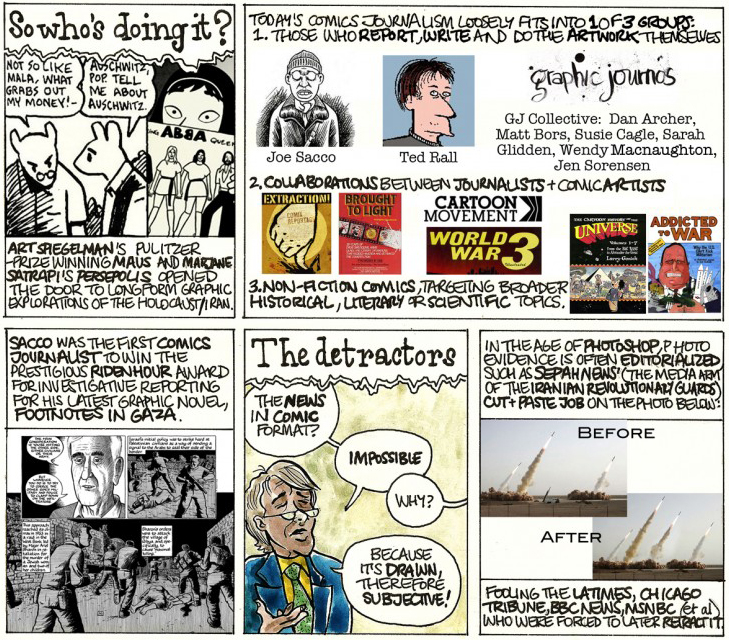
"... a new breed of journalist is emerging"
Go to: "An introduction to comics journalism, in the form of comics journalism" by Dan Archer, at Poynter (via The Ephemerist)
8/20/2011
Subscribe to:
Posts (Atom)