7/26/2010

Bad Movies: The Last Airbender

1) Hollywood's movie studios have become so good at hyping their own media franchises that audiences often act genuinely surprised and disappointed (or have learned to go through the proper motions of acting surprised and disappointed) when their sequels and adaptations fail to live up to the quality of the original creations. For The Last Airbender, the hype began more than three years ago when Paramount announced the signing of M. Night Shyamalan to write, direct and produce a trilogy of live-action films based on the popular TV series of the same name. The studio's promotion and marketing machine went through the usual motions: teaser trailers, a Super-Bowl ad, a toy line, fast food cross-promotions, a comic book tie-in. But how does someone go about condensing the show's entire first season into an hour and half feature film? Not very well as might be expected. This is one uninspired and indifferent adaptation: The storytelling is lazy, the pacing is choppy, the cinematography is incompetent, and the dialogue is incredibly stilted. So much of the movie is devoted to exposition that there's little left for more audience-pleasing elements like romantic complications or extended action sequences. All this info-dump makes the story so confusing that I doubt anyone who isn't already a fan will completely comprehend what's going on. Many characters appear so briefly before scene shifts, they barely register.

Iroh (Shaun Toub) and Zuko (Dev Patel).
Iroh (Shaun Toub) and Zuko (Dev Patel). Image from Avatar The last Airbender Online

2) Shyamalan's past success with child actors is not replicated here. The lead Noah Ringer puts up a valiant effort to convey the director's habitual gravitas, but lacks the charisma to pull it off. It doesn't help that he has to deliver some very atrocious dialogue. Most of the other cast members sleepwalk through their lines, barely expressing any emotion other than furrowing their collective brows. Dev Patel comes off the best as the conflicted antagonist Prince Zuko. But none of the cast has really been given that much to work with.

3) Given that the original series main draw was its mystically enhanced hand-to-hand combat, this happens to be the movie's biggest let-down for this fighting arts geek. The bending fails at pretty much every level. Hollywood directors are usually unable to mimic the balletic wire-fu of Hong Kong cinema, and Shyamalan is no exception: His staging of the fight sequences is pedestrian at best, and the fight choreography in itself is brief and perfunctory. There's not a single memorable duel between any two characters in this movie when there should have been at least half a dozen. As for the cast themselves: I'm used to untrained actors moving stiffly when trying to perform martial arts moves, but it looks even more egregious here. I understand that the twelve year old Noah Ringer is trained in taekwondo, which imbues him with a lot of physical dexterity. However, his tai chi chuan imitation is mediocre, and not significantly better than the efforts of co-star Nicola Peltz. Most of the supporting cast could have benefited with some more formal training, if only to learn how to maintain a proper stance. As for the special effects used to depict the elemental bending, they're generally disconnected from the actors physical movements. It often looks as if they're waving their arms and feet frantically for a few seconds before an element shoots out from behind them. It's terribly unconvincing, and lacks the clever variety found in the TV series.

4) Regarding the racebending controversy that has taken up a lot of public attention - Changing the cast to satisfy the critics would not have fixed the structural flaws of the story. However, there were two instances were I was more conscious of the racial makeup of the cast: Early, when I couldn't help noticing how everyone in the Southern Water Tribe was of Asian extraction except for Katara's and Sokka's family. And later during the climatic battle between the relatively light-skinned citizens of the Northern Water Tribe, and the swarthier Fire Nation soldiers. This is counterbalanced to some degree by the fact that the two most interesting characters are Fire Nation citizens Zuko and his uncle Iroh, played by Shaun Toub, who is underutilized in his role. The casting may not be the worst thing about this movie. But it's a terrible distraction that compounds the movie's many faults.

5) The TV series was not historically accurate in the conventional sense. But in its world-building, it cohered around certain details. The stylistic breakdown of the varieties of quan-fa was one. Or the way its architecture and fashions formed a close analog to real world Asian cultures. The movie deviates from the original in small ways that would be irritating to the series fans. For example, Chinese characters are replaced with an invented script that looks like someone's bad imitation of Chinese. Or Shyamalan's changing the pronunciation of certain words to make them sound more Indian, which only pushes the film further away from the imaginary milieu of the series just to satisfy his personal vanity.

6) When I first heard that Avatar: The Last Airbender was being made into a movie, I suspected that this would be just another poorly executed adaptation that I could afford to skip. The irony is that the casting controversy and calls to boycott the movie piqued enough of my interest that I wanted to see just how big of a train wreck it would turn out to be. Well, the movie isn't just bad. It's so bad, it lacks even the usual technical competence displayed by Shyamalan. It's as if Paramount went out of its way to ruin its very own franchise. So I should have stuck with my initial gut reaction. Another, more familiar, irony is that if the movie earns enough from its international releases, it could make back its costs despite being almost universally eviscerated by the critics.

More on Avatar Racebending

7/13/2010

Harvey Pekar (October 8, 1939 – July 12, 2010)

A Robert Crumb-illustrated page from American Splendor by Harvey Pekar
What's in a Name? A Robert Crumb-illustrated page from American Splendor by Harvey Pekar

I love Harvey Pekar. Okay, I've never actually met the man. And who knows if I could have actually tolerated him if he were my next door neighbor. But I have nothing but respect for his achievements. Looking past the juvenile wish fulfillment, corporate ownership, and slick genre conventions that dominated (and still do) the industry, he saw in comics the perfect medium for autonomous artistic expression. And in his American Splendor comics he told extraordinarily blunt, unromantic, even banal tales of his own rather ordinary life. For a long time he worked for little to no financial reward, and gained only intermittent, if dubious mainstream recognition. But he kept plugging away with it, and his comics were eventually adapted into a critically lauded movie with the same name. To me, American Splendor was a revelation when I first encountered it because, in contrast to most of the comics I had read (and my own upbringing), it was grounded on an uncompromising, blue-collar, adult perspective. I was immediately hooked. Others have since followed in creating their own autobiographical works. But Harvey's unsentimental voice remains a singular presence that I will miss.

More on Harvey Pekar by

7/08/2010

To Boycott or Not?

Believe me, as an actor, it’s no easy answer. My first gut feeling is, the best actor should be cast for the job no matter race… But maybe that’s just an ideal that is unreal when it comes to making a movie, and making a big budget movie at that. See, my whole career is based on playing roles that were not written race specific, matter fact, if I had to wait for Hollywood to come along with a script for a Filipino American, I would have no career at all.
- Dante Basco
More on Avatar Racebending

7/05/2010

What, no beavers?

Happy Belated Canada Day! from Kate Beaton
Go to: Happy Belated Canada Day! from Kate Beaton

About the Wonder Woman Cosmetic Changes

Wonder Woman by Don Kramer

Meh. It's not so much that I hate the idea as that I'm already bored with it. The whole urban crime-fighter schtick seems already played-out, as well as the black leather pseudo civvies. Even more telling - J. Michael Straczynski implies that his changes to the status quo are temporary at best, so it doesn't feel particularly substantial on paper at least. More reactions at Robot 6. Here's Tom Spurgeon's take on it. Kevin Church reminds everyone that this has happened before.

7/04/2010

More NonSense: Racebending Epic Fail Roundup

Noah Ringer plays Aang in the movie "The Last Airbender"

"As a Vietnamese American, I find “The Last Airbender’s” production and casting a great offense to my cultural roots, and believe that Paramount – and especially Shyamalan – should be ashamed of themselves. Frankly, I hope they go down in film anthropology as infamous practioners of self-indulgent, self-delusional ignorance, stupidity and racism"
- Q. Le (Quote added 07/11/10)

Despite its July 1st worldwide release, The Last Airbender has yet to hit my local movie theater. So I'm not going to be able to make any independent assessment of it just yet. But here's what the online critics have to say about it. The movie continues to draw criticism for its decision to cast Caucasian actors in the leading roles. Asian American cartoonists Derek Kirk Kim, Gene Yang, and Tak Toyoshima have repeated their initial objections to Paramount's "racist" casting. At the center of calls to boycott the movie, Racebending.com has organized several public protests and demonstrations in the hope of negatively impacting on the commercial success of the film. But they're also big enough fanboys to put up a handy guide deliniating the differences in the main plot points between the big screen adaptation and its source material.

With the movie having already alienated a significant portion of its existing fanbase months before its release, it would have to make up in box office sales from the general population. Early numbers indicate that the movie has not quite succeeded. It has received a critical drubbing from the mainstream press: As of this writing, aggregator site Rotten Tomatoes has given it a a horrendous 7% general rating, and Metacritic has rated it a "generally unfavorable" 20 based on 32 reviews. So the movie is a flop with the cognoscenti. But what does the public think? Entertainment Weekly reports that the film earned "$16 million on Friday after pulling in $16 million on its opening day for a 5-day holiday weekend gross that could total $70 million." This sounds like a decent box office weekend performance. But according to Patrick Goldstein, the film has received a grade of C from CinemaScore - an organization that tracks the reaction of audiences during a movie's opening night. "the C grade is a pretty reliable indicator that the movie will have a steep dropoff in its grosses in the weeks to come" explained Goldstein. He goes on to opine about director M. Night Shyamalan's future with the franchise:
"In the run-up to the film's opening, Shyamalan has been talking about quickly getting to work on a sequel, but if I were him, I'd be keeping my options open. This movie, to quote one of my father's favorite expressions, looks like a dog that won't hunt."

How much did the casting of white actors to play non-white roles hurt The Last Airbender? Roger Ebert thought it did some damage, or at the very least didn't help:
"His first inexplicable mistake was to change the races of the leading characters; on television Aang was clearly Asian, and so were Katara and Sokka, with perhaps Mongolian and Inuit genes. Here they're all whites. This casting makes no sense because (1) It's a distraction for fans of the hugely popular TV series, and (2) all three actors are pretty bad. I don't say they're untalented, I say they've been poorly served by Shyamalan and the script."

Kirk Honeycutt agrees saying:
"The Nickelodeon series, created by Michael Dante DiMartino and Bryan Konietzko, is wholly and inarguably centered on Asian (and Inuit) culture. But Shyamalan, a South Indian, for whatever reason -- you supply the motive -- chose to cast mostly white actors. Two fellow Indians, "Slumdog Millionaire's" Dev Patel and veteran Indian-American Aasif Mandvi, play different kinds of villains, but otherwise this fantasy world is pretty white until you get to the extras.

No one can say whether "Airbender" would have been a better film with a different cast. But as it is, the film loses substantial credibility in regard to its source material."

Others disagree with it's importance. Andrew O'Hehir opines: "Despite the Internet uproar launched by some fans of the animated series "Avatar: The Last Airbender" (which was going to be the title of this movie, until, uh, other forces intervened), I have to say that the racial controversy around this movie is overblown." Angry Asian Man on the casting of Noah Ringer, blamed the script for not giving the actor enough to work with: "To be fair, Noah Ringer, who plays Aang (the titular last airbender), does an okay job. Is he the only kid in the entire world who could play Aang, as Shyamalan has so boldly claimed? Absolutely not. But he does a passable job in an mediocre movie. Could this material have been elevated by casting an Asian actor? Probably not." Joe Morgenstern puts the casting controversy into the larger context of a series of bad decisions:
"The producers have been widely criticized for failing to cast the Asian characters of the original with Asian actors, and the criticism is valid, notwithstanding the presence of Asians in minor roles. Like the hero, Aang, the lead characters of the brave sister and brother, Katara and Sokka, are played by young and conspicuously Caucasian American actors—Nicola Peltz and Jackson Rathbone (who also plays the "Twilight" vampire Jasper Hale). But where does criticism end when a production is botched from start to finish?"

Richard Corliss tried to put a positive spin on it:
"The dearth of racially appropriate casting in the U.S. simply means that fewer Asians were humiliated by appearing in what is surely the worst botch of a fantasy epic since Ralph Bakshi's animated desecration of The Lord of the Rings back in 1978. The actors who didn't get to be in The Last Airbender are like the passengers who arrived too late to catch the final flight of the Hindenburg."

But some of the harshest criticisms were reserved not for the film's casting, but for its cynical implementation of 3-D technology. Ebert attacked it as "Not only is it unexploited, unnecessary and hardly noticeable, but it's a disaster even if you like 3D. M. Night Shyamalan's retrofit produces the drabbest, darkest, dingiest movie of any sort I've seen in years." Sam Adams reported on the industry's squeezing of theater goers: "audiences in upscale areas were having difficulty locating 2-D screenings. A listings search turned up exactly one non-3-D theater on the island of Manhattan; ditto Santa Monica." Keith Phipps sums up the general disgust for these practices: "...a few 3-D elements have been added to satisfy the current 3-D craze, and the higher ticket prices they allow. Worse still, the process makes the already-dark imagery darker, and turns the action blurry. Viewers who see it in this form will pay more for an even shittier experience than the one they would have had in 2-D."

Most of the reviewers I read confirmed my own nagging doubts about Shyamalan's ability to adapt a serialized fantasy epic aimed originally at children. Mr. Beaks commented "Burdened by an never-ending onslaught of expository dialogue awkwardly delivered by actors giving career-worst performances across the board, The Last Airbender is so outrageously bad it's a wonder it ever got before cameras. Frank Marshall and Kathleen Kennedy, veteran producers who know better, should've shut down production the minute Shyamalan turned in his first draft and found a writer with a vision for the material. Or just a writer with a vision, period." Charlie Jane Anders eviscerated the director's efforts: "Shyamalan's true achievement in this film is that he takes a thrilling cult TV series, Avatar: The Last Airbender, and he systematically leaches all the personality and soul out of it — in order to create something generic enough to serve as a universal spoof of every epic, ever." Peter Debruge thought Shyamalan misses the point of the series: "Here, we expect an epic martial-arts movie and instead get a soul-searching adolescent's decision to spare his enemies -- a character-driven approach that's ill served by the largely amateur cast."

I'll let Angry Asian Man sum it all up:
"M. Night Shyamalan attempts to adapt the entire storyline of season one (Book 1: Water) into this movie (the first of a planned trilogy). Having seen and enjoyed the animated series, I'm aware that this is no small feat. Unfortunately, overall, the plan fails. It's supposed to be epic, but the whole thing feels clunky, rushed and at times incomprehensible. You might not have to boycott this movie -- it's so bad, it could boycott itself."

More on Avatar Racebending

7/02/2010

Update to Flash Gordon Memories of Al Williamson

I mentioned in a previous post reading a copy of Flash Gordon #1 when I was a kid. I think it was a local reprint published sometime after the release of the Flash Gordon movie - the one with the Queen song. Out of this World has reproduced all but one of the pages of this famous issue, confirming my memories of this comics. here's Al Williamson's rendition of the see-through ski suits:

Flash Gordon #1 by Al Williamson.

And here's the giant "ice dragon" looking like a big green lizard:

Flash Gordon #1 by Al Williamson.

I love the now classic streamlined look of its futuristic technology. Not a trace of steampunk to be found anywhere. But time also amplifies the rather old fashioned heroism where men took it upon themselves to save the damsel in distress. Then there's the fact that everyone has the proportions of a supermodel, even the scientists. And of course, there's the lavish psuedo-Renaissance clothing they wore. All in all, this is a beautiful story to look at.

6/28/2010

Slideshow: Toycon 2010

My digital tools have been failing me lately. The computer is old, so that's understandable. But even newer equipment like my Cintiq and my DSLR have been malfunctioning. If the computer goes... I guess I'll have to get a new one. Duh.

Thor, Superman, Batman PVC Figures, 9th Philippine Toy Convention (Toy Con 2010), SM Megamall, Mandaluyong.
Go to: Flickr Album

6/22/2010

Prince of Persia: The Graphic Novel

Prince of Persia By Jordan Mechner, A.B. Sina, LeUyen Pham, Alex Puvilland, Hilary Sycamore. Prince of Persia By Jordan Mechner, A.B. Sina, LeUyen Pham, Alex Puvilland, Hilary Sycamore.

By Jordan Mechner, A.B. Sina, LeUyen Pham, Alex Puvilland, Hilary Sycamore

When First Second published a graphic novel adaptation of The Prince of Persia back in 2008, I didn't give it much attention. The original video game, like many other games, had only a skeleton of a story from which to hang its 2D action scenes. The player spends virtually all of the alloted time scampering around an impossibly large, maze-like, palatial interior while dueling haphazardly stationed guards, and avoiding booby traps. Even the graphic novel's original cover, dominated by a robust-looking running figure, gave the not-quite correct impression that it was a heroic action-adventure in the spirit of the original material. I'm unfamiliar with subsequent versions of the franchise, but the narrative contained within the comic is complex, deliberate, and not quite as swashbuckling as its video game origins would suggest.

The video game's creator Jordan Mechner seems to have limited his creative involvement to approving the efforts of writer A.B. Sina, and collaborating artists LeUyen Pham and Alex Puvilland. This wife and husband team draw in a wonderfully expressive style that' seems more influenced by Euro-comics, children's book illustration, and animation. Rather than the overwrought figures found in mainstream fantasy illustration and used to package the games themselves, the graphic novel's characters posses an easily approachable, down-to-earth charm. The art's simplicity offsets the intricacies of a plot that jumps back and forth between two time periods separated by 400 years, each with its own set of characters. Both are tied together by themes like the power of legend, the circularity of history, and the immutability of human nature. Oftentimes the four alchemical elements are used to reinforce them. That's quite a lot to hang on what's basically a dashing tale about heroes battling the machinations of would-be tyrants.

Prince of Persia By Jordan Mechner, A.B. Sina, LeUyen Pham, Alex Puvilland, Hilary Sycamore.

Pham and Puvilland eschew the more obvious devices that could have been used to delineate the two periods. They aren't drawn in contrasting graphic styles. They don't use clear chapter or page breaks to announce the shift in setting. The settings themselves look and feel very similar despite the centuries separating them. The transitions take place between adjacent panels and are only noticeable through small alterations in their details. The layout is also fairly conservative, favoring three to four tiered pages, with single-page panels to punctuate key moments. This makes the shift between the 9th and 13th centuries so seamless as to be almost unnoticeable. A rushed reading of the book will inevitably lead to a great deal of confusion. Colorist Hilary Sycamore paints the later period in more subdued hues using a blue-pink palette, and the earlier period with more saturated colors predominated by reds and oranges. This only partially helps the reader. As the story develops, the two periods begin to resemble each other more and more, especially in the later parts of the book when a prophecy explicitly connects the two casts of characters to each other.

Fans who come to the graphic novel expecting it to be more like the video game or the more recent movie adaptation might come away from it disappointed. In trying to balance the lighthearted romance of the original concept with the scope of its own ambitions, it never achieves the status of an epic. Still, this is far more rewarding than I would have expected from most media tie-ins. If nothing else, I'm looking forward to Pham and Puvilland's next comic book project.

6/17/2010

Flash Gordon Memories of Al Williamson

Flash Gordon #1 by Al Williamson.
Flash Gordon #1 by the late, great Al Williamson (1931-2010). Presented by Thom Buchanan.

I used to own a copy of this story as a kid. It may have been a a Filipino re-print edition. Sadly, it was lost, as with all my childhood comic books, probably when my family was moving house. If I recall correctly, the setting of the story moved from Mingo City to the kingdom of Frigia. Flash and Queen (?) don those funky see-through ski suits to go hunting for ice serpents, or something. Cool, but impractical. And as good an excuse as any to showcase Al's artistic talents with the human form.

6/14/2010

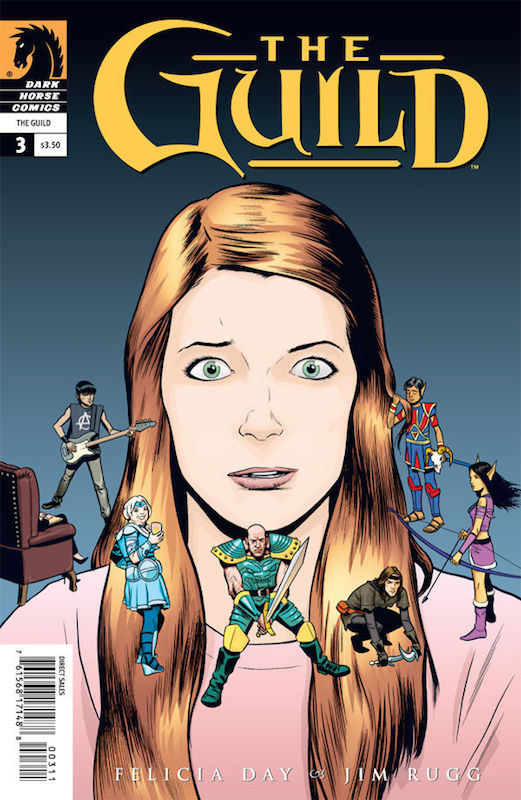
The Guild #2-3

The Guild by Felicia Day, Jim Rugg, Dan Jackson, Nate Piekos, Matthew Stawicki, Kristian Donaldson, Juan Ferreyra.The Guild by Felicia Day, Jim Rugg, Dan Jackson, Nate Piekos, Matthew Stawicki, Kristian Donaldson, Juan Ferreyra.

By Felicia Day, Jim Rugg, Dan Jackson, Nate Piekos, Matthew Stawicki, Kristian Donaldson, Juan Ferreyra.

Issues 2 and 3 of The Guild complete the prequel to the successful cult web series. Main protagonist Cyd Sherman's involvement with the online game deepens; she becomes emotionally isolated from the real world; the rest of the cast is assembled; and the story leaves off where the series begins. As I said in my review of the first issue, the comic is best appreciated by pre-existing fans. The deterioration of Cyd's relationship with her boyfriend is alluded to in the first few episodes of the series. And the comic contains in-jokes and references that will go over the heads of non-fans. The supporting characters that comprise her online friends aren't fleshed out enough within the pages of the comic, as they're written as a collection of quirks that fans will easily recognize and proceed to fill in the blanks.* But I'm not sure if most first time readers will understand why Cyd would actually enjoy hanging out with them.

The Guild by Felicia Day, Jim Rugg, Dan Jackson, Nate Piekos, Matthew Stawicki, Kristian Donaldson, Juan Ferreyra.

It is through Cyd that Felicia Day most effectively demonstrates the charm and wit of her writing. Cyd is largely portrayed as a sympathetic, if hapless, individual unable or unwilling to confront her manipulative boyfriend. Every real world disappointment prompts her to dive deeper into the fantasy world. Unlike the series, the comic illustrates more of the game's environment. This allows the visuals of the story to break up the monotony of looking at a series of talking heads staring into computer monitors. But even with this device, Day still prefers to largely tell the story through words. The combat sequences are minimally and perfunctorily staged, and tend to rehash Cyd's voice-over narrative. Day's panels are usually filled with dialogue, which isn't necessarily a problem in itself. But the virtual setting feels comparatively cramped and generic. While every character has an easily identifiable in-game avatar, it's really the verbal back and forth that animates them, and helps distinguish them from each other.

Of course, in the web series, the characters are brought to life by actors who have the advantage of being able to deliver their lines. Within the pages of a comic book though, Day's writing falls a bit flat. I don't get the impression that artist Jim Rugg possesses the necessary chops to pace her dialogue in a way that approaches the timing of the live casts' performance, especially Day's. But the page limitations presented by a three issue story doesn't exactly give either him of Day sufficient space to juggle half a dozen eccentric personalities. So while the fans are going to get the story's in-jokes, they're also likely to come away feeling disappointed with it for not being as funny as the web series.

The Guild by Felicia Day, Jim Rugg, Dan Jackson, Nate Piekos, Matthew Stawicki, Kristian Donaldson, Juan Ferreyra.

At the end of the day, The Guild comic doesn't function as a stand-alone story. Whatever the weaknesses of the art, or faults found within the writing due to Day's own inexperience with the comics medium, they aren't glaring enough to damage the popularity of the series. If the comic points people towards the main body of work, it's arguably done it's job.
__
* Admitedly, that's how they started out within the series.

6/06/2010

Wilson

Wilson by Daniel Clowes.
Daniel Clowes isn't known for working at a prodigious pace. Ever since Eightball #23 was published in 2004, his only comic was Mr. Wonderful - serialized for a few months in The New York Times Magazine. In the meantime, he's also launched a career as a screenwriter with adaptations to Ghost World and Art School Confidential. Wilson is Clowes most ambitious post-Eightball comic work to date, and features a most unadorned version of the unlovable curmudgeon archetype.

The titular character (It's not indicated if Wilson is his given name or surname) would be a much more difficult person to stomach if not for the comic's structure. Wilson is organized as a series of one-page gag strips, each designed to deliver a withering punch line. Wilson begins the story by happily proclaiming his love for his fellow human beings. But his misanthropic personality soon becomes obvious. In the early strips, Wilson accosts complete strangers by engaging in conversation with them. At first he appears genuinely interested. However it soon becomes apparent that he doesn't care about them except as a convenient target for his ridicule. Wilson casts his net far and wide. He cuts some people off for talking too much. He bullies others for refusing to converse with him. He disses their jobs, the vehicles they drive, their taste in movies, or their religious beliefs. Like Charlie Brown futilely trying to kick that football out of Lucy's hands, Wilson seems driven by the need to reach out to other people. But he's unable to connect with them due to an inability to suppress his inner critic. He's the type that doesn't suffer fools gladly. However, he takes it to such an extreme that just about anything someone else says, or doesn't say, can set him off. No wonder he's unemployed and friendless, not counting his pet dog.

Wilson by Daniel Clowes.

The gag strip format allows readers to absorb the character in easily manageable bits. Even so, seventy one pages of Wilson sneering at random people would grow quickly tiresome and repetitive. At first unnoticeable though is that with each succeeding page, a story emerges as circumstances force Wilson to interact with family members. First he's called to the bedside of his dying father. Then he attempts to reconnect with his ex-wife. And then he searches for a daughter he never knew he had. The social ineptitude that drove people away from him has far more painful consequences as Wilson's takes more active steps to re-establish his familial bonds. But the gap between his ideals and reality is vast since the people who know him best have already grown weary of his overly critical attitude. If Wilson were a straightforward family melodrama, this would be a character flaw that he would have to confront and overcome in order to earn the audience's sympathy. A convenient explanation could then be tossed in to account for its origins. Rather, Clowes adherence to the gag strip formula keeps the reader at arm's length from the character. While Wilson does become more miserable, pathetic, and earnest in his goal to find love and acceptance as the story progresses, he remains a comic figure who elicits some disdain, if for nothing else, for all the misery he inflicts on those around him. Wilson doesn't transcend his assigned role until, perhaps, the story's very last panel. Nevertheless, it's an oddly effective way to hold the reader's attention.

Wilson by Daniel Clowes.

Perhaps the most conspicuous feature of the book is that every page is marked by a change in graphic style. Clowes utilizes the full gamut of his craft: from realistic character renderings, to classic big foot cartooning. He colors range from grays, his preferred blue-greenish duotone, to his subdued four color palette. While the play of styles is clever and amusing on its own terms, I'm not sure they represent anything deeper than Clowes just having fun with different approaches, or his way to keep things interesting to him. They don't seem to represent any logical schema. But they're not annoyingly random either. Rather, they're all unified by an underlying organic approach. The quality of his line doesn't vary significantly. His instinctive color combinations remain consistent. And Wilson's visual identity has a way of carrying over through each stylistic shift.

Wilson by Daniel Clowes.

Because Wilson is a deeply irritating character, the book is unlikely to become a fan favorite. Given the all-encompassing nature of his ire, many will find something to dislike about him. But the emotional distance afforded by the technique Clowes employs makes the character easier to witness. The incremental revelation of personal information with each page is both highly entertaining and hugely riveting. Sure, Wilson might be the world's biggest prick. But he's also the overweening ego, found to varying degrees, within all of us.

Wilson by Daniel Clowes.

6/01/2010

Birthdays and Anniversaries

Autographed copy of the Comic-Con International 2001 Souvenir Book. Art and characters by Jeff Smith.

It used to be you could essentially not plan for Comic-Con and just go if the mood struck you. This was true just a few years ago. Those days are gone.
 - Tom Spurgeon

I was for a short period a regular attendee of - when it was still possible to show-up without pre-registering or even booking a hotel. In fact I've only pre-registered just once for any comics related event in the United States. I'm one of those who utter "San Diego" and "Comic-Con" in the same breadth. Back then, I thought that Comic-Con was positively humongous. The crowd was already straining against the walls of San Diego's convention center. Hollywood was making an even bigger imprint on the event's identity. Comics was becoming mainstream. And manga was fast developing into a seemingly unstoppable force. But for me, Comic-Con wasn't just an excuse to skip work and geek out, it became something of an annual celebration, of a more personal nature.

Things have changed a lot since I was last there. Circumstances prevent me from attending Comic-Con for the forseeable future. And I don't stress about it. But if Comic-Con's organizers decide to leave San Diego, part of me will sorely regret not going by 2012.

5/26/2010

Choices

Why I Won't Be Watching The Last Airbender Movie by Gene Luen Yang.

More NonSense: Philippine Week

Andrew Wheeler has recently begun Philippine Week for his Book-a-Day reviews. Given most Americans lack of familiarity with Filipino history, it'll be interesting to read the perspective of a complete outsider. The two books he's reviewed so far grew out of a particular milieu, but presented in a mainstream style familiar to Western audiences. I'm curious to see what variety of creative approaches he'll be able to uncover within the next few days.

Christopher Butcher writes the most stinging indictment yet on the clusterfuck that was CMX.

Simon Jones explains that adult manga isn't going to save the industry.

Sean Collins argues for the end of certain debates that have passed their sell by date, specifically the notion that alternative/literary comics are autobiographical "woe-is-me whining". Readers chime in with their own suggestions. Tom Spurgeon suggests three issues we should be discussing more thoroughly. To which Sean responds by asking: Why can't we stop talking about superheroes?

In order to honor the end of Lost (Thank God?), Tom lists his best good-byes in comics.

Yes, I was reading Bone when I wrote my contribution to this Five for Friday. Given the popularity of Hulk vs. ____  battles, maybe I should have substituted my own with Bronze Tiger vs. Batman.

Detective Comics #485 by Denny O'Neil, art by Don Newton & Dan Adkins.

Yes, I know that it was recently the 30th anniversary of The Empire Strikes Back, the second Star Wars film: It's a mystical martial arts movie with cool futuristic weapons; without the pesky Asian faces.

Nick Carr shares his thoughts on Google, Apple, and cloud computing.

5/24/2010

Miscellaneous

I'm certain people much smarter than I am have figured out this out and written endlessly on the subject, but the scary thing about social networking media is how it seems to engender a state of mind that mirrors what little I know about mental illness: you're constantly hearing voices in your head and you set about controlling them through the application of obsessive/compulsive maintenance tools. At best it feeds a narcissistic impulse to see your entire world of outside stimuli as some sort of ongoing vote on you and what you do.

Not that I'm stopping. 


- Tom Spurgeon

5/20/2010

Funny Wolverine Story

Wolverine Short Story Pitch by Faith Erin Hicks

R.I.P. CMX

You know, I don’t recall any other event to have elicited so much blasphemous language from the collective manga blogosphere as CMX’s demise.  Personally, I’m one who does little swearing in public or unfamiliar company, because I cherish the act.  I want my curses not to be regarded as common vulgarity, but as sincere and succinct expressions of rage and disgust.  I think that is true of most of these posters above as well.  Perhaps this is one of those situations that warrants it.

Oh, what the hell.  Fuck.

- Simon Jones

5/16/2010

Bone: Rose

Rose By Jeff Smith, Charles Vess, Steve Hamaker.Rose By Jeff Smith, Charles Vess, Steve Hamaker.Rose By Jeff Smith, Charles Vess, Steve Hamaker.

By Jeff Smith, Charles Vess, Steve Hamaker

I've started to re-read my Bone collection, which is composed of various original pamphlets and pre-Scholastic trade paperbacks. It's been many years since I first examined the series as a whole. But I decided to begin at the middle, and read Rose. This comic stands out for a number of reasons. Although it's often labeled as a prequel, it wasn't originally released after the completion of the series, but in the midst of its serialization. Creator Jeff Smith took a break from Bone to initiate Rose and Stupid, Stupid Rat Tails. Both projects were collaborations between Smith and other creators. Both were set in the distant past of the Bone universe. Since the series had begun to roll out a few significant revelations, such as the identities of the hidden main antagonists, this was as good a time as any for Smith to fill in some of the backstory for the readers. As such, Rose and SSRT serve as a kind of interlude, as well as a glorified flashback sequence, before Bone would move inexorably towards a climactic showdown.

Of course Rose contains no real surprises, since it requires that the reader be already familiar with the fantasy world revealed in the series at that point. Without the Bone cousins as reader identification characters, the story's fairy tale elements come to the foreground. This also means that much of the characterization that makes Bone so appealing is missing here. In the series, the eponymous hero Rose Harvestar is known as Gran'ma Ben - a no-nonsense, tough as nails farmer who races against cows because, well why the hell not? However in Rose, both she and her sister older Briar become archetypal feuding siblings: The latter's a power-hungry schemer, while the former is completely oblivious to the latter's open hatred towards her. Individual motives for their behavior don't extend far beyond one being pure and good, and the other being pure evil. Supporting character Lucius Down, a gruff but noble barkeep in Bone, has zero personality here except as an easily manipulated bodyguard. And the cigarette smoking Great Red Dragon in transformed into a stern, judgmental, and stubbornly impassive observer. The absence of the Bone cousins is usually brought up to explain the lack of humor. But my guess is that Smith was more concerned with producing a straight fantasy than injecting even a bit of levity into the story.

Rose By Jeff Smith, Charles Vess, Steve Hamaker.


This makes Charles Vess an appropriate choice as the book's artist. As someone influenced by Arthur Rackham, his art is charming enough to please adults while still appearing creepy enough to scare younger readers. But it's a different school of illustration from the Disney animation style that informs the rest of Bone. With each chapter, Vess becomes more capable with translating Smith's characters into his own idiom. But a few, most noticeably the Great Red Dragon, betray and uneasy balance between Smith and Vess' divergent artistic approaches. Rose is also the only book with interior art that was originally published in color. This contributed to its initial impact among fans who were accustomed to seeing the characters in black and white. Even today, his application of light color washes contrasts significantly with the more heavily textured styles found in most digitally painted comics. Vess is very adept at using color to enhance the story. As the mood becomes darker, the warmer reds, oranges, and yellows are gradually replaced by cooler greens and blues. White snow that initially appears in the background suddenly falls more heavily as the situation grows more dire, until it envelops the landscape. It's a traditional narrative device. But it's gorgeously executed by Vess.

When set against the events of the rest of the Bone series, Rose is a small scale work. The overall tone of the book is sinister and foreboding. And the ending is left unsettled not only to remain consistent with concurrent issues within the series, but also to foreshadow upcoming events. In retrospect, the battles depicted in Rose were probably a dry run for the even grander armed confrontations that would take place in future chapters of Bone. But since Rose is collected as a separate work to be read after the Bone story-line, most readers will find it redundant. The Bone series repeats most of the pertinent information found in Rose anyway. But when Rose first came out, it only added more intriguing layers, helped along with a dash of color, to the then unfolding Bone saga.

Rose By Jeff Smith, Charles Vess, Steve Hamaker.

5/10/2010

Ristorante Paradiso

Ristorante Paradiso by Natsume Ono.
Natsume Ono is the latest beneficiary of a growing market for adult and experimental manga which every U.S. publisher seems to be banking on these days. Indeed, her art seems to come out of left field of mainstream conventions. It's recognizable enough to be labeled "manga". But just quirky enough to attract the attention of the indie crowd. Her most ambitious work to date, the period story House of Five Leaves, is currently being serialized online and will also be printed by Viz. Ristorante Paradiso however is an earlier work with a very different subject matter.

Readers who prefer their comics art with a more polished finish are going to find Ono a potential turn-off. I find it pretty refreshing. In Ristorante Paradiso she draws lithe, elongated figures which straddle a fine line between appearing elegant and appearing grotesque. She employs relatively thick, broken strokes to delineate her figures. And she keeps her background details sketchy at best. Sometimes this can make her page layouts appear flat and a little difficult to follow. She compensates by filling large areas with black or shades of gray to help with the page's readability. Overall, her characters possess a shopworn look that's very appealing.

The art also complements the story's setting. Like Fumi Yoshinaga's workplace comedy Antique Bakery, it takes place in an eatery staffed with attractive males. The establishment is a restaurant in Rome named the Casetta dell'Orso. Ono slightly subverts the bishonen fetish by making them distinguished, bespectacled middle-aged men (If there's a popular Japanese term for this fetish, I'm unaware of it). This policy is reinforced by the owner partly to attract more patrons, and partly in order to please his wife Olga. She is however keeping a secret from her husband that she abandoned her only daughter Nicoletta after the dissolution of her first marriage. Now a 21 year old woman seeking revenge, Nicoletta shows up one night at the restaurant threatening to expose Olga's past. But she then settles on blackmailing Olga for a job as one of the kitchen staff after she becomes enamored with the restaurant's headwaiter Claudio.

Ristorante Paradiso by Natsume Ono.

From this convoluted soap opera beginning, the book settles into a low key, slice of life comedy with romantic underpinnings. The story unfolds at a leisurely pace. Character development comes in tiny increments and small revelations rather than big dramatic gestures. Many readers would probably agree with one character's assessment of the ending as being "anticlimactic". This suits the understated nature of the story just fine. But Ristorante Paradiso also touches on the lives of ancillary characters, mostly the wait staff, possessing backstories that are more interesting than that of the three main protagonists. It doesn't help that the wait staff are all cut from the same design template as Claudio. A single volume feels too slight to sufficiently differentiate them and leaves many intriguing glimpses of narrative threads waiting for more extensive development. Ono might have sensed that, as there is a prequel called Gente being currently serialized which delves into their backgrounds with greater detail.

The story has the characters also engage in several awkward actions which are then conveniently set aside, including a final reveal at the end of the story. While this hardly seems realistic, Casetta dell'Orso is a place where people surrender to its ambiance of and accept one another. Anger and bitterness are eventually washed away. And as sappy as this sounds, love finds a way to forgive past transgressions, at least in Paradise.

This is what defines Ristorante Paradiso as a work for mature audiences. Not with adolescent angst or over the top histrionics. Not even with passionate rendezvous between star-crossed lovers. But with a quiet acceptance of living in a present full of uncertainties.