Showing posts with label Sébastien Cosset. Show all posts

10/08/2016

Beautiful Darkness

Beautiful Darkness, By Fabien Vehlmann and Kerascoët (Marie Pommepuy and Sébastien Cosset) Translated by Helge Dascher.
By Fabien Vehlmann and Kerascoët (Marie Pommepuy and Sébastien Cosset)
Translated by Helge Dascher.


Beautiful Darkness is sort of a cruel joke played on readers who believe in the power of fairy tales. Or to be more precise the kind of fairy tales parents usually tell their kids when they want to assure them there is a higher power who punishes the wicked and rewards the innocent. In the later graphic novel Beauty (which was also drawn by Kerascoët in a completely different visual style), there are supernatural forces who interfere in the lives of mere mortals. No such beings exists here. Whatever magic is manifested is entirely earthbound and found only within human beings. But what happens when the moral order that guides them is dissolved and humanity’s constituent fragments are left to fend for themselves? BD explores in miniature what happens during the slow decay of civilized order and logic into the uncaring but much grander patterns of the natural world.

If this sounds very grim, the book’s narrative approach is disarmingly seductive. The story begins looking very much like a conventional children’s book illustrated in lush watercolors. A spritely blonde woman with large black eyes named Aurora is living a fantasy life as a princess. She’s having tea with her princely, redheaded beau Hector when their world suddenly begins to liquefy around them. As giant slimy globs fall, the denizens of this kingdom fight their way through the purification until they emerge into the open air. The reader is then made aware of the story’s first major twist: that their grand home is the body of a young girl who has died in the woods under mysterious circumstances.

Beautiful Darkness, By Fabien Vehlmann and Kerascoët (Marie Pommepuy and Sébastien Cosset) Translated by Helge Dascher.

The cause for the girl’s sudden death is never fully revealed, through an ominous full-sized adult figure keeps hovering in the background and will come to play an important role later on. Led by the irrepressible Aurora, the sprites attempt to rebuild their world around the girl’s rotting corpse like survivors eking out a living near the ruins of a crumbling city. The entire project starts out in good spirits, and everyone appears to be more-or-less cooperating with each other. But cracks soon appear as each character starts pursuing their own competing agendas.

BD’s narrative possesses a deceptive episodic structure. Everything starts out with an air of naive optimism. The incidents are mostly comical and seemingly inconsequential. But as the mistakes accrue, each mishap and misadventure pulls the sprites inexorably towards some terrible doom. Halfway through, there’s a growing sense that events have reached a point of no return. The sprites increasingly turn on each other and blood is spilled on a more regular basis. What starts out as an impromptu society has broken up into factions.

Beautiful Darkness, By Fabien Vehlmann and Kerascoët (Marie Pommepuy and Sébastien Cosset) Translated by Helge Dascher.

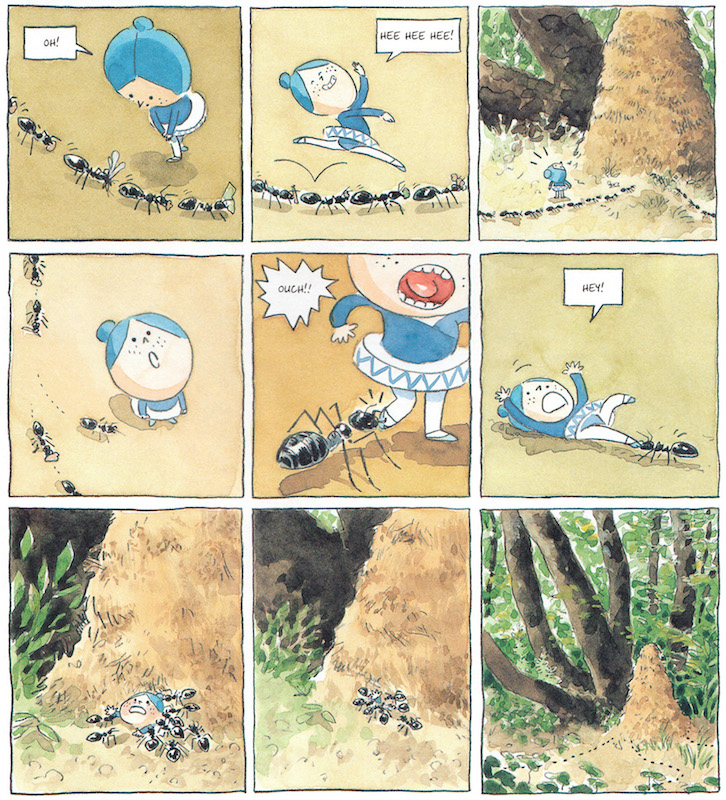
What enhances that dread is the cartoonishly cute manner of the sprites. This gives them a sense of vulnerability which stands in stark contrast to the humans and the natural setting, which are drawn with detailed realism. This visual contrast underlies a difference in scale. The magical beings are dwarfed by their surroundings, making them appear to be constantly in danger from attacks from the local fauna and exposure to the elements. But that scale mostly emphasizes the overall indifference that greets the sprites. For the most part, nature simply ignores them. And that kind of cosmic insignificance is so much worse.

The cartoony style is also key to making the sprites into instantly recognizable archetypes. There’s the shy wallflower, the manipulative queen bee, the eager sidekick, the self-sufficient loner, the squabbling triplets, the cutie doll, etc. Hector is a foppish aristocrat with little depth to him. As they all emerged from a dead girl’s corpse, it’s easy enough to suppose that they might embody different facets of her psyche. If this is the case, then Aurora is the heart of the girl. Sweet and trusting, the image of unassuming feminine beauty, she’s the only person who seems emotionally invested in keeping everyone together. And her reaction to her own failures makes for some of the book’s most unsettling passages.
Beautiful Darkness, By Fabien Vehlmann and Kerascoët (Marie Pommepuy and Sébastien Cosset) Translated by Helge Dascher.

Given BD’s premise and increasingly gloomy tone, I’m not entirely surprised that the book has drawn comparisons with Lord of the Flies. Both map out how altruism eventually loses out to the Will to Power. It’s certainly possible to see in BD’s subversion of fantasy imagery a nihilistic critique of the illusory nature of morality and futility of civilized modernity. This could be the most accurate interpretation of the tale, given the creators’ cultural milieu.

But there’s something about the lovely portrayal of verdant nature that reminds me of the Sea of Corruption in Nausicaä of the Valley of the Wind. Just as humanity fights a losing battle against the world-spanning toxic forest, the sprites are slowly being consumed by the incomprehensibly vast woods. The story begins in spring and follows the imperceptible rhythm of nature’s seasonal changes. BD ends on a down note, during the depth of winter. But just as Nausicaä saw a vision of a world cleansed of man-made pollution, maybe there’s a new, beautiful spring beyond the last page of this book? Or maybe not.

Beautiful Darkness, By Fabien Vehlmann and Kerascoët (Marie Pommepuy and Sébastien Cosset) Translated by Helge Dascher.

12/27/2015

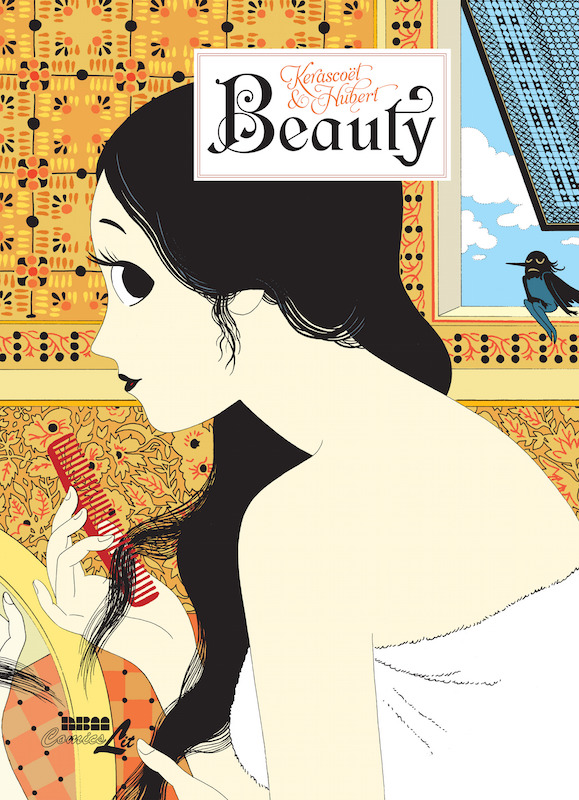
Beauty

Beauty, Story: Hubert Boulard Art: Kerascoët (Marie Pommepuy and Sébastien Cosset) Letters: Ortho Translation: Joe Johnson.
Story: Hubert Boulard
Art: Kerascoët (Marie Pommepuy and Sébastien Cosset)
Letters: Ortho
Translation: Joe Johnson

At first glance, Beauty looks like a classic “Be careful what you wish for” story. In these type of stories, the protagonist comes to regret a wish that has come true because its fulfillment exposes terrible unforeseen consequences. Or something essential has to given up in the bargain. Or the manner in which the wish has come true was less than ideal. This usually leads to either a tragic ending, or more innocuously a successful reversal of the wish. In the latter, the hero comes away chastened by the experience. It's ultimately a genre with a conservative message. The graphic novel Seconds was a modern use of this trope. In comparison, Beauty contains more traditional elements. It starts out as a mashup of the myth of King Midas with Cinderella. But writer Hubert and husband and wife art team of Kerascoët subvert the morality of the tale and turn the wish into a catalyst for personal growth and eventually greater actualization. Though not before the experience puts our heroine through the wringer.

The comic’s setting is the pseudo-medieval Europe of most fairy tales and fantasy novels. Kerascoët brings this world to life with the characteristic use of Ligne claire, bold, flat colors, and nonlinear perspective images, neatly composed on each page as a four panel high-tiered grid. The effect is a dense visual narrative which is far more iconic than realistic. This enhances the impression of an exotic world populated by mysterious magical forces. The character designs conveniently fit into easily-recognized archetypes: the poor peasant, the handsome knight, noble king, beautiful queen, or violent warlord.

Beauty, Story: Hubert Boulard Art: Kerascoët (Marie Pommepuy and Sébastien Cosset) Letters: Ortho Translation: Joe Johnson.

This artistic choice serves the comic’s key narrative device. The heroine is a poor, put-upon girl named Coddie who is on the verge of womanhood. One day, she inadvertently frees the fairy Mab from a magical prison and is granted one wish as a reward. Coddie wants to be beautiful, but Mab cannot change her. Instead, she imparts on Coddie a glamour which creates the illusion of beauty to whoever sets eyes on her. As such, the story is constantly shifting between Coddie’s true form and her idealized appearance. Coddie is aware of her physical imperfections every time she sees her own reflection, but this also highlights her pettiness, superficiality, and shortsightedness. To everyone else, her ethereal visage simply disarms any valid objections to her questionable behavior. Kerascoët’s art easily conveys how when even in the company of other attractive people, Coddie’s illusory charm makes her seem otherworldly in comparison.

The disadvantages of being an incarnation of the feminine ideal becomes quickly apparent when shortly after her encounter with Mab, Coddie is spotted by several of her male neighbors and they later try to gang rape her. The women react to this incident by driving Coddie out of the village. It doesn’t take long for Coddie to become a Helen of Troy object of desire as people either woo, worship, and fight for her approval. Or alternately attempt to manipulate, capture, imprison, possess, or consume her. As her legend grows, so does the chaos accompanying her until it threatens to engulf the entire kingdom.

Beauty, Story: Hubert Boulard Art: Kerascoët (Marie Pommepuy and Sébastien Cosset) Letters: Ortho Translation: Joe Johnson.

But Coddie isn’t an impassive figure. The granting of her wish connotes an obvious sexual awakening. So she behaves like an adolescent who suddenly becomes aware of the power she holds over the opposite sex. Coddie seduces a succession of powerful men as she moves up the social ladder. But unsurprisingly, she exhibits poor judgement and self-control. And her naive understanding of love and adult relationships causes greater misery for her lovers and the people around her.

Hubert and Kerascoët infuse the story with a number of modern touches. They don’t ignore the harsh social inequalities between peasant and nobility, not to mention the patriarchal nature of the feudal system of government. As a commoner, Coddie is easily tempted by the lavish lifestyle of the aristocracy. But unlike the typical fairy tale heroine, she doesn’t live happily ever after once she marries into royalty. Two other noble women in the story are forced to treat Coddie as a rival or a threat because of the inordinate amount of influence she exerts over the men. At some point, even the peasants (or at least the peasant women) turn on her after her attempts to alleviate their suffering backfires. There’s only so much one can accomplish when being viewed more as an object than a person. While not as blunt as Game of Thrones, the book's depiction of violence and misery can be fairly graphic at times.

Beauty, Story: Hubert Boulard Art: Kerascoët (Marie Pommepuy and Sébastien Cosset) Letters: Ortho Translation: Joe Johnson.

Indeed, everything has gone wrong for Coddie past the midway point. But where most traditional storytellers would have been content to leave off with a cautionary tale about accepting one’s limitations, this is when Coddie begins to apply the harsh lessons of her life and gradually fights back. By the end she attempts to turn the tables on her tormentors and strikes a crucial balance. The results don’t necessarily violate the rules of the comic’s fantastic milieu, but the story's concluding point is persuasively up to date.