Today's post looks at two alternate futures recently penned by the prolific comics creator
Brian Wood. Let's get to it then.
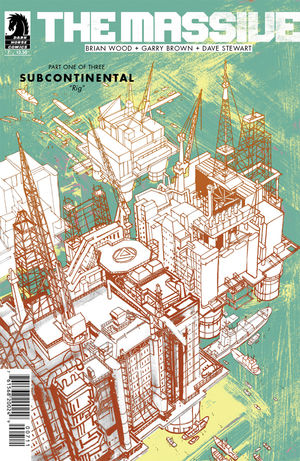
The Massive #7
Writer: Brian Wood
Art: Garry Brown
Colors: Dave Stewart
Letters: Jared K. Fletcher
Cover Art: J.P. Leon
So far,
The Massive has been a bit of a let down. It has a fascinating premise: A smarter, less WASPy-ish version of
Sea Shepherd called the
Ninth Wave finds itself in a world swamped by rising sea levels and a whole host of ecologically devastating knock-off effects, collectively referred to as "
The Crash". In all the ensuing chaos, one of the organization's vessels "The Massive" has mysteriously vanished. Ninth Wave founder and leader
Callum Israel and the crew of sister ship the
Kapital spent the first two issues chasing down a false lead, but since then seem to have all but given up on the search. The series has them meandering from Alaska to the Antarctic with little in way of a clear purpose. There's a considerable amount of world building that takes place as the Ninth Wave faces a new local power base at every turn. But there's very little forward momentum to the plot and hardly any emotional connection being developed with any of the main characters. It's hard to care about a group of unseen people whom the actual cast barely seems to miss. And for all of Callum's exhortations that his crew continue to practice pacifism, he doesn't bother to formulate any specific policy that would help redefine Ninth Wave's mission in a post-Crash world (e.g. what is the official Ninth Wave position now that rising sea levels have flooded much of the world's coastlines?). One unfortunate side effect of the lead protagonist's passivity is that he's constantly being upstaged by his two feuding lieutenants
Mary and
Mag Nagendra.
In this issue, the Kapital visits yet another port, a collective of hundreds of linked oil platforms situated in the middle of the Indian Ocean called
Moksha,
which has recently declared independence. Brian Wood continues to work the world building angle as this would-be nation's leader explains to Callum and Mary their origins in the Indian subcontinent's longstanding conflicts, which were being exacerbated by The Crash. Hints are dropped to indicate how much of the old world continues to exist: The UN is casually mentioned as still an ongoing concern. And in another verbal exchange, the Sri Lankan Mag encounters ethnic and religious-based prejudice from some of Moksha's residents.

While the series continues on in its episodic course, this is the first time the crew has disembarked at one place for a considerable period. The plot plays to the formula that beneath the surface, the natives are hiding some very troubling secrets. This gets picked up on by both Mary and Mag, who begin to act out in accordance to their own separate agendas, and right under Callum's nose. This is the most ineffectual he's looked in the entire series. But I'm just hoping the payoff for this story arc leads to something that eventually ties all of the disparate experiences the Ninth Wave has gone through.
Mara #1
Writer: Brian Wood
Art: Ming Doyle
Colors: Jordie Bellaire
The dystopian future of
Mara is a largely recognizable one which closely resembles the media-saturated landscape of the present day United States. It's one where sports-entertainment is closely associated with capitalism, the military, and imperialist propaganda. World news coverage often relates the government's latest foreign intervention in a far away land that usually ends with the suffix "stan". Any broadcast of a high-profile match is preceded by a reading of a long list of corporate sponsors. Sports are "bread and circuses" used to appease the general population, as well as a form of military recruitment. And celebrity athletes are richly compensated for performing this task. They're also naturally obsessed with their social media status.
Now none of this is necessarily relevatory.What's a bit atypical for this type of dystopian fantasy is the complete lack of bloodsports that have become standard to the subgenre (For a recent example, read
America's Got Powers). Brian shies away from such overtly warlike diversions. His choice for the country's most beloved athlete isn't some stone-faced gladiator who secretly longs to be free of the system, but a wholesome-looking seventeen year old girl named Mara, who plays indoor volleyball. Using such a tame sport might seem odd to sci-fi fans, but it does lend the story some verisimilitude since it more accurately reflects what kind of sporting event actually succeeds in drawing the largest audiences. The mainstream prefers watching basketball or baseball to mixed martial arts. Or if you prefer games with more global appeal, football or tennis. And they like their athletes looking clean-cut, not battle-scarred. To underline the point, the comic's omniscient narrator mentions that Mara even dabbled in MMA before finding her true calling in volleyball. That even her attractive but ethnically ambiguous physical features are exploited as a powerful marketing tool only adds to the believability of the premise.

It's a pleasure to see the art of
Ming Doyle grace the pages of a more mainstream project. Her style has a certain awkward charm not usually found in artists showcasing a slicker look. When combined with
Jordie Bellaire's saturated colors, this particular future setting is bright and colorful, even a little childlike. It's quite a ways from the more gritty urban environments that tend to accompany these kind of stories. If anything, it's ambiance is almost reminiscent of classic futuristic shows like
Star Trek or
Space 1999.
The thing that creates a great deal of uncertainty is a twist that suddenly interjects superpowers into the equation. My concern is that this comic could end up being a lot more conventional in the end if it goes down any of the already well-trod paths featuring tales of youngsters or celebrities in possession of superpowers.