Created by Shuho Sato
Having given the nod to Osamu Tezuka’s classic creation, Give My Regards to Black Jack goes in a different direction from its predecessor. While they both have a doctor as their main protagonist, the latter series is set in the more down-to-earth milieu of Japan’s healthcare system. The manga’s intent of exposing its flaws falls into familiar territory of the individual fighting a corrupt system. It’s a curious blend of serious social critique and manga tropes.
Author Shuho Sato front-loads the story with a bevy of statistics in order to impress on the reader the true scale of the country’s health care industry. Eight thousand students graduate from medical school annually and go on to become interns for two years at various teaching hospitals. Interns are overworked and underpaid, forcing many to take up part time jobs elsewhere despite a chronic lack of sleep. Our hero Eijiro Saito graduated from Eiroku University, the manga’s equivalent to Harvard, and is interning at the university hospital. The guy starts his career full of pep, boasting of surviving on only two hours of sleep a night. But he’s dirt poor, so he moonlights at the E.R. of an affiliated hospital. While there, his naive outlook is quickly shattered. He learns that the E.R. only accepts traffic accident victims due to a legal loophole that allows the hospital to overcharge to the patient’s insurance policy. Japanese hospitals are usually understaffed and Saito has to operate on patients he has no business treating without proper training. When he objects after being forced to deal with a particularly gristly accident victim, his immediate superior tells him “...if he’s got to die, you might as well cut his abdomen open...”
Things aren’t much better at Eiroku. Once his rotation training begins, he’s exposed to the unseemly underbelly of hospital administration. Surgical procedures are decided on dollars and cents as much as they are on the patient’s welfare. University professors are often revealed to be incompetent or indifferent doctors. Bureaucracy is often a hindrance and leads to interdepartmental conflict. It’s all pretty demoralizing. But what particularly offends Saito is the old boys network (Japanese medicine here is very much a male-dominated world) that informally links the nation’s hospitals to its medical schools, creating a kind of industry-wide web he disparagingly labels the “medical mafia.” Doctors obsessed with social climbing and prestigious positions often obscure the advancement of more qualified physicians.
None of this would be strange to people who regularly consume medical dramas. But Sato backs it up with liberal sprinklings of facts and figures. His storytelling has a certain muckracking quality, and for all I know he may have an axe to grind. With each department rotation, Saito gets involved in cases were his personal ethics often conflict with the orders of the department heads. These dilemmas seem grounded enough to be based on actual events. The hospital settings are lovingly rendered in detailed realism, which can be disconcerting to more squeamish readers when Sato illustrates several medical procedures. While I’m not qualified to comment on the accuracy of his research or the merit of his arguments, his characterizations often lack subtlety. Baby-faced Saito seems to only function through extreme moods, swinging wildly from joy to despair. In many ways, he’s your typical hot-blooded shonen protagonist. And the doctors can be distinguished by how they’re visually portrayed: The doctors Sato disagrees with all look haughty and a bit affected. The good doctors are naturally all rebels possessing rugged facial features which he loves to draw in extreme closeups just as they’re staring into the distance while wearing an expression of fierce determination.
Sato can sometimes be dismissive. Even when his antagonists put forth arguments that deserve a more considered response, he employs his art to present them as venal, condescending towards patients and subordinates, and self-serving. They’re the villains, they’re wrong, and Sato brooks no room for more nuanced take on the issues. A chapter showcasing a doctor running a private clinic as being a more dedicated caretaker than the staff at a large hospital is really no more sophisticated than the message found in Doc Hollywood.
Give My Regards to Black Jack is a flawed work. Its topical focus and heavy-handed approach isn’t going to appeal to everybody. While the art is accomplished, it's stiff and awkward, and can look gloomy and oppressive at times. And Saito isn’t a particularly well-rounded character. But to give Sato the benefit of the doubt, I’ve only reviewed the series' first three volumes. Its interesting that such a dissenting voice has managed to keep the series going and I’m curious to hear what people who are more informed about Japanese medicine would have to say about it.
9/26/2013
9/17/2013
Webcomic: Thunderpaw
Go to: Thunderpaw by Jen Lee (via Lauren Davis)
9/12/2013
9/01/2013
When in doubt, blame mythology
By the way, his Kryptonian name of Kal-El means ‘God’ in Hebrew.” (It actually translates as “Voice of God.”)...Because mass death in itself isn't a literal disaster, but an act of god.
I wanted the movie to have a mythological feeling. In ancient mythology, mass deaths are used to symbolize disasters...
- Zach Snyder, justifying the scenes of mass destruction in Man of Steel (via Charlie Jane Anders)
![]() |
| Mass Murderer of Steel by Kyle Baker |
8/29/2013
Webcomic: A Private Kirby Adventure
Go to: American Barbarian by Tom Scioli
Also:
Tributes to the King of Comics from Tom Spurgeon, Robert Steibel, Chris Sims, Kevin Melrose, Patrick Reed, Bully Says:
A detailed analysis of the Kirby ruling by Jeff Trexler
Kirby4Heroes Campaign and Hero Initiative
Other links by Kevin Melrose, Heidi McDonald
Happy 96th Birthday Jack Kirby.
8/23/2013
K-On! College
Created by Kakifly
Moe-themed comics are a matter of taste, and K-On! walks the fine line that separates adorable from annoying. Are shy girl Mio Akiyama’s cringing and whinging whenever she's pressured into confronting anything new and unexpected kinda endearing or kinda frustrating? Is space cadet Yui Hirasawa’s inability to function without the help of her far more capable younger sister Ui an expression of familial devotion or creepy codependence? What about Yui’s constant glomping on Azusa Nakano? Is that joyful affection or a form of harassment? Humor has a subjective component, and the cast of K-On! isn't so much populated by well-rounded creations but an assemblage of foibles finely balanced for cute interactions. But if the gags fail to amuse the reader, the results are just a bunch of characters overreacting to the most mundane of things.
To his credit, Kakifly is one of the more talented manga-ka working in the highly constrained yonkoma format. His designs are appealing without being too pandering. His linework is polished. And the story told of a clique of high school students forming a pop band is sweet and mellow, even if it can be a little too saccharine at times. When the original band members graduated, it seemed like a natural place to close the series. So I have to wonder if commercial considerations convinced him (or more likely the publisher HÅbunsha) to extend the story. In any case, the tone of K-On! College will feel familiar to fans, just without a tidy conclusion. For whatever reason, this spinoff never lasted long enough to establish its own identity.
One would think that having Yui, Mio, Ritsu Tainaka, and Tsumugi “Mugi” Kotobuki in a college setting would help create new and interesting setups. They’re all inhabiting the same dorm but attending different classes. They’ve joined the school's pop-music club, which has a much larger membership than their old high school club. There are new characters, most notably a rival band composed of a talented trio. But it isn’t long before it becomes apparent that the new cast members are mostly filling the same roles vacated by the old cast members. No more Sawako Yamanaka to act as the cosplay-crazy authority figure? The club president also has a cosplay fetish. No more Azusa for Yui to glomp on? Hey, there’s this other tsundere that will do just as fine. And the manga continues to rely on old standbys like Ritsu and Mio’s boke-tsukkomi routine, Yui’s sleepiness, or Mugi’s fascination with convenience store snack foods.
Thankfully, the manga does present several moments of character development. The college setting forces the four of them to consider whether they might actually want to become professional musicians after they graduate. This precipitates a mini identity crisis in both the ditzy Yui and lazy Ritsu. The new environment also pushes Mio and Mugi out of their respective comfort zones. Mio takes a few tentative steps to conquer her shyness, while Mugi, missing her wealthy family and household servants, learns to become more self-sufficient. There's just no follow-up to these incremental changes. And the new cast members suffer from not being sufficiently fleshed-out. The one exception is punk rocker Akira Wada, the only one with a backstory, and with a love interest to boot. It’s too bad the series was cancelled before anything could get going.
K-On! College is a commercial manga, so it’s no surprise that it conforms to the formula that previously made it a huge success. Fans looking for more of the same will not be disappointed. But there are times when the world the characters inhabit feels hemmed-in by those small panels, and I wonder what would happen if they could break free from them.
8/20/2013
8/10/2013
8/05/2013
The Wolverine (2013)
The Wolverine is the most straightforward superhero movie I’ve seen this summer, possesing none of the gravitas of Man of Steel and Iron Man 3. That’s probably a good thing. It's a star vehicle for the charismatic Hugh Jackman, who’s finally aging into the heavily muscled yet battle-scarred comic book character fans know and love ever since he started playing Logan back in 2000. Yes, ladies and gentlemen. If you can remember that far back, you too are old.
The Mutant vs. Human struggle gets left far behind as the eponymous hero travels to Japan and becomes entangled in the political intrigue of the extremely wealthy and powerful Yashida family. As a fish out of water tale, the movie is a throwback to the days when Japan was overwhelmingly defined by the West as the land of samurai, ninja and yakuza. Not surprising since the story is loosely based on a comic book from 1982 (incidentally, neither Wolverine creator Len Wein or original comic story creators Chris Claremont and Frank Miller get any recognition in the film credits, though Len was apparently paid by the studio. That's nice). There’s the usual cliched banter about honor, duty, loyalty and sacrifice that often describes those inscrutable Japanese, with an arranged marriage thrown in for good measure. Damsel in distress Mariko Yashida (a vision of delicate beauty played by Tao Okamoto) naturally gets rescued by handsome outsider Logan who labels her “princess”, probably for the benefit of the audience members who haven’t figured out what’s going on. The movie doesn’t employ the well-worn trope of the wayward White Guy who learns martial arts and bests the treacherous Orientals at their own game, but Logan is almost immediately identified by the locals as a “ronin” anyway. That’s a samurai without a master, in case you didn’t know. However, there's this one small lesson on how to handle a katana that becomes crucial later on.
What else? There’s the inevitable humor about cultural misunderstandings. Logan cluelessly walks into a love hotel with Mariko at one point, innocently hoping to rent a room for the night. Ha ha! When Mariko meets Logan for the first time, he looks pretty much the stereotype of the uncultured, dirty, hairy, and presumably very smelly gaijin. This leads to a bath scene involving some stern-looking house servants brandishing wash sticks. On the other side, virtually every Japanese male is a scheming, chauvinist SOB who treats Mariko and best pal Yukio (played by a red-haired Rila Fukushima fashionably dressed like a hip young lady going about the town) like personal property, though Yukio does get her share of badass moments. The plot makes no sense as it depends on the separate machinations of all those schemers to perfectly line up. I’m sure nitpicky fans have already expressed their thoughts all over the Internet. Then there’s the junk science about transferring Logan’s mutant healing powers to mere mortals. Apparently, all it takes is a direct infusion from Logan’s bone marrow, though why it requires removing his claws with high-tech samurai armor made of adamantium completely escapes me.
If the viewer can get past those little contrivances and massive plot holes, the reward is a stylish noire story with some very thrilling set pieces. Tokyo is shot as a gorgeous dreamland, whether it be the glittering modern skyline or more traditional structures, and where everyone is dressed to the nines. All except for grizzled mountain-man Logan of course. Like so many major Hollywood studio efforts, it falls apart in the third act. But hey, Hugh Jackman's back. And for completists, it connects X-Men: The Last Stand to the next movie in the series.
8/03/2013
8/01/2013
7/27/2013
More NonSense: Post Comic-Con 2013 Edition
Just a small sampling of San Diego Comic-Con 2013 links. Better than being there yourself? Uh-huh, whatever you say.
Words:
Megan Byrd
Heidi MacDonald
Tom Spurgeon 1, 2, 3, 4, 5
Glen Weldon 1, 2, 3, 4, 5, 6
Nicholas Eskey
Robot 6
The Beat
Torsten Adair
Annalee Newitz
Bleeding Cool
I09 1, 2
Eisner Award Winners
Audio:
Jamie Coville
Photos:
Jamie Coville
ComicsAlliance The Creators
ComicsAlliance The Publishers
ComicsAlliance Best Cosplay Ever 1, 2, 3, 4
Bleeding Cool Cosplay Photos 1, 2, 3, 4, 5
The Beat: 1, 2, 3, 4, 5
Robot 6
I09 1, 2
Video:
Superman 75th Anniversary Panel
Marvel Universe Panel
Racebending Panel
Legend of Korra Panel
Agents of S.H.I.E.L.D. Panel
Spider-Man 2 Panel
X-Men/Wolverine Panel
Batman/Superman Movie Logo
Game of Thrones Panel
Words:
Megan Byrd
Heidi MacDonald
Tom Spurgeon 1, 2, 3, 4, 5
Glen Weldon 1, 2, 3, 4, 5, 6
Nicholas Eskey
Robot 6
The Beat
Torsten Adair
Annalee Newitz
Bleeding Cool
I09 1, 2
Eisner Award Winners
Audio:
Jamie Coville
Photos:
Jamie Coville
ComicsAlliance The Creators
ComicsAlliance The Publishers
ComicsAlliance Best Cosplay Ever 1, 2, 3, 4
Bleeding Cool Cosplay Photos 1, 2, 3, 4, 5
The Beat: 1, 2, 3, 4, 5
Robot 6
I09 1, 2
Superman 75th Anniversary Panel
Marvel Universe Panel
Racebending Panel
Legend of Korra Panel
Agents of S.H.I.E.L.D. Panel
Spider-Man 2 Panel
X-Men/Wolverine Panel
Batman/Superman Movie Logo
Game of Thrones Panel
7/25/2013
7/20/2013
Pacific Rim (2013)
Even in an increasingly geek-friendly entertainment environment, I didn’t believe that Hollywood would do justice to two classic Japanese genres that are dear to me: Super Robot Mecha and Kaiju stories. The industry has a poor track record when it comes to translating more recent otaku-based obsessions for the North American audience, let alone older concepts. So when I heard that acclaimed horror/fantasy director Guillermo del Toro would be directing an action/SF spectacle combining the two, I was a little nonplussed. As it turns out, he's quite the fan. Coming after a disappointing crop of summer blockbusters, Pacific Rim has proven to be an exciting romp. Finally, someone actually gets that watching giant robots hitting giant monsters in the face is supposed to evoke a childlike sense of wonder.
Pacific Rim is constructed as the closing chapter of a protracted war helpfully recapped at the start of the movie. The premise is spot-on for the genre: Aliens from another universe launch an invasion of Earth by sending Kaiju through an interdimensional portal at the bottom of the Pacific Ocean. At first, the Kaiju trickle in one at a time, as par for the course, fixated on destroying major coastal cities. But after realizing that conventional weapons are ineffective against them, and unable to close the portal, the world’s governments pool their resources to construct an army of gigantic mecha they dub “Jaegers.” Initially, these Jaegers mop the floor with the Kaiju. But the Kaiju become smarter and stronger with every new incursion, and the rate at which they emerge gradually increases to the point were they begin to outstrip the world’s capacity to repair existing Jaegers, or to design and construct new ones. When the main story begins, humanity is retreating behind giant seawalls while the last remaining Jaegers are being housed in a decaying hanger at Hong Kong harbor called the Shatterdome. Facing defeat, the base commander is determined to launch one last-ditch effort to stop the invasion.
As expected from a 2-hour SF movie, there’s plenty of clunky exposition to go through accompanied by the usual technobabble. A bit of dialogue about how climate change facilitated the Kaiju invasion gets lost in the shuffle. But moving past the commentary reveals a world teetering on its last legs. Its technology has seen better days. Resources are scarce, but people carry on because what else is there to do? If a Kaiju falls in the middle of a city and the proper authorities can no longer be bothered to clean up the mess, build around it and harvest the carcass. No reason not to make a (less than) honest buck before civilization itself finally goes the way of the dinosaurs.
The Jaeger and Kaiju are unsurprisingly the movie’s stars, and they’re magnificently realized digital creations. Each possesses it’s own unique look and arsenal.The Jaegers’ utilitarian designs have a certain retro feel, vaguely resembling oversized mobile suits of the 80s. Their mechanical simplicity provides a welcome contrast to the overly-complicated technology found in most other films, such as the Transformers franchise. The Kaiju are also similarly retro, marrying the general outline of those classic movie monster suits with hyper-realistic anatomy and textures. The battle set-pieces are among the best-realized CGI action scenes I’ve ever watched, possessing added weight and physical presence. While the Jaegers lumber across the screen like giant, anthropomorphized machines, the Kaiju are hulking predators. They’re larger and swifter than the Jaegers, imbuing each confrontation with a sense of danger for the human pilots. One of the coolest moments is when an otherwise landbound Kaiju suddenly spreads a pair of massive, hitherto hidden batlike wings to drag a hapless Jaeger into the sky.
In a summer were critics have complained about the excessive use of destruction porn mixed in with 9/11 imagery, Pacific Rim stands out for being emphatically lighthearted. This is a war were millions have presumably died at the hands of the Kaiju. But del Toro keeps the focus firmly on the single combat. Scenes of mass destruction take place primarily at the beginning recap and in a few flashbacks. The one time the Jaegers are forced to fight the Kaiju within a densely populated area, its residents have already been evacuated to underground shelters, allowing the Jaegers to go all out. There’s goofy otaku fun in watching the Jaegers unleash the movie’s rough equivalent to chest missiles, rocket punches, arm cannons, and fire blizzards. I swear, at some point their pilots were even calling out their attacks. Once the lightning sword came out of nowhere to slice a Kaiju in half, I couldn’t help but grin and pump my fist at the sheer zaniness of it all.
Character development isn’t Pacific Rim’s strong suit, as the writing mostly follows certain Hollywood archetypes: the reluctant hero, the steely leader, the jerkface rival, the nerdy scientists, the vengeful warrior, the fast-talking huckster. But even here, del Toro is smarter than the average action movie director. Any super robot fan knows that teamwork is needed to synch the pilots with their gigantic mecha. And with the Jaegers, the pilots have to be telepathically linked in a state called “the drift.” This forces the pilots to bond with an unusual degree of intimacy. As a result, familial connections often play a huge role in Jaeger pilot selection and training, whether they be siblings, spouses, or parents and their children. The drift is often used as a plot device to uncover suppressed memories, self-doubts, fears, and hidden traumas. Heck, even the scientists prove their mettle when needed by entering the drift more than once. But the central relationship of the movie is between Raleigh Becket and Mako Mori. Raleigh is searching for a new partner after his older brother died in battle five years ago and gravitates towards Mako. This is what passes for a love story in the movie. But it’s more a meeting of hearts and minds than an erotic encounter. Their unusual courtship commences when Raleigh fences with Mako to test their drift compatibility, and further develops within the cockpit of a Jaeger. Martial arts followed by a mind-meld in a giant robot? How delightfully geektastic!
And in a mostly capable cast, Rinko Kikuchi and Mana Ashida (playing a younger Mako in flashbacks) are fantastic. Conventional war stories tend to be exercises in delineating brotherhood and all manly stuff. Not that Pacific Rim doesn't have its moments of male bonding. You’d expect Raleigh (played by Charlie Hunnam) and commanding officer Stacker Pentecost (played by the always solid Idris Elba) to form a kind of substitute father-son dynamic, and they do to some extent. But it’s the concerned father Stacker fretting over his adoptive daughter Mako going into battle that tweaks the formula and provides the tale with much emotional heft. Mako earns the respect of the boys and becomes Raleigh’s copilot, and what a difference this makes: man and woman psychically linked. Together, they go out to kick monster butt and save the world.
So yeah, this is a noisy, special effects-filled movie with heart. A big, nerdy monster and robot lovin' heart that beats within Guillermo del Toro.
7/17/2013
7/15/2013
Shelf Porn: Chinese TankÅbon
Go to: My Photoblog.
Photos taken by me at Hiro Comic World, Chinatown, Kuala Lumpur. If only the store’s copies weren’t localized for Cantonese speakers, they’d be perfect for me. This is the most manga I’ve seen with my own eyes in a single setting. They also had plenty of anime and Korean dramas on disc.
7/10/2013
Opinion: The generation we love to dump on
Go to: CNN, by Matt Bors (via Tom Spurgeon)
7/09/2013
7/06/2013
Comic-Con Episode IV: A Fan's Hope
It seems like I'm the oddball in a world of very normal people. But when I dream about going to a place like Comic-Con, it's got to be, like, nirvana, it's got to be the closest thing there is to heaven, because other people there are just as much of a nerd as I am. - Eric HensonI last went to Comic-Con International just as the convention was beginning to grow into its present-day form. I was playing it by ear the day I took the train down to San Diego, and for the first time in my life the hotels in the downtown area were fully booked. But I could still line up and purchase a 4-day pass. By contrast, tickets for this year’s event sold out in just over 90 minutes, which is now becoming typical since attendance was capped in 2008. Social media plays a bigger role in reporting what happens at the Con. Everyone online complains about the endless queues to get into some panels, the overcrowded halls, or the smell of 130,000 sweaty people in close proximity to each other during the height of summer. Then there’s the resentment over how much space, both literally and figuratively, Hollywood occupies at the convention. Comic-Con’s late founder Shel Dorf said back in 2002: "It's become too big and too depressing... The last time there, I could barely find any comic books." The situation has hardly improved for devotees of the medium. But you know what? Given half the chance, I’d attend Comic-Con again in a heartbeat.
Documentary film maker Morgan Spurlock is known for putting himself front-and-center during his satirical takedowns of Western consumerism. So it was with some trepidation that I first approached the rather annoyingly titled Comic-Con Episode IV: A Fan's Hope. It’s ironic verbosity is second only to POM Wonderful Presents: The Greatest Movie Ever Sold, which is a good example of how Spurlock's social critiques are premised on executing an elaborate stunt. But to my surprise, there are no stunts here and Spurlock himself is nowhere to be found in front of the camera. And while the observation that geek subculture has finally ascended the heights of mainstream entertainment still fits within Spurlock’s wheelhouse, the positive message that geeks are people too is a delightful twist.
Spurlock has lined-up a huge list of nerd idols to function as talking heads guiding the audience through Comic-Con’s 2010 event, including the film’s producers Harry Knowles, Joss Whedon, and Stan Lee. Combined with a random sampling of the diverse range of fans wandering the convention hall, this collection serves to emphasize just how much Comic-Con mirrors the popular landscape. Sure, not all of them are there for the comic books. But rather than seeming a depressing sight, there’s a powerful feeling of euphoria that envelops this motley crew. This is summed up by Whedon’s comment:
“I've brought people who'd never been to the Con and seen the look on their face that was on my face, which is, 'My tribe! I have found my tribe!’ Like, it is a time when these people can express themselves in a totally safe environment and it doesn't matter what they're a fan of."The narrative's meat is supplied by six attendees: Two aspiring artists, an aspiring costume designer, a longtime comics retailer, and a romantically involved couple. As someone who’s been there and done the whole portfolio review process, I quickly identified with the two artists, who could not have been more different from each other. Young hopeful Skip Harvey, who tends a geek-themed bar, is the closest thing to a stereotypical fanboy of the main cast. He’s first shown engaged in a debate on who would win a fight between Black Cat and Longshot which concludes with the two characters having sex. His parents were active trekkies. He sports a Flash Tattoo. He sleeps on a Spider-Man themed pillowcase. I wanted to yell at him to lose the hat and kiddie Marvel backpack where he stuffs his artist portfolio. This is a fuckin’ job interview, man. Was I ever that naive? The more clean-cut Eric Henson is stationed at a military base in the middle of nowhere. But he admits to living a double life as a nerd. He draws a mean Hulk and dreams of working for Marvel Comics. But going to Comic-Con is a big adjustment for someone unused to city living, let alone the California lifestyle. And it means temporarily leaving his adorable daughter and supportive wife, who's nonetheless perplexed with his decision. There’s no denying their passion for drawing comics, and their experiences brought back for me the personal dread that comes from the long waits and terse silence that commences every critique.
Holly Conrad is the film’s most charming character, and her “suicide mission” to get her cosplay troupe to Comic-Con’s Masquerade provides the film with it’s most exciting buildup as well as its most satisfying emotional payoff. It’s the kind of triumphant moment fans dream of. I love her amusing description of the piss-town she lives in as a place “where people stop to go to the bathroom on their way to go skiing” and her good-natured characterization of her neighbor’s misguided view of her as a meth head.
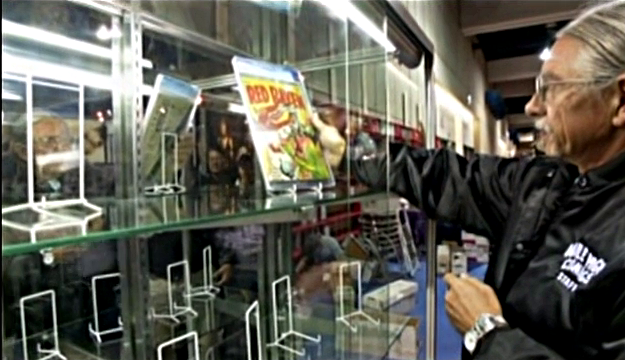
Veteran exhibitor and Mile High Comics proprietor Chuck Rozanski represents Comic-Con's old guard. His story is presented as a struggle to keep his business afloat as the annual event becomes less a true comics convention. This is news to me given how much of a fixture Mile High is at Comic-Con. Much hay is made out of whether or not he'll sell a personal treasure - an ultra-rare copy of Red Raven #1, though I never doubted the eventual outcome. While there’s not much that actually happens to him, Chuck is the most eloquent main character in the film and the only one to view the Con from a long term perspective.
James Darling and Se Young Kang began dating at last year’s Comic-Con. James plans on proposing to Se Young during the Kevin Smith panel. But he runs into a few obstacles along the way. While their plotline is actually uncomplicated, it’s a cute way to round out the cast. And Kevin proves to be a gracious host.
While the use of visual gimmicks like comic book panel transitions, caption boxes written in comic-style typeface, and superhero code names are a tad cliche, they serve to help delineate and juggle the different plot threads. Spurlock makes the clever choice not to so much fixate on his cast’s interests and Geeky obsessions but on their aspirations and personal struggles. The film follows them from their respective homes, families and dayjobs, to their experiences during the 4 days at the Con, to the time they’re about to leave. The results are cathartic. Though their individual stories are small, the audience gets to root for them and share in the fruits of their labor, whether for good or bad.
This approach sounds straightforward enough, but it’s remarkable how rarely it’s used whenever any kind of geek-oriented subculture is being covered by the mainstream press. It’s more typical to gawk at their strange pursuits, then characterize them as losers or loners. Trekkies was infamous among fans for exposing the audience to a number of eccentric and occasionally deluded individuals. This led to the inescapable conclusion that some of them were being set up to be mocked by the film makers. These attitudes can be internalized by the fans themselves, as anyone will attest after reading any issue of Wizard magazine. And sometimes the worst offenders are fans who attack other fans because they hold divergent views. So it’s kinda amazing that Spurlock accomplishes the fine balancing act of showing respect for his cast without necessarily becoming enmeshed in their worlds. He consistently maintains the stance of documentarian to avoid becoming an insider. And this emotional distance keeps him from falling into the more familiar patterns of showing contempt for his subject or pandering to the hardcore. This isn’t to say that Spurlock doesn’t employ some gentle humor from time to time. It wouldn’t be a Spurlock movie without him proverbially winking at the audience. But overall, this is as warm, sympathetic and very human a portrayal as any. No one comes across as being insipidly foolish or deeply unlikeable.
Given that Spurlock’s usual M.O. involves subjecting himself to a drawn-out process in order to expose a ridiculous excess of modern capitalism, it probably wouldn’t work within the confines of a 4-day event. So unlike his other films, satire takes a back seat. But the darker side of the triumph of the geek can be seen in the invasion by corporate Hollywood of Comic-Con, a phenomena that not a few comic professionals have felt ambivalent about. Accompanying a montage of celebrity actors from Chris Evans to Harrison Ford greeting cheering crowds, Marc Guggenheim notes “You have literally the entire fan base for your movie or TV show here in one concentrated place. So it's basically the world's largest focus group.” But it’s Chuck, channelling an angrier version of Shel, who delivers the best lines. Having witnessed the gradual takeover by film and television during his 38 years as a convention exhibitor, he observes:
“Even though they have 'comic' in name of the event, very little of the convention anymore is actually comics. We can't use the loading docks anymore, 'cause fricking Lucas films owns the loading docks. You know, that kind of pisses you off. It really does, 'cause IT'S OUR HOUSE!”What ultimately shines through isn’t so much the anger or cynicism, but Chuck's love for the place. It's that sense of belonging from having found an accepting tribe that has him coming back to Comic-Con.
Subscribe to:
Posts (Atom)