8/23/2013

K-On! College

K-On! College Created by Kakifly.
Created by Kakifly

Moe-themed comics are a matter of taste, and K-On! walks the fine line that separates adorable from annoying. Are shy girl Mio Akiyama’s cringing and whinging whenever she's pressured into confronting anything new and unexpected kinda endearing or kinda frustrating? Is space cadet Yui Hirasawa’s inability to function without the help of her far more capable younger sister Ui an expression of familial devotion or creepy codependence? What about Yui’s constant glomping on Azusa Nakano? Is that joyful affection or a form of harassment? Humor has a subjective component, and the cast of K-On! isn't so much populated by well-rounded creations but an assemblage of foibles finely balanced for cute interactions. But if the gags fail to amuse the reader, the results are just a bunch of characters overreacting to the most mundane of things.

To his credit, Kakifly is one of the more talented manga-ka working in the highly constrained yonkoma format. His designs are appealing without being too pandering. His linework is polished. And the story told of a clique of high school students forming a pop band is sweet and mellow, even if it can be a little too saccharine at times. When the original band members graduated, it seemed like a natural place to close the series. So I have to wonder if commercial considerations convinced him (or more likely the publisher Hōbunsha) to extend the story. In any case, the tone of K-On! College will feel familiar to fans, just without a tidy conclusion. For whatever reason, this spinoff never lasted long enough to establish its own identity.

One would think that having Yui, Mio, Ritsu Tainaka, and Tsumugi “Mugi” Kotobuki in a college setting would help create new and interesting setups. They’re all inhabiting the same dorm but attending different classes. They’ve joined the school's pop-music club, which has a much larger membership than their old high school club. There are new characters, most notably a rival band composed of a talented trio. But it isn’t long before it becomes apparent that the new cast members are mostly filling the same roles vacated by the old cast members. No more Sawako Yamanaka to act as the cosplay-crazy authority figure? The club president also has a cosplay fetish. No more Azusa for Yui to glomp on? Hey, there’s this other tsundere that will do just as fine. And the manga continues to rely on old standbys like Ritsu and Mio’s boke-tsukkomi routine, Yui’s sleepiness, or Mugi’s fascination with convenience store snack foods.

Thankfully, the manga does present several moments of character development. The college setting forces the four of them to consider whether they might actually want to become professional musicians after they graduate. This precipitates a mini identity crisis in both the ditzy Yui and lazy Ritsu. The new environment also pushes Mio and Mugi out of their respective comfort zones. Mio takes a few tentative steps to conquer her shyness, while Mugi, missing her wealthy family and household servants, learns to become more self-sufficient. There's just no follow-up to these incremental changes. And the new cast members suffer from not being sufficiently fleshed-out. The one exception is punk rocker Akira Wada, the only one with a backstory, and with a love interest to boot. It’s too bad the series was cancelled before anything could get going.

K-On! College is a commercial manga, so it’s no surprise that it conforms to the formula that previously made it a huge success. Fans looking for more of the same will not be disappointed. But there are times when the world the characters inhabit feels hemmed-in by those small panels, and I wonder what would happen if they could break free from them.

8/05/2013

The Wolverine (2013)

The Wolverine (2013), directed by James Mangold

The Wolverine is the most straightforward superhero movie I’ve seen this summer, possesing none of the gravitas of Man of Steel and Iron Man 3. That’s probably a good thing. It's a star vehicle for the charismatic Hugh Jackman, who’s finally aging into the heavily muscled yet battle-scarred comic book character fans know and love ever since he started playing Logan back in 2000. Yes, ladies and gentlemen. If you can remember that far back, you too are old.

The Mutant vs. Human struggle gets left far behind as the eponymous hero travels to Japan and becomes entangled in the political intrigue of the extremely wealthy and powerful Yashida family. As a fish out of water tale, the movie is a throwback to the days when Japan was overwhelmingly defined by the West as the land of samurai, ninja and yakuza. Not surprising since the story is loosely based on a comic book from 1982 (incidentally, neither Wolverine creator Len Wein or original comic story creators Chris Claremont and Frank Miller get any recognition in the film credits, though Len was apparently paid by the studio. That's nice). There’s the usual cliched banter about honor, duty, loyalty and sacrifice that often describes those inscrutable Japanese, with an arranged marriage thrown in for good measure. Damsel in distress Mariko Yashida (a vision of delicate beauty played by Tao Okamoto) naturally gets rescued by handsome outsider Logan who labels her “princess”, probably for the benefit of the audience members who haven’t figured out what’s going on. The movie doesn’t employ the well-worn trope of the wayward White Guy who learns martial arts and bests the treacherous Orientals at their own game, but Logan is almost immediately identified by the locals as a “ronin” anyway. That’s a samurai without a master, in case you didn’t know. However, there's this one small lesson on how to handle a katana that becomes crucial later on.

What else? There’s the inevitable humor about cultural misunderstandings. Logan cluelessly walks into a love hotel with Mariko at one point, innocently hoping to rent a room for the night. Ha ha! When Mariko meets Logan for the first time, he looks pretty much the stereotype of the uncultured, dirty, hairy, and presumably very smelly gaijin. This leads to a bath scene involving some stern-looking house servants brandishing wash sticks. On the other side, virtually every Japanese male is a scheming, chauvinist SOB who treats Mariko and best pal Yukio (played by a red-haired Rila Fukushima fashionably dressed like a hip young lady going about the town) like personal property, though Yukio does get her share of badass moments. The plot makes no sense as it depends on the separate machinations of all those schemers to perfectly line up. I’m sure nitpicky fans have already expressed their thoughts all over the Internet. Then there’s the junk science about transferring Logan’s mutant healing powers to mere mortals. Apparently, all it takes is a direct infusion from Logan’s bone marrow, though why it requires removing his claws with high-tech samurai armor made of adamantium completely escapes me.

If the viewer can get past those little contrivances and massive plot holes, the reward is a stylish noire story with some very thrilling set pieces. Tokyo is shot as a gorgeous dreamland, whether it be the glittering modern skyline or more traditional structures, and where everyone is dressed to the nines. All except for grizzled mountain-man Logan of course. Like so many major Hollywood studio efforts, it falls apart in the third act. But hey, Hugh Jackman's back. And for completists, it connects X-Men: The Last Stand to the next movie in the series.

7/20/2013

Pacific Rim (2013)

Pacific Rim (2013) Directed by Guillermo del Toro

Even in an increasingly geek-friendly entertainment environment, I didn’t believe that Hollywood would do justice to two classic Japanese genres that are dear to me: Super Robot Mecha and Kaiju stories. The industry has a poor track record when it comes to translating more recent otaku-based obsessions for the North American audience, let alone older concepts. So when I heard that acclaimed horror/fantasy director Guillermo del Toro would be directing an action/SF spectacle combining the two, I was a little nonplussed. As it turns out, he's quite the fan. Coming after a disappointing crop of summer blockbusters, Pacific Rim has proven to be an exciting romp. Finally, someone actually gets that watching giant robots hitting giant monsters in the face is supposed to evoke a childlike sense of wonder.

Pacific Rim is constructed as the closing chapter of a protracted war helpfully recapped at the start of the movie. The premise is spot-on for the genre: Aliens from another universe launch an invasion of Earth by sending Kaiju through an interdimensional portal at the bottom of the Pacific Ocean. At first, the Kaiju trickle in one at a time, as par for the course, fixated on destroying major coastal cities. But after realizing that conventional weapons are ineffective against them, and unable to close the portal, the world’s governments pool their resources to construct an army of gigantic mecha they dub “Jaegers.” Initially, these Jaegers mop the floor with the Kaiju. But the Kaiju become smarter and stronger with every new incursion, and the rate at which they emerge gradually increases to the point were they begin to outstrip the world’s capacity to repair existing Jaegers, or to design and construct new ones. When the main story begins, humanity is retreating behind giant seawalls while the last remaining Jaegers are being housed in a decaying hanger at Hong Kong harbor called the Shatterdome. Facing defeat, the base commander is determined to launch one last-ditch effort to stop the invasion.

As expected from a 2-hour SF movie, there’s plenty of clunky exposition to go through accompanied by the usual technobabble. A bit of dialogue about how climate change facilitated the Kaiju invasion gets lost in the shuffle. But moving past the commentary reveals a world teetering on its last legs. Its technology has seen better days. Resources are scarce, but people carry on because what else is there to do? If a Kaiju falls in the middle of a city and the proper authorities can no longer be bothered to clean up the mess, build around it and harvest the carcass. No reason not to make a (less than) honest buck before civilization itself finally goes the way of the dinosaurs.

Pacific Rim (2013) Directed by Guillermo del Toro

The Jaeger and Kaiju are unsurprisingly the movie’s stars, and they’re magnificently realized digital creations. Each possesses it’s own unique look and arsenal.The Jaegers’ utilitarian designs have a certain retro feel, vaguely resembling oversized mobile suits of the 80s. Their mechanical simplicity provides a welcome contrast to the overly-complicated technology found in most other films, such as the Transformers franchise. The Kaiju are also similarly retro, marrying the general outline of those classic movie monster suits with hyper-realistic anatomy and textures. The battle set-pieces are among the best-realized CGI action scenes I’ve ever watched, possessing added weight and physical presence. While the Jaegers lumber across the screen like giant, anthropomorphized machines, the Kaiju are hulking predators. They’re larger and swifter than the Jaegers, imbuing each confrontation with a sense of danger for the human pilots. One of the coolest moments is when an otherwise landbound Kaiju suddenly spreads a pair of massive, hitherto hidden batlike wings to drag a hapless Jaeger into the sky.

In a summer were critics have complained about the excessive use of destruction porn mixed in with 9/11 imagery, Pacific Rim stands out for being emphatically lighthearted. This is a war were millions have presumably died at the hands of the Kaiju. But del Toro keeps the focus firmly on the single combat. Scenes of mass destruction take place primarily at the beginning recap and in a few flashbacks. The one time the Jaegers are forced to fight the Kaiju within a densely populated area, its residents have already been evacuated to underground shelters, allowing the Jaegers to go all out. There’s goofy otaku fun in watching the Jaegers unleash the movie’s rough equivalent to chest missiles, rocket punches, arm cannons, and fire blizzards. I swear, at some point their pilots were even calling out their attacks. Once the lightning sword came out of nowhere to slice a Kaiju in half, I couldn’t help but grin and pump my fist at the sheer zaniness of it all.

Pacific Rim (2013) Directed by Guillermo del Toro

Character development isn’t Pacific Rim’s strong suit, as the writing mostly follows certain Hollywood archetypes: the reluctant hero, the steely leader, the jerkface rival, the nerdy scientists, the vengeful warrior, the fast-talking huckster. But even here, del Toro is smarter than the average action movie director. Any super robot fan knows that teamwork is needed to synch the pilots with their gigantic mecha. And with the Jaegers, the pilots have to be telepathically linked in a state called “the drift.” This forces the pilots to bond with an unusual degree of intimacy. As a result, familial connections often play a huge role in Jaeger pilot selection and training, whether they be siblings, spouses, or parents and their children. The drift is often used as a plot device to uncover suppressed memories, self-doubts, fears, and hidden traumas. Heck, even the scientists prove their mettle when needed by entering the drift more than once. But the central relationship of the movie is between Raleigh Becket and Mako Mori. Raleigh is searching for a new partner after his older brother died in battle five years ago and gravitates towards Mako. This is what passes for a love story in the movie. But it’s more a meeting of hearts and minds than an erotic encounter. Their unusual courtship commences when Raleigh fences with Mako to test their drift compatibility, and further develops within the cockpit of a Jaeger. Martial arts followed by a mind-meld in a giant robot? How delightfully geektastic!

And in a mostly capable cast, Rinko Kikuchi and Mana Ashida (playing a younger Mako in flashbacks) are fantastic. Conventional war stories tend to be exercises in delineating brotherhood and all manly stuff. Not that Pacific Rim doesn't have its moments of male bonding. You’d expect Raleigh (played by Charlie Hunnam) and commanding officer Stacker Pentecost (played by the always solid Idris Elba) to form a kind of substitute father-son dynamic, and they do to some extent. But it’s the concerned father Stacker fretting over his adoptive daughter Mako going into battle that tweaks the formula and provides the tale with much emotional heft. Mako earns the respect of the boys and becomes Raleigh’s copilot, and what a difference this makes: man and woman psychically linked. Together, they go out to kick monster butt and save the world.

So yeah, this is a noisy, special effects-filled movie with heart. A big, nerdy monster and robot lovin' heart that beats within Guillermo del Toro.

7/15/2013

Shelf Porn: Chinese Tankōbon

Manga Volumes, Hiro Comic World, Chinatown, Kuala Lumpur. Manga Volumes, Hiro Comic World, Chinatown, Kuala Lumpur. Manga Volumes, Hiro Comic World, Chinatown, Kuala Lumpur. Manga Volumes, Hiro Comic World, Chinatown, Kuala Lumpur. Manga Volumes, Hiro Comic World, Chinatown, Kuala Lumpur.
 Go to: My Photoblog.

Photos taken by me at Hiro Comic World, Chinatown, Kuala Lumpur. If only the store’s copies weren’t localized for Cantonese speakers, they’d be perfect for me. This is the most manga I’ve seen with my own eyes in a single setting. They also had plenty of anime and Korean dramas on disc.

7/06/2013

Comic-Con Episode IV: A Fan's Hope

Comic-Con Episode IV: A Fan's Hope, directed by Morgan Spurlock
It seems like I'm the oddball in a world of very normal people. But when I dream about going to a place like Comic-Con, it's got to be, like, nirvana, it's got to be the closest thing there is to heaven, because other people there are just as much of a nerd as I am. - Eric Henson
I last went to Comic-Con International just as the convention was beginning to grow into its present-day form. I was playing it by ear the day I took the train down to San Diego, and for the first time in my life the hotels in the downtown area were fully booked. But I could still line up and purchase a 4-day pass. By contrast, tickets for this year’s event sold out in just over 90 minutes, which is now becoming typical since attendance was capped in 2008. Social media plays a bigger role in reporting what happens at the Con. Everyone online complains about the endless queues to get into some panels, the overcrowded halls, or the smell of 130,000 sweaty people in close proximity to each other during the height of summer. Then there’s the resentment over how much space, both literally and figuratively, Hollywood occupies at the convention. Comic-Con’s late founder Shel Dorf said back in 2002: "It's become too big and too depressing... The last time there, I could barely find any comic books." The situation has hardly improved for devotees of the medium. But you know what? Given half the chance, I’d attend Comic-Con again in a heartbeat.

Documentary film maker Morgan Spurlock is known for putting himself front-and-center during his satirical takedowns of Western consumerism. So it was with some trepidation that I first approached the rather annoyingly titled Comic-Con Episode IV: A Fan's Hope. It’s ironic verbosity is second only to POM Wonderful Presents: The Greatest Movie Ever Sold, which is a good example of how Spurlock's social critiques are premised on executing an elaborate stunt. But to my surprise, there are no stunts here and Spurlock himself is nowhere to be found in front of the camera. And while the observation that geek subculture has finally ascended the heights of mainstream entertainment still fits within Spurlock’s wheelhouse, the positive message that geeks are people too is a delightful twist.

Comic-Con Episode IV: A Fan's Hope, directed by Morgan Spurlock

Spurlock has lined-up a huge list of nerd idols to function as talking heads guiding the audience through Comic-Con’s 2010 event, including the film’s producers Harry Knowles, Joss Whedon, and Stan Lee. Combined with a random sampling of the diverse range of fans wandering the convention hall, this collection serves to emphasize just how much Comic-Con mirrors the popular landscape. Sure, not all of them are there for the comic books. But rather than seeming a depressing sight, there’s a powerful feeling of euphoria that envelops this motley crew. This is summed up by Whedon’s comment:
“I've brought people who'd never been to the Con and seen the look on their face that was on my face, which is, 'My tribe! I have found my tribe!’ Like, it is a time when these people can express themselves in a totally safe environment and it doesn't matter what they're a fan of."
The narrative's meat is supplied by six attendees: Two aspiring artists, an aspiring costume designer, a longtime comics retailer, and a romantically involved couple. As someone who’s been there and done the whole portfolio review process, I quickly identified with the two artists, who could not have been more different from each other. Young hopeful Skip Harvey, who tends a geek-themed bar, is the closest thing to a stereotypical fanboy of the main cast. He’s first shown engaged in a debate on who would win a fight between Black Cat and Longshot which concludes with the two characters having sex. His parents were active trekkies. He sports a Flash Tattoo. He sleeps on a Spider-Man themed pillowcase. I wanted to yell at him to lose the hat and kiddie Marvel backpack where he stuffs his artist portfolio. This is a fuckin’ job interview, man. Was I ever that naive? The more clean-cut Eric Henson is stationed at a military base in the middle of nowhere. But he admits to living a double life as a nerd. He draws a mean Hulk and dreams of working for Marvel Comics. But going to Comic-Con is a big adjustment for someone unused to city living, let alone the California lifestyle. And it means temporarily leaving his adorable daughter and supportive wife, who's nonetheless perplexed with his decision. There’s no denying their passion for drawing comics, and their experiences brought back for me the personal dread that comes from the long waits and terse silence that commences every critique.

Comic-Con Episode IV: A Fan's Hope, directed by Morgan Spurlock

Holly Conrad is the film’s most charming character, and her “suicide mission” to get her cosplay troupe to Comic-Con’s Masquerade provides the film with it’s most exciting buildup as well as its most satisfying emotional payoff. It’s the kind of triumphant moment fans dream of. I love her amusing description of the piss-town she lives in as a place “where people stop to go to the bathroom on their way to go skiing” and her good-natured characterization of her neighbor’s misguided view of her as a meth head.

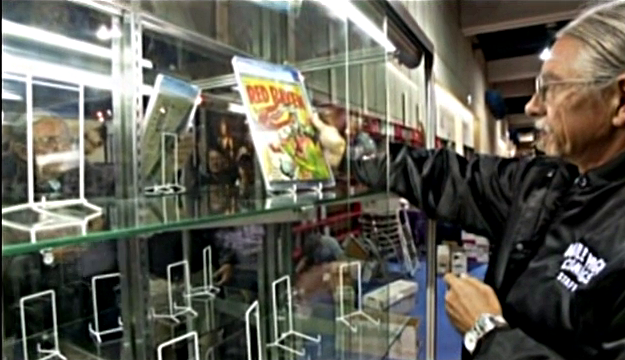
Veteran exhibitor and Mile High Comics proprietor Chuck Rozanski represents Comic-Con's old guard. His story is presented as a struggle to keep his business afloat as the annual event becomes less a true comics convention. This is news to me given how much of a fixture Mile High is at Comic-Con. Much hay is made out of whether or not he'll sell a personal treasure - an ultra-rare copy of Red Raven #1, though I never doubted the eventual outcome. While there’s not much that actually happens to him, Chuck is the most eloquent main character in the film and the only one to view the Con from a long term perspective.

James Darling and Se Young Kang began dating at last year’s Comic-Con. James plans on proposing to Se Young during the Kevin Smith panel. But he runs into a few obstacles along the way. While their plotline is actually uncomplicated, it’s a cute way to round out the cast. And Kevin proves to be a gracious host.

While the use of visual gimmicks like comic book panel transitions, caption boxes written in comic-style typeface, and superhero code names are a tad cliche, they serve to help delineate and juggle the different plot threads. Spurlock makes the clever choice not to so much fixate on his cast’s interests and Geeky obsessions but on their aspirations and personal struggles. The film follows them from their respective homes, families and dayjobs, to their experiences during the 4 days at the Con, to the time they’re about to leave. The results are cathartic. Though their individual stories are small, the audience gets to root for them and share in the fruits of their labor, whether for good or bad.

Comic-Con Episode IV: A Fan's Hope, directed by Morgan Spurlock

This approach sounds straightforward enough, but it’s remarkable how rarely it’s used whenever any kind of geek-oriented subculture is being covered by the mainstream press. It’s more typical to gawk at their strange pursuits, then characterize them as losers or loners. Trekkies was infamous among fans for exposing the audience to a number of eccentric and occasionally deluded individuals. This led to the inescapable conclusion that some of them were being set up to be mocked by the film makers. These attitudes can be internalized by the fans themselves, as anyone will attest after reading any issue of Wizard magazine. And sometimes the worst offenders are fans who attack other fans because they hold divergent views. So it’s kinda amazing that Spurlock accomplishes the fine balancing act of showing respect for his cast without necessarily becoming enmeshed in their worlds. He consistently maintains the stance of documentarian to avoid becoming an insider. And this emotional distance keeps him from falling into the more familiar patterns of showing contempt for his subject or pandering to the hardcore. This isn’t to say that Spurlock doesn’t employ some gentle humor from time to time. It wouldn’t be a Spurlock movie without him proverbially winking at the audience. But overall, this is as warm, sympathetic and very human a portrayal as any. No one comes across as being insipidly foolish or deeply unlikeable.

Given that Spurlock’s usual M.O. involves subjecting himself to a drawn-out process in order to expose a ridiculous excess of modern capitalism, it probably wouldn’t work within the confines of a 4-day event. So unlike his other films, satire takes a back seat. But the darker side of the triumph of the geek can be seen in the invasion by corporate Hollywood of Comic-Con, a phenomena that not a few comic professionals have felt ambivalent about. Accompanying a montage of celebrity actors from Chris Evans to Harrison Ford greeting cheering crowds, Marc Guggenheim notes “You have literally the entire fan base for your movie or TV show here in one concentrated place. So it's basically the world's largest focus group.” But it’s Chuck, channelling an angrier version of Shel, who delivers the best lines. Having witnessed the gradual takeover by film and television during his 38 years as a convention exhibitor, he observes:
“Even though they have 'comic' in name of the event, very little of the convention anymore is actually comics. We can't use the loading docks anymore, 'cause fricking Lucas films owns the loading docks. You know, that kind of pisses you off. It really does, 'cause IT'S OUR HOUSE!”
What ultimately shines through isn’t so much the anger or cynicism, but Chuck's love for the place. It's that sense of belonging from having found an accepting tribe that has him coming back to Comic-Con.

Comic-Con Episode IV: A Fan's Hope, directed by Morgan Spurlock

7/02/2013

Jim Kelly (May 5, 1946 – June 29, 2013)

Jim Kelly in “Black Belt Jones” (1974)
NYTimes
Han: We are all ready to win, just as we are born knowing only life. It is defeat that you must learn to prepare for.
Williams: I don't waste my time with it. When it comes, I won't even notice.
Han: Oh? How so?
Williams: I'll be too busy looking gooood.... 
Williams: Man, you come right out of a comic book.
- Enter the Dragon 
Pinky: Who the fuck hit me?
Black Belt Jones: Batman, muthafucka!
- Black Belt Jones
I once mentioned the awesome here.

6/25/2013

Whale Wars: Viking Shores

Whale Wars: Viking Shores

Last time on Whale Wars, maritime crusader Paul Watson and the plucky volunteers who make up his organization Sea Shepherd had run the Japanese Whaling Fleet out of the Southern Ocean. Despite some doubt as to whether this truly meant the end for Antarctic whaling, Sea Shepherd celebrated, then cast about for another place where they could apply their high profile obstructionist tactics while being filmed for television consumption. Their new target would be the Faroe Islands off the coast of Denmark, where the natives observe an ancient whaling tradition called the grindadráp. Seems like the perfect cocktail of ingredients. The grind is a notoriously bloody spectacle and already the subject of considerable negative attention from several environmental groups. Sea Shepherd is already infamous for skirting the line between fervent activism and moronically executed violence. The setup looks like it would make for an explosive showdown. What we get instead for five episodes of Whale Wars: Viking Shores is an awkward social experiment were Sea Shepherd plays the role of general nuisance to the Faroese while psyching themselves up for a confrontation that never takes place.

Even Paul will admit that local attitudes towards the grind aren't uniform. And for reasons that have nothing to do with him. There are legitimate concerns about the rising toxicity levels found in whale meat. There's a growing generation gap between the old who see it as integral to their cultural identity and the young who find it a Medieval anachronism. And there's also a growing gender gap as young women are more likely to express ambivalence towards this traditionally male dominated activity. Only a few of those voices get to have their say, mainly a local doctor who's worried about the health effects of consuming whale meat. For their part, Sea Shepherd seems more interested in picking a fight than in fostering constructive dialogue. A group of volunteers disrupt a festival by playing whale songs over a loudspeaker until they're told to move their vehicle. I'm not sure if this behavior is the product of genuine obtuseness or a shameless ploy to drum-up some excitement for the camera. But it's almost cartoonish how the volunteers react with surprise and dismay when their activities predictably evoke a belligerent response from the locals. My guess is if anyone wanted to express doubts about the grind to the film crew, they would have been intimidated rather than empowered by the fear of an angry mob possibly forming around Sea Shepherd's finest.

Naturally, some low-level hostility accompanies Sea Shepherd's interactions with the Faroese wherever they go. Some of the locals even play-up their dislike for Paul to the camera. The irony of being the ones on the receiving end of such verbal harassment seems to be lost on the volunteers, and after awhile, they become a little paranoid. But the threat is overstated and there's no breakout of actual violence. And while that's a good thing, it also highlights the problematic nature of the series. In the past, the Japanese Whalers could be counted on to function as convenient antagonists who Sea Shepherd generally avoided confronting face-to-face. This made them far easier to demonize for the TV audience, not to mention exoticize for being the inscrutably foreign "other". Not so with the Faroese, who are even more whitebread than the activists themselves and eager to defend their views to the camera. They provide a counter-narrative missing in past seasons of the show. While they mostly come across as old-fashioned and even a little insular, the Sea Shepherd crew doesn't exactly help their own cause when some of them label the locals "ignorant" and "violent" during their own confessionals.

Given that Viking Shores substitutes the usual high seas adventure with a lot of pointless intrigue and onshore bickering, the series odd payoff only occurs when after six weeks the campaign ends a little prematurely so that Sea Shepherd can resume their war with the Japanese Whalers. Not that anyone is pleased to hear that the Japanese have begun whaling again, but at least with them Sea Shepherd is on more familiar footing. As they're making their way out of Faroese waters, the crew finally spots their first pod of pilot whales. After herding them away from the Islands, Paul declares the entire campaign a resounding success because of course he does. Perhaps the series producers weren't so impressed with his glowing assessment or the decision to take off and leave behind one subset of whales just to go rescue another subset, as it's noted in the show credits that 109 pilot whales were killed in a grind that took place exactly a week later.

6/16/2013

More NonSense: Superman's 75th Anniversary Edition (Updated)

Entertainment Weekly Cover: Superman at 75
Entertainment Weekly celebrates the 75th Anniversary of the Man of Steel (via Kevin Melrose).

ComicsAlliance honors the artists who have given life to "Jerry Siegel and Joe Shuster's brilliant creation" these past decades.

Edward Helmore on the long legal battle to control the rights to Superman.

Siegel family attorney Mark Toberoff swears "This case is by no means over" (via Kevin Melrose).

Alan Moore on the seedy, disreputable comic book industry that profited from Superman's early popularity while ripping off its creative talent:
The industry’s apologists have offered various glosses for the shameful act of theft upon which the vast business that supports them seems to have been founded. One of the more despicable of these constructions has it that Siegel and Shuster should have been more shrewd in signing contracts, which appears to be a variant on the well-known American proverbial advice regarding suckers and the inadvisability of giving them an even break. More lately there have been attempts to mitigate the industry’s offence with an appeal to half-baked mysticism and postmodernism, maintaining that Superman and the commercial children’s comic characters which followed him are all in some sense archetypes that hover in the ether, waiting to be plucked by any lucky idiot who passes by. Ingeniously, this sidesteps the whole Siegel and Shuster problem by insisting that creators in the superhero field aren’t actually creators after all, but merely the recipients of some kind of transcendent windfall fruit that should be freely shared around. Even if this were true, it’s difficult to see exactly how it justifies a perhaps gangster-founded company of fruiterers (just to continue the analogy) declaring that these profitable magic apples all belong to them in perpetuity. Still, one can see why such a morally-evasive brand of metaphysics might appeal to the large corporate concerns which steer the comic industry; to those amongst the readership whose primary allegiance is to a specific superhero rather than the ordinary non-invulnerable human who originated him; and to those loyally and profitably labouring at franchises, who know they’re in no danger of ever creating an original idea which would be valuable enough to steal.
"Five Superman Publications I Like Better Than The Movies" 12345 by Tom Spurgeon and some other guys.

Joe Shuster draws Superman vs. a Grizzly Bear. Awesome.

Classic Superman Radio ads.

This town wants to be Smallville.

Tom Scioli thinks Jim Starlin’s brief stint on the character is the best Superman ever.

Jake Roper explains that Superman, or any superhuman for that matter, hitting an object with a fist that's traveling at 99% the speed of light would be really, really, really, really, really bad (via Kevin Melrose). I suppose that means that if you can take a punch from Superman, you're way beyond bulletproof.

Tom Bondurant on this week's Superman-related projects: Superman Unchained and Man of Steel.

Bully on the apocalyptic aspects of the movie.

Andrew Wheeler would like you to know that Henry Cavill is the latest in a line of unknown actors cast to play the Man of Steel. And if the pattern holds up, this role will be the high point of his entire acting career. It's a good thing then that he is one absurdly handsome man.

Marc Singer in his review of Man of Steel is irritated by the same elements that bother me, especially this particular pet peeve:
Like the ponderous Superman Returns, Man of Steel can't resist the cheap and easy Christ imagery. The subtext isn't helped when the villainous Kryptonian starts talking about how evolution always wins or how morality is an evolutionary weakness. Which I'm pretty sure is not how evolution works, but Snyder made his point. 
(The Superman I love the most, the genial scientist and humanist who walked into a golden sunset in 1986 and reappeared for a dozen glorious issues in the mid-2000s, would no doubt respond with some gentle corrective about how morality is humanity's greatest evolutionary adaptation. And then knock Faora into orbit.)
I'm rarely unequivocal when making recommendations, especially with superhero movies. And Man of Steel is not the greatest example of the genre. So for all the watered-down Nietzsche and muddled understanding of science, I still kinda like the movie, if for no other reason than on the strength of its cast. This off course in no way alters my skepticism of Zach Snyder.

Michael May asks whether there is a meaningfully right or wrong way to interpret corporate-owned characters.

Tom Scioli on how Man of Steel is filled with 80s nostalgia for geeks.