Hellboy created by Mike Mignola
Colors: Dave Stewart
Letters: Clem Robins
Design: Cary Grazzini
Hellboy in Hell is not only the official end (for the time being) for one of the comic industry’s most successful characters within the last twenty years, it also marks the return of creator Mike Mignola to his role as Hellboy’s principle artist. Even now, that Mignola chose to conclude Hellboy’s narrative arc on his own terms, is something of a triumph. It must have been tempting to simply hire new creative talent to maintain the present continuity and cash-in on the character’s ongoing popularity. That Hellboy himself retains considerable name recognition after most of the comics published under the Legend imprint (remember them?) have faded from memory is damn impressive. So if Mignola wants to spend more of his time painting watercolors, the choice is more than well-earned.
Not that Hellboy’s retirement would end the larger universe that Mignola has already wrought. Since Hellboy quit the Bureau for Paranormal Research and Defense (B.P.R.D.) in 2001, Mignola has collaborated with an expanding circle of writers and artists. The titles now include (but are not limited to) the B.P.R.D., Abe Sapien, Lobster Johnson, Baltimore, Sir Edward Grey, and a prequel called Hellboy and the B.P.R.D. As for the Hellboy comics themselves, Mignola would gradually allow Hellboy’s post-B.P.R.D. adventures to be illustrated by other talents. It almost looked as if Mignola was making a slow exit while handing the reigns to his universe to other, capable hands.
The initial phase of Hellboy’s career was spent as a paranormal investigator/monster hunter, working under the direction of the B.P.R.D. These were the stories where Mignola laid the ground for him as a gruff, well-meaning figure, staunch defender of humanity, but haunted by ancient prophecies and visions that foretold of him as the harbinger of the Apocalypse and the one being capable of freeing the Lovecraftian horror known as the Ogdru Jahad from its deep space prison. The second phase had Mignola cede his artistic duties while Hellboy would lead a vagabond life in an attempt to learn more about his origins. This ended when he died battling the mad sorceress Nimue (who was channeling the Ogdru Jahad). With the descent into Hell, Mignola reunited with longtime collaborators colorist Dave Stewart and letterer Clem Robins. A new phase for Hellboy was poised to commence.
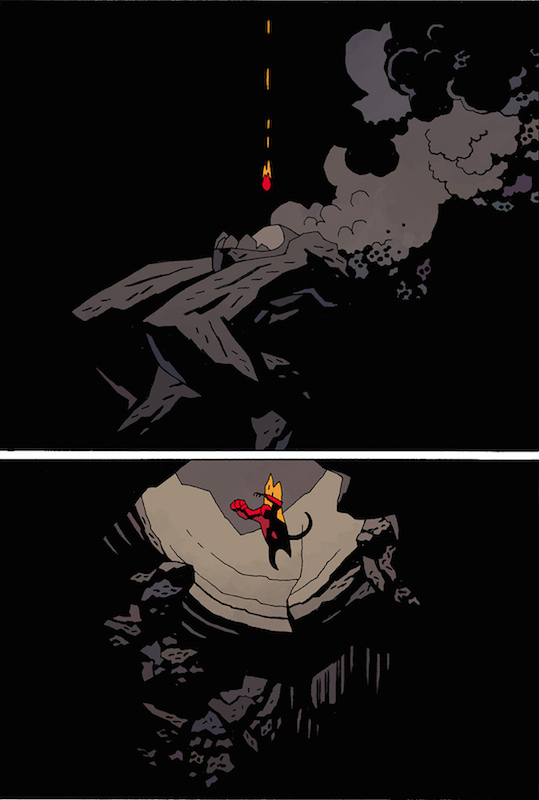
The first half of Hellboy in Hell certainly operates under that conceit. While Duncan Fegredo was a more than able to play the role of principle artist, Mignola’s signature style has since further evolved. Few artists working today are able to convey gloom with so few strokes of the pen. His characters have become flatter, more impressionistic through the years. But with just the right amount of linework and chiaroscuro to suggest their inner state. Mignola is a master of the kind of decompressed storytelling that places just as much focus on mood and atmosphere as on action. A favorite device is the use of small, rectangular, inset panels to control the pace and reveal tiny details that would be otherwise have been overlooked. With the realm of Hell, there’s more than enough wierdness fighting for the reader's attention. Mignola’s understated approach will forever be associated with Stewart’s equally nuanced use of colors, which keep the panels eminently readable with subtle shading and a minimal palette that maximizes emotional impact.
All of this serves as a counterpoint to the comic’s very dry sense of humor. Hellboy and his supporting cast are so constantly beset by the weird and terrifying that it’s become characteristic to cope by wearing a deadpan expression while emitting a stoic shrug. Arch-enemy Baba Yaga summarizes her venomous relationship with Hellboy like he was just another annoying coworker: “I never liked him, but even I have to admit he ended well.” Hellboy describes his initial impressions of the underworld like a typical day at work: “Let’s see… I got killed, fell into a hole full of giant bugs, and a big iron guy beat the crap out of me with a hammer. Considering the day I’m having, I think I’m doing pretty good.” Unsurprisingly, his message to his demonic family (who obviously feel betrayed by his life choices) is similarly irreverent: “Well screw you guys!” And don't think that someone wouldn't notice the incongruity of the hero with demonic ties being named after the very place where the wicked are condemned to in the afterlife. Longtime readers will already be familiar with how humor is often used to offset the grim nature of the threats the protagonists usually face. But with Hellboy, it now keeps him sane given his unusual circumstances.
Once he’s got his bearings, Hellboy quickly resumes his wandering ways. He explores the geography of Hell, encounters its varied denizens, dukes it out with numerous demons, even becomes infected with a mysterious ailment, and does his best to save lost souls from eternal damnation. This might have been a pattern that Mignola could have tried to sustain for the next few years with his fertile imagination He even seems to be finding his groove in the episodic nature of events. But then, he chooses instead to end Hellboy’s infernal adventures in an unexpectadly abrupt manner.
Ending Hellboy’s story means ending the struggle that’s always defined him - his coming to terms with the apocalyptic destiny set upon him by his demonic brethren. He would have continued this struggle by feuding with all the princes of Hell. But that would change nothing. In a chance encounter with a demon he once knew in life, he receives some pretty good advice on finding a way out: “You want to start over? You want a new life? First you have to finish the old one.”
It's advice Hellboy takes to heart. He finishes the old in the most spectacular way possible. The climax is a monumental series of panels composed of stark landscapes dwarfed only by monstrous forms battling like kaiju. In one fell swoop, Hellboy finally breaks free of his fate by embracing it in a way that ends up laying waste to the infernal kingdom’s fragile balance of power. It’s a masterpiece of low key storytelling. And yet, it's still a gloriously epic display of Mignola's penchant for inky shadows and Kirby crackle. In the final chapter, Hellboy never speaks. His actions are narrated by a lone surviving demon witness. This distancing effect is maintained to the very last page. The demon eventually falls silent. And with his task done, Hellboy continues to wander an abandoned Hell alone before finally settling down in a quiet corner. Even here, he finds there is a light in the darkness to show the way. It's an ambiguous, even mysterious, but hopeful conclusion.
So it ends. No fanfare, happy reunions with loved ones, celebrations with allies, or victory speeches. Not even a wry comment coming from Hellboy. Could he return to action in the future? Sure. This is comics, after all. The B.P.R.D. is still desperately fighting to prevent the Apocalypse from happening on the earthly plane. Supernatural forces are constantly at work in this fantasy mileau. But for now at least, Mignola has given his character a fitting, if melancholic sendoff.
Showing posts with label Hellboy. Show all posts
6/28/2016
10/26/2010
Hellboy: The Storm
by Mike Mignola, Duncan Fegredo, Clem Robins, Dave Stewart
Despite moments of wonderful visual beauty, I was never overly impressed with Guillermo del Toro's film adaptations of the Hellboy comic book series. Part of it is found in the differences between the two mediums. A ninety minute feature film is always going to look cramped next to a long-form story told through many individual chapters and interlocking arcs. Recent events in the comic mirror the premise of Hellboy II: The Golden Army insofar as some disgruntled characters decide to declare war on humanity. But whereas del Toro resorted to a freshly-minted villain commanding a conveniently prefabricated army of shiny robots, creator Mike Mignola has taken years to build-up his rogues gallery. From the series pulp-inspired beginnings, Mignola has used the time to fashion a sizable cast of characters, and cleverly weave disparate mythological sources into the protagonist's quest to prevent Armageddon.
The Storm is by itself an incomplete arc - continuing where The Wild Hunt left off, and ending just before it reaches any resolution. But the screws are beginning to tighten. The pace quickens. The stakes are higher. The danger is more palpable. Several characters not seen for awhile reappear just to emphasize how things are going from bad to worse. Hellboy makes a surprising decision which is calculated to keep the reader on tenterhooks (Actually he makes a few smaller decisions too, like quitting alcohol now that the end of the world is nigh). And a familiar figure is revealed to be manipulating everything, tying together plot threads that originated at the beginning of the series.
Even with the situation becoming more dire, Mignola still leaves room for quieter character moments. The Gruagach finally gets his comeuppance for his part in instigating the war, and yet is still deserving of some pity. Hellboy reflects on his relationship with father figure, the late professor Trevor Bruttenholm. But it's the romance between him and Alice that finally comes into focus. Given penciller Duncan Fegredo's involvement since The Wild Hunt, she's now as much his creation as she is Mignola's. Not that Hellboy doesn't get to tussle with more monsters - there's one fight scene that forms the centerpiece of The Storm. But his relationship with Alice goes far in opening up the hero's stoic facade. I wonder if she'll come through all this intact when the story is concluded in The Fury...
1/14/2010
Hellboy: The Wild Hunt
Hellboy #37-44
by Mike Mignola, Duncan Fegredo, Clem Robins, Dave Stewart
In the tradition of the best geeky, superhero comics storytelling, Hellboy meshes disparate elements together into a grandiose action adventure tale: The eponymous hero is always fighting a varied menagerie that included Nazi agents, Japanese vampires, European werewolves, or Lovecraftian alien monsters. But like many serials begun in the late nineties, it is framed by a larger story arc: In those early stories there was already a sense that there was more going on. Creator Mike Mignola took those monster-fighting episodes as far as he could before setting his protagonist free to explore his place in the larger cosmos. With Hellboy: The Wild Hunt, this phase of the character's development seems to be over as he's forced to make a choice between the various factions determined to start a war that could possibly destroy the world. The story is the latest in a series of revelations beginning with The Island that answers many previous unexplained elements; outlines the history of the universe Hellboy inhabits; and reveals his role within it. Mignola finally seems to have finished preparations for the presumably climactic end of the series.
As with the previous Darkness Calls, the linework is by Duncan Fegredo. I sometimes miss Mignola's visuals, but Fregredo is a more than capable replacement. He's able to duplicate Mignola's angular character designs and idiosyncratic chiaroscuro; but his style is more realistically detailed; and his panels far more panoramic. While Mignola's backgrounds would progressively become more pared down and abstract, Fegredo uses establishing shots and often pulls back from the characters to illustrate the larger physical setting. Fegredo excels at highlighting interior details e.g. the underground passage of the Wild Hunt filled with decapitated giant heads; or the mysterious floating knights found in Morgan le Fay's castle.
It's fortuitous that Fegredo took over as the primary artist when the series began to concentrate on certain female characters. The Wild Hunt deals with the aftermath of Hellboy's conflict with Baba Yaga and the witches in Darkness Calls; and his ongoing conflict with Hecate. In The Wild Hunt, Fegredo gets to portray three pivotal characters in Hellboy's development: The queenly Morgan le Fay; her adversary Nimue; and the adult version of Alice - last seen way back as a baby in the The Corpse. Fegredo imbues them with a physical presence usually not found in Mignola's character renditions. The villanous Nimue is a gloomy figure cloaked in perpetual shadow; Morgan carries herself with a certain inherent nobility that belies her evil reputation; while Alice possesses a down to earth charm that sets her apart from the other Hellboy characters. Her addition to the cast has the effect of softening Hellboy's typically reserved machismo. Her influence allows Hellboy to take positive action.
The Wild Hunt marks a first step past the emotional conflict between the human and demonic sides that has often paralyzed Hellboy. From the beginning he's been beset by hints that he is the Beast from Revelations that will bring about the end of the world. When he left his surrogate family at the BPRD, the knowledge he gained only cast him further adrift. Morgan supplies Hellboy (and the reader) with a dizzying amount of detail about his Arthurian heritage; which helps fill in some important plot points and gives him an abstract ideal to fight for. But with Alice, Hellboy has at least found an emotional anchor and one human connection.
None of this should be misinterpreted to mean that The Wild Hunt doesn't have its fair share of ass kicking. Mignola has given Hellboy more than the usual "just doing my job" rationale when its hero was working for the BPRD. But this story functions as an interlude before the long delayed showdown between Hellboy and the forces of Hell commited to destroying the world.
by Mike Mignola, Duncan Fegredo, Clem Robins, Dave Stewart
In the tradition of the best geeky, superhero comics storytelling, Hellboy meshes disparate elements together into a grandiose action adventure tale: The eponymous hero is always fighting a varied menagerie that included Nazi agents, Japanese vampires, European werewolves, or Lovecraftian alien monsters. But like many serials begun in the late nineties, it is framed by a larger story arc: In those early stories there was already a sense that there was more going on. Creator Mike Mignola took those monster-fighting episodes as far as he could before setting his protagonist free to explore his place in the larger cosmos. With Hellboy: The Wild Hunt, this phase of the character's development seems to be over as he's forced to make a choice between the various factions determined to start a war that could possibly destroy the world. The story is the latest in a series of revelations beginning with The Island that answers many previous unexplained elements; outlines the history of the universe Hellboy inhabits; and reveals his role within it. Mignola finally seems to have finished preparations for the presumably climactic end of the series.
As with the previous Darkness Calls, the linework is by Duncan Fegredo. I sometimes miss Mignola's visuals, but Fregredo is a more than capable replacement. He's able to duplicate Mignola's angular character designs and idiosyncratic chiaroscuro; but his style is more realistically detailed; and his panels far more panoramic. While Mignola's backgrounds would progressively become more pared down and abstract, Fegredo uses establishing shots and often pulls back from the characters to illustrate the larger physical setting. Fegredo excels at highlighting interior details e.g. the underground passage of the Wild Hunt filled with decapitated giant heads; or the mysterious floating knights found in Morgan le Fay's castle.
It's fortuitous that Fegredo took over as the primary artist when the series began to concentrate on certain female characters. The Wild Hunt deals with the aftermath of Hellboy's conflict with Baba Yaga and the witches in Darkness Calls; and his ongoing conflict with Hecate. In The Wild Hunt, Fegredo gets to portray three pivotal characters in Hellboy's development: The queenly Morgan le Fay; her adversary Nimue; and the adult version of Alice - last seen way back as a baby in the The Corpse. Fegredo imbues them with a physical presence usually not found in Mignola's character renditions. The villanous Nimue is a gloomy figure cloaked in perpetual shadow; Morgan carries herself with a certain inherent nobility that belies her evil reputation; while Alice possesses a down to earth charm that sets her apart from the other Hellboy characters. Her addition to the cast has the effect of softening Hellboy's typically reserved machismo. Her influence allows Hellboy to take positive action.
The Wild Hunt marks a first step past the emotional conflict between the human and demonic sides that has often paralyzed Hellboy. From the beginning he's been beset by hints that he is the Beast from Revelations that will bring about the end of the world. When he left his surrogate family at the BPRD, the knowledge he gained only cast him further adrift. Morgan supplies Hellboy (and the reader) with a dizzying amount of detail about his Arthurian heritage; which helps fill in some important plot points and gives him an abstract ideal to fight for. But with Alice, Hellboy has at least found an emotional anchor and one human connection.
None of this should be misinterpreted to mean that The Wild Hunt doesn't have its fair share of ass kicking. Mignola has given Hellboy more than the usual "just doing my job" rationale when its hero was working for the BPRD. But this story functions as an interlude before the long delayed showdown between Hellboy and the forces of Hell commited to destroying the world.
12/21/2008
Short Pamphlet Reviews
A brief rundown of a few recently read pamphlets.
Phonogram: The Singles Club #1
Writer: Kieron Gillen
Artist: Jamie McKelvie, Laurenn McCubbin, Marc Ellerby, Matthew Wilson
I haven't read the original miniseries, which was based on the idea of the magic of pop music. The lead story Pull Shapes is a beautifully illustrated character piece about the somewhat immature Penny B, a woman who derives her magic from dancing to music. The backup stories aren't as compelling. She Who Bleeds for Your Entertainment is about the dual portrayal of women in music as both victims and empowering figures. Murder on the Dance Floor is a lighthearted piece about how the right kind of music can change the mood and diffuse a tense situation.
Glamourpuss #4
Dave Sim continues tracing photorealistic art by analyzing the development of Alex Raymond's extreme fine line inking technique using brushes - He christens it the nightingale style. After he rejects the conventional explanation of how Raymond achieved the effect, he claims to have found another way to successfully duplicate the results (The reader can judge Sim's copy of Rip Kirby panels throughout the issue), but won't reveal how. As with every previous issue, his obsessive shop talk is mixed with eye-catching fashion illustrations and fake ads. These drawings are some of the best so far in the series, so maybe he does know what he's talking about. Heh. His satire, as usual, is still hit or miss and contains more than a little condescension. This disconnect between the fashion material and art instruction is linked by Sim's formalist fetish for figure drawing.
Supergirl: Cosmic Adventures in the 8th Grade #1
Writer: Landry Walker
Artists: Eric Jones, Pat Brosseau, Joey Mason
Why does every children's comic book DC puts out feel like it was also designed for the fanboy? Three pages in and the series is already cracking jokes about Kara being a "secret weapon". This is basically a fish-out-of-water story aimed at older children, with the super-powered alien functioning as a stand-in for the middle school student. Kara's developing powers work as a metaphor for the awkwardness of early adolescence. This is the gawkiest visual interpretation of Supergirl being currently published. As if the folks at DC didn't find her modest attire androgynous enough, she's given a boyishly short haircut. All she needs now are braces. The brightly colored art is similar to the retro look used in many Cartoon Network original programming. This could be a successful book, assuming kids still visit comic book stores these days.
Secret Invasion #8
Writer: Brian Michael Bendis
Artist: Lenil Francis Yu, Mark Morales, Laura Martin, Chris Eliopoulos
The final issue to this chaotic miniseries continues the rather confusingly staged Central Park showdown between the Skrulls and Earth's defenders from the last issue. It's the Skrulls for Pete's sake, so it's no surprise who wins. But Tony Stark gets blamed for the invasion, and Norman Osborne is celebrated as a hero, proving once again that Marvel Earth's media is run by a bunch of hapless idiots. Oh, the issue leads into the Dark Reign event arc.
Secret Invasion: Dark Reign #1
Writer: Brian Michael Bendis
Artist: Alex Maleev, Dean White, Chris Eliopoulos
This one-shot sets up the next link in Marvel's chain of event crossovers. Having replaced Tony Stark as the guy in charge of the Initiative and the Avengers, Norman Osborne convenes a new secret cabal consisting of Emma Frost, Namor, Loki, Dr. Doom and the Hood, for who knows what end. No one, except maybe the Hood, seems wiling to work with Osborne. But then he concludes the meeting by revealing some shadowy enforcer, which seems to achieve the desired effect. For an issue full of talking heads, the dialogue has all the flavor of a corporate board discussing a hostile takeover rather than a villainous gathering plotting to rule the world. Where's the bombastic pronouncements from Doom and Namor? Or Emma Frost's dry wit? As for the visuals, the characters, except Doom, appear rather mundane. Namor in particular looks like an unshaven, smelly, fat slob. What's up with that?
Hellboy: The Wild Hunt #1
Writer: Mike Mignola
Artist: Duncan Fegredo, Dave Stewart
Mignola continues to add even more layers to his already texturally dense world. Hellboy finally learns that the fairie folk are preparing for war. He then accepts an invitation to hunt for giants in the English countryside. Most space is used for recapping past events, building tension amongst the supernatural races, and explaining the traditions of the mysterious Wild Hunt. But it does end in a clever cliffhanger. Expect to see some two-fisted action involving our hero next issue.
Phonogram: The Singles Club #1
Writer: Kieron Gillen
Artist: Jamie McKelvie, Laurenn McCubbin, Marc Ellerby, Matthew Wilson
I haven't read the original miniseries, which was based on the idea of the magic of pop music. The lead story Pull Shapes is a beautifully illustrated character piece about the somewhat immature Penny B, a woman who derives her magic from dancing to music. The backup stories aren't as compelling. She Who Bleeds for Your Entertainment is about the dual portrayal of women in music as both victims and empowering figures. Murder on the Dance Floor is a lighthearted piece about how the right kind of music can change the mood and diffuse a tense situation.
Glamourpuss #4
Dave Sim continues tracing photorealistic art by analyzing the development of Alex Raymond's extreme fine line inking technique using brushes - He christens it the nightingale style. After he rejects the conventional explanation of how Raymond achieved the effect, he claims to have found another way to successfully duplicate the results (The reader can judge Sim's copy of Rip Kirby panels throughout the issue), but won't reveal how. As with every previous issue, his obsessive shop talk is mixed with eye-catching fashion illustrations and fake ads. These drawings are some of the best so far in the series, so maybe he does know what he's talking about. Heh. His satire, as usual, is still hit or miss and contains more than a little condescension. This disconnect between the fashion material and art instruction is linked by Sim's formalist fetish for figure drawing.
Supergirl: Cosmic Adventures in the 8th Grade #1
Writer: Landry Walker
Artists: Eric Jones, Pat Brosseau, Joey Mason
Why does every children's comic book DC puts out feel like it was also designed for the fanboy? Three pages in and the series is already cracking jokes about Kara being a "secret weapon". This is basically a fish-out-of-water story aimed at older children, with the super-powered alien functioning as a stand-in for the middle school student. Kara's developing powers work as a metaphor for the awkwardness of early adolescence. This is the gawkiest visual interpretation of Supergirl being currently published. As if the folks at DC didn't find her modest attire androgynous enough, she's given a boyishly short haircut. All she needs now are braces. The brightly colored art is similar to the retro look used in many Cartoon Network original programming. This could be a successful book, assuming kids still visit comic book stores these days.
Secret Invasion #8
Writer: Brian Michael Bendis
Artist: Lenil Francis Yu, Mark Morales, Laura Martin, Chris Eliopoulos
The final issue to this chaotic miniseries continues the rather confusingly staged Central Park showdown between the Skrulls and Earth's defenders from the last issue. It's the Skrulls for Pete's sake, so it's no surprise who wins. But Tony Stark gets blamed for the invasion, and Norman Osborne is celebrated as a hero, proving once again that Marvel Earth's media is run by a bunch of hapless idiots. Oh, the issue leads into the Dark Reign event arc.
Secret Invasion: Dark Reign #1
Writer: Brian Michael Bendis
Artist: Alex Maleev, Dean White, Chris Eliopoulos
This one-shot sets up the next link in Marvel's chain of event crossovers. Having replaced Tony Stark as the guy in charge of the Initiative and the Avengers, Norman Osborne convenes a new secret cabal consisting of Emma Frost, Namor, Loki, Dr. Doom and the Hood, for who knows what end. No one, except maybe the Hood, seems wiling to work with Osborne. But then he concludes the meeting by revealing some shadowy enforcer, which seems to achieve the desired effect. For an issue full of talking heads, the dialogue has all the flavor of a corporate board discussing a hostile takeover rather than a villainous gathering plotting to rule the world. Where's the bombastic pronouncements from Doom and Namor? Or Emma Frost's dry wit? As for the visuals, the characters, except Doom, appear rather mundane. Namor in particular looks like an unshaven, smelly, fat slob. What's up with that?
Hellboy: The Wild Hunt #1
Writer: Mike Mignola
Artist: Duncan Fegredo, Dave Stewart
Mignola continues to add even more layers to his already texturally dense world. Hellboy finally learns that the fairie folk are preparing for war. He then accepts an invitation to hunt for giants in the English countryside. Most space is used for recapping past events, building tension amongst the supernatural races, and explaining the traditions of the mysterious Wild Hunt. But it does end in a clever cliffhanger. Expect to see some two-fisted action involving our hero next issue.
Subscribe to:
Posts (Atom)


