3/16/2013

Sketch: Jack Kirby

Comics Will Break Your Heart by Dylan Horrocks
Comics Will Break Your Heart
(pencil & watercolour on 300gsm paper)
A5 (148 x 210mm, 5.7 x 8.3 inches)
Go to: Hicksville by Dylan Horrocks (via Trouble With Comics)

This sketch tells the story behind the quote that opens Hicksville. It was told to me by James Romberger, an artist and cartoonist whose amazing graphic novel Seven Miles a Second (written by activist and artist David Wojnarowicz) has just been reissued by Fantagraphics.

In the 1980s, Romberger met Kirby at a convention in New York. Kirby kindly looked at Romberger’s work and then gave him a piece of advice: “Kid, you’re one of the best. But put your work in galleries. Don’t do comics. Comics will break your heart.” - Dylan Horrocks

3/15/2013

Oz the Great and Powerful (2013)

Oz the Great and Powerful (2013)
Hi, I'm Mr. Creepy!
As a homage to The Wizard of Oz from 1939, Oz the Great and Powerful looks positively amazing, with a hyper-obssesive attention to detail when duplicating the sets of the earlier movie. All the impressive visual effects are realized in glorious technicolor. But I have to single out the porcelain doll character as the film's triumphant CGI achievement. Unfortunately this prequel whitewashes the darker and more ambiguous overtones found in L. Frank Baum's story. What's left is a predictable and decidedly lightweight tale of redemption that doesn't come across as truly earned. As played by a constantly smirking James Franco, The titular character's transformation from huckster to hero is so unconvincing that when Oz finally gets to kiss the angelic Glinda, the scene feels kinda gross.

3/13/2013

Architecture: Homes made from shipping containers

Crossbox House, by CG Architectes Pont-Péan, France, 2009
Adriance House by Adam Kalkin, somewhere in Northern Maine, USA, 2012
Cove Park, Scotland, by Urban Space Management, 2002 and 2006
Go to: i09, by Vincze Miklós

2/27/2013

Honey and Clover Vol. 8

Honey and Clover Vol. 8 By Chica Umino
By Chica Umino

When people look back nostalgically at their time in college and proclaim that those were the best years of their lives, what they're actually celebrating is a period of arrested development. At least that's the case with the cast of Honey and Clover. Not one member has managed to progress in anything resembling a grown-up relationship for the past seven volumes, not even the series' actual grown-ups. No one plays the field. Or has short term affairs. All anyone does in this manga is pine for another person for the last five years. It's an idyllic situation that has to come to an end because, frankly, it's starting to become unhealthy. In this volume, at least two characters are coming to the realization that they need to move past their childhood crushes and get on with their lives.

No more is this evident than with Ayumi Yamada, whose prolonged childhood is symbolized by an imaginary pack of cussing, overprotective unicorns. Now a post-graduate ceramics student, everything she's done up to this point has been in order to hang-on to her love interest Takumi Mayama despite having no chance with him. As a new man tries to situate himself in her life, the animal guardians become increasingly aggressive. The emotionally devastating climax of the volume is when she comes to a personal reckoning on why she's carried the torch for Mayama for such a long time. This is the most brutally introspective passage creator Chica Umino has written about her, but at least the overall impression is that she may be able to move on and find someone more worthy of her attention. Maybe.

Honey and Clover Vol. 8 By Chica Umino

This is mirrored by the enigmatic Rika Harada. She carries her physical frailty like a badge of honor and as a visible reminder of her dead husband. In flashback sequences, she's willing to follow him anywhere. And it appears she's now prepared to follow him to oblivion. A sudden visit to her childhood home serves as a painful reminder of how much she's lost. But as with Ayumi, the presence of another man (this time Mayama) forces her to reconsider.

With Yūta Takemoto appearing at to have accepted that his love will remain unrequited now that he's chosen his individual path through life, the manga is left with its two most eccentric and juvenile characters: hyper-aggressive man-child Shinobu Morita, and moe-magnet Hagumi Hanamoto. The story continues to drop hints that Morita and his brother are conspiring on something big. And the very conflicted Hagu has been avoiding Yūta since he's returned from the trip he took in the last volume. I just know their respective resolutions are going to be a bit more high key than the rest.

2/19/2013

Mara #2 and America's Got Powers #5

Today's post looks at a pair of comics that are studiously trying to avoid looking like a traditional superhero comic. What that apparently means is that to the average American teenager, superpowers are a horrible curse, not a wondrous gift. And organized competition is somehow involved, though in different capacities.

Mara #2  Script: Brian Wood Art: Ming Doyle Colors: Jordie Bellaire
Mara #2

Script: Brian Wood
Art: Ming Doyle
Colors: Jordie Bellaire

Ming Doyle and Jordie Bellaire's bright and colorful world shifts to more somber blue an purple tones as the titular heroine faces the fallout from the the revelations of the last chapter. Or maybe not. Mara and teammate Ingrid visit the futuristic capitalist equivalent to the Soviet-era sports school. Or maybe they're meant to mirror ancient Spartan bouai. Whatever the case, they're corporate-sponsored training centers located in the remote countryside in order for their young charges to be inculcated with core American values. Ideals such as rugged individualism and a take-no-prisoners attitude. Just like Clark Kent. But things don't run smoothly, and the cliffhanger ending is absolutely jaw-dropping.

This is such a sports-obsessed culture that when it's biggest star is rumored to might have superhuman abilities, it's treated like a doping scandal. No one's screaming "Holy crap, superpowers actually do exist!" Instead they're accusing her of being a "cheater." That's pretty messed-up. Are people that myopic, or does this happen more regularly than the story has so far let on? Mara herself is still an enigma. While the strain of trying to hold on to her sponsors while maintaining an impeccable public image is beginning to show, she's still not very forthcoming about what just happened, or the extent or origins of her abilities. And that mystery generates anticipation for the next issue.

America's Got Powers #5  Script: Jonathan Ross Art: Bryan Hitch Inks: Paul Neary, Jason Paz Colors: Paul Mounts Letters: Chris Eliopoulos
America's Got Powers #5

Script: Jonathan Ross
Art: Bryan Hitch
Inks: Paul Neary, Jason Paz
Colors: Paul Mounts
Letters: Chris Eliopoulos

Let's state the obvious: Take away the extreme sports angle, and America's Got Powers is basically X-Men set in the 2010s. There are rebellious and not-so-bright teenagers. The neo-fascist authority figures who fear and hate the teenagers for being different. And the obsequious professor caught in the middle. Update the formula with an evil military-industrial complex that wants to turn the runts into obedient weapons of mass destruction. Get Bryan Hitch to draw it. The result isn't so much a comic as a movie in comic book form.

And it's not just because the reader is constantly distracted by the fact that two of the characters are being played by David Tennant and Sarah Palin. Or Hitch's love for widescreen panels. Or the over-the-top scenes. The whole story is paced to fit within the confines of a ninety minute feature film. There's little plot or characterization. Just a series of set-pieces culminating in the big showdown in this issue, presumably to be concluded in the next. The main part of what happens here involves a standoff between young hero Tommy Watts and the above-mentioned evil parties, which is reminiscent of the climax in Ang Lee's oft-maligned Hulk movie. If your wish this year was to see Hitch draw Godzilla-sized adolescents rampaging across the Bay Area, accompanied by a full-blown, superpowered riot, then this is your kind of comic book.

2/16/2013

Book Cover Illustration: Harry Potter 15th Anniversary Trade Paperback

Harry Potter 15th Anniversary Trade Paperback, cover by Kazu Kibushi
Go to: Scholastic, by Kazu Kibushi 

With all due respect to Mary GrandPré and her beloved cover illustrations for the American editions to the Harry Potter series, I prefer Kazu's interpretation to Harry Potter and the Sorcerer’s Stone than to her own effort. It has more of an animated feature film feel to it when placed next to the more design-oriented, children's book approach from 1998.

Harry Potter and the Sorcerer's Stone, cover by Mary GrandPré

Despite the action, Mary's composition appears a bit too static and the poses look a little clumsy to my eyes. She would off course get much better. Her visuals for all the books are flat and impressionistic, and there's certainly nothing wrong with that. I'm just partial to Kazu's more naturalistic and substantial characters right off the bat. Besides, I think they're a much better fit for an audience already aware that the books have been adapted to the screen.

With art like that, I wouldn't mind seeing the book's interior filled with more of his illustrations.

2/13/2013

Bad Television: Whale Wars (Season 4)

Whale Wars (Season 4)

Sea Shepherd founder Paul Watson likes to say that the Japanese whalers he regularly harasses are scared of him and getting desperate, disregarding how his own actions often come across as perfectly reflecting those assertions. The first season of the television show Whale Wars set the tone for future episodes. Outgunned and outnumbered by the Japanese whaling fleet, Paul convinces two of his volunteer crew to illegally board one of their vessels with the intent to generate an international incident. He's dismissive of the danger involved and brands those who disagree with his plan "cowards". He gleefully confesses to the camera afterwards that everything worked according to plan, as the involuntary holding of his crew created a "hostage incident". Towards the end of the climactic clash with the fleet in the season finale, he suddenly extracts a bullet from a hole in his bulletproof vest, professing to not have noticed to being shot in the chest at the time. Huh? While never substantiated by an independent investigation, this improbable sounding claim has raised considerable doubts. One brilliant thing about Whale Wars is how it (probably unintentionally) offers a glimpse of Paul's overweening ego, his pathological need for attention, his self-satisfied manipulation and bullying of others, and his barely concealed contempt for his critics, rivals, and enemies. When combined with a small measure of eloquence and the uncompromising stance of a true believer, they produce a charismatic figure whose attitudes naturally seep down to his idealistic but often tone-deaf followers. It's proof that autocrats can be found anywhere, no matter how righteous the cause. While these qualities may, or may not help in his crusade to end whaling forever, they admittedly make Paul an oddly fascinating, if altogether insufferable anti-hero.

The Japanese whalers, off course, are meant to be the villains of the story. But because the show's embedded style of reportage fails to present them with a human face, they're inevitably transformed into a cataclysmic force Sea Shepherd feels compelled to face every year. Every season of the show ends with the organization claiming success for having reduced the number of slaughtered whales. Yet at the start of the next season, the whalers return with tougher countermeasures, forcing Sea Shepherd to adopt even more reckless tactics in order to outfox their foe. The fourth season of the series is notable for how this brinksmanship finally appears to have yielded them not just another dubious moral victory to crow about, but genuinely positive results in the form of Japan suddenly suspending all whaling during the middle of the campaign.

Due to this premature cessation, this season admittedly lacks the same level of hostile activity that made last season so exciting. No ship-to-ship collisions, sinkings, or unwelcome boardings occur this time. You can always count on the Sea Shepherd crew to supply some drama, whether it be inter crew bickering, dealing with unreliable equipment, or demonstrating sheer incompetence. But most of this season's suspense comes from the typical frustrations of finding the whaling fleet while dealing with the dangers of working in Antarctica. The worst incident comes from an almost tragic attempt by one of their ships, the Bob Barker, to shake off a tailing Japanese vessel. Two small boats are launched to carry out a complicated maneuver to distract and disable the spy ship while the Barker makes a break for it. This results in the boats being unintentionally damaged and separated from the Barker for a good twelve hours. In the meantime, the onboard camera operator records the slow deterioration of the boat crews as they futilely try to keep hypothermia at bay while stranded in the middle of the Southern Ocean. This object lesson about the harshness of the environment is underlined a bit later, when Sea Shepherd is drafted into an unsuccessful search and rescue mission.

But the tensest confrontation actually occurs between Paul and helicopter pilot Chris Aultman. After working nineteen hours straight, nine of which were spent in aerial reconnaissance, Chris finally spots the Japanese whaling flagship the Nisshin Maru from the sky. However, sheer exhaustion forces him to return to Paul's flagship, the Steve Irwin. Paul wants him back up ASAP, but Chris firmly insists that he won't be able to safely continue until he gets at least four hours of sleep. So while he rests, the Irwin looses track of the Maru in an ice field. A visibly annoyed Paul begins to loudly voice his frustrations with Chris' inactivity. By the time a refreshed-looking Chris returns to duty, the mood on the bridge has grown noticeably sour.

The whingeing ends up being unwarranted when the other ships eventually catch up to the Maru, and after a merry chase Japan's government announces its withdrawal from Antarctic waters. The Sea Shepherds are naturally euphoric over this news, and what follows are a series of individual tributes praising Paul's leadership, dedication, and courage to "reject an ordinary life". Paul himself returns the compliments when he gives a speech to the Irwin crew. Calling whaling an antiquated activity, accompanied by a litany of less kinder labels, he hopes that it will be "tossed into the dustbin of history". He congratulates everyone for their hard work, and in classic Steve Jobs fashion, calls them a "bunch of bloody pirates". Season four's finale is a kind of victory lap with Paul, Chris, and a few chosen crew members being interviewed about their latest success. So I guess that's it then? We've got our happy ending. No more whaling in the Southern Ocean, amirite?

With the benefit of hindsight, this triumphant closure turns out to be illusory. While I've yet to see it, a fifth season aired last year, with yet another season on the way. Paul has been arrested and is now wanted for skipping bail. After eight years of campaigning in the Antarctic, Sea Shepherd has achieved a lot of notoriety for themselves through the TV series. But with no peaceful resolution to the conflict in sight and both sides continually raising the bar for aggression, I gotta wonder how long the near misses will last before someone is severely injured. Paul also likes to say that anyone who wants to be a part of his crew has to be willing to put their life on the line for the whales. Someone might get that chance to make that sacrifice while the cameras are rolling.

2/09/2013

Warm Bodies (2013)

Warm Bodies (2013)
Really? An obsolete Polaroid camera still full of unused film survived the apocalypse?
Photo via FilmoFilia.

As a loose retelling of Romeo and Juliet, Warm Bodies isn't a particularly profound or tragic story. In fact, this mashup of rom-com and zombie apocalypse movie genres definitely leans towards the cutesy side. Like many an awkward boy who falls for the pretty girl, the hero becomes a little tongue-tied around her. Off course, it doesn't exactly help that he's a mute zombie and she's one of the last living humans on Earth. Given that the male lead is a twenty-something slacker worried about being stuck in a rut, this movie could have been a lot more pandering. But his undead state provides a fresh twist to the tiresome ennui. The movie sometimes overplays the zombies as a metaphor for today's brain-dead, smartphone-addicted youth. But the wry, self-depreciating inner monologue keeps things lightheartedly funny. "R", as he comes to be know to the living, is intelligent and fully cognizant about his condition as a walking corpse. But he's trapped inside his own head. He wishes he could apologize whenever he accidentally bumps into another zombie. He'd really like to have a meaningful conversation with someone. Then one day he has his meet-cute with Julie when his zombie horde attacks her scouting party while they're foraging for medical supplies. He kills her boyfriend and eats his brains, which allows R to absorb the deceased person's memories. This kickstarts something in him. He switches from wanting to eat Julie to wanting to protect her from his undead companions. So begins an unlikely romance between an independent-minded woman who's frustrated with her dictatorial father's hardline views, and her neurotic but stiff kidnapper/stalker/boyfriend. Nicholas Hoult and Teresa Palmer make this silly premise work by being very likable without being too cloying, and there is genuine onscreen chemistry between them. The resulting affair becomes sweetly nostalgic (even exhibiting a few luddite inclinations) as the two start to wonder about what life was like before the zombie plague.

There seems to be a penchant to compare Warm Bodies to the Twilight series. I can't speak for Isaac Marion's novel.  As for the film itself - uh, no. That has more to do with slick marketing than with the narrative's actual substance. Aside from the vastly different mood that permeates the entire story, the plot hews closely to the more old-fashioned notion of the monster trying to reclaim its lost humanity. At no point does anyone seriously considering turning the mere mortal into a supernatural denizen. And without giving away too much of the ending, love does conquer all, even the apocalypse.

2/05/2013

MIND MGMT #7

MIND MGMT #7  By Matt Kindt
By Matt Kindt

Conspiracy theories are a perennial favorite with writers. There's something clever and intensely satisfying about finding hidden connections between random and unrelated events. And people like to feel being initiated into some great secret. Matt Kindt's series MIND MGMT provides a geeky twist to the concept with its titular equivalent of the Bavarian Illuminati as a government-run organization made up of superhumans who possess vast psychic abilities, which they use to secretly manipulate everyone. In the first six issues, true crime writer Meru investigated the mystery of an airline flight were everyone onboard suddenly came down with a case of amnesia. Her research leads to her uncovering the clandestine activities of MIND MGMT. Following a trail of clues that takes her from Mexico to China while being pursued by a pair of immortal assassins, she finally confronts Henry Lyme, formerly MIND MGMT's greatest agent. But even as she learns of the organization's secrets and her own shocking connection to it, Henry wipes her memories - perhaps not for the first time. Meru wakes up in her apartment a few days later, with no recollection other than the nagging sense of having forgotten something of great consequence.

Having brought Meru back to square one, Matt could have started over with a new cast in order to explore the series' premise from a different angle. However the next arc begins right were the last one left off. As Meru's wracking her brains trying to remember what happened to her, someone drops of a letter into her mailbox. Because it happens on a Sunday, she's immediately suspicious. She tracks the letter to its source. Unlike before, Meru finds the culprit relatively quickly. She runs into Henry, who's been keeping tabs on her. And we're introduced to a new agent called Brinks, who specializes as an "Ad Man". Brinks has the ability to psychically endow images and symbols with powerful thoughts and emotions, making him the perfect tool to hide subliminal messages within print ads, illustrations, etc. Meru's interactions with the two bring her up to speed. And with that, she and Henry go off to uncover more former agents. Lending urgency to the new quest is a dangerous rival faction who has the same idea, but is trying to accomplish a different agenda.

MIND MGMT #7  By Matt Kindt

Adding to the main plot are the various devices used to layer the story. Placed at the comic pages' bottom margin is a detailed explanation about how the Ad Men invented "assassination letters" to eliminate their targets. The left-hand margins are occupied by text that may have come from one of Meru's books, which conveys the backstory of a woman who murdered her husband and two children. There's the usual "Mind Memo" section highlighting the careers of individual MIND MGMT agents. And then there's the back cover which reproduces a MIND MGMT questionnaire answered by Brinks. Some of the material obviously references the events in the issue, while others are more obscure. But it also creates the impression that one is viewing a secret dossier combined with a comic book, and this devotion to obsessiveness invites even more speculation about the significance of every last detail.

Then there's Matt Kindt's impressionistic artwork. At first glance it seems a strange fit for a conspiracy-laden thriller. But his flat cartoon characters inked with thick brushstrokes and painted over with watercolor washes imbues the whole narrative with an odd hallucinatory quality. It's almost as if one we're peering into a child's nightmare. Reality and fantasy meld into one another, making it harder to spot MIND MGMT's handiwork. People's blank expressions become vaguely threatening within the context of the story. And seemingly innocuous details acquire an element of hidden danger. This is because you can never be sure if you're being manipulated by the Ad Men. When Meru approaches Brinks' secret headquarters, she suddenly runs into several massive street signs in Times Square, illustrated within one of the comic's larger panels. They seem like typical ad copy, but they look unsettling nonetheless. And Brinks confirms later that they're meant to function as impenetrable psychic defenses. Brinks also confesses his role in destabilizing several foreign governments, and name drops the EDSA Revolution. Given that this particular event was well-documented by the press as a largely peaceful, populist movement (I should know), it's remarkable when the true events hidden from the media are portrayed in another large panel as a violent mob subconsciously driven mad by Brinks' own iconography. Now that's just paranoid!

MIND MGMT #7  By Matt Kindt

And there's the rub. Meru is on an adventure with the very person who may have been responsible for repeatedly fucking with her fragile psyche. Henry promises that her life will become better if he follows him. And for all we know, he might be truly sincere. But given what he's done in the past, that's a little hard to blindly accept. What's the popular expression again? Oh yeah… Trust no one.

2/03/2013

Five Years Ago...

Some thoughts and musings about making things for the web by Matthew Inman
From The Oatmeal by Matthew Inman

I think I should mention that today marks five years since I've started blogging on this site, which might be the longest that I've been able to sustain any kind of online activity. It's at best a meager achievement. And I'm not the most prolific or talented blogger in this field. But it's probably helped keep me sane throughout. And I've enjoyed doing something productive with my free time, for the most part. Hopefully, I've become a better writer since I begun this blog. There you have it.

1/30/2013

Adventure Time with Fionna and Cake #1

Adventure Time with Fionna and Cake #1 Story and Art: Natasha Allegri, Noelle Stevenson Letters: Britt Wilson Covers: Jen Bennett, Lisa Moore, Joe Quinones, Vera Brosgol, Ethan Rilly, Becky Dreisdadt, Frank Gibson, Sina Grace, S. Steven Struble, Colleen Coover, Natasha Allegri, Penelope Gaylord, Emily Warren, Stephanie Gonzaga, Yssa Badiola, Kassandra Heller  Adventure Time created by Pendleton Ward
Story and Art: Natasha Allegri, Noelle Stevenson
Letters: Britt Wilson
Covers: Jen Bennett, Lisa Moore, Joe Quinones, Vera Brosgol, Ethan Rilly, Becky Dreisdadt, Frank Gibson, Sina Grace, S. Steven Struble, Colleen Coover, Natasha Allegri, Penelope Gaylord, Emily Warren, Stephanie Gonzaga, Yssa Badiola, Kassandra Heller

Adventure Time created by Pendleton Ward

The highly popular Adventure Time television episode "Fionna and Cake" functioned as affectionate commentary on the often-used fan fiction device of gender-swapping well-liked characters (as well as a critique to fans who habitually insert themselves as a Mary Sue character into their own fiction). So it was probably inevitable that the publisher would release a comic book adaptation of this premise once the cartoon was determined to be successful in its comic book incarnation. Written and drawn by Natasha Allegri,  the character designer for that very episode, the comic seeks to be a worthy companion to the Ryan North penned series.

At its core, AT accurately maps out a kid's imagination at work. The viewer could simply accept at face value the idea that Finn the human and Jake the dog are heroes who thrive in a post-apocalyptic world. But at the meta-level, they could just as easily be thought of as the daydreams of a young boy playing in the backyard with his dog, or a group of friends entertaining themselves with their favorite fantasy-based RPG. The Land of Ooo is a comforting place where its young protagonist faces, and usually defeats, all varieties of monsters and demons while attempting to understand the mysteries of the opposite sex. The series is known for the large array of princesses Finn often interacts with, most notably by rescuing them from the clutches of the socially maladjusted Ice King. Then there's the unobtainable Princess Bubblegum whom Finn pines after, and the bewitching Marceline the Vampire Queen, whose friendship is the closest thing he has to a platonic relationship with a girl. Given how Finn-centric the show is, gender-swapping the roles significantly changes the dynamic of the stories.

Natasha does a very good job modulating the characters away from their familiar TV series portrayals. This comic begins with a bittersweet fairy tale about the origin of volcanoes which is drawn with a sensuous line not often seen in the show. Her color palette of warm reds and oranges balanced out by deep blues and pale grays is exquisite. And the type employed by Britt Wilson effectively compliments her art. The scene shifts to Cake narrating this tale to a dour Fionna, who objects to the lack of  "butt-punching" within the story. There's a lovely intimacy between them demonstrated in the humor and the body language. Cake enfolds her friend like a motherly serpent with her elastic body while an upset Fionna tightly hugs a Cake doll. While their camaraderie is similar to that of Finn and Jake, there's a certain emotional intensity that sets Fionna and Cake apart. Fionna comes across as slightly more subdued and introverted. Cake on the other hand isn't as relaxed and easygoing as Jake, and possesses a rather intimidating appearance when she bares her fangs. The funniest scene in the comic is when Cake tries to convince Fionna to choose from several unreliable-looking swords she handcrafted for her. Ever dubious, Fionna tentatively asks if the kitty litter sword still has poo in it, which sets off a comical overreaction.

The main story ends all-too abruptly with a cliffhanger as the duo is about to engage the Ice Queen in combat. However, Noelle Stevenson's silly backup story is delightful to look at, and fans will be amused at the indignant expressions on the faces of Prince Gumball and Vampire King Marshall Lee complaining about the relative value of sweaters. And hey, those two will appear in an upcoming episode to facilitate more gender-bending goodness.

1/23/2013

Superior Spider-Man #1

Writer: Dan Slott Art: Ryan Stegman Colors: Edgar Delgado Letters: Chris Eliopoulus  Spider-Man created by Stan Lee and Steve Ditko
Writer: Dan Slott
Art: Ryan Stegman
Colors: Edgar Delgado
Letters: Chris Eliopoulus

Spider-Man created by Stan Lee and Steve Ditko
[Spoilers Ahead]

So longtime nemesis Doctor Octopus/Otto Octavius is Spider-Man/Peter Parker now? That's an unexpected development, especially for a lapsed reader like myself. But it's no sillier than any of the other recent attempts to shake-up his comic book status quo. And frankly, it's pretty obvious from page one that this won't be permanent. Otto is such a barely disguised bad guy that it's a wonder his cover hasn't been blown yet.

For one, this Peter being secretly possessed by Otto's mind is such a douche towards his colleagues, friends, and Mary Jane Watson. That's really the heart of what makes this arrangement so objectionable to Marvelites, isn't it? That the dirty old man is now sleeping with their hero's main squeeze. The dinner scene where Otto's not listening to a word M.J. says because he's too busy monitoring criminal activity while leering at her cleavage... Isn't that the very image of fanboy creepiness? And it's kind of odd that none of the cast seems to comment on the change in Peter's behavior. He uncharacteristically calls someone a "dolt". He also grins, sneers, snarls, and lurks in the shadows like so many a miscreant. He wears a darker shaded version of his uniform, and he's rendered with rougher-looking art, just in case the reader still doesn't get it.

Then there's the ruthless approach he displays when battling the new Sinister Six. Once a mastermind, always a mastermind? There's a point in the confrontation when he acts like the villain revealing his masterplan while cackling at his own brilliance. And like many villains, he has to share his triumph with the public. Only now, he's boasting about capturing super criminals. So it's apparent that this Spider-Man is no selfless do-gooder, but the vainglorious vigilante Peter has been accused off being so many times in the past. While the world gawks, it takes the supervillains to notice that Spidey isn't acting like his usual self.

Writer: Dan Slott Art: Ryan Stegman Colors: Edgar Delgado Letters: Chris Eliopoulus  Spider-Man created by Stan Lee and Steve Ditko

And finally there's the twist ending which reveals that whenever Otto's better nature gets, well, the better of him, it's actually Peter's disembodied spirit pulling the strings. So in a way, Peter's still the true protagonist of the story, with Otto playing Jean-Paul Valley to his Bruce Wayne. This isn't about Otto adjusting to his new role as hero, it's about Peter finding his way back. I'd like to say that coming back from the dead is harder than coming back from a broken spine, except that this is superhero comics we're talking about.

It took Bruce more than a year to make his way back to donning the familiar cape and cowl. So in the meantime, get used to the idea of Otto brandishing those web-shooters. Breath deep. Relax. Maybe even try to enjoy the transition. Then witness the eventual unravelling of his new life.

1/17/2013

The Massive #7 and Mara #1

Today's post looks at two alternate futures recently penned by the prolific comics creator Brian Wood. Let's get to it then.

The Massive #7  Writer: Brian Wood Art: Garry Brown Colors: Dave Stewart Letters: Jared K. Fletcher Cover Art: J.P. Leon
The Massive #7

Writer: Brian Wood
Art: Garry Brown
Colors: Dave Stewart
Letters: Jared K. Fletcher
Cover Art: J.P. Leon

So far, The Massive has been a bit of a let down. It has a fascinating premise: A smarter, less WASPy-ish version of Sea Shepherd called the Ninth Wave finds itself in a world swamped by rising sea levels and a whole host of ecologically devastating knock-off effects, collectively referred to as "The Crash". In all the ensuing chaos, one of the organization's vessels "The Massive" has mysteriously vanished. Ninth Wave founder and leader Callum Israel and the crew of sister ship the Kapital spent the first two issues chasing down a false lead, but since then seem to have all but given up on the search. The series has them meandering from Alaska to the Antarctic with little in way of a clear purpose. There's a considerable amount of world building that takes place as the Ninth Wave faces a new local power base at every turn. But there's very little forward momentum to the plot and hardly any emotional connection being developed with any of the main characters. It's hard to care about a group of unseen people whom the actual cast barely seems to miss. And for all of Callum's exhortations that his crew continue to practice pacifism, he doesn't bother to formulate any specific policy that would help redefine Ninth Wave's mission in a post-Crash world (e.g. what is the official Ninth Wave position now that rising sea levels have flooded much of the world's coastlines?). One unfortunate side effect of the lead protagonist's passivity is that he's constantly being upstaged by his two feuding lieutenants Mary and Mag Nagendra.

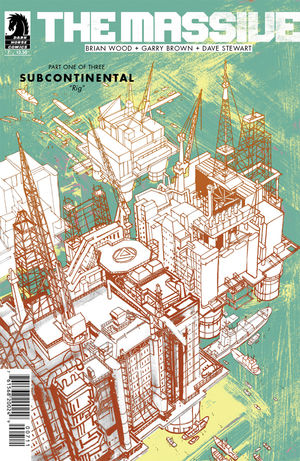
In this issue, the Kapital visits yet another port, a collective of hundreds of linked oil platforms situated in the middle of the Indian Ocean called Moksha, which has recently declared independence. Brian Wood continues to work the world building angle as this would-be nation's leader explains to Callum and Mary their origins in the Indian subcontinent's longstanding conflicts, which were being exacerbated by The Crash. Hints are dropped to indicate how much of the old world continues to exist: The UN is casually mentioned as still an ongoing concern. And in another verbal exchange, the Sri Lankan Mag encounters ethnic and religious-based prejudice from some of Moksha's residents.

The Massive #7  Writer: Brian Wood Art: Garry Brown Colors: Dave Stewart Letters: Jared K. Fletcher Cover Art: J.P. Leon

While the series continues on in its episodic course, this is the first time the crew has disembarked at one place for a considerable period. The plot plays to the formula that beneath the surface, the natives are hiding some very troubling secrets. This gets picked up on by both Mary and Mag, who begin to act  out in accordance to their own separate agendas, and right under Callum's nose. This is the most ineffectual he's looked in the entire series. But I'm just hoping the payoff for this story arc leads to something that eventually ties all of the disparate experiences the Ninth Wave has gone through.

Mara #1  Writer: Brian Wood Art: Ming Doyle Colors: Jordie Bellaire
Mara #1

Writer: Brian Wood
Art: Ming Doyle
Colors: Jordie Bellaire

The dystopian future of Mara is a largely recognizable one which closely resembles the media-saturated landscape of the present day United States. It's one where sports-entertainment is closely associated with capitalism, the military, and imperialist propaganda. World news coverage often relates the government's latest foreign intervention in a far away land that usually ends with the suffix "stan". Any broadcast of a high-profile match is preceded by a reading of a long list of corporate sponsors. Sports are "bread and circuses" used to appease the general population, as well as a form of military recruitment. And celebrity athletes are richly compensated for performing this task. They're also naturally obsessed with their social media status.

Now none of this is necessarily relevatory.What's a bit atypical for this type of dystopian fantasy is the complete lack of bloodsports that have become standard to the subgenre (For a recent example, read America's Got Powers). Brian shies away from such overtly warlike diversions. His choice for the country's most beloved athlete isn't some stone-faced gladiator who secretly longs to be free of the system, but a wholesome-looking seventeen year old girl named Mara, who plays indoor volleyball. Using such a tame sport might seem odd to sci-fi fans, but it does lend the story some verisimilitude since it more accurately reflects what kind of sporting event actually succeeds in drawing the largest audiences. The mainstream prefers watching basketball or baseball to mixed martial arts. Or if you prefer games with more global appeal, football or tennis. And they like their athletes looking clean-cut, not battle-scarred. To underline the point, the comic's omniscient narrator mentions that Mara even dabbled in MMA before finding her true calling in volleyball. That even her attractive but ethnically ambiguous physical features are exploited as a powerful marketing tool only adds to the believability of the premise.

Mara #1  Writer: Brian Wood Art: Ming Doyle Colors: Jordie Bellaire

It's a pleasure to see the art of Ming Doyle grace the pages of a more mainstream project. Her style has a certain awkward charm not usually found in artists showcasing a slicker look. When combined with Jordie Bellaire's saturated colors, this particular future setting is bright and colorful, even a little childlike. It's quite a ways from the more gritty urban environments that tend to accompany these kind of stories. If anything, it's ambiance is almost reminiscent of classic futuristic shows like Star Trek or Space 1999.

The thing that creates a great deal of uncertainty is a twist that suddenly interjects superpowers into the equation. My concern is that this comic could end up being a lot more conventional in the end if it goes down any of the already well-trod paths featuring tales of youngsters or celebrities in possession of superpowers.