7/15/2011

Join the dark side: +1 me

 Diesel Sweeties by Richard Stevens
Go to: Diesel Sweeties by Richard Stevens

Should have posted this earlier. It does seem inevitable that for social networking sites, many users get sucked into the game of accumulating the largest possible number of online contacts. That's probably already the case with Google+, regardless of what kind of "circles" are being used to manage one's contacts. A hierarchy of sorts develops anyway based on popularity and name recognition. Doesn't Leo Laporte's ego get stoked from having so many hundreds of people placing him in their circles? In how many new ways is G+ going to end up fortuitously fostering this behavior?

The PC Weenies has its own funny take on the subject.

7/14/2011

No more Akira

Akira

It appears that the troubled Hollywood adaptation of Akira is truly dead. While I've never been emotionally invested in seeing the critically lauded manga series being turned into a live action film, I find myself feeling ambivalent about the news of its demise. It's interesting that the project attracted so much high-profile attention, from George Takei's strongly worded denunciation of Akira's casting, to virtually every actor being courted to play the lead often rumored to be turning it down. It's in no one's interest to produce a horrible movie that will tank at the box office. But this quitessentially Japanese product almost seems to have been treated as something toxic by the glitterati, and its failure to make it to the big screen makes me wonder why Hollywood is so prone to engendering such a clusterfuck.

Update: Huh? Apparently reports of the movies death were premature.

Blog: Covered

Love and Rockets #27Love and Rockets #27, by Sarah Blum.

Miracleman #1Miracleman #1, by John Douglas.


Go to: Covered by Robert Goodin

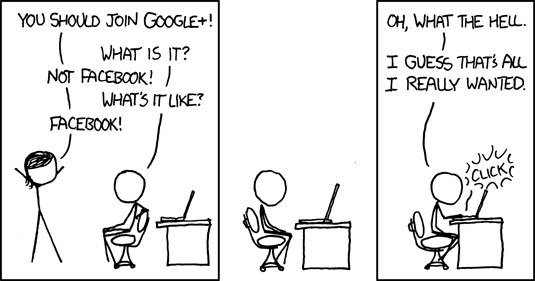
It's not Facebook

xkcd by Randall Munroe
Go to: xkcd by Randall Munroe

When Google applied its programming expertise into cracking social networking, they came up with a social network that appeals to techno-geeks. What that means is that Google+ is a bit more discriminating in managing user's personal data than Facebook. Whether the control is just illusory is another matter.

Atlantis

Shuttle Atlantis, by NASA.
Go to: NASA Image Gallery

Astronauts get the best views.

7/09/2011

Spidey's Dreams

Peter's Muscle by Michael DeForge
Go to: Peter's Muscle by Michael DeForge at What Things Do (via Sean T. Collins)

Wonder Woman, Red Sonja, and Xena go to school

Teenage Archive: Amazons by Dave Kiersh
Go to: Teenage Archive by Dave Kiersh (via Sean T. Collins)

Don't be a teenage sidekick

Comics, Everybody by Curt Franklin and Chris Haley
Go to: Comics, Everybody by Curt Franklin and Chris Haley, at Comics Alliance

Harry Potter by Lucy Knisley, Complete

Harry Potter by Lucy Knisley

Blog: They Boldly Went

On the set of Star Trek IV: The Voyage Home, there was a little boy supposed to shoot Sulu’s big scene with George Takei; however, the boy’s mother was hovering so badly that the boy was a silent, nervous wreck. When Leonard was made aware of the situation, he had two AD’s distract the mother, and, as Takei explained, “Clad in the robe he wore throughout the movie, Leonard got on his knees in front of the boy, smiled, then pointed at George, asking ‘Do you know this man?’ The kid grinned a little, nodded, and…now, right before our eyes, Leonard miraculously transforms from a curmudgeon to cheerleader. He starts bopping up and down, smiling like crazy, tousling the kid’s hair, trading high fives, and by the time he’s called back to set, Leonard’s performance has left the kid laughing.”

littlepunkryo: On the set of Star Trek IV: The Voyage Home, there was a little boy supposed to shoot Sulu’s big scene with George Takei; however, the boy’s mother was hovering so badly that the boy was a silent, nervous wreck. When Leonard was made aware of the situation, he had two AD’s distract the mother, and, as Takei explained,
“Clad in the robe he wore throughout the movie, Leonard got on his knees in front of the boy, smiled, then pointed at George, asking ‘Do you know this man?’ The kid grinned a little, nodded, and…now, right before our eyes, Leonard miraculously transforms from a curmudgeon to cheerleader. He starts bopping up and down, smiling like crazy, tousling the kid’s hair, trading high fives, and by the time he’s called back to set, Leonard’s performance has left the kid laughing.”
Go to: They Boldly Went by Kevin Church and Ming Doyle

Bad Movies: Clash of the Titans, and Avatar

Clash of the Titans

Sam Worthington is my idol.

A false idol, mind you. His career-defining role in Terminator Salvation demonstrated what passes for acting these days. Worthington manages to get away with so little of it. He struts around with a near-constant scowl, punctuated with the occasional snarl or scream for emphasis. The cast around him then works hard to fill the emotional void he leaves behind. So yeah, I'm impressed that given his acting chops, he snatched the lead to his next two films, Avatar and the 2010 remake of Clash of the Titans. Worthington is to some degree a throwback to an older era of he-man action heroes. That's not necessarily a bad thing, depending on one's tastes.

The first Clash of the Titans was the swan song of special effects guru Ray Harryhausen. His stop-motion animation techniques were then giving way to a new, more kinetic, style of film-making practiced by emerging directors such as Steven Spielberg, George Lucas, and James Cameron. The newer Titans is in many ways a nadir of this approach. There's plenty os shaky camera work, close cropping, and frenetic intercutting to keep the audience guessing. And the film takes full advantage of computer generated imagery to stage its fairly ridiculous action sequences. Like its hero, the story lurches from one set piece to the next with minimal introspection or sensitivity. The new Titans movie perfectly embodies the philosophy that blockbusters need to be less about the story and more about the thrill ride. By  those standards, I think it succeeds quite well.

Notwithstanding the insertion of a new character named Io, it's amusing to see how far the remake has gone to stamp out the female presence found in the first. The plot of the 1981 film was partially driven by the intrigue amongst the goddesses Thetis, Hera, Athena, and Aphrodite, as well as queen Cassiopeia. The remake is all about the sibling rivalry between Zeus and Hades, and the complexity of the Olympian pantheon is replaced by a more simplistic Manichaean dualism. All the more easier for Worthington, playing the hero Perseus, to direct his righteous anger at some convenient target. So much time is spent fueling his feelings of revenge that the traditional love story between Perseus and Andromeda is completely jettisoned. Just as well, because Worthington has yet to exhibit a genuine romantic streak. Overall, this is one uncouth movie.

Avatar

Far more refined is the 2009 film Avatar. Director James Cameron combines the instincts of a pulp artist with the ambition of a poet. Every so often, there's an earnest desire in him to tell something grand and mythical, but he inevitably resorts to hackneyed storytelling devices in order to get his point across. The end product can come across as schmaltzy. His most successful works use a combination of trite characterizations, basic plots, and visual spectacle. More than most, Cameron has invested in groundbreaking visual effects to convey the emotional impact of his stories. This often leads to films that can be described as amazing technical achievements, even if everything else suffers by comparison. Take Titanic for example. The movie was a sumptuous recreation of the historic ocean liner and its fateful journey. Its cast was clumsily defined in terms of class conflict and man's hubris, and in the end merges with digital extras to become fodder for the ship's elaborately staged sinking.

Avatar has an equally unsubtle conflict at its heart - about a white saviour helping the natives defend themselves from the evil colonists. Only this time the unspoiled eden is the alien world Pandora, the native stand-ins are the Na'vi, the colonists are the Earthlings, and the white saviour, Jake Sully, is played by Worthington. Stephen Lang's warmongering marine and Giovanni Ribisi's corrupt capitalist are as broadly painted as Titanic's wealthy snob played by Billy Zane - thin, two dimensional villains designed to contrast in about as obvious a way possible against the noble, pantheistic Na'vi. Jake Sully's conversion from colonist infiltrator to Na'vi leader feels rote, not to mention his relationship to a Na'vi female called Neytiri. It happens because that's what ussually happens. But beyond the formulaic plot, Worthington isn't able to give his character a lot of individual personality, which is both due to the limitations of the script and his own stiff onscreen persona. That's too bad, because even Cameron at his most techno-centric has hugely benefited from strong casting to bring his characters and ideas to life. Worthington's no Linda Hamilton, or Sigourney Weaver (who has a role in Avatar), or even a Leonardo DiCaprio or Arnold Schwarzenegger. As with Titans, he's dependent on the supporting cast to give him greater depth.

I happen to concur with the opinion that it would be nice if Hollywood could move beyond such hoary narratives. Deliberate or not, there's something insidious about the habit of turning white people into native leaders from within, in addition to the centuries-old tradition of imposing leadership from without through the use of brute force. But there's also something equally insidious and inadvertently clever about Worthington's transformation. Sully is a paraplegic who circumvents the confines of his body by having his mind remotely link with a synthetic Na'vi body - the "avatar" of the film's title. When he does so, not only does he regain full mobility, but he's able to enjoy the sensual pleasures of Pandora.

This is where Cameron's techno-geekery comes into play. Pandora and the Na'vi are highly rendered CGI creations. There's so much care and attention in the fashioning of this world that watching the human actors and CGI elements interact is more seamless than even Peter Jackson's adaptation of the Lord of the Rings. Resembling a blend of Asian and South American rain forests with the deep ocean, Pandora's environment is an exotic, mesmerizing, and immersive experience. It's this part of a Cameron project that's celebrated as a stunning technical achievement. No wonder Sully would rather stay there. Pandora's unspoiled environment is differentiated from the dying wasteland that is the Earth. The Na'vi's spiritual beliefs that nature is a vast interconnected information network is watered-down and rehashed pablum designed to work on well-heeled urbanites (it even echoes the Avatar: The Last Airbender episode "The Swamp"). But even as pretty a world as Pandora still looks as artificial as any hyperrealistic computer simulation. It doesn't help that a lot of the visual elements, like the day-glow life forms and the floating mountains, are already sci-fi cliche.

And that's the central paradox of Avatar which undermines its own environmental messge. It idealizes Pandora and the Na'vi as natural, but at no point does it fool the audience (certainly not myself) into thinking that they're not unreal. Worthington's character wants to escape into Pandora. But he does so in the movie through the use of cyber-technology. And since what he's escaping into isn't convincingly organic, but a virtual reality mediated by Cameron, it feels like he's indulging in a post-colonial fantasy. When Sully finally swaps his humanity for a Na'vi body, what Avatar heralds isn't a return to the old, or a more innocent age, but the coming of a new cybernetic order.

In short, Avatar is reconstructed nature for nerds.

7/05/2011

Super Dinosaur #1-2 and Origin Special

Super Dinosaur #1 by Robert Kirkman, Jason Howard, Rus Wooton. Super Dinosaur #2 by Robert Kirkman, Jason Howard, Rus Wooton. Super Dinosaur Origin Special by Robert Kirkman, Jason Howard, Rus Wooton.

By Robert Kirkman, Jason Howard, Rus Wooton

Robert Kirkman reaches back to 1980s kiddie cartoon formula in his latest comic book series Super Dinosaur. It's a high concept premise calculated to sell toys. Dinosaurs are cool. Futuristic weaponry is cool. Fighting dinosaurs using futuristic weaponry is extra cool. Imagine the action figures, lunch boxes, t-shirts, and video games generated from the intellectual property. If this sounds cynical, well yes it is. But as someone who grew up watching those cartoons, I won't deny the inherent appeal of a talking tyrannosaur being a lonely boy's best buddy - Super Dinosaur is a genetic experiment who turns against his evil master Max Maximus to side with his good-guy counterpart Doctor Dexter Dynamo and his son Derek Dynamo.

Super Dinosaur by Robert Kirkman, Jason Howard, Rus Wooton.
Dinosaurs firing missiles! How cool is that?
And the series is chock-full of the kind of dippy, playful ideas that my twelve year old self would have found absolutely enthralling: A hollow earth populated by prehistoric creatures. Mutant sentient dinosaurs created by mad scientists. The easy-to-grasp good vs evil plot-line involving family loyalties. The G-rated violence involving high-tech gadgetry (There's a lot of emphasis on the constant upgrades to the title-character's armor). Exotic power sources. The silly code names (Doctor Dynamo, Max Maximus, Dynore, Tricerachops, Breakeosaurus, Terrordactyl). The appealing designs of artist Jason Howard. Howard's clean, animation-style line art ably manages the already large ensemble of humans and "dino-men". Unfortunately, it's not quite matched by his cluttered color palette, resulting in unnecessarily muddy page layouts.

Next to the art, the characterizations are relatively weak. As the POV character, Derek suffers too much from the Wesley syndrome. It doesn't help that he keeps proclaiming that he's awesome at everything. Super Dinosaur doesn't say much, lacking any kind of personality other than a willingness to jump into action at every opportunity. Supporting characters in the form of a married couple of mechanical geniuses named the Kingstons and their two teenage daughters are barely fleshed-out at this point. As for the antagonist Maximus, he's the standard world-conquering villain, which is fine when considering the intended audience. So far, the only interesting character is the anti-hero Tricerachops, who works for a third party neither aligned to Dynamo or Maximus.

Super Dinosaur by Robert Kirkman, Jason Howard, Rus Wooton.
Shut up Derek.
As an "all ages" read, Super Dinosaur doesn't strike me as having a lot of crossover appeal with adults, unless they're the type who want something to feed their Dino-Riders, Centurions, GI Joe, ThunderCats, Transformers etc. nostalgia. Of course, I realize there are plenty of comic book fans who might fit that description. But everyone else can probably wait until their kids start bugging them about buying them the toys. Awesome!